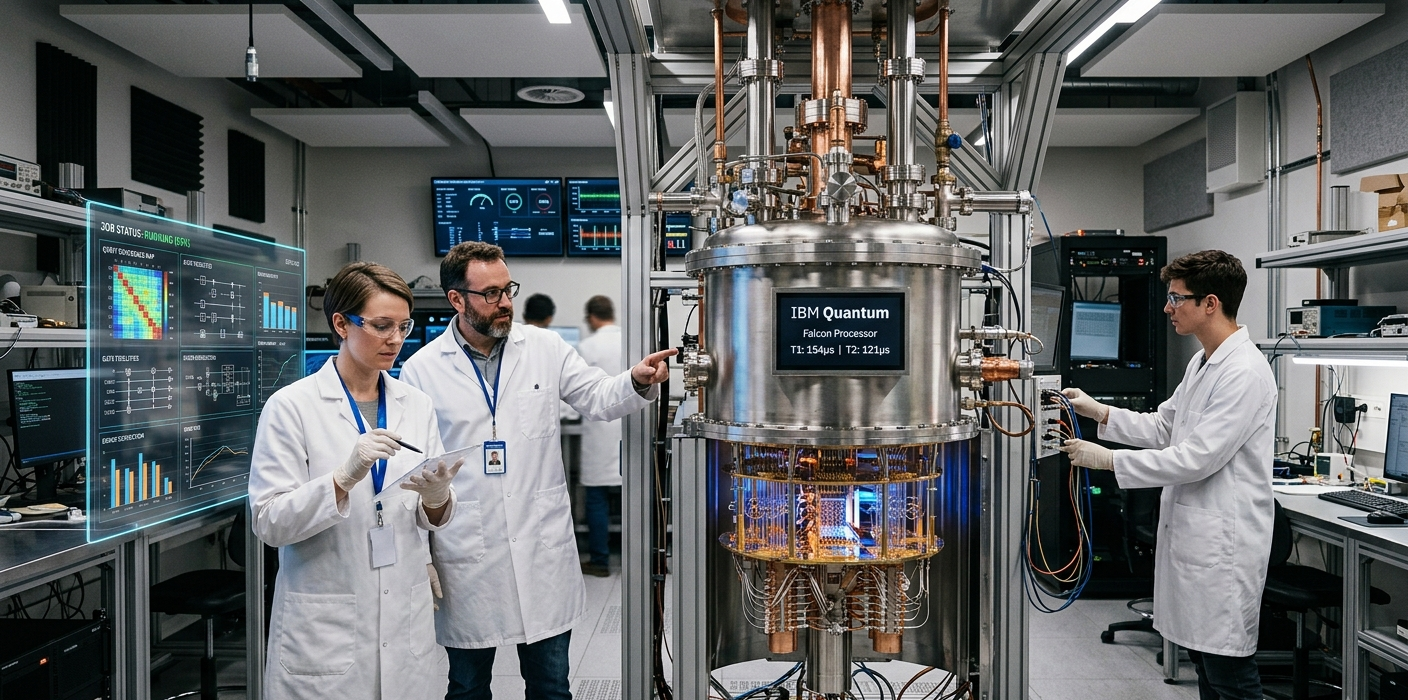
Introduction: The Future of Computing
Computers have revolutionized the lives of people, their work, and their methods of communication, and their use is increasingly helping people solve problems. Classical computers are now ubiquitous in today’s society, from the personal through to the commercial, and from the personal to the scientific. As technology evolves, however, researchers are finding some of the world’s trickiest problems demand more computing power than conventional machines can handle effectively. This is where quantum computing comes into play. Quantum Computing is a new technology based on quantum mechanics, the physics governing the behavior of very small particles, like atoms and electrons. As opposed to binary computers which compute with only 0s and 1s, quantum computers compute in entirely new ways employing unique properties of quantum systems.
Quantum computers are not intended to replace the regular computers current in everyday use like laptops and phones. Rather, it proposes to address very complex problems which are at the moment too difficult or too time consuming to be addressed by classical machines. These challenges are present in fields like developing new drugs, making better financial models, safeguarding digital data and developing AI more powerful. Beginners should familiarize themselves with the fundamental concepts used in this technology, such as qubits, superposition, and entanglement. At first these concepts might seem complicated, but they can be explained with simple examples to illustrate how quantum computers function and why they may be one of the most important technologies of the future.
What is Quantum Computing Based on?
The laws of quantum mechanics are the foundation of quantum computing, which works on the properties of matter and energy at the atomic and sub-atomic level. Classical physics is the science of objects that tend to behave in predictable ways – most of the time, anyway – but quantum mechanics brings bizarre behavior that is hard to believe based on our everyday experience. These behaviors are harnessed to process information in ways that are significant to quantum computers. The key concepts involved in this technology are quantum states, qubits, superposition and entanglement. These concepts also shed light on the differences between quantum computers and conventional computers, and why scientists hope that quantum computers can help them solve certain problems more efficiently.
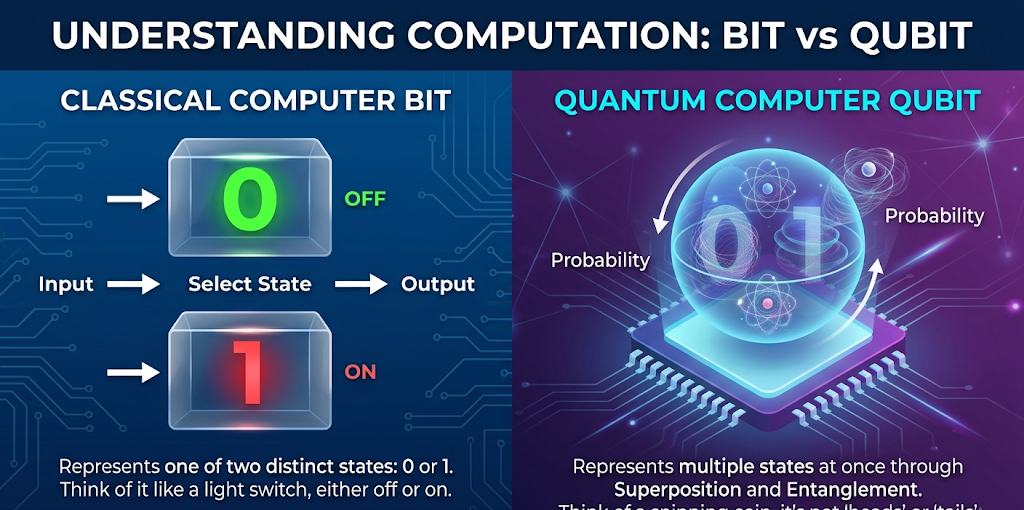
Quantum computers are based on the fundamental concepts of principles of quantum computing, which are represented by quantum properties. The information, in a classical computer, is stored in bits that have only two different values: 0 or 1. Quantum computing presents qubits that are able to store information in quantum states. In certain cases, this enables quantum systems to simultaneously test various options. But it is not just that quantum computing makes everything faster – it makes everything faster that can be done. Rather, it offers an alternative method that is particularly helpful for some problems containing a huge quantity of data, intricate patterns, and numerous solutions.
One of the other key principles of quantum computing is that quantum systems are very sensitive to their surroundings. The accuracy of calculations can be disturbed in minor ways, like small changes in temperature, vibrations, or electromagnetic interference. Scientists and engineers will therefore have to develop extremely controlled environments to enable the successful operation of quantum computers. While obstacles still exist, ongoing research has increased the level of reliability and performance of quantum systems. This kind of knowledge enables students and non-technical readers to appreciate the potential and constraints of this emerging technology.
How Classical Computers Work
A good way to grasp the concept of quantum computing is to first grasp the concept of classical computers. Electronic circuits of transistors are used to process information in traditional computers. These computers use information stored as a series of bits, with each bit having one of two possible values: 0 or 1. The binary numbers are used to carry out different instructions and data and enable computers to work with applications, browse the internet, play videos and manage information. The engineers have been constantly improving the design of the processors and the manufacturing process of them and hence the modern computer can execute billions or even trillions of operations per second.
In classical computers, they solve a problem by executing certain instructions sequentially. This technique is very useful for some tasks and is going to be useful for everyday computing as well. But, as problem difficulty increases, some problems get harder to solve. In the fields of science, for instance, solving vast numbers of potential combinations can be a very time-consuming task; optimizing a complex system can take a lot of time as well. Some calculations are simply too complex for the most sophisticated classical computers since they have to consider possibilities one by one or by following a specific algorithm.
For all that, classical computers are not obsolete or useless! They are still the backbone of today’s technology and are continually improving. Quantum computers are regarded as complementary rather than a replacement technology. Future applications can involve classical and quantum computers working together: Classical computers for normal computing tasks, quantum computers for special tasks that demand high-end computation.
What Is a Qubit?
The quantum computing basic unit of information is the qubit, which stands for quantum bit. Just like a bit forms the basis of classical computers, a qubit forms the basis of a quantum computer. But as qubits are based on quantum properties, they are different. A qubit can be in a mix of quantum states thanks to a phenomenon called “superposition” that does not occur with a classical bit. This special property enables quantum computers to represent and process information in ways that are not possible with the bits of conventional computers.
Atoms, ions, photons and specially designed electronic circuits are among the different physical systems that can be used to create qubits. Various methods are being investigated by researchers all over the world on how to create stable qubits; each method has its own pros and cons. Some may have higher accuracy, or may be easier to expand into larger sized quantum computers. The aim of the project is to develop quantum machines that can have sufficient number of reliable qubits needed for useful calculations that are beyond the capability of the classical computers.
But just because there are more qubits doesn’t mean that there is a better computer. The quality and stability of qubits is very critical. The quantum states are very easily disturbed, leading to errors in calculation. These have been minimized by scientists using techniques like error correction and advanced engineering methods. Making practical quantum computers is still a tough technical problem to overcome, but advances are steadily being made in this area.
The Concept of Superposition in Quantum Computing
One of the basic concepts in quantum computing is superposition. It is a property of a quantum system that can be in several different states until it is observed. One way to think of this is to consider a spinning coin. During the rotation of the coin it is not clearly displaying heads or tails. After it hits the ground, the outcome is determined. This example is not a perfect description of quantum behavior, but is helpful in conveying the notion that a quantum system may have more than one possibility prior to a measurement.
In quantum computing, superposition is used to store multiple values of 0 and 1 instead of just one. This ability can be used to process information in new ways in quantum computers. A quantum computer, for instance, is capable of exploiting the superposition state to explore relationships between possibilities more efficiently than an ordinary computer with bits of information.
It is crucial to note that when a quantum computer is used, superposition does not imply that the quantum computer attempts all answers at the same time and selects the right one, but rather that it simultaneously attempts all answers. The algorithms are carefully designed to exploit the quantum properties to enhance the likelihood of discovering useful solutions. Superposition is the most powerful property of quantum computing, as it can be used in combination with other quantum properties, notably entanglement and interference.
The Role of Quantum Entanglement
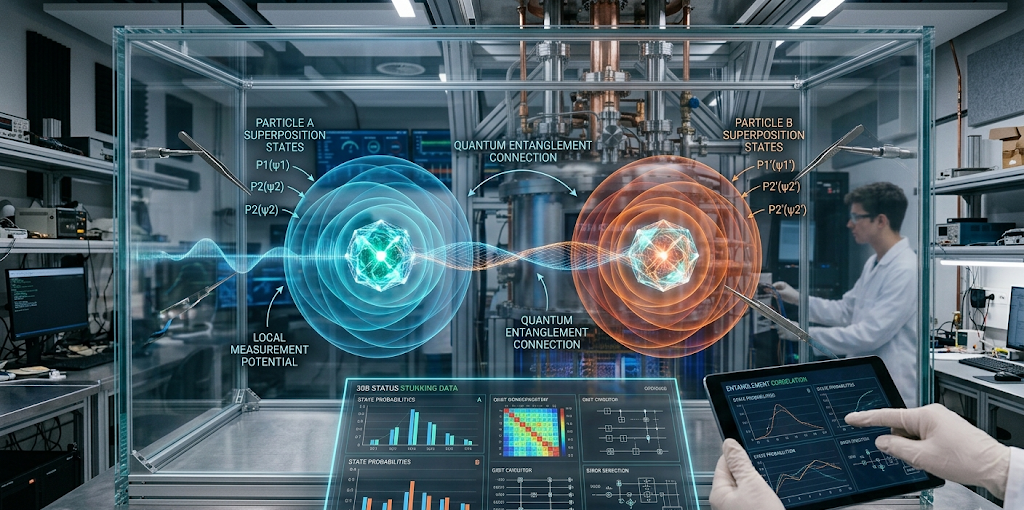
Another key aspect of quantum computing is quantum entanglement. When two or more qubits are entangled, the quantum states of the qubits are related, even if they are not physically touching. This link enables quantum computers to form links between bits of information that classical computers would not easily be able to form. The scientists have been researching entanglement for many years, as it demonstrates some of the most bizarre phenomena in quantum physics.
In quantum computing, it is possible for groups of qubits to act as a unified system, or be entangled. This can help quantum computers to perform complex calculations more effectively by organizing and processing information through these special relationships. For the purpose of quantum algorithms, entanglement is used in combination with superposition in order to carry out activities that can be more beneficial than classical procedures.
Entanglement may sound mysterious, but it does not enable information to travel faster than the speed of light or defy physics. Rather, it is the relationship of quantum particles themselves. Problems with entanglement are being solved, and scientists are learning to control and harness it, making it one of the most important characteristics that may be used to make a quantum computer work in the future.
How Quantum Computing Differs from Classical Computing
The primary difference between quantum computing and classic computers is how information is manipulated. Bits are the fundamental units of information in classical computers, whereas qubits are the fundamental units in quantum computers that can encode more complex quantum states. A classical computer executes logical instructions by means of electronic circuits, whereas a quantum computer uses quantum phenomena to execute specific calculations. The differences are such that quantum computers are not just faster versions of the traditional computers, but they are entirely different machines altogether.
Classical computers are good for daily tasks like writing documents, watching videos, running a website, etc., and for managing databases. Researchers are working on creating quantum computers to solve specific tasks such as complex simulations, optimization problems, and data analysis. A quantum computer could, for instance, simulate molecules more accurately with the aim of understanding chemical reactions and creating new materials.
The two technologies will most likely work together in the future. Common tasks will still be done on classical computers, and quantum computers may offer extra powers in areas where classical computers are limited. The mix could generate new opportunities for science and technology development.
The Impact of Quantum Computing
Quantum Computing in Medicine
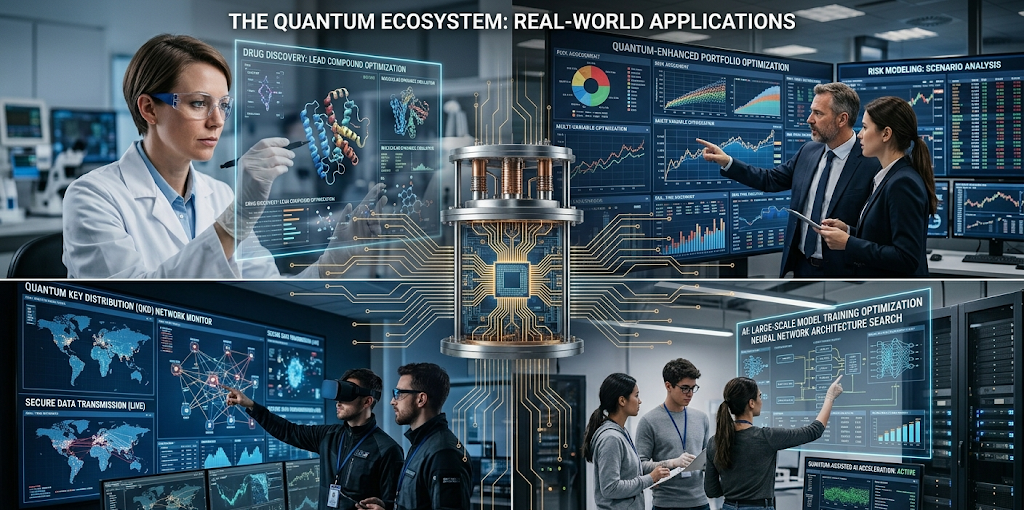
Medical applications are one of the most promising applications of quantum computing. Detailed knowledge of interactions between molecules, proteins, and biological systems is needed for the development of new medicines. Many biological systems are very complex; these processes can be simulated by a traditional computer. Quantum computers could aid researchers in developing more accurate simulations that can help them identify potential treatments more efficiently.
Another field of medicine where quantum technology might play a role is personalized medicine, where the processing of large, biological amounts of information is important. Future physicians and scientists could use highly sophisticated computing techniques to gain a deeper understanding of diseases and to create treatment plans with information specific to the patient. While these applications are still under investigation, quantum computing could enable significant advancements in health care.
Quantum Computing for Finance
In the financial industry, tons of information and complex mathematical models are processed. Investment strategies, fraud detection, market predictions and risk analysis are only a few of the sectors where quantum computing could make a positive difference. Quantum systems can help process complex relationships between various factors, which could assist in making better decisions in financial institutions.
But, quantum computing will not take uncertainty out of financial markets. There are many factors that can affect economic systems that are unpredictable, such as human activity, world events, etc. Rather, quantum technology could offer more powerful means of processing information and enhancing current means of processing.
Applications in Quantum Computing in Cybersecurity
Quantum computers have the potential to make significant contributions to cybersecurity, as well. Quite a few existing encryption systems are based on mathematical problems that are hard to solve using classical computers. Eventually, powerful quantum computers could be able to crack some current security approaches, posing new challenges to ensuring the security of digital information.
Meanwhile, quantum technology could also help to develop more robust security technologies. Researchers are developing quantum-based communication methods as well as new encryption technologies that are resistant to future quantum attacks. Post-quantum cybersecurity is an emerging field that is growing in significance as quantum technology advances.
Quantum Computing and Artificial Intelligence
AI relies heavily on handling vast quantities of data and identifying intricate patterns. AI processes could be enhanced by quantum computing’s ability to analyze information more efficiently. Studying quantum machine learning, which involves the integration of quantum computing with artificial intelligence techniques.
While quantum AI is in its nascent phases, it has the potential to shape the future of various fields like data analysis, optimization, and automated decision-making. The union of quantum computers and artificial intelligence could result in new capabilities that are not feasible with a traditional computer.
Problems Encountered in Quantum Computing
While quantum computing has the potential to be a powerful technology, there are still several challenges that need to be addressed before it is widely adopted. The key issue is to keep the qubit stable. Errors can easily happen when computing with quantum systems, and the systems are extremely sensitive. Researchers are working on ways to make them more reliable, but operation of large-scale, fault-tolerant quantum computers is still challenging.
The other challenge is the cost and access. The construction of such quantum computers will be highly expensive and will need the use of sophisticated equipment, specific expertise and controlled environments. At the moment, quantum technology is mostly confined to research institutions, universities and large technology companies. As the field continues to grow, scientists hope to increasingly make quantum systems useful and accessible.
In addition, there are problems with useful quantum software. There are special algorithms and programming techniques necessary for quantum computers. Developing applications that fully exploit quantum capabilities will involve bringing together a range of different skills and expertise—from physicists to computer scientists and engineers.
Conclusion: Why Quantum Computing Matters
Quantum Computing is the new way to go in the evolution of technology. Instead, quantum computers will use qubits, superposition and entanglement to solve some of the world’s most complex problems in a new way. The technology is still in its early stages and has a long way to go, but it has the potential to revolutionize the fields of medicine, finance, cybersecurity, and artificial intelligence.
The quantum computing basics do not need to be based on advanced physics knowledge for beginners and students. The fundamental concept is that quantum computers operate differently than traditional computers, and are intended to solve problems that need new ways of calculation. But as research advances, quantum computing could be a key partner with classical computing that will enable discoveries and innovations that will have a positive impact on society.



I like the efforts you have put in this, regards for all the great content.