Introduction
Blockchain has come a long way from its roots in cryptocurrencies and is now being eyed as a backbone for a variety of financial services. Banks, payment services, investment companies, exchanges and others are studying the distributed ledgers, cryptographic verification, smart contracts and tokenized assets to better facilitate transfer of financial information and value between participants. This is a sign of how blockchain is maturing in the financial industry from an experimental phase of digital currency to a more in-depth exploration of blockchain in actual financial functions. Institutions are recognizing certain applications for which shared records, programmable transactions or quicker settlement may provide solutions to current challenges. The future, however, will rely on regulation, interoperability, privacy, governance, cyber security, cost and whether or not financial organizations can gain a meaningful benefit from the new infrastructure.
Records, verification, intermediaries and relationships are vital to the financial system. There may be multiple organizations involved in the process of payment before it arrives at its destination, and Securities transactions can involve intermediaries such as clearing and settlement systems, brokers, exchanges and custodians. Some of this complexity might be eliminated by using blockchain to provide a shared transaction history of participants who are authorized to do so, under mutual agreement. There are many applications where traditional systems are faster, simpler and cheaper. So the question is where does blockchain offer a definite benefit? The best applications will probably be found when more than one organization requires a shared source of truth but still requires robust access, privacy and accountability controls. This means blockchain is not a panacea, more of an option, when it comes to financial activities.
Blockchain and the Future of Banking
Blockchain has the potential to make a difference in back office and customer services, especially in the banking sector. Financial institutions have a lot of data on each account, loan, payment, collateral, trade documents, and regulatory data. Authorized institutions may be able to share verified information on shared blockchain networks, without excessive duplication and reconciliation operations. For instance, if an individual bank loans funds to a number of other banks, each bank can access a shared ledger to list the bank’s ownership stake, its payment obligations, and the agreement’s conditions. If certain conditions are met, some events could be automated using smart contracts, thus cutting down on manual labor. Blockchain might also be used in cross-border banking for a shared record of transactions among participating financial institutions. However, until these systems can be properly governed, secured, protected, and monitored by banks, they will not be widely adopted. It is therefore more likely that the future banking applications will be based on controlled and regulated networks rather than totally open networks.
Another way blockchain might be used to modernize is in collateral and asset management. Financial institutions may require determining the ownership of an asset, whether it has been pledged and whether there are any restrictions on the asset. This blockchain record could help offer a shared history of pertinent transactions, which would boost visibility for lenders, custodians, and other delegated parties. This can be helpful for assets which are moved often or used as security. Additionally, when multiple organizations need to coordinate information, blockchain could automate parts of the loan servicing, insurance claims and trade finance processes. The information on a blockchain, however, is not accurate information per se. There is still a need for institutions to have processes that are reliable for entering data and solving disputes. Blockchain must, therefore, be considered a tool for coordination and verification, not as a substitute for human judgment, legal agreements or institutional responsibility.
Blockchain in Digital Payments
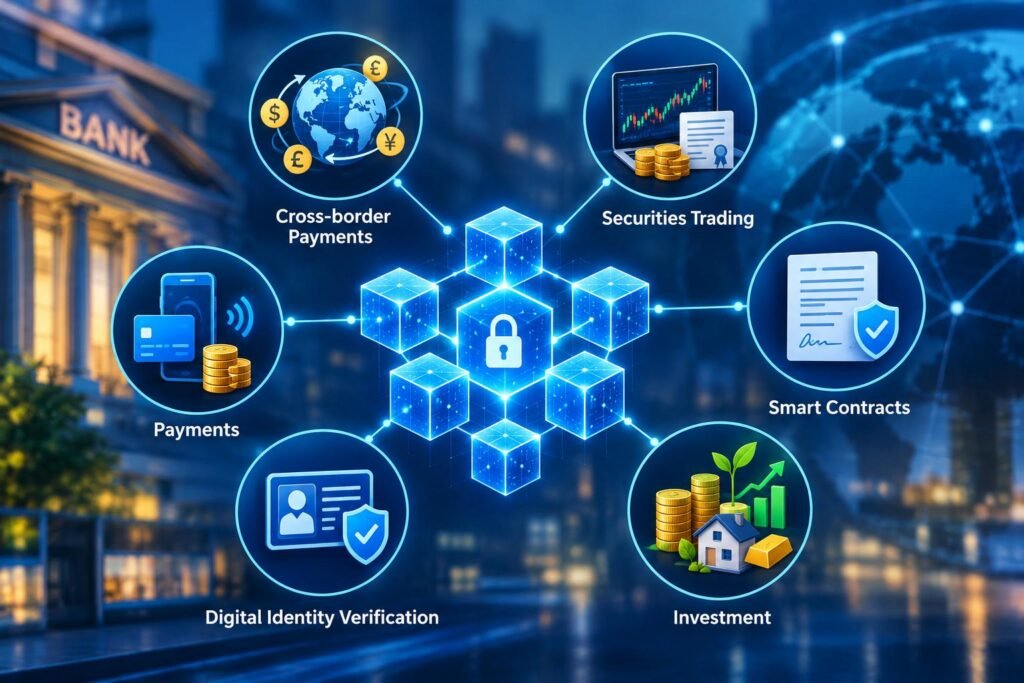
Blockchain could enable payments to become one of the more obvious use cases, as this is an area where the distributed network can provide support for digital payments and programmable settlement. Cross-border payments can have several intermediaries, currency conversions, operating times and reconciliation procedures. Institutions could perhaps directly settle transactions through blockchain-based payment networks and tokenized currencies. There are various ways for blockchain infrastructure to be linked to monetary value, such as the introduction of Stablecoins, Tokenized Deposits, and Central Bank Digital Currencies. Programmable payments also have the potential to unlock money when defined conditions are met, enabling business processes and commerce and international trade. However, payment systems face some high expectations including speed, reliability, protection of consumers, anti-money-laundering safeguards and monetary stability. Even though blockchain-based payment systems are not yet standardized and regulated, it is likely that they will coexist with existing payment systems for some time as current systems offer a wide array of infrastructure and regulatory oversight.
The Exchange of Securities Trades and Settlement
Blockchain may revolutionize securities markets by altering the way that securities, bonds, funds and other assets are issued, traded, and settled. The process of traditional securities transactions may involve coordinating exchanges, brokers, clearing and settlement systems, custodians, and other participants. Ownership or economic rights can be tokenized electronically and enable securities to flow within these blockchain-based networks. A possible advantage would be to have settlement and trading more intertwined, which would reduce settlement time. Smart contracts can also be used to make compliance checks and transfer restrictions more automated for companies, along with dividend payments. The securities markets, however, are very well regulated and owning securities does not eliminate legal obligations related to ownership. The rights of a token need to be well defined and the participants need to be informed about the rights being recognized under applicable law. Blockchain adoption is expected to grow in a regulated manner through permissioned networks and market infrastructure that has been carefully crafted. This suggests that blockchain adoption will most likely take place in systems that are regulated, permissioned, and well-designed.
Investment and a Tokenized Asset
Another sector where blockchain could expand access to assets and new forms of asset ownership is investment. Some assets may be tokenized into digital pieces of an asset that represent an economic or ownership stake in it, which can reduce the minimum amount that can be invested by eligible investors. Several options for assets have been proposed, including real estate, private funds, bonds, commodities, and other assets. A blockchain can hold a digital record of token transactions and movements in place of using the transfer of ownership via separate documents or intermediaries. While the tokenization can help with transparency and accessibility, it doesn’t guarantee liquidity or security of an asset. While there are fewer purchases, legal issues, and valuation challenges for a tokenized property, there will still be management costs. Investors should look into the underlying asset, the issuer, the legal rights, the custody and the liquidity and not believe that the asset itself has investment value by virtue of the blockchain technology it uses.
The Development of Smart Contracts and Financial Automation
Smart contracts could be one of the most significant contributions of blockchain to the financial industry as they enable financial agreements to be programmatic. A smart contract is a program that can only execute certain actions once agreed upon conditions are thrown in. This could be useful in finance for automating the repayment of loans, escrowing, insurance claims, securities transfers, and computing interest payments. For instance, payment might be made and delivery of the asset received in accordance with some predetermined guidelines. But smart contracts are not necessarily correct just because they are being used on another blockchain. The results of software bugs, incorrect external data, ambiguous legal terminology and unforeseen occurrences can have negative implications. Test, audit, governance, emergency controls and legal mechanisms for automated instructions and real world situations will be required. For smart contracts to be effective, there will need to be a balance of trustworthy software and financial and legal guidance to ensure that they operate correctly.
Application of Blockchain in Financial Records and Identity Verification
Other solutions that use blockchain technology, such as identity verification and financial recordkeeping, may also be beneficial. Financial institutions have a lot of resources devoted to customer verification, record-keeping, know your customer (KYC) requirements and fraud detection. Using blockchain technology would enable shared credible credentials between trusted institutions without having to go through the process of verification again and again for each institution. Using the credentials might be more under an individual’s control and institutions might get cryptographically verifiable data. Blockchain recordkeeping might also be used for specific financial information to generate verifiability and minimize disputes over data and when it was generated or updated. Privacy is always of great concern as financial and identity information is very sensitive. There should be a system in place that minimizes any unnecessary disclosure of data and facilitates correction and revocation of it and adherence to privacy law. The persistence of blockchain can supply a more secure audit trail and also make it hard to alter or eliminate information later.
Why Implementation of Blockchain is slow
Although blockchain has potential, it has its hurdles that may hinder the use of blockchain in financial transactions. Financial systems need to be scalable as they have to handle significant amounts of transactions and require consistent performance. Interoperability is another hurdle, as there can be a variety of blockchain networks, databases, digital asset standards and regulatory regulations used by banks and markets. When transactions have confidential customer data, it can be hard to find a balance between privacy and distributed transparency. Governance is also critical, as when it comes to upgrades, disputes, access rights, cyber security incidents and network failures, institutions require clear governance. The regulation can also take different forms in different countries and may take time to come into effect; both can cause uncertainty for organizations working across borders. It’s not possible for a bank to just switch mature financial systems for blockchain technologies in a single day. It should not only merge new infrastructure with existing platforms, but also educate workers, address operational risks, and prove to be successful in terms of return on investment.
Benefit of Blockchain to Financial Institutions and Investors
Financial institutions are expected to select the blockchain, instead of replacing the existing systems with it, as its development continues. The banks can start with any of the recordkeeping, settlement, trade finance or identity applications. Custody and compliance are also an issue for investment firms that could consider combining assets into tokenized funds and securities, and creating new compliance and custody procedures. The payment companies can integrate blockchain settlement with common user interfaces, meaning that the consumer doesn’t have to be knowledgeable of the technology. Regulators will also have a role in shaping adoption through setting standards for digital ownership and consumer protection, market integrity, privacy and financial crime prevention. These factors will still be critical when an investment product employs more advanced blockchain technology, and the way the issuer manages the product, the legal framework, how the product is held, the liquidity and technology and the regulatory framework will remain key elements in its evaluation. The step-by-step could enable financial organizations to explore the practical benefits without putting significant resources into broader transformation.
The Future Outlook
It will not be possible to replace the banks, exchanges, payment networks or traditional databases with blockchain in finance. More realistically, elements of the blockchain will become part of financial infrastructure to solve particular coordination, settlement, ownership or verification issues. Some networks can be permissioned and managed by regulated institutions; others can be open networks with well-defined interfaces that connect to public blockchain networks. Standards are maturing and tokenized deposits, digital securities, and programmable payments may become more commonplace. Classic databases will remain for applications that have the centralized control that is more efficient or appropriate. The most successful blockchain projects will instead focus on technological innovation along with robust governance, well-defined legal rights, valid data, cybersecurity, and potentially interesting economic results, instead of just attempting to go decentralized.
Conclusion
Examples of how blockchain can impact various aspects of finance include banking, payments, trading, investment, identity verification, smart contracts and financial record-keeping. Perhaps the biggest value it brings is the development of a new way of sharing trusted information, assets, automating agreements, and settling transactions between institutions and users. For various reasons of scalability, interoperability, privacy, regulation, governance, implementation costs, cyber-security, and others, adoption will be slow, and uneven. However, further testing and better rules and regulations may take blockchain from isolated pilots to actual infrastructure. Assessment of the potential for long-term benefits in efficiency, transparency, accessibility and financial coordination will be a key factor in making blockchain a sustainable force in the future of finance for banks, businesses, regulators and investors.
Get more well researched information about Blockchain in finance here.