
Artificial intelligence (AI) is changing what we see from a business point of view, by which I mean that it’s a tool for our companies to use in automation of processes, analysis of data, better customer care, and, in the end, better decision making. From the small business owner to the large corporation, AI is an asset in the day-to-day doings, in the reduction of manual labor, and in overall growth. Companies may use AI for the analysis of large data sets, identification of trends, and support staff in the efficient completion of their tasks.
Also, AI has issues which it’s at present putting out, which are related to implementation costs, data privacy, security issues, and the element of human supervision. That said, we see value in knowing about AI’s uses, benefits, and shortcomings, which in turn helps business owners and managers determine what may be practically applied.
What Is Artificial Intelligence in Business?
Artificial intelligence in the business context is that which computers perform which in the past has been the domain of human intelligence for things like language comprehension, pattern recognition, info analysis, and prediction. We see in this also machine learning, natural language processing, computer vision, and generative AI.
In the present time, we see which AI technologies are used by businesses for customer support, financial analysis, marketing, automation, and planning. For example, retail companies which may predict what products will do well, banks which identify which transactions are suspicious, and professional services which sum up documents. That which AI is useful for companies is when they choose tools that meet their specific business needs.
Uses of AI in the Corporate World
Support Team and Customer Care
AI-enabled chatbots and virtual assistants for businesses handle FAQs, provide off-the-shelf product info, and support routine customer requests. Also, they are able to manage many conversations at the same time and are available around the clock, which in turn allows human staff to concentrate on complex issues.
AI also does, in real time, summing up customer issues and, at the same time, is a resource which agents may put to use in putting together their responses. But also, auto systems may get the question wrong or come up with the wrong info. It is best that businesses have human reps available for when the issue is large-scale or very personal.
Sales and Promotion
AI is used by marketing teams to analyze customer behavior, which in turn helps to identify audience groups. We also see it in the generation of promotional content and in the personalization of advertising campaigns. Also, businesses can use to their benefit the fact that they have at their disposal purchasing patterns and customer data to design more relevant marketing messages.
AI tools can also assess campaign performance and put forth which areas for which improvement is possible. Also, it is up to the companies to protect customer info, verify that generated content is accurate, and to see that marketing actions are, in fact, within the set privacy and ad rules.
Data Analysis and Business Intelligence
Businesses accumulate data from sales, customers, websites, and financial transactions. AI processes these large sets of info, identifies trends, and puts together reports, which in turn help managers analyze business performance.
For instance, a company may use AI to study sales trends, determine which products are in decline, or compare department performance. Also, what we see is that poor-quality or insufficient data may be produced, which in turn may yield incorrect results; hence, the role of human verification is very important.
Fraud Prevention and Financial Health
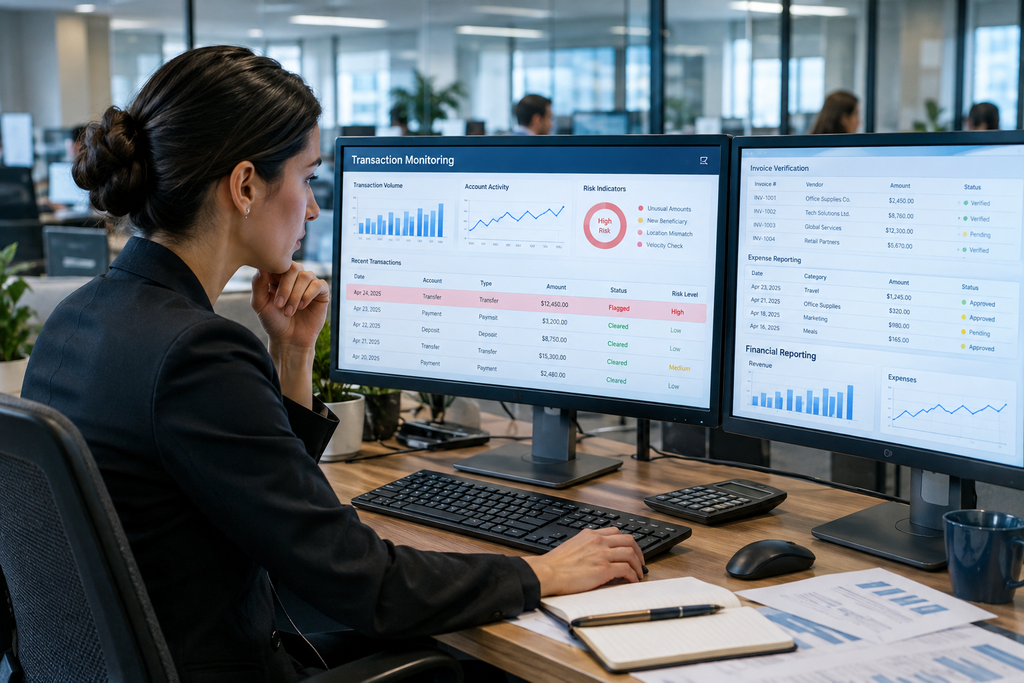
Banks, retailers, and insurance companies are using AI in the detection of abnormal transactions and fraud. We see machine learning systems analyzing transaction trends, which in turn they use to identify out-of-the-ordinary behavior for investigation.
AI also plays a role in invoice verification, expense reporting, and financial reporting. That said, we see that some of these systems misidentify which transactions are valid, or they ignore what may be suspicious activity. Human investigation and regular monitoring still are very much a requirement.
Forecasting and Logistics Management
AI is used for businesses to predict demand, manage inventory, plan production, and determine resource requirements. Retailers put out seasonal demand predictions, which in turn manufacturers use to time their purchase and production.
AI also notes to look out for delivery disruptions which may be reported by machine learning; also, some suppliers may present issues. But also, we see that economic surprises and supply shortfalls can disrupt the models’ outputs. It is best for companies to use AI as a tool in conjunction with professional judgment and also have contingency plans in place.
Cyber Information and Threat Response
AI in the field of cybersecurity is for monitoring of network activity, identifying atypical login trends, and detection of out-of-the-ordinary behavior. Security teams use AI to put alerts in order and to put forward which threats are the most pressing.
Also, it is not true that AI can do away with cyberattacks or that it can guarantee full protection. Businesses still must use strong passwords, access controls, software updates, employee training, and proper security procedures.
Document Management and Automation
AI is able to extract info from invoices, contracts, applications, and other business documents. Also, with optical character recognition, we are able to turn scanned documents into searchable info, which in turn reduces manual data entry.
Businesses also use AI to run meetings, sort emails, and put together reports. These applications show how AI can reduce repetitive work, which in turn allows workers to focus on more in-depth issues. It is also very important that we go over the main documents and data out of the AI, which in case may not be 100% accurate.
Decision Making and Strategy Planning
AI is a tool which managers may use to compare business scenarios, analyze operating costs, evaluate customer demand, and identify potential risks. For example, a business owner may use AI to go over market research before bringing out a new product.
However, AI is used in recommendation; we see that it often leaves out ethical issues, employee issues, and other important elements. Managers should use reliable data, professional judgment, and business goals in evaluating recommendations.
Benefits of Artificial Intelligence in Business
Improved Efficiency and Productivity
AI can do away with the time spent on repetitive tasks like data entry, document processing, and routine customer inquiries. Thus, which in turn allows employees to focus on customer relationships, planning, and problem-solving.
Automation also plays a role in which large-scale work issues may be addressed without growing manual effort. Also, we see that for productivity to improve, it is a must to choose the right tasks and to measure actual results.
Better Customer Experiences
AI can present quicker responses, tailored recommendations, and more consistent customer support. We see that companies use customer data to determine preferences, which in turn improves communication.
Still, customers have issues which require human help in complex problems. Companies must balance between auto service and personal care to keep up customer satisfaction and trust.
Better Business Decisions
AI has the ability to recognize patterns, assess performance, and present information which in turn supports planning. In which area of business, this also is used to run resources better, analyze market conditions, and identify opportunities.
AI also plays a role in innovation through which it enables staff to develop ideas, produce early-stage content, and look into what solutions may be out there. Also, it is true that tech by itself does not ensure business success.
Issues in AI for Business
Implementation Costs
AI adoption includes software subscriptions, system integration, employee training, data preparation, and ongoing maintenance. Also, businesses with legacy systems may see greater out-of-pocket expenses.
Starting out with a small-scale project allows organizations to assess the costs and benefits before growing the project. Managers put forward a look at the total long-term expenses instead of paying attention only to the software’s price at first.
Data Privacy and Security
AI also processes sensitive business info, financial records, and customer details. Poor data management leaves organizations at risk of privacy breaches and security incidents.
Businesses must put in place proper access controls. Also, it is important they review what their AI providers do with data, and we must train staff in safe AI use. We should process sensitive info only via approved and well-protected systems.
Accuracy and Human Oversight
AI is producing wrong info; also, it’s not to be trusted on instructions given to it and, at times, gives out faulty recommendations. Also, we see that systems which are trained on biased or incomplete data sets do so in a way which is unbalanced and unfair.
Human input is especially important for financial reports, recruitment, legal papers, and sensitive customer issues. Also, employees should check important results of AI and be responsible for which decisions they make.
Employee Training and Organizational Change
Employees will require training in order to make effective use of AI tools, and some may also be dealing with changes in job responsibilities.
Businesses put out what they will do with AI, give practical training, and get employees into the implementation. Development of skills in analysis, communication, and tech can help employees with workflow changes.
How Businesses Can Adopt AI Successfully
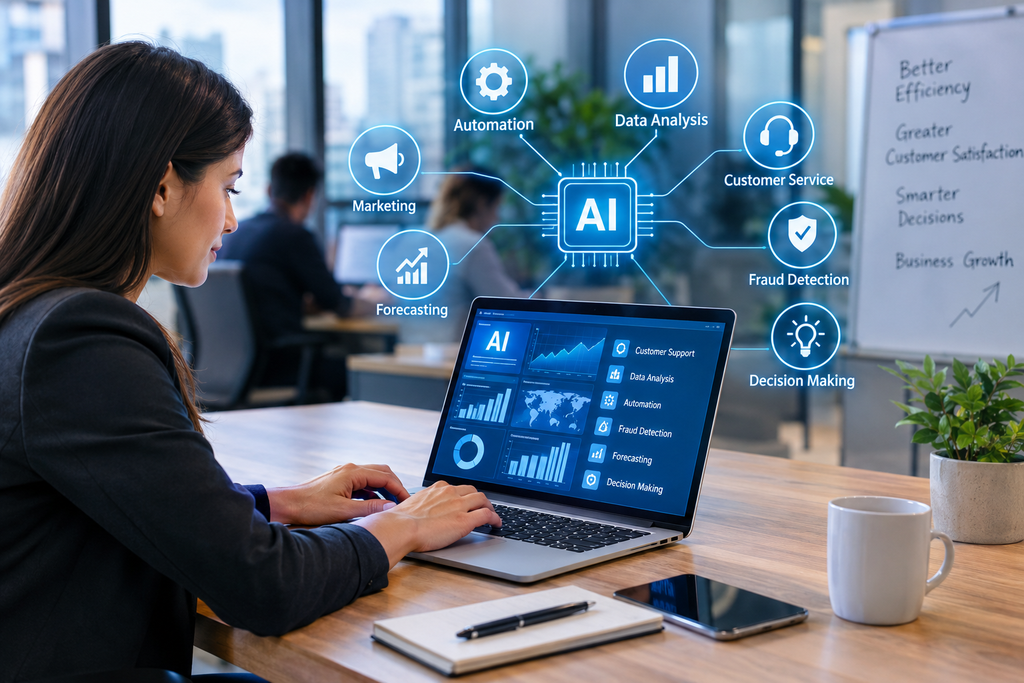
Businesses first off should determine what specific issues AI may improve, like slow document processing, customer service delays, or inventory management issues. They should set measurable goals and see if AI is the right fit for the task.
Starting out with a pilot project, which is to test performance, identify errors, and evaluate costs before expansion, is what we do. Also, businesses should put in place clear policies regarding data protection, human approval, employee responsibility, and ongoing monitoring.
Regular review, which in turn guarantees AI is aligned to business needs, and we see results.
Conclusion
Artificial intelligence presents business with solutions to better customer service, automate repeat tasks, analyze data, detect fraud, forecast demand, and support decision making. When it is implemented right, it may improve efficiency, provide in-depth insights, and help companies with day-to-day operations.
However, in many cases, AI presents problems related to cost, privacy, security, accuracy, and employee resistance. Businesses do well to take a measured approach to adoption, to put forward practical applications, and to include human elements in the process. In the end, AI works best when it is used to augment human knowledge and to support responsible and informed business decisions.