Introduction: Understanding the Internet of Things
How about an alarm clock that, when it rings at 6:30 AM, also can chat directly to your coffee maker to begin brewing a new pot as soon as you swing your legs out of bed? When you enter the bathroom the shower automatically adjusts to your water temperature, and your smart refrigerator learns that you are running out of milk and puts that item on your virtual grocery list. In a seamless dance of interconnected devices, it’s not a futuristic fantasy anymore, but rather a reality of everyday life due to the Internet of Things. Technology has shifted from something which humans are proactively working with to one that is working on our behalf, managing our environment and streamlining our daily routines without requiring us to manually operate it all of the time.
The Internet of Things is amazing, at this basic level a huge network of physical objects—or “things”—which are equipped with hardware, such as sensors, specialized software, and processing power, all designed specifically to connect to and exchange data with other devices and systems over the internet. Some of the products include common household items such as light bulbs, thermostats, and more advanced industrial products and machinery used in high-tech manufacturing facilities. Technology makes it possible to gather and share data without any human intervention and turns ordinary tools into active digital participants that make real-time decisions.
To fully value this technological revolution, it’s essential to grasp the underlying principles of IoT and their impact on our relationship with today’s electronics. The internet has traditionally been a digital space in which people mainly interact with each other. Getting results required people to sit at a computer keyboard, start a web browser, and type in data, search terms, or instructions. It’s a completely different story with the Internet of Things, and machines can now collect data, communicate with each other and take automated actions. This dramatic change allows for a new world in which environments will be able to dynamically adapt to people’s behavior and real-time changes in the environment, without the need for human intervention and without the possibility of human error.
The Four Essential Building Blocks of an IoT System
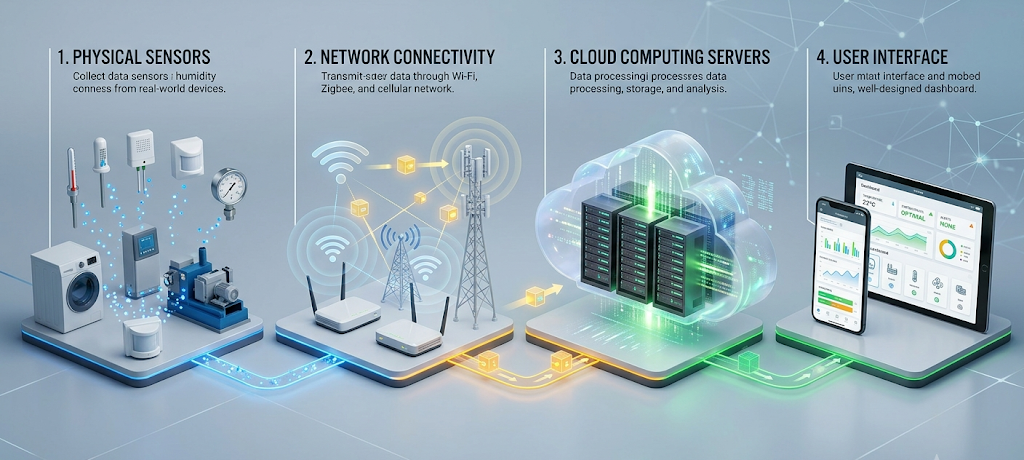
It’s helpful to divide the entire smart system into four distinct, essential stages in order to grasp the entire system as a unified whole. From a simple smart watch recording heart rate data to a large factory that automatically handles thousands of assembly components, every smart setup—no matter how complex—is built on a constant stream of data flowing through four key elements: the physical sensors, strong network connectivity, powerful data processing in the cloud, and an intuitive user interface. When one of these essential components is taken away or goes down, smart network connected hardware becomes just ordinary disconnected hardware.
1. Hardware and Sensors: The Physical Senses
Sensors and actuators are the initial components of any smart network, starting at the base level. In the analogy of a smart network as a human body, the sensors are the nervous system that continuously collects real-time raw physical data from the environment.
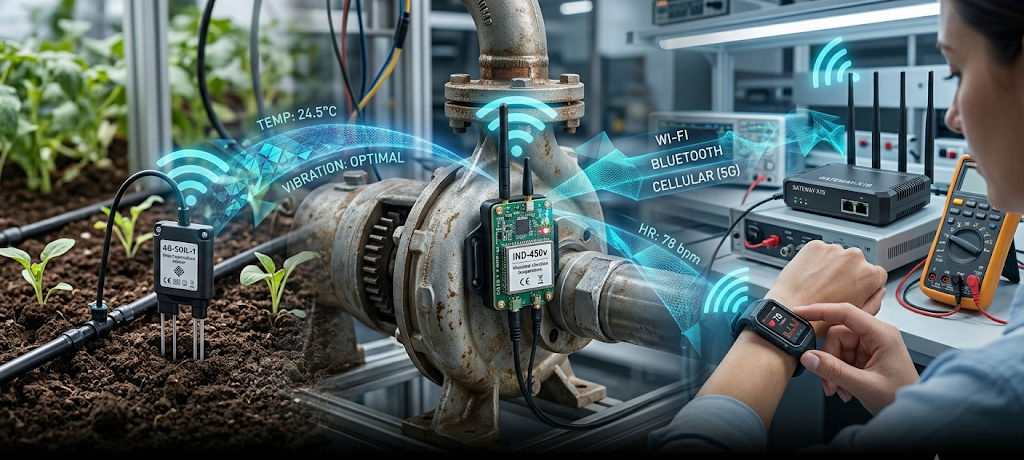
They are tiny electronic devices that can record many measurements, from temperature to humidity, atmospheric pressure, movement, light, proximity, GPS location, chemical composition of air, and more.
Importantly, sensors are not simply passive devices, but they transform real-world physical phenomena to digital signals: signals that can be processed by computers. In today’s smart devices, multiple sensors are sometimes integrated into the same device to get a fuller picture of the environment around the device. For example, a modern cell phone has a GPS sensor to locate its geographical position, a light sensor to change the brightness of the screen, a proximity sensor to turn off the screen when used during a phone call and an accelerometer to detect screen orientation. The execution part of the devices is where the digital data is converted into real action, like opening or closing a valve or flipping an electrical switch with a tiny motor, valve or relay.
2. Connectivity: The Digital Highway of IoT
If the embedded sensors have gathered raw physical data successfully, information must be transmitted to its final destination, where it can be analyzed, via a secure, rapid and reliable channel. Network connectivity comes into play here, as it is the digital superhighway between the physical hardware and centralized computing networks. If an embedded sensor is not connected to a powerful network, then it is an “island” that cannot transmit its valuable real-time data to the network.
Based on the application they have to serve, ranging from physical deployment to power consumption, data bandwidth, geographic deployment, and others, the devices use different wireless and wired communication protocols:
Short-Range Wireless
These technologies are suitable for smart homes or offices, and they rely on signals that are relatively short-range, such as Wi-Fi, Bluetooth, Zigbee and Z-Wave.
Cellular Networks
Connecting mobile devices such as connected vehicles, delivery fleets and smart city infrastructure with technologies such as 4G LTE and high-speed 5G networks.
Low-Power Wide-Area Networks (LPWAN)
These are standards designed for sending small amounts of data over long distances with very little power so batteries don’t need changing for several years.
3. Cloud Data Processing: The Central Brain
Once raw sensor data passes through the digital highway it arrives at high-powered central computing facilities, typically cloud-based computing platforms. This phase is the thinking part of the whole process. Cloud processing platforms combine huge volumes of incoming data from thousands of widely distributed devices, curate, store and make sense of the raw numbers as they flow in. In just milliseconds, this data mountain is run through advanced algorithms and machine learning models to find patterns, anomalies or satisfy certain pre-defined criteria.
For example, when the temperature sensor reading in an industrial deep freezer changes from -10ºC to 5ºC in one instant, this cloud platform immediately concludes that this is a metric that is far beyond safe operating limits. The cloud system doesn’t just record that number in a passive database—it analyzes the meaning of the spike, determines the real-time threat to frozen inventory and automatically activates a corresponding digital response, such as notifying of an emergency cooling backup or alerting a technician to respond.
4. The Human Connection: User Interface
The last component of the system architecture is the return of processed data to human operators via an intuitive user interface. The value of the hardware or cloud infrastructure will be null and void without easy access, monitoring, or control by its end-users. User interfaces can display many different visual representations from a clean, intuitive interface on a smartphone application for a domestic “smart home” user to a large, multi-screen full-dashboard control center for a large-scale enterprise.
The applications enable users to receive proactive push notifications, view historical trend graphs, view real-time status information and send remote commands down the line to the physical hardware. A button click on the homeowner’s cell phone starts a message traveling from the homeowner through the cloud, over the network, and to the physical lock motor on the door.
Real World Applications: Transformative Impact Across Industries
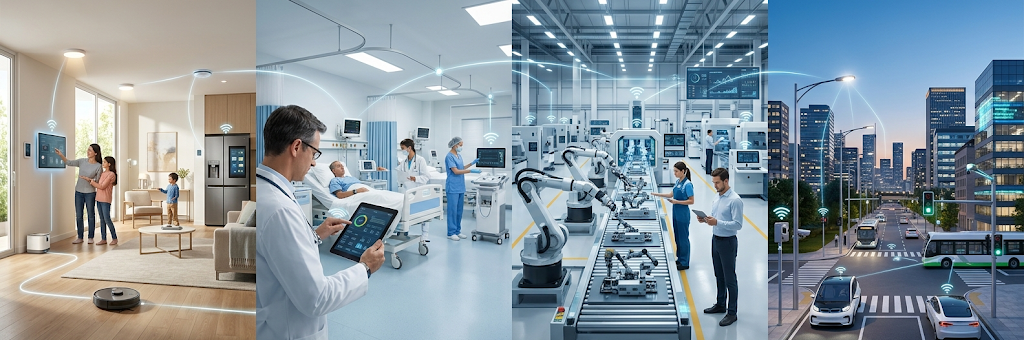
However, the potential of connected technologies goes beyond the individual smart gadget; to truly understand the impact, one must consider the whole system of global sectors and how it is using continuous data flows to significantly boost productivity, safety and operational costs.
| Sector | Primary IoT Applications | Key Operational Benefits |
| Smart Homes | Smart thermostats, automated lighting, voice assistants, and security systems | Energy efficiency, better security and convenience from a distance. |
| Healthcare | Fit-for-wear health monitors, remote patient monitoring, smart beds for the hospital. | Experiencing continuous patient monitoring, intervention at an early stage, and shortened hospitalizations. |
| Industrial (IIoT) | Energy, predictive maintenance sensors, automated assembly, tracking the supply chain. | Less downtime, more efficient production & inventory tracking |
| Smart Cities | Intelligent traffic management, smart street lights, automatic waste management systems. | Reduced traffic flow, reduced city energy consumption, better public services |
Smart Homes and Daily Living
Smart technology is heavily used in residential spaces to increase personal convenience, improve home safety, and significantly cut down on home energy consumption. Smart thermostats also take into account the day-to-day patterns of a home, adjusting the temperature setting for the heating or cooling system to reduce energy costs, such as when the family leaves for work in the morning or returns home just before they fall asleep at night.
Smart lighting systems can detect natural light sources and automatically dim during peak sun hours; integrated security cameras can provide instant video alerts and notifications to a homeowner’s cell phone, should any odd movement be detected on the premises.
Revolutionary Advances in Healthcare
The Internet of Medical Things (IoMT) has revolutionized the medical field by introducing a revolutionary new paradigm.
Wearable devices are always connected, measuring vital signs like blood pressure, oxygen saturation, glucose, and more, in real-time and sending the health data directly to the doctors in attendance.
Real-World Impact
With continuous remote patient monitoring, healthcare providers can detect potential health risks before they even reach the level of an acute emergency, avoiding readmissions to hospitals and saving lives.
Industrial Internet of Things (IIoT)
The manufacturing, logistics, and heavy industry sectors make use of the technology in a specialized way, named Industrial IoT (IIoT). The latest factories can install vibration and temperature sensors directly into heavy equipment and continuously monitor the health of the equipment.
Predictive maintenance algorithms track changes in the performance of microscopic parts of the machinery and warn the engineer to service the equipment long before the failure will occur, stopping expensive production downtime due to a critical conveyor belt or robotic arm breaking down unexpectedly.
Efficient Smart Cities
Around the world, cities are implementing extensive networks of connected devices to make them cleaner, safer and more efficient. Smart traffic management systems leverage connected cameras and roadway sensors to dynamically adjust traffic signal timing to optimize vehicle flow and to help unclog flow bottlenecks.
When streets are entirely empty, the lights turn off, which saves millions of dollars in taxpayer energy costs, and smart garbage containers alert city sanitation staff to the need to pick them up when they are full optimizing garbage routes.
Key Challenges: Security, Privacy and Standards
The benefits of connected technologies are indisputable, but the explosion of connected hardware devices creates significant, indisputable technical challenges that society and technology leaders must take up. Each one of the devices connected to a network is a potential new entry point for malicious parties. When a smart security camera, industrial valve sensor or smart lock has unencrypted, default passwords, adversaries can take advantage of these vulnerabilities to access larger corporate or private networks. The infamous Mirai botnet attack was a huge example of this vulnerability, by hijacking a bunch of insecure consumer devices (such as digital video recorders and routers) and using them to send out the power of many computers to crash major internet services around the world.
The impacts of mass data collection are not just cyber security related; they also raise significant consumer privacy issues that must be addressed with proper laws and regulations. Smart devices record intimate details of our daily lives – from when we leave home to which roads we take to work, our medical problems, to even what music we listen to while cooking dinner. However, if companies do collect, hold, and sell this sensitive personal information without user consent, in an opaque and opaque manner, the trust of consumers is gone.
Last but not least, there is interoperability, or the ability of hardware from one manufacturer to communicate with another. To address this, the tech alliances have created open standards, such as Matter, an industry-unifying connectivity standard that aims to enable a smart device from one brand to function seamlessly in a different brand’s ecosystem.
What Is the Future of the Road Ahead?
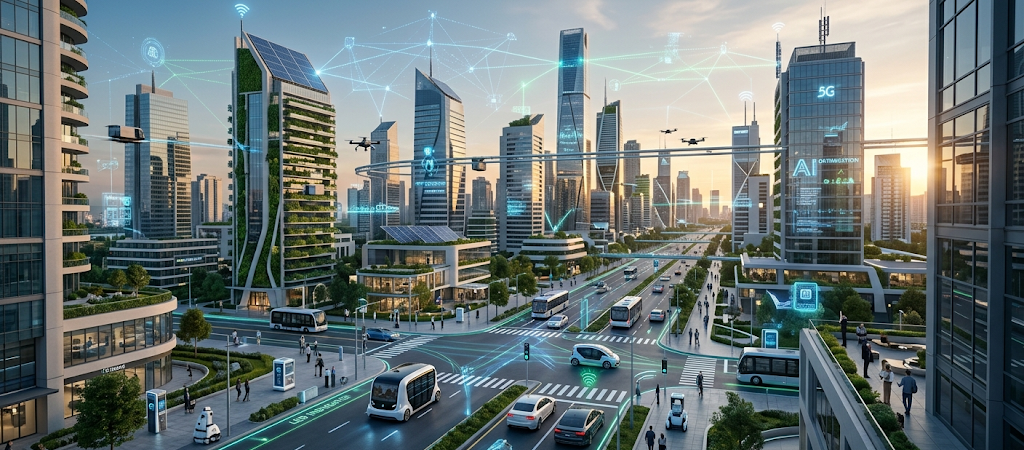
Looking ahead, the Internet of Things is undergoing a dynamic transformation, fueled by significant progress in AI, edge computing, and ultra-fast 5G telecommunications technology. By combining the latest in AI and machine learning, connected things turn from data receivers into fully autonomous decision makers that learn and adapt to complex environments in real time, becoming what we call “Artificial Intelligence of Things” (AIoT).
At the same time, the emergence of edge computing has taken data nearer to the edge devices themselves, as opposed to further off into cloud server farms. The devices can process raw network data at the point of collection, without relying on the network for any delay, which is critical for safety-critical applications such as fully autonomous self-driving cars or robot surgery tools. Connected technology will continue to subtly permeate all aspects of modern human civilization, in the wake of the rollout of global 5G networks, which offer ultra-fast speeds and high network capacity to enable billions of hardware units to connect at once.
Frequently Asked Questions (FAQ)
What do you consider to be the truest definition of “The Internet of Things”?
The Internet of Things (IoT) is an interconnected network of physical objects that can communicate and exchange information with each other and the wider internet, without any direct human interaction.
What is unique about IoT when compared to the Internet in general?
The traditional internet is dominated by human involvement in its production, input, and consumption through the use of computers, cellphones and tablets. In contrast, IoT is all about M2M communication, or machine-to-machine communication, which enables the real-time collection, transmission, processing and action of data without human intervention.
What is the difference between IoT and Industrial IoT (IIoT)?
Consumer IoT aims to enhance daily life by making people more convenient, comfortable and productive, such as smart home thermostats, voice assistants, and wearable fitness trackers, while Industrial IoT (IIoT) brings connected sensor technology to critical business areas like manufacturing, logistics, agriculture, and power grids to optimize complex supply chains, automate production lines, and enable predictive machinery maintenance.