
Introduction
Blockchain technology is a valuable innovation in the digital world because it provides an alternative means of recording, verifying and sharing information. Historically, organizations rely on centralized systems and institutions, like banks, government bodies and private entities, to keep track of records and verify transactions. These systems have their benefits but they can present problems of trust, transparency, data security and cost to manage information. With blockchain, multiple parties could have a single ledger to track the transaction, making it hard to manipulate without being noticed. Beyond cryptocurrencies, it has found use in the financial, health, logistics, digital identity and other sectors. Therefore, knowing blockchain is becoming more and more important for pupils, companies, developers and people wanting to know about the latest technology. But blockchain isn’t a panacea for all digital dilemmas. It is helpful in particular circumstances, because of how well it is designed and put into practice, and because of who will use it.

What Is Blockchain Technology?
Blockchain technology is one way to save information in a digital ledger that’s shared throughout a network of computers. The information is partitioned into blocks of information that are linked together in sequence through cryptographic techniques. Typically each block will hold transactions, a timestamp or other identifying info as well as a cryptographic reference to the previous block. This connection can be used to identify alterations to previously recorded data. Whereas with a traditional database, which is managed by one organisation, a decentralised blockchain can enable several independent entities to store and validate the same ledger. For instance, if you have multiple business partners that have copies of each other’s record of payments. Whenever a new payment is received they are updated with the new payment based on agreed rules. Blockchain is a similar concept, but without the need for a single administrator to coordinate recordkeeping, it relies on specialized software, cryptography, and network protocols.
The value of blockchain is its ability to share and keep records while verifying data and ensuring the parties agree on these records. Blockchain Technology is a useful introduction that provides a basic understanding of what Blockchain is and how it is used in business. While mostly known for Bitcoin and other cryptocurrencies, blockchain is not synonymous with digital currency. A blockchain is a technology that can be used to record information and to coordinate transactions, a cryptocurrency is one such use case for a blockchain. A blockchain can be used to record payments, track products, verify digital documents, or run computer programs called smart contracts. It primarily serves to offer a consistent record that participants can check against against existing rules. However, a blockchain is not able to ensure that all information that is placed in the blockchain is accurate. The system is able to maintain a record of the information submitted without independently checking for the validity of the information in the real world.
Fundamental Concepts of Blockchain
Blocks and Cryptographic Hashing
Calculate the hash code of a string of characters.Compute cryptographic hashes of strings.
A block is a series of records that the blockchain network has corroborated in order to record. In a cryptocurrency network, a block can store information regarding multiple transactions, and in other blockchain networks, it can store information about a product, a document, or a digital agreement. In addition to the technical information, blocks also include some data that aids other blocks to organize records and to link them to previous blocks. To this process, cryptographic hashing is critical. A hash function is a procedure that takes in some information and outputs a fixed-length digital value, sometimes referred to as a fingerprint of the information. Typically, any variation in the original data will yield a new hash. Since blocks reference other blocks, altering an older block may cause a problem in the following blocks. Many unauthorized changes can thus be detected by a network. While hashing makes blockchain modifications difficult in practice, it doesn’t mean that such modifications are impossible, as the security, economic and administrative design and consensus protocols of the network play a crucial role in making it hard to change.
Distributed Ledgers
A distributed ledger is a record that is shared and maintained by several different computers or organizations. Participants would not need to rely solely on a single central system of records, but instead would each have a copy of the ledger and follow agreed procedures to decide the valid updates. While blockchain is a category of distributed ledgers, not all distributed ledgers are made up of a chain of cryptographically linked blocks. For instance, if a group of financial institutions has a shared ledger, it can be used to keep track of the movement of money between these institutions. Each authorized participant could check where needed without relying solely on the separate records kept by each institution. This way, you will avoid a lot of potential complications with different databases and easier transaction reconciling. But there is still a need for rules about access and responsibility, dispute resolution, and corrections. Another key attribute of a distributed ledger is that access to specific information on the ledger is not always available to every participant – permissioned systems can restrict access to specific information on the ledger.
Nodes and Decentralization
A node is a software or computer system that joins the blockchain network. A node can store the ledger, validate transactions, propagate them to other nodes or disburse new blocks. Some networks permit the general public to run nodes, others only permit selected entities to do so. Decentralisation refers to the spread of authority, record keeping and decision making between participants, instead of being held by a single dominating party. In public blockchain there are multiple entities performing the task of maintaining the network and they are independent of each other making it difficult for any single entity to alter the records unilaterally. However, there are varying degrees of decentralization. A blockchain might feel distributed, yet rely on a handful of infrastructure providers, validators, and developers, or organizations. It is important to consider who is controlling the network, how decisions are made and how people can join and leave the network when assessing the reliability of the network.
Consensus Mechanisms
A consensus mechanism is a mechanism which helps achieve consensus among the nodes of a blockchain network about the validity of transactions and which version of the blockchain to accept. With different computers being able to receive information at different times, the network must have a way of coordinating updates and ensuring that the information is not conflicting. Proof of Work is a process that involves solving a computational problem that is proposed by the participant who successfully completes it, and verified by other nodes. Bitcoin employs this technique. PoS randomly chooses or delegates who will propose and validate blocks based on a cryptocurrency system in which participants pledge themselves to the protocol, and other rules and penalties. There are other networks which rely on a voting or authority-based system. Both have various energy, speed, security and governance implications. There is no risk elimination in a consensus mechanism. The correct design is dependent on the goals of the network, the autonomy and independence of the network members, and the repercussions of bad or faulty judgments.
Smart Contracts
Smart contracts are computer programs either hosted on or linked to a blockchain that perform specific actions once certain conditions are met. They can trigger actions when the conditions are met, which means that someone doesn’t have to do each one of them manually. For instance, a smart contract can disburse a digital payment once it receives an accepted confirmation when a specific transaction condition is fulfilled. Smart contracts are used in decentralized finance to automate financial processes, such as lending, trading, and more, following predetermined conditions. They can also be used to aid digital ownership records, automated business agreements, and handling of digital assets. Smart contracts, however, don’t necessarily mean legally binding contracts, and they rely on the honesty of the code and the data that’s passed into them. Programming mistakes, weak external data sources, or improper permissions can cause big issues. As a result, smart contracts need to be tested, secured, monitored, and have well-defined action plans for contingencies.
How Blockchain Works
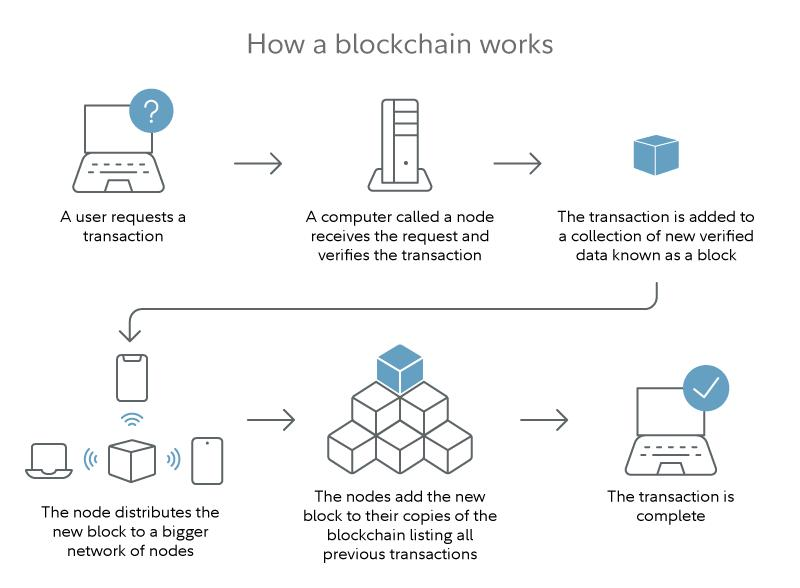
Step 1: A Transaction Is Initiated
In step 1, a transaction is initiated.In Step 1, a transaction is initiated.
When a player initiates a command, for example a transfer of cryptocurrencies or a movement of a product or interaction with a smart contract, the blockchain transaction begins. In any cryptocurrency system, the sender will normally rely on a digital wallet to create and digitally sign a transaction. The signature is a way of showing that the person that held the corresponding private key authorized the transaction. The deal then goes to the network for handling. The process may instead come to an end when an authorized computer system or employee records it via an application in a business blockchain. The details of a transaction vary from blockchain to blockchain, depending on the function and design of the blockchain. Importantly, it is not an accepted transaction when it is submitted. The network will have to evaluate if the request meets the network’s restrictions, if the sender has the required authority, and if the transaction can be carried out without breaking the network’s restrictions.
Step 2: The Network Verifies the Transaction
Thereafter, the Network verifies the Transaction.
Once the transaction is submitted it is distributed to the nodes that participate in the network and they verify it based on the rules of the network. A cryptocurrency node can check the digital signature, ensure that the transaction is in the proper format, and verify that the user has enough funds or valid unspent transaction outputs to cover the transaction. It may also refuse to accept transactions that are attempting to spend the same amount of money more than once. For a permissioned business network, verification may include validating user permissions, transaction information, and business policies. The transactions are then made available for inclusion in a block (in different ways on different blockchain platforms). This stage is significant because the network shouldn’t accept all requests out of hand. Verification lets participants use the same criteria and it enables them to decline the transactions that do not meet the criteria. Despite this, the checks can only confirm what the protocol is intended to confirm, and cannot stand alone to guarantee the truth of outside claims about physical things, identities or events.
Step 3: Transactions Are Channeled into Blocks
After collecting and verifying transactions, a block producer or other authorized participant generates a candidate block. The block includes the transactions that are to be included, and some technical information that is needed by the protocol. This information typically contains a reference to the previous block and information to check the contents of the current block. In the case of staking, blocks can be created by voting, staking, or another accepted method, depending on the network. The proposed block is then tested with the rules of the network before entering into the accepted ledger. Each blockchain has varying sizes of blocks, limits on the number of transactions per block, and confirmations, so there are different times to process transactions. The structure of grouping transactions in blocks helps to organize the record, and gives a structured history of accepted activity. But not every network that has a proposed block guarantee that the transaction is final, and other rules of finality are implemented in some networks.
Step 4: Consensus Is Reached to Establish the Accepted Record
Once a candidate block is proposed, the network’s consensus protocol decides whether it is accepted or not. Each node checks out the block by itself and discards it if it fails to meet the protocol rules. The acceptance procedure can include computational tasks, selection by stakeholders, voting by validators, or approval by accepted participants, depending on the specific blockchain. Upon meeting consensus conditions, the block is added to the ledger and nodes adjust their records as per the protocol. Some networks allow competing blocks, which can cause a transaction to be in a block that is subsequently replaced by a different block in the chain. Some other blockchains have explicit finality mechanisms to determine that a block cannot be reverted at normal operation of the protocol. Therefore, users and businesses need to be aware of the difference between initial inclusion and final settlement, particularly if the transactions involve valuable assets or time-sensitive operations.
Step 5: The Ledger Is Updated
Once a block has been accepted, the nodes that are involved in the transaction update their ledger records and then they update the rest of the network. The new block is linked to the previous block via cryptographic links, forming a chain of accepted blocks. This makes it easier to see if unauthorized modifications have been made as the hash of the earlier block will be null or different if it is altered. If the blockchain is well protected, an attacker would need to gain access to a significant technical, economic or organizational barrier to be able to alter the finalized records successfully. The level of protection will vary, however, based on the network. Private systems could be relying on the integrity of a smaller set of authorised organisations, whereas public blockchains may be relying on a large number of independent participants. After a transaction has been entered, you may have to make another transaction or an approved administrative process to correct an error, instead of simply deleting an entry. This ensures a long lasting audit trail, and it is imperative to take care in data entry.
Types of Blockchain Networks
Public Blockchains
Typically, public blockchains are those that are open to all readers of the ledger, and can submit transactions or participate in the validation process, depending on the protocol specifications. Bitcoin and Ethereum come to mind. These networks do not need to be authorized by any central entity before users can use the core functions. They can open their participation, provide independent verification and applications across national borders. Cases in which the participants don’t need to rely on a single company to maintain the transaction record could be particularly beneficial with public blockchains. However, there are privacy issues involved in making it public, transaction fees may fluctuate based on demand, and network performance may be constrained by design decisions. Specialized knowledge or appropriate software often is required to participate. While many public blockchains are built to be impossible to be manipulated from a single point of control, the governance and security of the network are still reliant on the actions of participants, software developers, validators, miners and many other influential groups.
Private Blockchains
Private blockchain are the blockchain that allows only a select few people or organizations in the blockchain, such as the controlling entity. It could be used to keep internal records, to coordinate departments or provide information to selected suppliers. The organization can control who will be involved in making transactions, who will be able to view specific records, and who will be responsible for keeping the ledger. This arrangement can benefit quicker processing, increased confidentiality, and seamless integration with current systems in place. For instance, a manufacturer might share their logistics network and authorised distribution channels, but not other parties’ commercial information. But a private blockchain could be less decentralized than a public blockchain due to a single entity having control over access and key administrative decisions. Sometimes, however, a traditional database can provide the same benefits without the complexity. Private blockchain is best suited, therefore, for instances in which there is a clear benefit to the participants sharing verification.So for cases where there is a clear benefit for the participants to share verification, then private blockchain is best suited.
Consortium Blockchains
A consortium blockchain is managed by a select group of organizations, not by one organization or public participation. It may be beneficial in cases where multiple institutions are sharing of information and where no single institution wishes to have a monopoly on the system. A consortium of banks, manufacturers, insurers, or healthcare companies, for example, could cooperate in maintaining a ledger for transactions that span across organizational lines. The duties for document validation, access and document governance may be separately delegated to each participant. For some business-to-business (B2B) uses, consortium systems can be decentralized and have a controlled membership. The participants, however, are required to agree upon the operating rules, software upgrades, access to data, costs, and dispute resolution. Governance issues may arise if there are disagreements among members or a small group acquires too much power. The reliability of the system is therefore not only technically designed but also the degree of cooperation between the participating organisations.
Some of the Benefits of Blockchain Technology
Transparency and Accountability
One of the key benefits of blockchain is that it provides a verifiable and consistent record of transactions that can be independently reviewed and verified by authorized participants. A public blockchain is a system where transaction history is typically visible to everyone, and users can access and view information without solely depending on a private entity’s claims. Transparency can be selective in a permissioned network, allowing for an audit trail without compromising privacy among the allowed network members. This can help increase accountability, as it can make it easier to tell when a transaction was made and which authorized process accepted it. A supplier and a retailer, for instance, could have a shared ledger and be able to sync their shipments and resolve any disputes over shipment events. But it’s not the same as all information being public. Confidential information, trade secrets, and contracts are frequently needed to be protected by businesses. Good systems must allow for documentation of the data but also have some type of restriction on access to sensitive data.
Security and Data Integrity
Blockchain technology can provide additional security to data integrity by using cryptographic hashes, digital signatures, distributed recordkeeping, and consensus mechanisms. These attributes make it possible to spot the unauthorized changes and make it harder for one participant to alter accepted records without an alteration being noticed. Digital signatures can also be used to determine if a particular transaction was authorized by the owner of the cryptographic key. Record keeping in different, independent nodes can minimize dependence on any one database or server. However, blockchain security is not foolproof. The attacks can come through a digital wallet, the private keys, weaknesses in software, compromising a user account, or poorly secured software on a network. A blockchain can also contain false information that was accepted for the system to have no means to determine the truth in the real world. However, secure software, access controls, key management, independent audits, and organizational practices are all a part of the equation when it comes to strong security—blockchain is not the only factor.
Traceability and Recordkeeping
Blockchain can improve traceability by linking successive records of an item’s movement or a transaction’s history. In a supply chain, for example, participating organizations could record when a product was manufactured, transferred to a distributor, inspected, or delivered to a retailer. Authorized users could then review the available history to identify discrepancies and investigate potential problems. This can be valuable in industries where provenance, compliance, and accountability matter, including food production, pharmaceuticals, and high-value goods. A consistent history can also reduce disputes caused by separate organizations maintaining inconsistent records. However, traceability depends on the accuracy of the information entered into the system. If someone records the wrong product identity or falsely reports an inspection, blockchain may preserve that inaccurate claim rather than correct it. Reliable implementation therefore requires trustworthy data collection, appropriate verification procedures, and clear responsibility for the quality of submitted information.
Efficiency and Reduced Dependence on Intermediaries
Blockchain can simplify processes that involve multiple organizations maintaining separate databases and repeatedly checking one another’s records. A shared ledger can reduce some reconciliation work, while smart contracts can automate eligible steps such as recording payments or updating transaction statuses. For example, two businesses that use compatible systems might verify the same transaction history instead of exchanging several versions of a spreadsheet and manually resolving inconsistencies. In some settings, blockchain-based transfers can also reduce dependence on traditional intermediaries, although the need for regulated financial services, identity checks, or dispute resolution may remain. These efficiencies are not automatic. Integrating a blockchain with existing systems can be expensive, and poorly designed networks may introduce additional delays or administrative work. Before adopting the technology, organizations should compare its total costs and expected benefits with simpler alternatives, including conventional databases, electronic signatures, and established payment platforms.
Risks and Limitations of Blockchain
Scalability and Performance
Scalability refers to a system’s ability to handle increasing numbers of users and transactions without unacceptable delays or costs. Some public blockchains process transactions more slowly than centralized payment systems because many independent participants must follow common verification and consensus rules. During periods of high demand, transaction fees may rise and users may experience longer confirmation times. Developers are addressing these limitations through approaches such as transaction batching, more efficient consensus mechanisms, layer-two networks, and alternative blockchain architectures. Layer-two systems process certain activities outside the main blockchain while using it for settlement or security, although the details vary by design. These approaches can improve capacity, but they may introduce additional technical complexity, trust assumptions, or security considerations. Organizations must therefore assess real performance under realistic workloads instead of relying on advertised transaction rates alone. A blockchain that works well for a small pilot project may not be suitable for a large service with millions of users.
Regulatory Uncertainty
Blockchain operates across national borders, while laws governing financial services, personal data, taxation, consumer protection, and digital assets differ between jurisdictions. This can create uncertainty for organizations that want to introduce blockchain-based services in several countries. Cryptocurrency-related activities may be subject to licensing requirements, reporting obligations, anti-money-laundering rules, and other financial regulations, depending on the location and activity involved. Businesses may also need to consider contractual liability, intellectual property, electronic records, and the legal status of digital assets. Because regulatory approaches change over time, organizations cannot assume that a system permitted in one country will be treated in the same way elsewhere. Compliance should be considered during system design rather than added only after deployment. For projects operating in Nigeria or serving Nigerian users, relevant local financial, data-protection, and other applicable rules should be reviewed with qualified professionals before a product is launched.
Privacy and Confidentiality
Blockchain’s recordkeeping properties can conflict with the need to keep personal and commercial information confidential. Public transaction histories may reveal patterns of activity even when users are identified only by cryptographic addresses. If an address becomes associated with a real person’s identity, earlier and later transactions may become easier to connect. Storing personal information directly on an immutable blockchain can also create difficulties when records need to be corrected, restricted, or deleted under applicable privacy laws. Businesses can reduce these risks by storing sensitive data outside the blockchain, recording only necessary references or proofs, and using access controls or privacy-enhancing cryptographic methods where appropriate. Permissioned networks can restrict who views certain information, but their administrators must still be trusted to manage permissions correctly. Privacy should therefore be treated as a fundamental design requirement, not as an optional feature added after a blockchain system has already been built.
Energy Consumption
Energy use varies significantly between blockchain networks. Proof-of-Work systems require participants to perform computational work, which can consume substantial electricity when mining activity operates at scale. The environmental impact depends on factors such as the amount of computing equipment used, the energy sources supplying it, and the efficiency of mining operations. Proof-of-Stake systems use a different security model that does not rely on continuous competition through energy-intensive mining, and they generally require much less operational electricity for consensus. This difference is one reason why energy efficiency has become an important consideration when evaluating blockchain platforms. Nevertheless, energy consumption should be assessed using evidence about the particular network rather than broad assumptions about all blockchains. Businesses should compare security, performance, environmental impact, and governance when selecting a platform. Choosing a more energy-efficient system may help reduce operational costs and environmental concerns, but it does not eliminate the need to evaluate the technology’s overall suitability.
Cyberattacks, Fraud, and Human Error
Blockchain networks face several forms of security risk, including compromised private keys, phishing attacks, software vulnerabilities, malicious smart contracts, and weaknesses in connected applications. A network that relies on a small number of validators may also face risks if those validators collude or become unavailable. In decentralized finance, poorly designed smart contracts have sometimes exposed digital assets to theft or unintended transactions. Users may also lose access to assets when private keys or recovery credentials are lost, particularly when no trusted recovery mechanism exists. These risks demonstrate that blockchain’s cryptographic foundation does not automatically protect every application built on top of it. Organizations should conduct independent security reviews, test software before deployment, monitor suspicious activity, and establish clear incident-response procedures. Individuals should use reputable services, protect authentication credentials, and understand the consequences of authorizing transactions. Effective governance and user education remain essential even when the underlying blockchain protocol is technically robust.
Real-World Applications of Blockchain Technology

Cryptocurrency and Digital Payments
Cryptocurrency is the most widely recognized application of blockchain technology. Bitcoin uses a public blockchain to maintain a shared record of transactions and help participants transfer digital value without relying on a single central payment administrator. Ethereum extends this idea by supporting programmable transactions and smart contracts that enable a broader range of applications. Blockchain-based payment systems can support international transfers, digital asset exchanges, and payments between participants using compatible networks. These systems may provide alternatives to some traditional financial processes, although users can still face transaction fees, exchange-rate changes, regulatory requirements, and security risks. Cryptocurrency values can also fluctuate significantly, making them unsuitable as a stable store of value in many situations. Blockchain payments do not automatically eliminate banking services or guarantee cheaper transfers. Their practical usefulness depends on network costs, local regulations, the availability of conversion services, and whether the intended recipients can access and use the digital assets.
Banking and Financial Services
Banks and other financial institutions can use blockchain to improve the recording and settlement of financial transactions. Traditional financial operations may involve several institutions maintaining separate databases, checking documents, and reconciling records before transactions are completed. A shared ledger can provide a common record of selected activities, potentially reducing duplicated work and disagreements. Blockchain can also support tokenized assets, in which digital tokens represent interests in assets such as bonds, funds, or other financial instruments. Smart contracts may automate certain settlement conditions when the necessary requirements are satisfied. However, these applications must still address identity verification, financial crime prevention, consumer protection, legal ownership, and operational resilience. Tokenization does not automatically make an asset legally valid or guarantee that it can be sold easily. Financial institutions therefore need to integrate blockchain applications with appropriate legal agreements, risk controls, and established financial infrastructure to ensure that the technology provides measurable benefits rather than simply adding another layer of complexity.
Supply Chain Management
Supply chain management involves coordinating the production, transportation, storage, and delivery of goods. Because these activities often involve many organizations, tracking a product’s history can be difficult when records are scattered across different systems. Blockchain can provide a shared record of selected events, such as manufacturing dates, shipping details, inspection results, and delivery confirmations. For example, a food distributor could use a blockchain-based system to trace a batch of products from a supplier through warehouses to retailers. If a contamination concern arises, the recorded history may help identify affected batches and relevant distribution points more quickly. Similar approaches can support pharmaceutical tracking, responsible sourcing, and product authentication. However, blockchain cannot independently confirm that a physical product matches its digital record. Businesses must use reliable identification methods, inspections, sensors, and trusted reporting procedures to connect real-world goods with blockchain entries. The technology is most valuable when participants agree on common standards and consistently provide accurate information.
Healthcare and Medical Records
Healthcare organizations generate large amounts of sensitive information, including medical histories, laboratory results, prescriptions, and treatment records. Blockchain can support the controlled sharing of selected records, verification of data integrity, and management of permissions across participating institutions. For example, a patient might authorize different healthcare providers to access relevant information through a system that records when permission was granted or when a document was referenced. Blockchain may also help track medicines and medical supplies, supporting efforts to identify unauthorized products or gaps in distribution records. However, storing complete medical records directly on a public blockchain would raise serious privacy and security concerns. A more suitable design may keep the actual records in secure healthcare databases while using blockchain to maintain references, permissions, or audit events. Healthcare providers must also comply with applicable privacy requirements and ensure that authorized professionals can access information when needed. Blockchain should complement reliable clinical systems rather than replace medical judgment or established patient-care procedures.
Digital Identity and Document Verification
Digital identity systems help people prove information about themselves when accessing online services, opening accounts, or presenting official documents. Blockchain can support identity-related applications by recording verification events, managing credentials, or allowing users to present digitally signed information issued by trusted organizations. For example, an educational institution could issue a digitally verifiable certificate that an employer can check without repeatedly contacting the institution. Similarly, a professional organization could issue credentials that users present when applying for work. Some systems use decentralized identity models, in which individuals can manage selected credentials through digital wallets while relying on trusted issuers to establish the original claims. Nevertheless, blockchain does not independently prove that a person’s name, qualification, or identity information is accurate. That information must be verified by an appropriate authority at the point of issuance. Strong privacy protections, secure recovery methods, and inclusive access are essential to prevent identity systems from excluding people who lack suitable devices or reliable internet connectivity.
Voting Systems
Blockchain has been proposed as a way to support electronic voting by creating an auditable record of submitted votes or election-related events. A carefully designed system might make certain alterations easier to detect and help authorized observers verify that recorded information follows established procedures. It could also support voting in limited organizational settings, such as elections within professional associations or shareholder groups. However, election security involves much more than preserving records. A credible voting system must protect ballot secrecy, verify voter eligibility, prevent duplicate voting, resist coercion, and allow independent auditing. It must also remain accessible to eligible voters and provide trustworthy procedures for resolving disputes. Recording votes on a blockchain does not automatically guarantee that the correct person voted, that the vote was cast freely, or that the system counted it correctly. For these reasons, blockchain-based voting requires extensive testing, independent security assessment, and a clear legal framework. The technology should not be assumed to make public elections more secure simply because the resulting records are difficult to alter.
Other Emerging Applications
Blockchain can also support applications in education, intellectual property, insurance, energy, real estate, and digital content management. Educational institutions may use verifiable credentials to reduce certificate fraud, while insurance companies may explore shared records and smart contracts to automate selected administrative tasks. In energy markets, blockchain-based platforms can coordinate transactions involving distributed energy resources, subject to local infrastructure and regulatory requirements. Real estate applications may use digital records to track ownership-related information or support transactions, although official registration systems and legal procedures remain important. Artists and digital creators can use blockchain-based tokens to represent digital assets or record transactions involving their work, but a token does not automatically establish copyright ownership or prevent unauthorized copying. Across these industries, the strongest applications usually address a specific coordination problem involving multiple participants who need a consistent, verifiable record. Successful adoption requires clear benefits, reliable data, appropriate governance, and a realistic assessment of whether blockchain performs better than available alternatives.
The State of Blockchain Technology in 2026
By 2026, blockchain has developed beyond its early association with cryptocurrency into a broader collection of tools for digital transactions, programmable assets, and shared recordkeeping. Public networks continue to support cryptocurrencies and decentralized applications, while businesses explore permissioned systems for financial settlement, supply chain coordination, and the verification of digital information. One important area is tokenization, which involves representing certain assets or rights through digital tokens. Depending on the legal and technical arrangement, tokenization may support more automated recordkeeping, fractional participation, or new methods of transferring assets. Another significant area is the development of layer-two systems and other scaling approaches intended to improve transaction capacity and reduce costs. These developments demonstrate continuing technical innovation, but progress is uneven across projects. The existence of a functioning blockchain platform does not prove that its applications have achieved widespread adoption, commercial success, or regulatory approval.
Interoperability, privacy, and regulatory compliance remain important priorities in 2026. Interoperability refers to the ability of different blockchain networks and conventional systems to exchange information or transfer assets under defined rules. Without effective interoperability, businesses may become dependent on isolated networks that are difficult to integrate with existing operations. Privacy-enhancing methods are also important because organizations often need to verify transactions without exposing confidential business information or personal data. Meanwhile, governments and regulators continue to address questions involving digital assets, financial stability, fraud prevention, consumer protection, and data privacy. Artificial intelligence and blockchain may also be combined in selected applications, such as verifying the origin of digital records or coordinating transactions between software services. However, these combinations do not automatically establish that information is accurate or that a system is trustworthy. In practice, the most promising projects are those that solve clearly defined problems, demonstrate reliable performance, and meet relevant legal and operational requirements.
For organizations considering blockchain adoption in 2026, the most useful approach is to begin with a practical problem rather than assuming the technology is necessary. A business should identify the participants who need to share records, the disagreements or delays caused by current systems, and the level of trust between those participants. It should then compare blockchain with conventional databases, secure application programming interfaces, digital signatures, and other established technologies. If a shared ledger offers a genuine advantage, the organization can evaluate suitable network types, transaction costs, governance arrangements, privacy requirements, and integration needs. A limited pilot project can help measure performance before a larger investment is made. It is equally important to establish who will maintain the software, resolve disputes, correct inaccurate records, and respond to security incidents. This practical approach helps organizations distinguish between realistic opportunities and projects that use blockchain mainly because the technology is fashionable.
Conclusion
Blockchain technology provides a way to maintain shared digital records using cryptography, network participation, and agreed methods for validating transactions. Its fundamental components include blocks, cryptographic hashes, distributed ledgers, nodes, consensus mechanisms, decentralization, and smart contracts. Together, these elements can help participants verify records, establish a consistent transaction history, and automate certain processes without depending entirely on a single administrator. Public, private, and consortium blockchains offer different approaches to participation, governance, privacy, and control. The technology has practical applications in cryptocurrency, financial services, supply chain management, healthcare, digital identity, voting research, and other industries. However, it also presents significant challenges involving scalability, regulation, privacy, energy consumption, cybersecurity, and the accuracy of information entered into the system. Its benefits are therefore not guaranteed simply by adopting a blockchain platform.
In 2026, blockchain is best understood as one of several technologies available for improving digital transactions and information management. Its value depends on whether it solves a real problem more effectively than existing alternatives. Organizations must consider costs, security, governance, legal obligations, and the needs of their users before choosing a blockchain solution. Individuals should also understand that blockchain does not eliminate fraud, guarantee privacy, or make every digital asset reliable. A balanced understanding of both its capabilities and limitations is essential for making informed decisions about its use. As the technology continues to evolve, its long-term importance will depend less on public excitement and more on the development of secure, practical, accessible, and responsibly governed applications that provide measurable value to businesses and society.