Home security doesn’t need to be complex or costly with monitoring contracts. With the advent of smart home gadgets that are relatively inexpensive, it is now possible for homeowners or renters to secure their homes without spending hundreds of dollars. The problem is that the devices have to remain functional in the event that the internet is slow, the power is difficult to maintain, or there is no professional installation. There are lots of inexpensive products out there claiming to offer top-of-the-line security measures but which fall short in actual use, especially in the face of power outages, weak wireless signals, and a lack of technical expertise.
A pragmatic approach is to use devices that offer reliable protection and are easy to install and will work to offer protection where conditions are less than optimal. It is possible to design a security system at a lower cost than a traditional security subscription, using a combination of motion sensors, smart lighting, cameras, and alarms.
Why Budget Smart Security Makes Sense
A lot of people think that a good home security system must be costly, but that’s not the case anymore thanks to modern technology. Smart devices have become more powerful and affordable, with features similar to professional security systems. The main benefit of this is flexibility. Homeowners can add devices as they go instead of buying a full package. Budget-friendly devices also work well for people who are renting, as they won’t need to drill, rewire devices, or make any changes to the structure.
The majority of devices are connected via mobile applications and can be installed in less than 10 minutes. While looking for a vacation side casino to play, people need to pay attention to battery backup, local storage support, and compatibility with standard web connections. These features are valued more than advanced features that rely on cloud services. Well-chosen cost-effective devices can provide several layers of protection and be readily managed and maintained.
Choosing Motion Sensors That Work in Real Conditions
The motion sensor is one of the most important security devices. It can sense motion and trigger an alert, light, camera, or alarm based on movement. Knowing how motion sensors work enables consumers to select the right model for them. If electricity in and around the house is unreliable, battery-operated motion sensors may be the best option, as they will keep working when power is out. Products that rely on low-power wireless transmission tend to have better battery life and reliability than those that require continual communication with Wi-Fi networks. Effectiveness is also strongly related to placement.
Motion sensors should be placed at entry areas, hallways, and outdoor entryways where movement is likely to occur. Do not place them close to windows, heaters, or heating sources because they may give false alarms due to temperature fluctuations or sunlight. A number of budget models under $30 offer reliable performance and can be used in conjunction with smart bulbs or alarms to trigger an automated response that deters would-be intruders from entering the home.
Use Smart Bulbs for Security
Smart bulbs are frequently advertised as a convenience, but they are also a great security measure. Often, a burglar will break into a home that looks empty, and lighting automation is an easy solution to making it look like someone is in the house. Smart bulbs that can be programmed by time or motion detection and cost less than $20 are available. Lights can automatically turn on if there is movement in pathways, driveways, or entryways through the use of a motion sensor. This abrupt shift tends to catch people’s attention and may deter undesirable behavior.
Smart bulbs that can remember their previous settings when the power comes back on are especially useful in settings that don’t always have a stable power supply. It is also important for buyers to find products that do not stop functioning if the internet connection is momentarily lost. This local functionality allows lighting systems to remain useful even when networks are down. Smart bulbs can help increase awareness, improve visibility, and contribute significantly to a layered security strategy, and they can be installed by anyone in the right location.
Affordable Door Cameras Worth Considering
The convenience of door cameras for real-time monitoring of visitors, deliveries, and unusual activity has made them a top choice for home security. Luckily, there are several good choices under $100. Battery life is a crucial factor to take into account when assessing budget door cameras. Rechargeable battery models do not require continuous electrical power and can operate during power outages. Another important feature is local storage support, which enables video recordings to be stored directly on memory cards instead of depending entirely on cloud subscriptions.
This can minimize data usage and keep footage available even if internet service is not working. While image quality is important, consistency may be even more important. A camera that consistently records at 1080p resolution is more beneficial than one with higher resolution that does not always record. Many cost-effective door cameras also have motion detection zones, allowing users to focus alerts on specific areas and reduce unnecessary notifications.
Simple Alarm Systems Without Professional Installation
One of the best ways to discourage unauthorized access is by using an alarm. Fortunately, today’s alarm systems do not need to be professionally installed or extensively wired. Some alarm kits use batteries, can be mounted with adhesive strips, and can be activated in minutes. Most basic systems feature a central alarm unit with a loud siren that activates if a door sensor or motion detector is triggered. Battery operation offers an extra degree of security for homes that don’t always have electricity.
Some systems can even send smartphone notifications, but the main benefit is the loud sound that attracts attention. Alarms with adjustable volume settings and low-battery warnings are best suited for buyers. Regularly testing the alarm helps ensure it will work in an emergency. When a camera, motion sensor, and alarm are combined into a single network, the result is an inexpensive solution that is simple to maintain and easy to use while capturing, recording, and reacting to suspicious activity.
Security: Secure Privacy, and Prevent Hacking
While security devices can keep homes safe, poor privacy practices can create new risks. Each smart gadget connected to the internet should have a unique password that is difficult to guess. Devices are often compromised because their default passwords are well-known and frequently targeted by hackers. Two-factor authentication provides an additional security layer by requiring two verification steps before access is granted. Another important step is keeping firmware up to date, as manufacturers regularly release updates to fix vulnerabilities.
Special attention should be given to camera privacy settings. Only enable remote viewing features when necessary and review video-sharing permissions periodically. For devices that support local storage, keeping recordings under the owner’s control can help reduce exposure to cloud-related risks. If possible, place smart devices on a separate network to reduce potential threats. These measures are relatively easy to implement and are crucial for enhancing security and minimizing the risk of unauthorized access. These are the best home security gadgets under $100 that actually work.
Building the Best Budget Security Setup
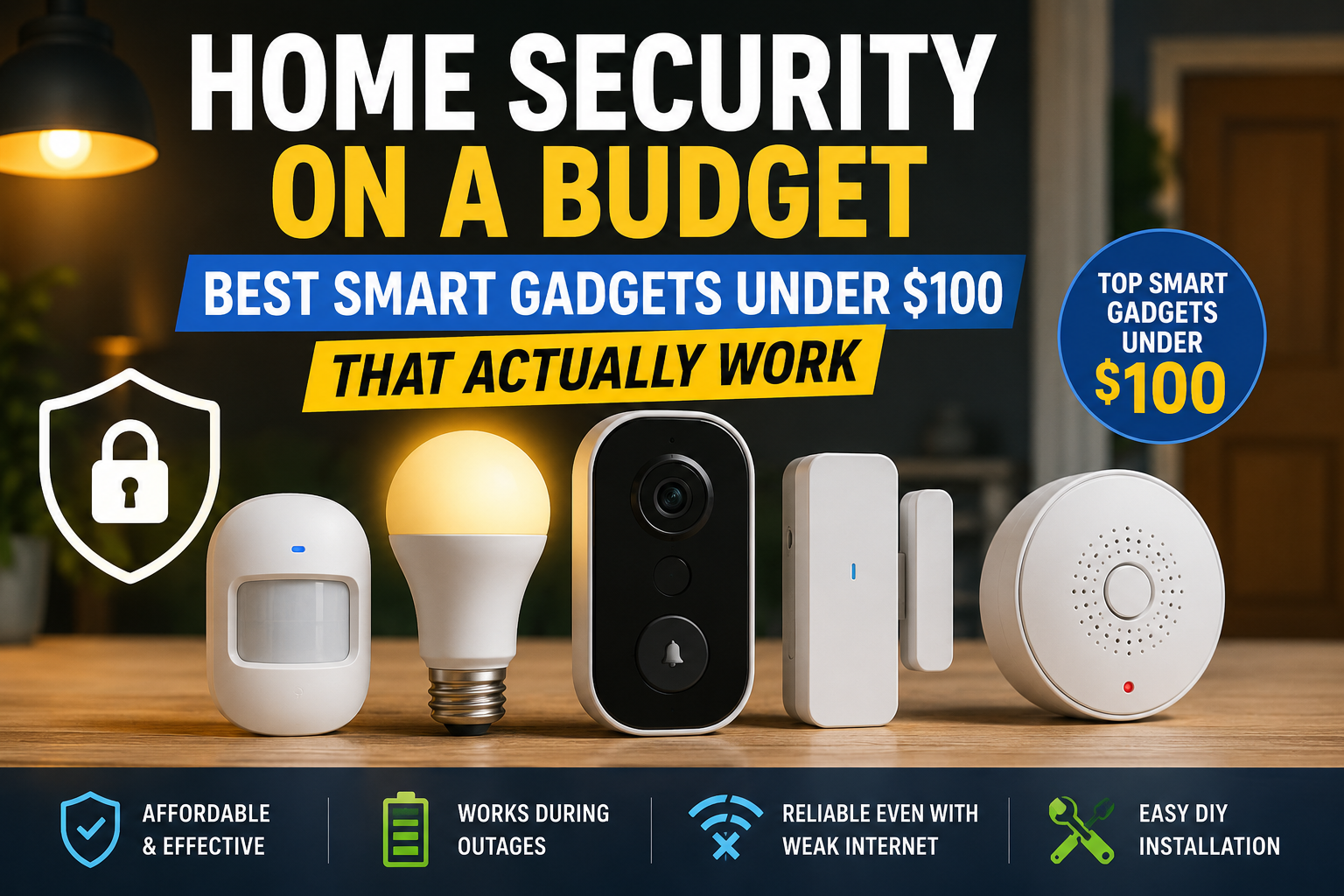
Building an affordable home security system isn’t necessarily about purchasing the latest and greatest gadget; in fact, it’s more about using a few reliable tools that work together. A working system could include a battery-operated motion sensor placed near the main entrance, a smart bulb set to turn on when movement is detected, a camera with local storage at the door, and a basic alarm that sounds when someone enters without permission. This combination provides detection, visibility, recording, and deterrence, all within a reasonable budget.
Every device plays a role in a multi-layered defense system that continues to function even when internet speeds are slow or power outages occur. Most importantly, these products can be installed without specialized skills or professional help. Homeowners can create a reliable, battery-powered, privacy-focused, and user-friendly security system for as little as $100.