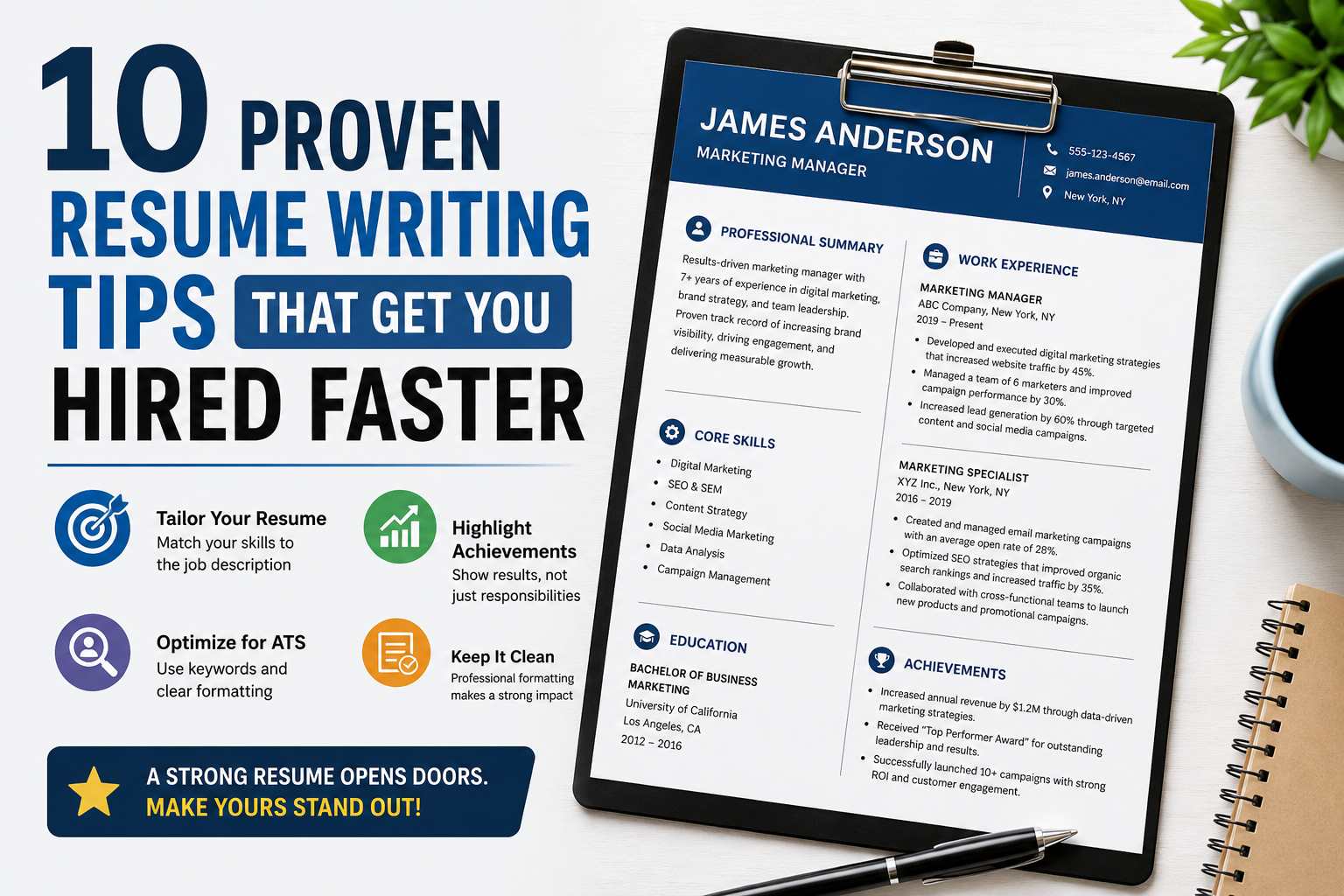
It is hard to find a job with hundreds of applicants bidding for the same position. The resume is one of the most critical documents in the hiring process because it’s often the first thing a recruiter will look at. A good resume does not just state qualifications and work experience. It conveys a powerful message about your professional worth, showcases quantifiable results, and indicates why you’re the best person for the job.
The way resumes are reviewed has also changed. Hiring has also evolved and resumes are now reviewed in a new way. An Applicant Tracking System (ATS) may even scan your application before a recruiter even reads it to see if there are any keywords or qualifications that are relevant. Having a human-readable resume doesn’t mean that it will get to the interview phase if it’s not optimized for the ATS software. When it comes to knowing how to build a results-driven resume that stands out, these resume tips will help you get hired faster.
1. Start with a Strong Professional Summary
The professional summary is the topmost section of your resume and serves as your introduction. It takes recruiters just a few seconds to determine whether they should continue reading. A concise and clear summary instantly conveys your experience, expertise, and career accomplishments.
Phrase it in terms of strength and achievement rather than general statements like “hardworking professional seeking opportunities.” Include your years of experience, your industry knowledge, and measurable results where possible. A salesperson may highlight sales or revenue growth; a project manager may mention project delivery success rates. A compelling summary signals to recruiters that they should keep reading and gives them context about the rest of your CV.
2. Tailor Your Resume to Every Job Application
Many job seekers make the mistake of sending the same resume to all employers. Recruiters are looking for proof that your abilities match the position. Customizing your resume shows attention to detail and can significantly improve ATS performance.
Take time to read the job description carefully. Identify technical skills, qualifications, certifications, and responsibilities using keywords. Use those words naturally in your resume, particularly in your summary, skills, and work experience sections. Do not keyword-stuff your resume, as this can make it hard to read. The aim is to match the employer’s needs with your experience while appearing professional and authentic.
3. Emphasize Accomplishments, Not Duties
Many resumes do not show results; they only show what you did. Recruiters are already familiar with the general responsibilities of common job titles. They are more interested in how well you performed those tasks and the difference you made.
In your work experience section, focus on accomplishments, not tasks. Rather than writing “Responsible for managing customer accounts,” write “Managed 50+ customer accounts, achieving a 20% growth in customer retention in one year.” This shows impact and helps hiring managers understand your contribution. Each bullet point should answer: What difference did you make?
4. Quantify Your Achievements Whenever Possible
Using numbers adds credibility and makes achievements more convincing. Numbers provide tangible proof of your skills and create a stronger impression than vague statements.
Include data such as revenue, savings, productivity gains, customer satisfaction, project completion rates, or team size managed. Instead of “improved company processes,” write something like “implemented workflow improvements that reduced processing time by 35%.” Even if you are not directly tied to financial outcomes, there are usually measurable results you can highlight. Specific achievements help your resume stand out.
5. Use Powerful Action Verbs
Powerful verbs make accomplishments more impactful and engaging. They communicate confidence, leadership, and initiative, making your resume more professional.
Use active language such as “achieved,” “implemented,” “developed,” “increased,” “optimized,” “streamlined,” “led,” “designed,” and “delivered.” Compare: “Was responsible for training employees” vs “Trained and onboarded 25 new employees, resulting in a 15% increase in productivity.” The second example is stronger and clearer. Rewriting bullet points with strong action verbs improves your resume significantly.
6. Optimize for Applicant Tracking Systems (ATS)
Many companies use Applicant Tracking Systems to track and filter job applications. These systems search for specific keywords and formatting before passing candidates to recruiters.
Use standard section headings such as Professional Summary, Work Experience, Education, and Skills to improve ATS compatibility. Avoid complex graphics, tables, text boxes, or unusual fonts, as they may interfere with scanning. Submit your resume in the required format and include keywords from the job posting throughout. If your resume is not ATS-friendly, it is less likely to be seen by a human recruiter.
7. Select the Appropriate Resume Length
Choosing between a one-page or two-page resume depends on your experience and background. Students, recent graduates, and professionals with less than 10 years of experience should use a one-page resume. This ensures focus on only the most relevant information and improves readability. A two-page resume is appropriate for experienced professionals, managers, or technical specialists with extensive achievements. Every section must add value—do not include information just to fill space.
8. Highlight Relevant Skills Strategically
The skills section is one of the first areas reviewed by ATS software and recruiters. Including relevant skills helps showcase your qualifications and match job keywords.
Separate technical skills and soft skills where possible. Technical skills may include software, programming languages, project management tools, or industry-specific systems. Soft skills include leadership, communication, teamwork, and problem-solving. Avoid listing too many skills; focus only on those relevant to the job. Supporting your skills with examples in your work experience adds credibility.
9. Keep Formatting Clean and Professional
A well-designed resume creates a positive impression and improves readability. A resume that is hard to read can be overlooked, even if the candidate is highly qualified.
Maintain consistent fonts, spacing, margins, and headings throughout the document. Organize information logically and use bullet points for clarity. Ensure job titles, company names, and dates are clearly visible. White space is also important because it reduces visual clutter and helps recruiters quickly find key information. Good design supports the content rather than distracts from it.
10. Proofread Thoroughly Before Submitting
A single spelling or grammatical error can reduce credibility and hurt your chances of getting an interview. Unchecked errors can act as red flags to recruiters.
Read your resume multiple times and consider reading it aloud to catch awkward phrasing. Use grammar-checking tools and ask a trusted colleague, mentor, or friend to review it. Verify dates, job titles, contact details, and achievement metrics for accuracy. Thorough proofreading ensures your resume meets the professional standard employers expect.
Common Resume Mistakes That Trigger Instant Rejections
No matter how much experience you have, certain mistakes can remove you from consideration. One of the most common is sending an unmodified resume. Another issue is focusing on duties instead of results, which fails to show impact. Poor formatting, excessive graphics, missing keywords, and inconsistent employment dates can also hurt ATS screening and recruiter evaluation.
Other reasons for rejection include spelling errors, exaggerated claims, incorrect contact information, and overly long resumes. Some candidates list every job they have ever had, making it difficult to identify relevant experience. Successful resumes are concise, targeted, and aligned with the job description. Avoiding these common pitfalls increases your chances of progressing in the hiring process.
Final Thoughts
Resumes remain one of the most effective tools for attracting hiring managers and advancing your career. To make your resume effective, keep it structured and easy for both computers and humans to read. Focus on measurable results, relevant content, targeted keywords, and clear formatting.
Using strong action verbs, quantifiable achievements, and polished presentation strengthens your application and improves your chances of getting interviews. The job market is competitive, but a well-crafted resume can make a significant difference. By applying these 10 resume writing tips, you can clearly communicate your experience, highlight your achievements, and position yourself as a strong candidate for the roles you want.