Introduction
The financial sector is undergoing an AI-driven transformation with the rise of Artificial Intelligence and Machine Learning technologies. In a rapidly changing financial world, driven by the advent of Artificial intelligence and machine learning, traders are increasingly relying on these technologies to manage investments, spot patterns, and navigate through the sea of information, as well as to make swift decisions. Conventional trading techniques are based on subjective analysis, set rules, and the historical data, while AI-based systems are capable of sifting through tremendous amounts of information and fine-tuning their approaches according to market movements. With prices continuing to quickly move in response to economic data releases, corporate earnings reports, investor sentiment and world developments, these qualities are more and more crucial in the modern financial trading scene. The more investors are involved in the trading of financial markets, the more important these features are because the prices are influenced by various factors like economic announcements, company performance, investor mood and world events. But, AI is not going to eradicate uncertainty in the financial markets. It will rely on the quality of the data, as well as the models designed, risk management and that of other market actors. Knowing what these technologies do, how they differ from traditional algorithms and their limitations enables investors to more respectfully utilize technology while not believing that every price movement is accurately predicted by a technology and that there are no losses to be made by trading on a computer.
The Concept of Artificial Intelligence and Algorithmic Trading
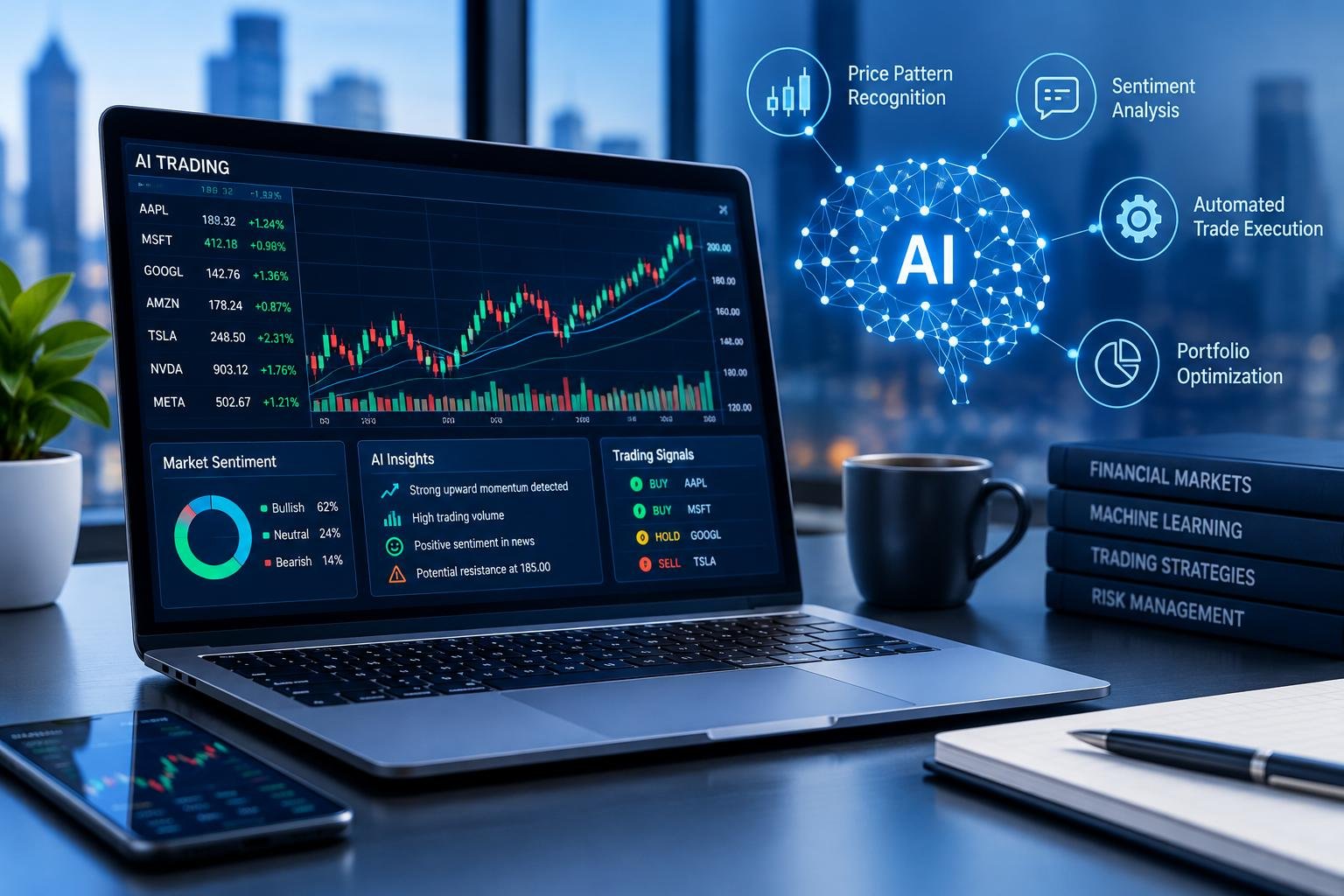
Algorithmic trading is a methodology which involves automated trading according to a set of instructions in financial programs. A classic algorithm could buy a stock when the price drops to a certain level and when technical indicator reaches a certain level, the algorithm could sell a stock. They can be more consistent, less manual and can process orders quicker than anyone. The addition of machine learning adds another dimension with the ability to discover patterns within past and current data. An ML model can predict market outcomes based on the patterns it has learnt and identified rules are hard coded by the programmer. None the less, machine learning systems run in human designed objectives, training mechanisms and risk bounds. The repercussions of their decisions depend on the assumptions, information and security procedures that they apply.
Utilization of Machine Learning for Interpreting Market Data
There is a wealth of data produced by the financial markets, such as the prices of stocks, orders on book, company announcements, economic indicators and interest rates. These inputs can be used in machine learning systems that will identify relationships that may not be clear to the human eye. In a model it may be, for instance, a correlation of the trading volume of the model, the interest rate expectation and recent price changes, with the subsequent price change. Volatility can also be estimated using time series models and trends or forecasts can be made regarding price range. The above estimates are for decision making only and not definitive. Geopolitical events, policy changes and unexpected corporate news are just a few examples of events that, if they occur, can have a tremendous impact on the market, but have not yet entered the historical record. It is thus crucial to have regular reviews of effective systems to make sure that data pipelines are reliable, maintained and that systems that used to be effective are still effective.
Price Pattern Recognition and Sentiment Analysis
Recognizing Market Patterns
Historical price data, trading volumes, and technical indicators can help identify patterns and trends in the market, which machine learning algorithms can recognize and leverage to make predictions. Market conditions can be known or the likelihood of price change can be forecasted using machine-learning algorithms like decision trees, neural networks and gradient boosting machines. One of these is, if a system self-finds a time of volatility is occurring that is not within the norm, then the system may decide to cut down on positions that they have. But a trend seen in the earlier records does not necessarily form a good relationship. There are some apparent trends out there but there’s some that are random and some that get dampened as market participants respond. When using a trader’s model for trading, it is important to test the model on data that it has not seen before and tweak the model to different market scenarios.
Understanding Investor Sentiment
AI can use sentiment analysis to analyze information in financial news, company reports, analyst commentaries, and public discussions online. The NLP system is able to classify the text as positive, negative, or neutral and identify topics that may impact investors’ expectations. If for instance, a company has issued a negative announcement in its earnings release, then a system might follow up to see if it affects the company’s assessment of its future prospects. More sophisticated models can extract topics from the text, but this process can be tricky due to sarcasm, false assertions and context. The tone of the news may rapidly change, and talking online may be rumors or orchestrated misinformation. It is therefore best used in conjunction with verified financial, price and independent risk assessments so as to provide a more comprehensive picture of the mood of the market.
Automated Order Execution and Portfolio Optimization
One of the most traditional uses of algorithmic trading is to automate the execution of trades. Programs can break up a large order into smaller ones, and make trades during the day. With proper execution, these methods can lessen the market impact, but it depends on how well done they are done and how the markets react, the size of the order and the depth and volatility of the market. Machine learning can be used for liquidity estimation, short-term price forecasting, and determining execution strategies as time goes on. AI can also aid in portfolio optimization by providing a estimation of asset relationships, assessing risk exposures, and contrasting prospective allocations. During a market stress, a portfolio model may suggest limiting exposure to assets that are being more co-related. These recommendations should take into consideration the trading fees, taxes, liquidity, investment goals and concentration limits because a theoretical attractive portfolio could turn out poorly after costs of implementation.
Differences between Conventional Algorithms and AI-driven Trading Algorithm
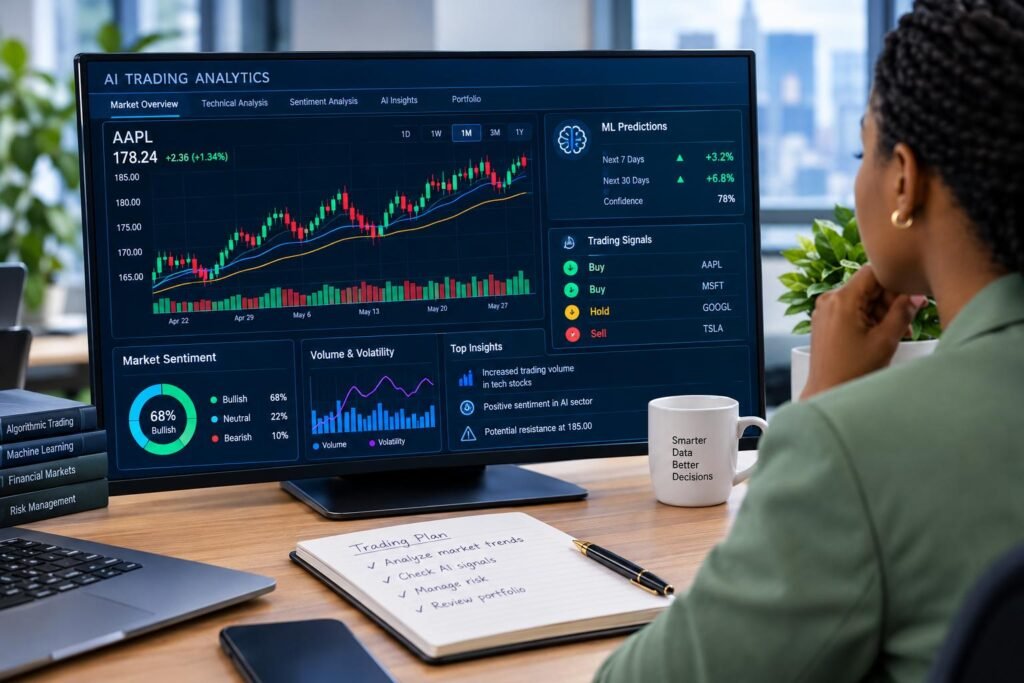
Algorithmic trading based on the traditional algorithms is based on a set of clear rules created by the algorithm’s developer, which are relatively easy to describe and test. For instance, a program may purchase an asset when the moving average is moving above another moving average. Machine learning systems, on the other hand, can learn relationships from data and adapt their predictions as they get more data. They can be used together – that is, predetermined rules are applied to limit trading while ML models provide signals. With Generative AI, there are also new capabilities like summarizing financial reports, extracting information from announcements and assisting analysts with exploring potential scenarios. Agentic AI systems can also be used to coordinate multiple analytic or operational steps, or tasks, within a given set of permissions. But generative AI can generate false or misleading information, misread numbers, or provide fabricated explanations. It should not therefore be regarded as a forecaster of certainty, or be used to make trades without independent confirmation and the necessary precautions.
How Trading Systems React to Markets Changing
Financial markets operate in various phases such as a strong growth period, a period of falling prices, low market volatility and market instability. An effective trading strategy in a stable interest rate period could not be effective in a declining liquidity or changing interest rate period. Adaptive machine learning systems can track the new information, tweak the estimates and classify the market conditions. Certain RL methods use a reward signal to assess actions in a simulated, or controlled, environment. However, there are dangers in continual adaptation: a model may overreact to short-term changes in the environment or it may learn information that is not correct. Real systems are then a mix of adaptation and constraints on position sizes, frequency of trading and acceptable loss. It is important to involve human supervision, especially in exceptional events in which historical relationships may not be of any help.
Risks and limitations of AI Trading
1. Overfitting and Poor Data Quality
Overfitting is when a model has learned random features from the past data and not relationships that apply to future data. This type of system can yield spectacular back testing outcomes, but can be a money loser in the actual market. The other challenge is data errors. Inconsistent prices, bad time stamps, more than one transaction, and wrong corporate action adjustments may affect the signals and cause incorrect buy and/or sell orders. Historical simulations should be done in a realistic way, with separate historical training, validation and testing data sets, and performance should be tested under varying market conditions. They should also make sure to verify their data sources and keep in mind that data used in the backtest might not have been accessible when a decision was made in the past.
2. Transaction Costs and the Limitations of Models
Profitability in the trade is not only based on a prediction being correct. The cost of frequently trading can wipe out gains, via brokerage fees, bid ask spreads, taxes, slippage, and market impact. Even a perfect small price change prediction model can be disadvantageous if the execution costs are higher than the expected price change. Another challenge that can be difficult for models is adapting to unexpected situations, evolving investor interactions, and shifting investor behavior. Headline profits should not be the sole focus of risk adjusted returns, drawdowns, turnover and execution in regular performance reviews. It is the responsibility of risk managers to create controls to manage unexpected losses, system downtime and irregular orders. These safeguards cannot eliminate all the risks, but they can help reduce the risks to a manageable level, or help prevent the weaknesses in a model from escalating to a degree of financial exposure that is out of control.
3. Correlated Trading Behavior and Market volatility
Yet another issue is when a lot of institutions feed on the same information, indications, or trading methodology. When their systems react to the same market move, with them all selling at the same time, it can amplify the downward trend and in turn cause a lack of liquidity. When multiple trading strategies respond to triggers under stressed conditions and behave in a similar manner, automated trading can be a cause of rapid market movements. If the AI systems are based on similar models or prevalent information sources, they can further exacerbate this effect. But, all this depends on the set up of the market, trading regulations, market liquidity and strategies used. To limit some of these risks, financial institutions can try to apply stress testing, exposure limits, circuit breakers and position monitoring. Regulators also look at automated trading practices for orderly markets and minimize negative disruptions to markets.
Conclusion
The advent of AI and machine learning has revolutionized financial trading, allowing traders to process vast amounts of market data, identify trends, gauge investor sentiment, execute trades automatically, and optimize portfolios. Learning based systems are able to recognize complex relationships and react to variable conditions, whereas, generative AI can aid with research and information processing, as compared to conventional rule based algorithms. However, such attributes cannot eliminate uncertainty and guarantee investment success. Performance can be undermined by the risk of over-fitting, data unreliability, transaction costs, unanticipated events and correlated trading decisions. To achieve successful implementation, it is essential that the necessary testing, information, risk limits, oversight and monitoring are carried out. AI should be used as a continuation of the discipline in making informed trading decisions, rather than a replacement for it. The long-term value of it will depend on the ability of financial institutions to use the computational power and human knowledge and risk management in good faith.
Get more well researched information about AI in Algorithmic Trading here.