
Introduction
Financial sectors are highly influenced by many external factors. Therefore, banks must consider various factors to understand market trends, identify risks and make informed financial decisions. However, traditional forecasting techniques often rely on small amounts of data, and basic statistical analysis, meaning complex financial trends cannot always be accurately analyzed. Due to the increasing amount of information available digitally, financial institutions have been able to improve their forecasting capabilities. By utilizing large amounts of structured and unstructured data, the banks can identify trends, understand new market trends, and predict possible financial trends. As a result, Big Data Analysis has become a crucial tool in financial forecasting. It enables financial institutions to understand market trends, make informed investment decisions, and create sustainable financial strategies.
Big Data Analysis in Financial Forecasting
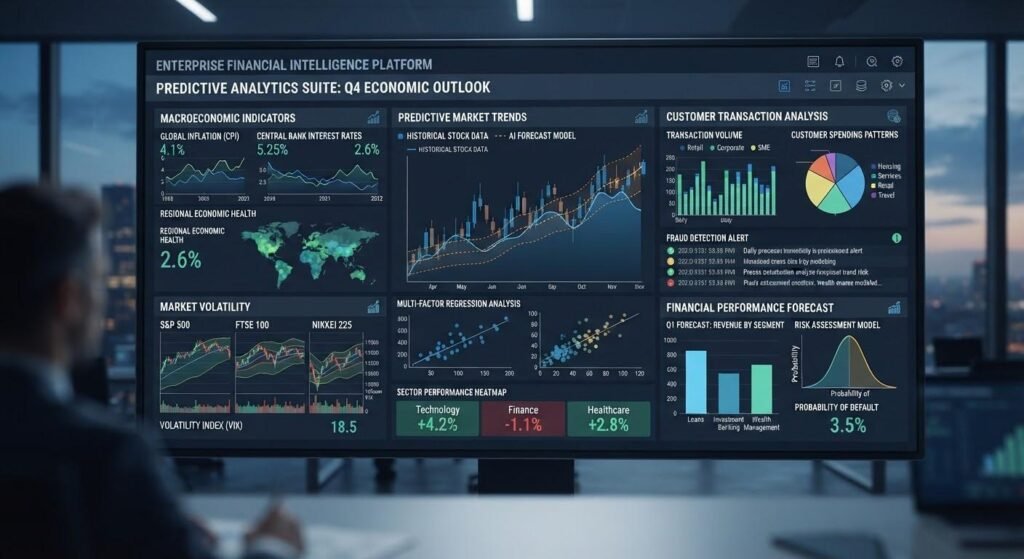
Big Data Analysis in Finance uses large amounts of data to identify trends, correlations and patterns to make informed decisions. Within banking, this data can come from different sources including customer transactional data, loan applications, payment history, financial markets, economic publications, and communication platforms. Unlike traditional analysis, which may look at limited financial variables, big data analysis allows for multiple variables to be considered and how they relate to each other. For example, consumer spending patterns can be analyzed alongside inflation, changes in interest rates, and employment figures. This enables banking institutions to understand how loan demand and repayment may be impacted by economic conditions. Overall, big data analysis in finance enables organizations to gain very detailed insight into market conditions and make forecasts using multiple pieces of evidence.
As markets are increasingly competitive, big data analysis is becoming increasingly important in finance. Using analysis software, financial institutions can extract valuable insights from data to help with financial planning, investment decision making, risk management and business development. This allows organizations to consider historical data, alongside current data from a variety of economic and financial sources. For example, if a bank is considering increasing loan availability, they can consider customer income, repayment trends of current loans, interest rates, and economic growth projections. By considering multiple variables, the organization can predict borrowing demand, and whether increasing loan availability would be a sustainable business move. Therefore, big data analysis in financial forecasting means that banks can make more informed decisions. They can also adapt to changes in market conditions more effectively.
Sources of Data
1. Customer Transactional Data
Transactional data allows banks to understand how people and businesses are managing their money. By analyzing deposits, withdrawals, transfers, card transactions, repayment of loans and other financial activity, trends in customer spending can be identified. This can indicate whether consumers are spending more money, less discretionary money, saving more, or struggling to pay. This can give insight into consumer confidence levels and economic changes within the market. If large increases in withdrawals have occurred alongside decreased savings deposits, this can indicate customers are under financial pressure or that they are cutting back on spending due to increased living costs. With this knowledge, banks can predict changes in deposit levels, credit demand and repayment of loans. Customer data also allows financial institutions to identify new market segments, and what products are likely to see increased demand.
2. Interest Rates, Inflation and Economic Data
Macroeconomic data is very important in financial forecasting. Interest rates help banks to understand how changes in monetary policy may impact demand for loans, costs of making deposits and profitability of operations. Inflation data gives insight into purchasing power, cost of production and whether customers are able to make payments. If there is high inflation, families may be spending less on discretionary items, while businesses may be facing increased costs in production and increased requirements for funding. Financial institutions also consider macroeconomic data such as unemployment rates, gross domestic product, output within industries, exchange rates, and government spending. By considering all of these macroeconomic indicators, banks can understand which way economic activity is moving, and predict how future economic changes may impact a bank’s financial position. This means banks can effectively prepare for changes in economic conditions.
3. Share Price Data
Share price data provides insight into investor confidence, company performance and overall market expectations. Banks consider share prices, volume of shares traded, share indices, bond yields and commodity prices to understand what changes may be occurring within the market. Large changes in share prices could indicate changing expectations of company performance, industry performance, or economic conditions. Bond yield data can indicate expectations of interest rates. If government bonds have increasing yields, this may impact the value of current bonds held, and therefore financial product pricing. When combined with other economic data, banks can understand levels of market volatility and potential risks in investment. Considering multiple financial factors increases the reliability of forecasts compared to just considering individual share price trends.
Tools Used by Banks to Predict Market Trends
1. Data Mining
Data mining helps identify hidden relationships, patterns and anomalies within large sets of data. Within banking, data mining can be used on customer transactional data, credit history, investment data, and financial market data. This can help banks identify relationships between different economic factors. For example, a business may face repayment issues in loans when certain commodity prices fall within their industry. Knowing this relationship means that if similar market conditions arise again, the bank can take extra precautions when lending to businesses within this industry. Identifying trends within data can help financial institutions understand where increasing demand for particular investment products may be, changing customer preferences, and new business opportunities. Making decisions based on these insights as early as possible means that banks can adapt effectively to future changes.
2. Predictive Analysis and Machine Learning
Predictive analysis uses statistical techniques and machine learning to make predictions about future results. In banking, predictive models can be used to analyze how changes in interest rates, customer spending, inflation, credit demand, market performance, and repayment of loans relate to each other. Using machine learning in these models can allow complex patterns to be identified and means predictions can be made as new data becomes available. For example, banks may create a predictive model to predict future demand for loans based on past loan trends, employment rates, interest rate changes and consumer confidence. Predictive models can also be used to help estimate investment returns, potential defaults and how changes in economic conditions may impact earnings. Although predictions may not be completely accurate, they provide useful estimations for financial planning. They mean banks can consider a variety of potential economic situations.
4. Sentiment Analysis
Sentiment analysis uses AI and natural language processing to identify opinions, attitudes or expectations within text data. Financial institutions can look at financial news articles, company announcements, economic commentaries, investor discussions and other public data to understand what opinions people in the market have on certain financial situations. For example, if there are many negative reports about a company’s financial situation, this may indicate falling investor confidence in the company leading to pressure on the share price. Alternatively, if there is positive discussion in a particular industry, this may indicate increasing interest in investing in within this industry. Sentiment analysis means that financial institutions can identify changing expectations in the market even if they have not yet appeared in traditional financial indicators. Combined with transactional data and economic data, this allows for more information to be considered in predicting market movements. However, banks must be careful to ensure they are taking reliable information into consideration, as rumour or misleading online discussions may lead them to make bad decisions based on incorrect sentiment.
Benefits of Big Data Analysis in Financial Decision Making
1. Investment Decisions
Big data analysis can be used within financial institutions to identify good investment opportunities. By considering performance in financial markets, market trends, business developments and potential returns, analytical models can be developed to compare different investment options. This can be done using company profits, historical share price performance, market volatility, interest rates and economic forecasts. This allows investment teams to identify suitable investment opportunities that fit with their financial goals and risk appetite. For example, if a financial institution is considering investing in renewable energy companies, they can research industry growth, government regulations, demand for energy, commodity prices, and the financial performance of relevant businesses. This information means that businesses can decide whether the investment opportunity will be beneficial in the long run, or pose high risks. By Using Big Data analysis, banks can compare different investment options, and understand how changes in economic conditions may impact returns. Therefore, investment decisions can be made using a wider range of evidence, rather than relying on individual opinions or limited previous performance data.
2. Predicting Volatility in Markets, and Managing Risk
Financial markets are influenced by economic announcements, political changes, changes in monetary policy, global trade and investor behavior. As a result, sudden changes in markets may occur, impacting asset prices, exchange rates, interest rates and investment portfolios. To identify potential increases in market volatility, banks can use big data analysis to constantly review relevant data. Using predictive models can allow banks to estimate the impacts of changes in inflation, interest rates and commodity prices on investment and lending. Financial institutions can also complete stress tests to understand how financial positions may be affected by different economic situations, such as recessions, or a sudden increase in borrowing costs. This means that banks can understand any potential risk of loss, and implement suitable risk management strategies. While it may not always be possible to accurately predict market volatility, analyzing a wide range of information means that institutions can be more aware of any warning signs in the market, and be prepared for any potential disruption to finances.
3. Improving Financial Planning within Institutions
Big data analysis can be used within institutions to make effective financial planning. This can allow banks to understand future income and outgoings, cash-flow, changes in deposits and lending. By comparing past performance with current economic conditions, financial institutions can make predictions on future income and identify where costs may increase. If interest rates are increasing, and less borrowing is expected from consumers, a bank may alter target lending amounts and future revenue expectations. Information on customer behavior can also allow managers to identify which branches, products or digital services require extra investment. Predicting future figures means that decisions can be made on capital distribution, cash-flow management and business expansion. Knowing potential financial outcomes allows banks to set realistic budgets, and create strategies for different market conditions. As a result, resources can be allocated effectively and decisions can be made by management teams to balance profitability, efficiency and long term financial sustainability.
Risks and Challenges of Using Big Data in Financial Forecasting
1. Reliable Data
For financial predictions to be accurate, reliable data is essential. If incomplete data, old economic data, duplicated data, data in an inconsistent format or incorrect customer data is included in models, then inaccurate conclusions may be made. Including incorrect data in financial forecasting models can lead to incorrect investment or lending decisions. To ensure accurate predictions, it is important for financial institutions to implement effective data management processes. This includes validating, cleansing, standardizing data and regularly checking data. Financial institutions must also ensure that data from different sources is appropriately combined, and that data is updated as market conditions change. In addition, data bias may occur if data from the past does not represent current customers and market conditions well. Having reliable data sets within businesses means that forecasts will be more accurate, fewer errors in analysis will occur, and more confidence can be put in decisions made based upon the models.
2. Meeting Regulatory Requirements
There are strict requirements in place for financial institutions in relation to data security, customer privacy, financial reporting and risk management. When using large volumes of data regarding customers and market conditions, the data must be processed in accordance with data protection legislation and financial regulation. To protect sensitive customer information, banks must have suitable security in place so that unauthorized access to data, theft of data and misusing data cannot occur. Additionally, analytical processes must be clear enough to allow regulatory bodies to review decisions, and for important financial decisions to be justified if necessary. Furthermore, risks must be managed in relation to using data from third parties and cloud based analytical software. If customer data is being used to form predictive models to make decisions on lending, credit and financial product recommendations, it is particularly important to follow regulation. Good procedures, access control, encryption and regular audits within banks mean that big data can be effectively and responsibly used, gaining customer trust and meeting legal requirements.
3. Relying too much on historical trends
While using historical data is extremely informative in financial forecasting, relying heavily on historical market trends can present major risks. As economic conditions, government policies, technology, consumer behavior, and global circumstances are constantly changing, it may not be reliable for financial markets to follow previous trends. If a model is largely based on previous market trends, it may not be very effective if unexpected circumstances occur, or major changes occur in the relationship between economic variables. For example, if a model is based on stable interest rates, but there is a period of fast monetary tightening, predictions may be unreliable. Similarly, previous share market performance does not guarantee profitable investment returns. Therefore, banks should consider current market indicators, expert opinion, scenario analysis, and regularly review models in conjunction with historical data. This means that a prediction of future outcomes is less likely to be made purely based on historical performance, and banks will be better able to adapt to unexpected changes.
Future of Big Data Analysis within Banking
With advances in AI, machine learning, cloud computing and real time data processing, big data analysis within banks is expected to increase. More data can be analyzed, models can be updated more frequently, and emerging trends can be identified quickly. More advanced analytical systems may be increasingly used to simulate economic situations, monitor investment portfolios, and determine potential risks in financial situations based on new information. However, improvements in technology must be accompanied by skilled employees, reliable data systems, responsible data handling and effective regulation. As decisions within financial sectors are often uncertain, human judgment remains very important within decision making. Therefore, banks able to combine advanced analytics and skilled personnel will be best placed to understand changing markets, identify opportunities and create sustainable business strategies.
Conclusion
Big data analysis is an important tool in financial forecasting. It allows banks and financial institutions to understand market conditions using a wide range of information. By analyzing customer transactional data, interest rates, inflation levels, share market data and economic data, trends can be identified to estimate future developments. Tools such as data mining, predictive analysis, machine learning and sentiment analysis have further improved the ability of financial institutions to make informed investment decisions, predict market volatility, manage financial risk and improve strategic planning. However, effective use of these tools relies on reliable data, meeting regulation, suitable security measures, and careful interpretation of results. Furthermore, due to changing economic conditions, banks should not make decisions based purely on previous patterns in the market. By combining big data analysis with expert judgment and responsible financial management, financial institutions can make more informed decisions, adapt to market changes, and improve long-term financial performance.
Get more well researched information Big Data Analytics in Banking here.