Introduction: The Great Transformation in Modern Education
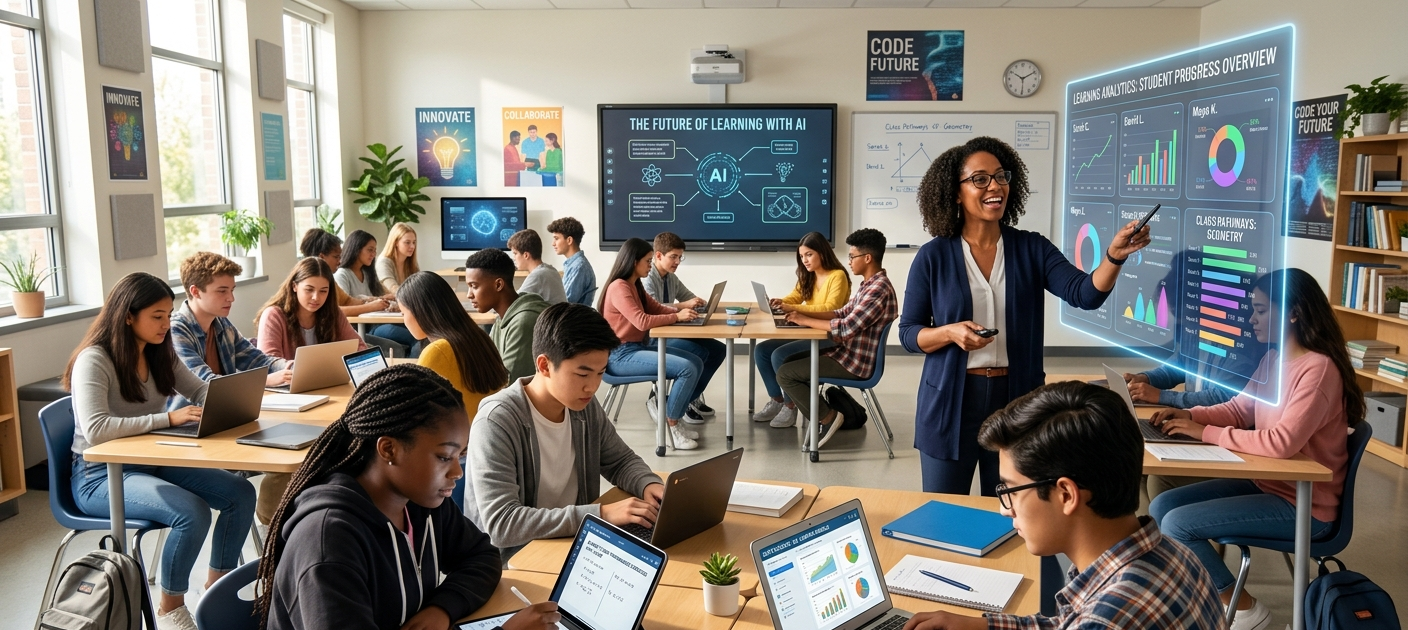
High performing students often found themselves out of the game, left unchallenged and bored, at the same time struggling learners were left behind as we maintained a fast pace which paid no attention to individual conceptual mastery. But today’s digital age has brought in a very different structure. We see that AI in the present day classroom is redefining in very basic terms how we pass on, process and retain knowledge which in turn we see is turning traditional learning settings into responsive, student based ecosystems that change in real time to meet each and every student’s needs.
Understanding what AI does in education is to look at the system-wide shift to what is in fact totally dynamic and data driven learning settings which we see play out in schools all over the world. Also we must note that from the point of view of educational policy experts and global academic bodies AI is put forward not in the role of a replacement for human teachers but rather as a tool which augments what the human mind does and which is also a very good admin support. We see today that through the use of advanced machine learning algorithms, deep neural networks and very sophisticated natural language processing we have software which is able to analyze very complex student interaction patterns in real time. This tech evolution in turn allows school districts, universities and training organizations to close individual learning gaps, increase academic retention and at the same time make personal instruction available to more. As AI becomes a key player in global educational strategy the smart classroom is a very large step forward in present day pedagogy, in fair instruction and in the development of the student over a lifetime.
Main Factors of AI in the Classroom Personalization
Adaptive Learning Platforms: Tailoring Instruction to the Individual
Adaptive learning systems are the leading edge in what AI does in today’s primary, secondary, and tertiary education settings. What we have of traditional textbooks and static e-learning modules are linear content which treat all students the same way without regard to the individual cognitive structures or base abilities of each. In contrast, adaptive learning platforms continuously assess a student’s performance in terms of accuracy, speed of response, confidence levels, and also specific errors as they go through learning exercises. Also they use complex predictive models like Bayesian Knowledge Tracing and Deep Knowledge Tracing which in turn develop very detailed and dynamic models of each learner. As a student shows mastery over a basic concept the software will scale up the instruction by presenting more advanced problems. But if a student is struggling with a concept the platform will scale back by breaking it down into smaller parts, giving out targeted supportive prompts, or recommending related background material.
Adaptive learning systems’ greatest assets go beyond what is seen in raw academic performance scores and standardized test results. What we see is that students had math anxiety or were having reading issues found in adaptive digital environments, a safe non judgmental space where failure is to be used as a learning tool not a mark of academic defeat. Also it is the case that with adaptive learning the average pace of the physical class is left behind thus — at their own pace some students are to explore advanced topics and to develop critical thinking. Also we have research that reports that in classes which use adaptive learning frameworks we see great improvement in subject mastery also we see a large drop off and failure rates go down which is the transformable power of tailored learning paths.

Intelligent Tutoring Systems (ITS): Around the Clock Academic Guidance
Intelligent Tutoring Systems (ITS) which are very advanced digital tutors that put forward what was until recently the exclusive role of the human tutor in terms of in depth and personalized instruction. Over the past few decades’ research in cognitive science has played a key role in the development of ITS which in recent time has seen input from the field of modern generative AI. In these platforms we see a domain model which is a repository of expert subject knowledge, a student model that tracks each individual’s knowledge state, and a pedagogical model which is the brain behind the instruction. As a student works through complex multi step problems in fields like calculus, organic chemistry, or computer programming which a human tutor may have once handled, an ITS doesn’t just mark a response as right or wrong. Rather it goes in depth into the student’s thought process, pinpoints where the breakdown in procedure is, and gives out very targeted, conversational prods which in turn guide the learner to the right answer without giving it away.
Intelligent Tutoring Systems’ round the clock access is what is breaking down barriers to wide scale academic support which in the past was a privilege of well off families. In the past high quality continuous individual tutoring was very much a feature of the private tutor’s repertoire which in turn was an indicator of large financial outlay which in turn was a factor in growing socio-economic educational gaps. Today we see that through the use of AI powered virtual tutors which is a part of the public domain we are seeing personal academic support which is almost unlimited in its time frame going out to students all over the world that include those in under-resourced school districts or in remote rural areas. Also we have today’s AI tutors which are fitted out with natural language interfaces, voice recognition features, and multilingual translation tools, they are able to answer in depth open ended questions, put across difficult concepts in different terms which may be more familiar to the student, and give out immediate feedback during the late night study sessions. This round the clock support which breaks free from the four walls of the physical school is what is also seeing academic growth to go on without break and in doing so is empowering students to build up their confidence and to master very tough academic material at their own speed.

Streamlining Teaching Operations: Automated Assessment and Administration Tools
Automated Assessment and Instant Feedback
One of the greatest issues that educators around the world report is that of the great deal of time spent on grading which is a very large element of the job. We see in traditional manual grade reporting that which creates great delay in feedback which we give to our students often we are reporting back on marked work a few days to even a few weeks after the fact which in turn reduces the formative value of that which we do. But what Artificial Intelligence does is it changes this model with the introduction of automated assessment platforms which use computer vision, natural language processing and deep learning algorithms. Today’s modern systems not only grade multiple choice questions but also open ended short answer questions, complex math problems and large scale software code assignments which they do with great accuracy and detail. Also what we see is that this is done almost in real time which means that we are giving almost immediate feedback to our students which in turn preserves the flow of the instructional process.
By means of present and in depth qualitative feedback AI assisted evaluation tools which is what we do. In the case of subjective tasks like essay writing and analytical literature reviews we put forth advanced natural language evaluation algorithms which look at structural coherence, thesis support, grammatical accuracy, and argumentative clarity and which in turn put out action oriented suggestions for iterative revision. This immediate feedback loop we see as a transformation of assessments from passive grade doles out exercises into active and continuous learning which in turn fosters academic resilience. What we also see is that automatic grading systems are designed to augment and not to replace human judgment; teachers still have full authority to go over the algorithm’s grades, to change the auto generated marks if they so choose, and to add in personal qualitative input which in turn keeps evaluation practices at high standards of academic rigor, fairness, and also very much under human empathetic care.
Administrative Efficiency and Teacher Empowerment
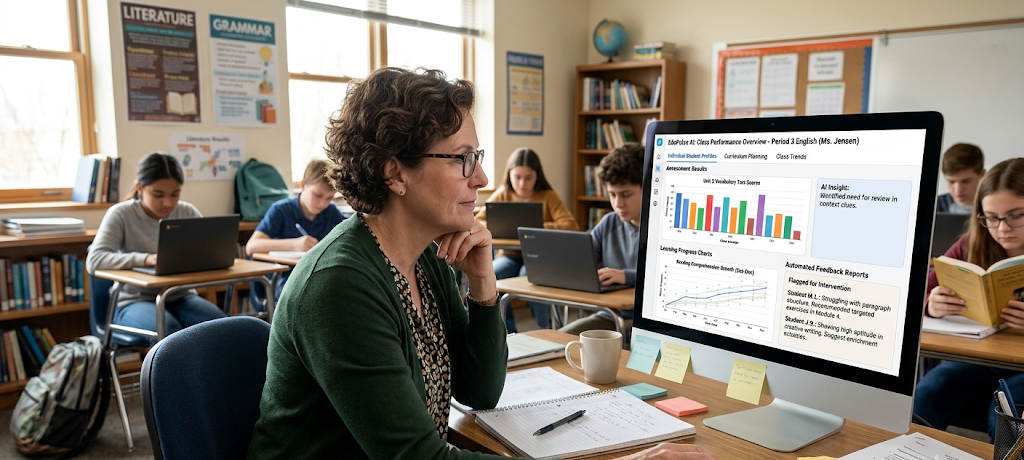
Beyond what is in the classroom and out of class instruction, present day teachers report to also run large scale admin functions that include but are not limited to developing detailed lesson plans, daily attendance of students, mapping to learning standards, maintaining grade books, and continuous parent communication. We see from large scale studies that almost 50% of a teacher’s total work week is spent on admin tasks which in turn is a major factor in the wide spread issue of educator burn out and high turnover in the teaching profession. AI in the form of admin productivity tools is put in place to help with these issues which are systemic in nature by putting routine digital tasks on autopilots. Generative AI assistants are able to draft up detailed standards based lesson plans, put together tailored question banks, translate reports out to multiple languages for non native families in the audience, and in general to put in order very complex learning management systems at a fraction of the time it took to do so by hand in the past.
Administrative Workflow
| Traditional Operational Method | AI-Enabled Smart Classroom Method | Efficiency Impact & Benefit |
| Lesson Plan Development | Hours of work put into the drafting and research of standards. | Rapid development of AI created for curriculum frameworks. Reclaims over 75% of preparation time |
| Assignment Evaluation | Manually done over the course of days or weeks. | Automatically score with contextual suggestions. Enables immediate student revision loops |
| Student Progress Tracking | Term by term review of mid terms or end terms marks. | Real-time predictive analytics and risk alerts. Allows timely, proactive interventions |
| Parent & Guardian Outreach | Individual manual emails and translated documents | Automated multi-lingual newsletters and updates. Fosters continuous, inclusive communication |
Learning Analytics and Predictive Interventions
Learning in digital environments which are fueled by machine learning algorithms gives school and class based teachers a level of unprecedented access to information on student progress and instructional performance for whole scale educational programs. In past educational models academic risk indicators were made known only at mid term reports or report card issuance which by then it was too late for any effective intervention. AI enabled predictive analytics which used to put together very fine grain interaction data from learning platform logins, assignment turn in rates, video play back issues, discussion board inputs, and quiz performance over time to develop in depth predictive learning models. Also these early warning systems which are put in place by the tools alert the staff to very small drops in student engagement or understanding before that which was before visible to the eye grows into academic failure or drop out.
Equipped with real time predictive data educators are able to put in place pro active very targeted interventions which in turn will prevent at risk students from dropping out or getting left behind in the classroom. School counselors, specialized interventionists and classroom teachers may work as a team to design individualized learning recovery plans, modify instructional materials, or to put in place targeted one-on-one mentoring sessions based on the empirical data which the system has collected. Also beyond the individual student level we see that aggregate learning analytics which the system provides enable school leaders to systemically look at the performance of certain curricula, text book software and teaching methods across entire school districts.
Navigating Challenges: Ethics, Justice, and the Digital Gap
While in the field of education we see that which AI brings to the table in terms of personalization is at the same time bringing up very serious ethical and privacy issues which require us to put in place very robust management structures and clear governance frameworks. At the fore of these issues is data privacy and security which is a growing concern as AI based learning platforms collect and analyze large sets of very sensitive student info which includes academic performance, behavior trends, location data, and private communications.
Another key ethical issue is that of reducing algorithmic bias and also we must address the digital divide which we see in under-resourced communities all over the world. We see machine learning algorithms which are trained on non representative or past data sets as which in turn put forward social economic, racial, or gender based biases in issues like automatic grading, essay assessment, and predictive risk analysis.
The Future Outlook: In the Coming Decade We See
In the coming decade we see the increase of artificial intelligence in the emerging tech spaces which will in turn greatly transform the modern smart classroom. We will have what I like to call next generation educational systems that will very smoothly integrate generative natural language models with spatial computing, VR and AR tools to present very immersive learning experiences.
In the end what we see is a strategic play to put AI in education which is not to supplant the human element of teaching at all but to augment and expand what we as humans are able to do in profound ways. By personalizing learning paths to the unique paces and cognitive needs of each student, AI sees to it that no learner is left behind or held back by rigid structures. Also at the same time by taking over routine administrative tasks which take away from instruction, technology enables teachers to focus on mentoring, moral development, empathy, and creative inspiration. As educational systems go through this tech transformation which is in full swing we see that the balanced partnership between human empathy in pedagogy and powerful AI will define the future of sustainable, high quality and global access to education for the generations to come.