
Introduction
Machine learning has become a vital part of technology today. It helps computers to learn patterns in data to help them carry out tasks. It can be used to recommend products on online shopping sites or identify unusual financial activity. Unlike traditional coding, machine learning allows computers to learn from examples in order to improve.
Understanding key concepts like k-means clustering will help you to understand how they organise information and find patterns in large sets of data. It can be used in a variety of industries such as healthcare, banking, manufacturing, transport and retail. Understanding how they work will help you as a beginner to understand the technology behind many digital services and why choosing the right algorithm for your problem is vitally important.
What Are Machine Learning Algorithms?
A Machine learning algorithm is a mathematical process that allows computers to learn patterns within data. Rather than relying solely on coded instructions, they look at examples and find patterns in variables. For example, online shopping sites can use machine learning algorithms to look at the history of what customers have bought to recommend products to those with similar interests.
Banks can look at past activity to find patterns in what makes a transaction suspicious. The algorithm looks at the information provided and adjusts its parameters to improve the results. Once the model has been created, it can be used on new information.
How Machine Learning Algorithms Work
Although there are a variety of different algorithms they will generally all follow a similar process to develop. First, the relevant information is gathered from different sources such as databases, apps, sensors and business information. This information will then be cleaned so that any unimportant data and errors are removed. Then developers will choose an algorithm based on the problem they are looking to solve and train it using the training data.
This means that the algorithm will look at the information provided and adjust its parameters to find patterns. The model will then be tested on different data to see how accurate it is. Once it is performing to the desired standard it can be used within an application or business to analyse new information and make predictions.
Machine Learning vs Traditional Rule-Based Algorithms
Traditional rule based algorithms operate by following coded instructions. Developers will create rules about what conditions need to be met, what calculations need to be made and what actions need to be taken. For example, an email filtering tool may have a simple rule that if an email contains a certain word it will be marked as junk. This works well with simple problems that have clear conditions however can become difficult to maintain if the situation becomes more complex.
Machine learning looks at examples and finds patterns automatically. Developers will provide relevant data and let the algorithm learn from it. This makes them useful for complex problems that involve large sets of data.
Main Types of Machine Learning Algorithms
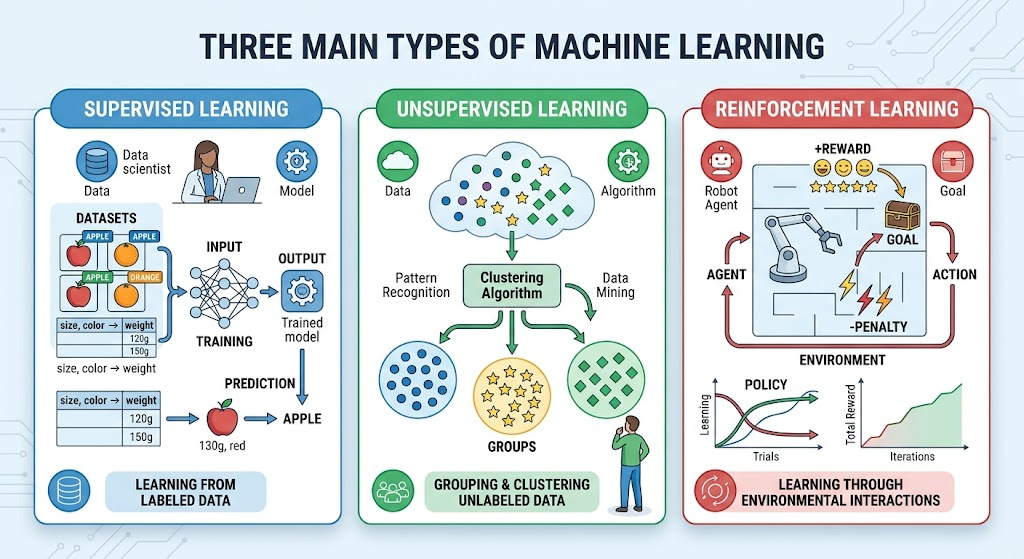
There are 3 main types of machine learning algorithms. These are supervised learning, unsupervised learning and reinforcement learning. Supervised learning uses examples with known outputs. Unsupervised learning looks for patterns in data. Reinforcement learning aims to improve decision making.
Understanding the difference between the 3 types is important as it will affect the type of data that is required, how the model is trained and the results it can provide. Developers will need to decide which type of learning they want to use based on what they want to solve. Using the wrong type of learning may provide inaccurate or irrelevant results.
1. Supervised Learning Algorithms
Supervised learning is a type of machine learning where the algorithm learns from labelled training data. This means the examples will contain inputs with the correct outputs. The algorithm will look at the examples to understand the relationship between the data and desired results. The model will then be able to use the patterns to make predictions about new data.
For example, a bank may use supervised learning to train a model using historical transaction data. This will contain information about what transactions were genuine and what were fraudulent. The model will look at the characteristics of the data such as the amount, location and buying habits to learn to recognise what activities are similar to previously identified fraud. Supervised learning is commonly used for making predictions, classifications and forecasts.
Types of Supervised Learning
There are 2 main types of supervised learning. Regression and classification.
Regression
Regression algorithms use patterns in historic data to make predictions. This type is useful if you want to predict a numerical output. For example, a property company may use regression to predict how much houses will cost based on their location, size, number of rooms and previous sales.
A manufacturing business may use regression to predict how much their production costs will be based on historic operational costs. The algorithm will look at the relationship between the different variables and create a model which can estimate values. How accurate these predictions are will depend on the quality of the training data and how well the chosen model fits the data.
Classification
Classification algorithms will group information based on patterns found in the labelled examples. Rather than predicting a numerical output, they will decide which group the observation should fall into. For example, an email filtering application may group emails into spam or genuine based on their content, sender information and other characteristics.
A banking application may group transactions based on how likely they are to be fraudulent. This type of algorithm is useful for problems that require organisations to make decisions with clear outcomes. It can be measured using evaluation metrics such as accuracy, precision, recall and F1 score to see how well it can identify the correct groups.
Common Supervised Learning Algorithms
There are a variety of algorithms commonly used to solve supervised learning problems. Which one you use will depend on how complex your data is, what you want to predict and how interpretable you want the results to be.
Linear Regression
Linear regression is a supervised learning algorithm that predicts numerical values. It works by finding patterns between variables and creating a straight line through the data points. For example, a business can use linear regression to predict how much sales they will make in a month based on how much they spent on advertising. The algorithm will look at previous records to understand how much sales change based on advertising spend.
Once it has been trained it can predict how much sales will be for different advertising budgets. This algorithm is easy to understand and is a great place to start for beginners. It works best if the relationship can be reasonably shown using a linear pattern. If the relationship is more complex then another algorithm may be required.
Decision Tree
Decision trees are a supervised learning algorithm. They make predictions by separating the data into smaller groups using some decision making rules. The tree will look like a flowchart with each branch containing conditions and the final nodes containing the predicted outcome. For example, a financial institution may use a decision tree to group loan applications based on income, repayment history and current financial commitments.
This algorithm can be useful as the decision making process can often be easier to understand than complex models. It can also be used with a variety of data types. However, if the decision tree isn’t restricted it can become too complex and learn unnecessary details from the training data.
Neural Network
Neural networks are machine learning models inspired by biological nervous systems. They contain layers of artificial neurons. A typical neural network will have an input layer, one or more hidden layers and an output layer. During training the strength of the connections will be adjusted to reduce errors in predictions. This type of algorithm is useful for finding complex relationships in large data sets.
This makes them useful for image recognition, speech processing and language related tasks. For example, an image recognition system can learn to recognise objects by looking at thousands of labelled images. However, they can often require large amounts of training data and can be computationally intensive. They can also be difficult to interpret.
2. Unsupervised Learning Algorithms
Unsupervised learning is a type of machine learning that looks for patterns in data sets. Unlike supervised learning the algorithm will not be given examples showing the correct output for each observation. Instead it will look at the data provided and try to find similarities, differences, relationships or unusual patterns. This can be useful if an organisation has a lot of information but do not know how to categorise it.
For example, a retail company may have thousands of customer records containing buying history, favourite products and browsing habits. An unsupervised learning algorithm can look at this data to identify groups of customers with similar characteristics. Businesses can then use the patterns to understand their audience and make better marketing decisions.
Types of Unsupervised Learning
There are a variety of different unsupervised learning techniques. Common examples include clustering and dimensionality reduction.
Clustering
Clustering is an unsupervised learning technique that groups similar observations. The algorithm will look at the relationships between data and group them based on similarities. For example, a retail business can use customer buying information to group customers who regularly buy similar products.
This could be customers who like electronics or those that regularly buy household items. This can help businesses to understand their customers and make more relevant marketing strategies. This can be useful as there won’t be any pre-defined groups.
Dimensionality Reduction
Dimensionality reduction is used to reduce the number of variables in a data set. Large data sets can have hundreds or thousands of features making it difficult to process. Some variables may be providing redundant or overlapping information. Dimensionality reduction techniques will reduce the data set to a smaller version whilst keeping the important patterns.
A common example would be principal component analysis (PCA). This will look for combinations of variables that show significant variation within the data. This can help organisations simplify their analysis, make it easier to visualise and sometimes reduce the compute power required to train machine learning models.
Common Unsupervised Learning Algorithms
There are a variety of unsupervised learning algorithms that can identify different relationships within data. Two commonly mentioned examples are k-means clustering and hierarchical clustering.
K-Means Clustering
K-means clustering is an unsupervised learning algorithm that will split the data into a specified number of groups. Each group will have a central point called a centroid. The algorithm will first decide on some centroids and assign each observation to the closest centroid based on distance. The centroids will then be re-calculated based on the observations in each group.
This will continue until the groups are relatively stable. For example, an online retailer can use k-means clustering to group customers based on how often they buy, how much they spend on average and favourite products. This can help to identify different patterns in the customers without having pre-defined customer groups. However, you will have to decide how many groups you want and the results can be affected by the initial positions of the centroids and quality of the input data.
Hierarchical Clustering
Hierarchical clustering is an unsupervised learning algorithm that separates observations into groups that are related. This is commonly done using an agglomerative or divisive approach. Agglomerative clustering starts with individual observations and combines similar groups. Divisive clustering will start with one large group and split it into smaller groups.
The results can be shown using a tree-like diagram called a dendogram. This can be useful if researchers want to understand relationships between observations at different similarity levels. For example, a business may want to understand customer preferences and use hierarchical clustering to identify general customer groups and smaller groups within these. However, this can become computationally expensive when dealing with very large data sets.
3. Reinforcement Learning Algorithms
Reinforcement learning is a type of machine learning where an agent learns how to make decisions. Unlike supervised learning, rather than learning from a data set with known answers, the agent will make decisions and evaluate the outcome. They will receive feedback in the form of rewards or penalties. The aim of this algorithm is to create a strategy which will maximise the total reward.
For example, a computer system can be developed to manage energy consumption within a building. The system can learn to adjust temperature settings based on changing environmental conditions and energy requirements. Over time the system can improve its performance by evaluating the results of its decisions. This can be useful for problems that require sequential decision making.
How Reinforcement Learning Works
There are a few important parts to consider when using reinforcement learning. The agent will be the system making decisions. The environment will be the situation. At each stage the agent will observe the current state and make a decision based on its existing strategy. The environment will then respond by moving to a new state and providing a reward or penalty.
The agent will use this to improve its strategy going forward. This will continue until the agent has developed a policy which will give satisfactory results. Unlike supervised learning, there won’t be any known answers to the model during training. This means the quality of learning will be dependent on how well rewards represent the desired outcome.
Examples of Reinforcement Learning Algorithms
There are a variety of algorithms that can be used to create reinforcement learning systems.
Q-Learning
Q-learning is a reinforcement learning algorithm which will help the agent to learn which actions are likely to give the best reward in the future. It does this by assigning a value to actions based on how beneficial they are long term. As the agent interacts with the environment, this value will be updated based on the rewards and future state information.
Over time the agent will learn which decisions are more beneficial. This algorithm is commonly introduced using simple navigation and games examples as it is relatively easy to understand. However, in its traditional form it can become difficult to implement when there are extremely large numbers of possible states and actions.
Deep Reinforcement Learning
Deep reinforcement learning uses reinforcement learning techniques along with deep neural networks. This can be useful if the agent needs to process complex information or work within an environment with many possible states. Neural networks can help the agent to estimate values or make decisions based on patterns found. For example, this can be used in systems that learn how to control robots in a simulation or make decisions in complex gaming environments.
It can also be useful for research into managing resources. Whilst this can be used for complex problems it can require a large amount of compute power, careful consideration of rewards and a large amount of testing to ensure the system is reliable.
Real-World Examples of Machine Learning Algorithms

Machine learning algorithms can be used in a variety of industries. They can process large data sets, find patterns and help with decision making. The type of algorithm will depend on what data is available and what you want to achieve. Supervised learning is commonly used when organisations have historical examples with known outcomes.
Unsupervised learning can help to find hidden patterns. Reinforcement learning can be useful for systems that need to improve decisions through repeated interactions. Below are some examples of how different machine learning techniques can be used to solve real world problems.
1. Fraud Detection
Financial institutions can use machine learning algorithms to identify suspicious transactions. They will look at transaction information such as how much was paid, how often, where and previous customer behaviour. Supervised learning models can be trained using historical transactions that have been labelled as genuine or fraudulent.
This can help to identify patterns of suspicious activity. Unsupervised learning techniques can also help to identify unusual transactions. For example, if there is an unexpected transaction it may be flagged up for further review. Machine learning can help financial organisations to process large amounts of transactions more efficiently. However, predictions shouldn’t be assumed to be fraudulent and organisations should have the correct verification processes in place to reduce incorrect decisions.
2. Product Recommendation
Machine learning is used on online shopping platforms to recommend products to individuals based on their interests, behaviours and previous purchases. Recommendation systems work by analysing product and user data to find correlations which can help to find products that would actually be useful. For example, collaborative filtering looks at similarities between users or how they interact with products.
Other recommendation systems look at the features of products such as category, price and description. This can help customers to find the right products easily instead of having to search manually. However, great care must go into creating recommendation systems to ensure that customers aren’t shown the same type of products repeatedly and do have a good variety of products to choose from.
3. Image Recognition
One of the most famous uses of machine learning is image recognition. This typically uses neural networks such as convolutional neural networks to analyse visual information. Using training data, the model learns to recognise different features such as shapes, borders, texture and object placement. An image recognition program could be used to identify different types of vehicles, animals or objects in images.
Visual recognition can also help manufacturers to inspect products and to identify any visible defects. Image recognition technology can also be used in healthcare research. The quality of the data the models are trained on, proper testing and ensuring humans are also carefully involved will help ensure the systems are useful.
4. Predictive Maintenance
Machine learning can be used by manufacturing companies to predict when maintenance may be needed. Typically maintenance would be done on a set schedule or regular checks and wouldn’t be an accurate reflection of the true condition of all machines. Predictive maintenance uses data gathered from sensors such as temperature, vibration, pressure and speed. The machine learning models can find patterns in this data to help predict when maintenance may be needed.
For example, manufacturers could use previous machine performance data to find unusual vibration patterns that have occurred in the past. This can help organisations plan maintenance, reduce unexpected interruptions and improve equipment management. However, predictions must regularly be evaluated as they can be influenced by changes to the conditions and sensor quality.
5. Customer Analytics
Businesses can use machine learning algorithms to understand customer behaviour. Customer analytics looks at data such as previous purchases, website activity, likes and feedback. Customer groups can be created using clustering algorithms based on similarities in behaviour. Classification models can also help to predict if customers are likely to respond to certain offers.
Regression models may also be used to predict future customer purchasing. Overall this can help organisations improve their marketing strategies, create relevant services and efficiently manage their resources. For example, a retail company could identify that certain customer groups regularly purchase certain products together at specific times. However businesses must manage customer data responsibly.

The Importance of Quality Data
The quality of the data used greatly influences how well machine learning algorithms work. As they are trained on examples, using inaccurate, incomplete or inconsistent data will cause them to find misleading patterns. For example, if the fraud detection model is trained on incorrect data labelling, it may struggle to identify suspicious activity. If the customer analytics model is using old customer data then this may cause the recommendations to not be relevant.
When preparing data, it is important to identify any missing data, inconsistencies, unnecessary duplication and whether the data represents the problem. Developers must also consider if there are enough examples of important scenarios. Poor quality training data can’t be overcome by choosing the right algorithm, therefore it is vital to prepare the data properly for any successful machine learning projects.
Common Problems with Data
There are several issues that can affect machine learning. Missing data means important data isn’t available for some examples. Inconsistent data means the data isn’t presented in the same way. Duplicate data will cause some examples to stand out due to being duplicated.
Class imbalance means that there will be a lot more examples of one category than another. For example, there may be many more legitimate transactions in the fraud detection data. This could cause a model to have a high overall accuracy but poor fraud detection. Developers must consider these issues and choose the right data preparation methods.
Evaluating Machine Learning Models
Evaluating a machine learning model helps the developers to understand how well the model performs after training. This shows the developers if the model has learnt any useful patterns and will make accurate predictions. A common method is to split the data into 3 sections; training, validation and testing. The training data is used to train the algorithm, the validation data helps to guide the choice of model and the testing data provides an independent evaluation of the model.
Depending on the problem the evaluation will differ. Regression models are commonly evaluated using error measurements whilst classification models are evaluated using measurements of how well the model identifies the different categories. By properly evaluating the model will help prevent the developers from using a model that works well in training but not when given new data.
Important Evaluation Metrics
There are several evaluation metrics for models depending on what you want to achieve with your model.
- Accuracy
Measures how many predictions were correct. This gives a general idea of how well the model is doing if the data has a reasonable balance of categories. However, if there is a large imbalance, accuracy can be misleading.
For example, if the fraud detection system is predicting almost all transactions as legitimate then it could still give a high accuracy as fraudulent transactions aren’t very common. Accuracy should be considered along with other evaluation metrics.
- Precision
Measures how many observations predicted as positive are actually positive. This is useful if there are large issues with false positives. A fraud detection system with a low precision may flag many legitimate transactions as needing further investigation.
Increasing precision will help reduce unnecessary investigations but shouldn’t cause too many suspicious transactions to be missed.
- Recall
Measures how many actual positive observations are identified. This is important if missing out on a certain category has serious consequences. A high recall for the fraud detection system will mean that a large amount of fraudulent transactions are identified.
However, increasing recall may cause more false positives so must be balanced with other requirements.
- F1-Score
This takes both precision and recall into consideration by calculating the harmonic mean.
This is useful if the developers need to consider both requirements. This can be useful if there is an imbalance in the data. A high F1-Score means that there is a good balance between positive identifications and not predicting positives incorrectly.
- Mean Absolute Error and Mean Squared Error
Regression models will have different evaluation measurements. The Mean Absolute Error (MAE) measures how much the predicted value differs from the actual value on average.
The Mean Squared Error (MSE) measures the average squared difference between the predicted and actual value. This helps developers understand how far off the regression model predictions are. Which measurement to use will depend on the problem.
- Overfitting and Underfitting
Overfitting occurs when the machine learning model has learnt too much from the training data. This means that it includes random fluctuations and extra details. The model may perform extremely well on the training examples but produce poor predictions on new data. Underfitting occurs when the model is too simplistic and doesn’t identify the important relationships in the data.
This means that the model won’t perform well on the training and testing data. These issues can be overcome by using techniques such as cross-validation, regularisation, choosing the right features and carefully adjusting the complexity of the model. It is important to test the model on data it hasn’t seen before to give a better indication of how it may perform in real life.
Choosing the Right Machine Learning Algorithm
When choosing the right machine learning algorithm it is important to understand the problem, data available and what outcome you want. Firstly identify if you need to make numerical predictions, categorise observations, find hidden groups or make decisions using repeated interaction. If you have historical data with known outcomes then a supervised learning algorithm could be suitable. If you want to explore the data then an unsupervised learning algorithm could be useful.
If you have a problem that requires sequential decisions then a reinforcement learning algorithm could be suitable. When choosing an algorithm it is important to consider the size of the data, computing power, how fast you want predictions and how interpretable you want the model to be. If you can get a simple model that still provides enough accuracy then this could be preferable. For more complex problems you should consider more complex models.
Considerations
What type of problem? Identify what type of output you want. Different algorithms will be needed for numerical predictions, categorisation and finding patterns.
What data do you have? Consider if you have labelled examples, unlabelled data or interaction feedback.
How complex is the model? More complex algorithms may find complex relationships but will require more training data, computing power and maintenance.
How interpretable do you want? Some applications may require predictions to be interpretable.
How accurate do you want? Consider how accurate, fast and resource heavy you want your predictions to be. Consider what the consequences of incorrect predictions would be.
Can it scale? Consider if your algorithm can still function effectively as your organisation gathers more data.
Challenges and Limitations
Although there are many benefits to using machine learning algorithms there are also some limitations that should be considered. They rely heavily on the quality of data. If the training data isn’t accurate or representative then the predictions may not be reliable. There may also be bias in the models. Historical data may show bias and not fully represent certain groups. Models can also become out of date as the patterns in their environment change.
Complex algorithms may require a lot of computing power which can become expensive to train and maintain. Some models can be difficult to interpret which can cause issues if the organisation needs to understand how certain predictions were made. Privacy and security can also be an issue as machine learning systems may use sensitive personal or business data. These issues can be overcome by managing data responsibly, regularly evaluating, having the right human involvement and maintaining the model.
The Future of Machine Learning Algorithms
Machine learning is constantly evolving with new algorithms being developed, current models being improved and new applications being found. Improvements in deep learning, natural language processing and automated machine learning are helping computers solve more problems. More businesses are using machine learning to analyse data, improve processes and make decisions. Improvements in computing have also meant that increasingly complex models can be trained.
There is also increasing focus on explainable and responsible machine learning. Organisations will want systems that can make useful predictions but also be transparent. In the future developments will likely focus on improving predictions but also making machine learning more efficient, accessible and reliable. This will create new opportunities across industries but data quality, privacy and responsible technology management will become even more important.
Conclusion
Machine learning algorithms allow computers to find patterns in data, make predictions and help make decisions. The 3 main learning types; supervised learning, unsupervised learning and reinforcement learning each help to solve problems in different ways. Supervised learning uses labelled examples to make predictions. Unsupervised learning finds hidden patterns in data. Reinforcement learning helps improve decisions using feedback from an environment. Different algorithms such as Linear Regression, Decision Trees, Neural Networks and K-Means Clustering can be used.
They can be used in fraud detection, product recommendations, image recognition, predictive maintenance and customer analytics. However, choosing the right algorithm isn’t the only thing to consider when using machine learning. The quality of data, proper evaluation, complexity of the model and responsible use will all impact how useful the final system will be. Knowing these principles will give beginners a solid foundation to start looking into machine learning.