
One of the most crucial techniques for making a database faster to locate and retrieve information is database indexing. A database may be able to search through the rows without a significant delay if there are just a few records in a table. In some modern applications, however, there may be millions, or even billions, of records and searching through all of them will be very costly. A database index is another data structure that can be used to assist the database engine in finding the appropriate records when a query executes without having to scan the entire table. The database doesn’t have to keep scanning the entire table, but can use an index to determine how to locate the matching data more efficiently. Indexing becomes an integral aspect of database performance optimization, especially with growing applications and demanding user expectations for swift responses.
The principle behind an index is like the index at the end of a big book. The reader who is looking for information about a specific topic does not read all of the pages, from start to finish. Instead, the reader will be able to find the pages they need from the index of the book and then directly go to the information they need. Database indexes are similar, except that they are organized to facilitate computer-based searching. An index can be used to organize values in one or more columns, and include references to the corresponding rows, depending on the database system and the type of index. If the database is configured with an index that is applicable to the query, then the database optimizer can determine whether to use the index or to scan the entire table.
How a Database Index Works.
A database index contains information about the values in one or more columns that is organized and also contains a path to the records where the values are found. The tree-based structures like B-tree and B+-tree structures are used by many traditional relational database indexes because they enable efficient search, insertion, deletion, and range queries. Other databases and workloads might employ other structures, such as hash tables or specialized indexes for specific data types. If a query selects records for which a condition must be evaluated, the database engine analyzes the possible execution plans and might select an index to limit the data it must process. An Index on EmployeeID in an Employees table can, for instance, allow a query looking for a particular EmployeeID to find the record by the index instead of having to look at all the employees in the table to find the record.
This can be seen especially when comparing an indexed lookup with a full table scan. A database might have to scan numerous or even all records to check for those that match a condition if it doesn’t have a useful index. This process can be high disk/memory consuming, particularly for large tables. If the index is appropriate, the engine can sometimes use the index structure to directly move through the index to find rows with matching keys and then retrieve the corresponding rows. An index does not necessarily result in all queries being faster, though. It takes into account the number of the rows that match, whether indexes are available, how many rows are in the tables, which indexes are used, what conditions are used in the query and the cost of reading index and table data. Sometimes it may be more efficient to repeatedly use an index than to scan a table if a query is likely to return a large percentage of a table.

Primary Indexes and Primary Keys.
In most DBMSs, a primary index is associated with the primary key of the table, but this is not a strict requirement. Each record is identified by a primary key, which makes it clear that it is a good choice for being indexed efficiently. For instance, there could be an Orders table with an OrderID column that stores the unique identifier for each order. If the primary key is indexed, then the more efficient structure to search for the OrderID can be used. Primary key indexes are also useful in establishing relationships between tables since foreign keys are likely to reference values of primary keys. The terms should not be interpreted as the same across all database products as the physical organization of the table and its primary index varies.
A primary key serves as an important access path and as an integrity constraint. The integrity rule will make sure that the values in the record identifier columns are unique and are not null, and the related index may aid in rapidly locating records in the database. Imagine a customer database with several million customers. An indexed primary key might be very useful for a query that is looking for a single customer, based on a unique customer identifier, because the database doesn’t have to look at all the rows of the customer table. Primary indexes are therefore very useful in point lookups, joins and operations involving relationships between tables. It is important, however, that database designers be aware of how their specific database engine creates primary keys, since some engines create primary keys automatically, and some engines give greater control over the physical and logical structure of the primary key indexes.
Unique Indexes
Unique Indexes are indexes that eliminate duplicate values in the indexed column or columns. This can therefore be used not only to give a performance benefit, but also can be used to give a data-integrity benefit. Assume there is a Users table with a column called EmailAddress with a unique index.If there is a Users table with a unique index on the EmailAddress column, with the constraint that each User should only have one email address in the table, then. That column has a unique index, so that the database can find a user by email efficiently and two records can’t break the “uniqueness” requirement. When adding or updating data to the database, the index is checked to ensure that no duplicate is added that would be prohibited. In such cases, unique indexes can be useful because they ensure that values are unique in accordance to a business rule.
Unique indexes may also be defined over a set of multiple columns if the uniqueness of the index is defined for the entire set of columns, not just one column. For example, a CourseID may not be repeated in the same semester at the same university system, but CourseID and SemesterID are unique. That can be enforced by a unique index that is composed of multiple columns. It is important to note that a unique index is different from an ordinary index, as the former serves not only for faster access to the data but also as a constraint on the data. In both cases, the database must keep the index up to date whenever there are relevant records to be inserted, edited or deleted and so the performance gain in reading means a cost of maintenance in writing.
Composite Indexes
A composite index (also known as a multi-column index) is an index structure that includes two or more columns. A composite index is especially useful if applications often use the same combination of columns for their searches, sorting and joins. For instance, a web merchant could have a lot of queries that filter orders based on the CustomerID and OrderDate. A database designer may decide to have a composite index on both columns, rather than a separate index on each. Note that the order of columns is important, because many database engines will find the index most useful if the queries that are run go through the first column or first few columns. So, when choosing the composite index you have to understand how the application actually accesses the data, and not just including as many columns as you can.
The columns of a composite index may have a significant impact on the index’s usefulness. Suppose you have an index on the combination of (CustomerID, OrderDate). A query filtering on CustomerID might be able to take advantage of the index, and a query filtering on both CustomerID and OrderDate may benefit from the index. If OrderDate is not the most significant column in the index, then a query that filters on just OrderDate may not benefit from this. This is sometimes referred to as the leftmost or leading-column semantics but it is not always guaranteed by the optimizer as it depends on the optimizer’s behavior, which differs across database systems. Well-designed multi-column indexes can thus provide performance benefits, in the form of reduced query costs, but poor design can result in wasted storage. When designing a database, it’s important to consider actual query patterns and execution plans before attempting to create indexes on combinations of columns.

Clustered and Non-Clustered Indexes
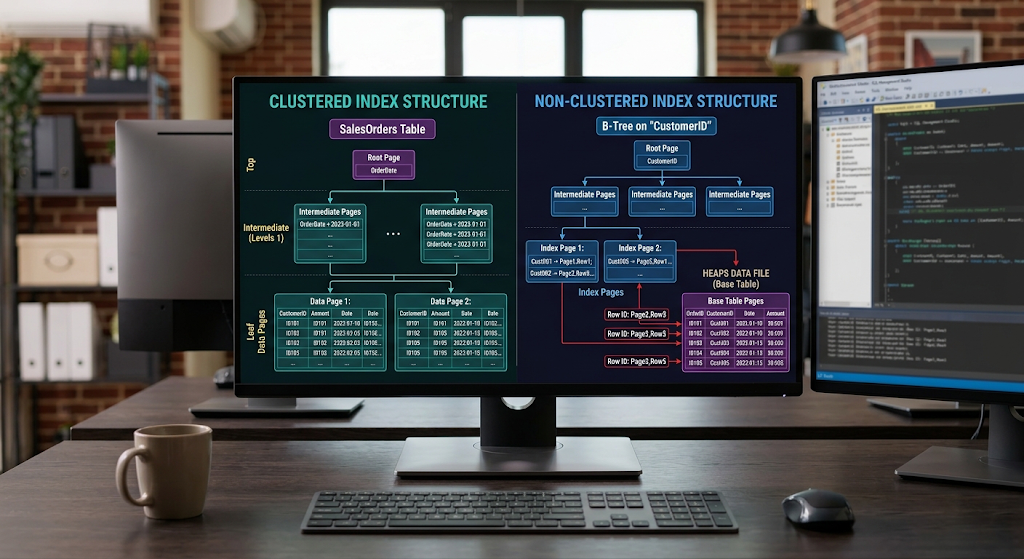
Depending on the physical or logical structure of the data in a table, an index can be clustered or non-clustered; there are differences between the various database management systems. For systems with a traditional clustered index, the clustered index is used to define the organization of the data in the table based on the key of the clustered index. The data in the table is often tied to the clustered structure, so that typically only one clustered ordering exists for a table. This can be useful for queries that often return ranges of data based on the column that is indexed, which is why clustered indexes can be useful. In some cases, for instance if an access path is designed to be an ascending identifier on an index, then the range can be efficiently accessed depending on the workload and database implementation.
A non-clustered index is stored in a structure separate from the data in the table and consists of an index value and other data used to identify the associated rows in the table. There can be multiple nonclustered indexes on a table, and each table can have multiple ones, each of which provides a different access path to the table for various queries. In Example, there could be different indexes on the Products table for ProductID, CategoryID and ProductName. The database optimizer can use the query currently running to determine which index to use. Non-clustered indexes are flexible, but they come at a price; the more indexes in the table, the more storage space and maintenance effort. Also, certain queries can cause the database to access more columns of the underlying table if there is a match for the query in the index, leading to extra data reads.
Indexing Strategies for Better Query Performance
The first step in effective indexing is to understand how an application is using its database. Instead of indexing all of the columns, developers should identify queries that are important, resource intensive, frequent, and slow, and which columns do they use to join, sort, group, and filter on? Depending on the database engine and workload, these types of columns might be ideal for equality conditions, range conditions, joins, and ordering. It is good practice to always index primary keys and sometimes columns with the uniqueness constraint, but extra indexes should be considered based on the specific access patterns. Optimizing a database is a continuous process as query workloads, data volume, application behavior and hardware and cloud environments can vary over time.
Useful for making sure that the database is designed correctly, or for evaluating indexes, execution plans indicate how the database will execute a query. Developers can see if a query is using an index, doing a table scan, an index scan or other operations like join and sort. An index that seems like a good idea conceptually may not be used if the optimizer decides that another approach is more cost effective. For instance, if a query retrieves most of the rows in a table, it is possible that sequentially scanning the table will require less work than scanning thousands or millions of individual rows using an index. These decisions also are affected by statistics kept by the database. Thus, good indexing is not just about making the indexes but about workload behaviour measurement, analysis of execution plans, changes testing, and post-deployment performance monitoring.
Covering Indexes and Selective Queries
Another concept of indexing that is important is that of covering index. An index is said to be covering for a specific query if it contains all the information necessary to satisfy the query and does not have to retrieve more columns from the table to answer the query. For instance, the CustomerID value may be included in a Customer index together with the required CustomerName and Status values, depending on the database system’s indexing capabilities, if CustomerID is often used in a query that requires CustomerName and Status. Preventing unnecessary table lookups can benefit the performance of more frequently-used queries. The disadvantage of adding more columns to an index is that it will make the index larger and cost more to maintain.
Another important criterion of the use of an index is its selectivity. As a result, a very selective column can have values that serve to distinguish relatively small groups of rows, and a column with few possible values might be less selective. For example, an index on a unique customer identifier is very selective, since only one record has a particular identifier. If ~50% of the table’s rows satisfy a query seeking one of two possible status values, a column that stores this status value might not be as useful for that query as an index would be. Not all low-cardinality columns should be removed from the index because the benefits of an index rely on the workload, data distribution, query, and database engine. The key is to look at how the table is used, and not at a universal rule.
Tradeoff between Faster Reads and Slower Writes.
While indexes may provide a significant improvement in read performance, they come at a cost. Additional storage is needed for each index, and the database must keep the index updated when the data changes. When a row is added, there are normally additional entries to be added to relevant indexes. If one of the indexed values is changed, then the database might have to alter the entries in the corresponding index. The index entries should be removed if the row is deleted. Therefore, a table with more indexes may need more time to write than one with just a few indexes, if those indexes are used correctly. This tradeoff is especially significant in applications that are performing many inserts, updates or deletes.
Another factor to consider is storage. If a large table already takes up a lot of disk space, and multiple indexes are added, they represent a significant amount of extra space. Furthermore, indexes can use memory or cache resources that can be used by the data in the tables, and these resources can be shared with other parts of the database. However, an over-indexing can have negative consequences or even cause performance issues with write-intensive workloads. Over-indexing, on the other hand, can lead to costly scans and slow queries. The idea is not to build as many indexes as possible but to build a sufficient number of indexes for the significant access patterns that match the needs of the application and do not incur too high a maintenance cost. This balance is the key to a practical database performance optimisation.
Common Indexing Mistakes
A frequent indexing error is the fact that indexes are made without regard to actual queries. While the optimizer may not use some indexes frequently, developers might assume that every column which is frequently searched should have an index. Another error is to develop more than one index that is highly similar for no specified reason. For instance, if the combination of two or more of the columns in a single index does not offer much benefit over a well-designed composite index, then it’s better to have the two separate indexes. Indexes can also be less effective as the applications might change but the indexing strategy is not. This database, which started with thousands of records, can end up with millions of records, altering the performance of what can be deemed as “acceptable” queries.
Another one is the lack of the monitoring of indexes after their creation. As a database system grows and new features are added, and as users grow in varied ways, database workloads change. An index value that is helpful at the time of application launch may not have as much value or even need as much to be helpful at a later time. Likewise, if an application update adds a new query to the database, it could reveal an index that was not added or it might need a different composite index. These changes can be picked up by monitoring tools, query logs, database statistics, or execution plans. The type of index maintenance procedure varies with different database systems, so it is advisable for the administrator to use the appropriate index maintenance procedure for his/her database system, not those of other systems as described above.
Importance of indexing in a Database
As data sets increase in size, the value of indexing becomes more apparent. A query that is good when there are 10,000 rows in a table may be quite slow when there are 10,000,000 rows in the same table—especially if the query needs to scan the entire table and applies further filtering or sorting. Indexes offer ways to get to the data in the database without doing work that isn’t necessary. These are just one part of a larger optimization plan that may also include query design, schema design, statistics, caching, partitioning, hardware resources and workload management. Optimization, says IBM, is a continuous process of tuning the execution, schema, storage, and indexing of queries; it’s not a one-time, one-off operation.
Scaling applications can also impact user experience and infrastructure costs if indexing decisions are made. The faster the queries, the less CPU, memory, and storage I/O will be needed for specific operations, and inefficient queries can be the cost of the unnecessary use of resources. But indexing should be done with caution as more indexes require more space and maintenance while updating/update inserting data. Hence, an indexing strategy for a scalable database must be appropriate to its usage. Slow queries can be periodically reviewed, index plans can be analyzed, index usage can be monitored and indexes that are no longer adding value can be deleted or modified. The goal is a balanced system that provides meaningful indexes for meaningful access patterns but doesn’t have unnecessary overhead.
Practical Example of Database Indexing.
Imagine an online shopping app where there are 10M orders in the Orders table. Often the application will retrieve all orders for a specific customer and then sort the orders by their purchase date. If the database doesn’t have the proper index, it might have to scan through a significant amount of the table, find out which orders the customer had in the table, and then sort. If the CustomerID and OrderDate columns are used by the query, a composite index may offer a better access path for this workload since it groups information around the columns accessed by the query. The database may be able to find the appropriate customer’s records and retrieve them in an order that minimizes further processing. The precise gain in performance will vary from one database engine to another, depending on the distribution of data, the specific query structure, and the physical storage environment.
Imagine that the application gets thousands of new orders each minute. The composite index needs to be updated whenever new order records are added. This leads to some extra write work for the index that aids in customer-order searches. The more additional indexes the application creates for reporting, filtering, searching and sorting, the more work the indexes may require when the application inserts and updates records. The database designer is thus faced with the need to take both sides of the load into account. An index that helps you with a lot of queries that need to return the data quickly could be worth it; an index that has very few queries and returns the data slowly may not be worth storing and maintaining. Testing and monitoring must be carried out to ensure that theoretical assumptions are not always reflected in actual production.

Conclusion
Database indexing is a technique that enables a database system to find information without having to scan all rows of a table over and over again. The different types of indexes serve different access and data-management needs, including primary indexes, unique indexes, and composite indexes, clustered indexes, and non-clustered indexes. The right index can help to eliminate unneeded scans, shorten query response times and keep applications responsive as datasets become larger. Meanwhile, indexes require space, and they need to be updated when records are added, modified or deleted. This is because increasing the number of indexes is not always beneficial. To do well on the database design, you should be familiar with how applications access their data, and choose indexes accordingly with the real-world data access patterns.
It’s best to start with the workload and make assumptions later when applying a practical indexing strategy. Developers can find significant queries, analyze the execution plan, analyze selectivity, review composite column order, see index usage, and measure performance before and after changes. They should also scrutinize indexing strategy as applications and datasets change as it may turn out to be the best access path for a small database that is not necessarily appropriate at a larger scale. With proper design and periodic review and tuning, indexes can be a valuable tool for creating databases that can retrieve data efficiently with reasonable performance, write overhead, storage, and scalability.