Introduction: Rising Role of AI in Medicine
Healthcare has always counted on accurate information, careful decision making, and timely treatment. As medical knowledge grows and patient data sets expand, health care professionals are presented with a great opportunity to analyze complex info quickly and efficiently. In to this enter artificial intelligence which is becoming to be the most important technology health care systems are using to overcome these issues. By using advanced algorithms, machine learning models and data analysis methods AI is able to put out issues that may not present themselves to humans which in turn causes better informed decisions to be made. From very early stage disease detection to which also improved patient care and medical research, AI is to change what we see in health care service delivery all around the world. Also, rather than to replace health care professionals, AI is put into use as a powerful support to which in fact increases human expertise and also in which it greatly improves the quality of health care.
AI in health care we see how technology plays a role in supporting health care professionals with large info sets at the same time which they put forth personal care plans for patients. As these systems grow and improve we see great opportunities for better health results but also bring up issues of privacy, security, fairness and ethical responsibility. It is important to grasp both the pros and cons of AI as health care becomes increasingly technology based. The use of AI applications in healthcare shows how artificial intelligence is becoming an important part of modern medicine and patient care.
AI in Early Diagnosis and Prevention of Disease
In health care one of the great values that artificial intelligence brings is that it supports early disease detection. Many diseases which include cancer, heart issues, and neurological disorders do better with treatment when they are caught early. Also we see that traditional diagnostic methods which play out as medical professionals going over symptoms, test results, and patient history report by report don’t scale. While doctors are still very much at the core of this process, AI systems are able to look at large scales of medical data in a short amount of time and to identify patterns which may be early indicators of illness. Also what we see with machine learning models is that they look at patient history, genetic info, lab results and lifestyle factors to put together pictures of health risk before symptoms really present. This in turn gives health care providers the ability to take preventative action and to develop treatment plans at an earlier stage.

AI based detection tools also do very well at identifying what may be hard to quickly diagnose. For example AI algorithms are able to see very fine details in medical data which may not come across during a routine exam. Also in many cases they are able to point out warning signs of disease before more traditional methods would. Early diagnosis in turn improves the success rate of treatment and also we see health care costs go down as we prevent complications and reduce the need for emergency care. But also it is very important that we very carefully test and put in place AI based diagnoses to see that they are indeed accurate, reliable, and also free of any bias which may favor certain groups of patients against others.
AI’s Role in Medical Imaging and Diagnosis
Medical imaging is a field in which artificial intelligence has brought about great change. In health care we see the use of imaging tools like X-rays, MRIs, CT scans, and ultrasounds which allow us to see inside the human body. What goes into interpreting these images is a great deal of skill and focus, also large numbers of scans may put a strain on medical experts. AI in this setting is a support which does very fast analysis of medical images, brings to the attention of issues which require attention, and also aids doctors in the identification of what may be abnormal. Also these tools play a role in improving efficiency by reducing the time it takes to go over the scans and at the same time they support the doctor during the diagnosis.
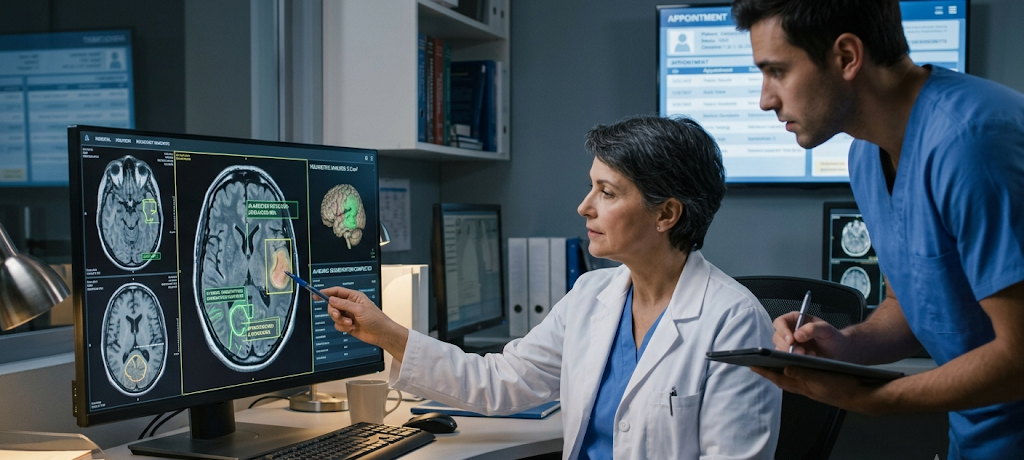
AI doesn’t take the place of radiologists or other medical specialists but rather functions as a resource which supports them in their work. For instance AI in image analysis is able to recognize patterns which are associated with certain diseases and to point out areas that may require more in depth study. Also we see this support as very valuable in health care settings which have a low specialist to patient ratio or very high patient volume. By the combination of human medical expertise with what AI brings to the table health care teams are able to produce more reliable results. At the same time it is also true that medical imaging AI systems must be trained on large sets of varied high quality data which in turn will make them more effective for different groups of patients and medical issues.
AI in the World of Drug Discovery
Developing new drugs is a very complex, very expensive, and time intensive process which in the past has taken many years of research and testing. AI is playing a role in transforming drug discovery by way of researchers analyzing bio information, predicting how what we put forward as potential medicines will do in the body, and identifying which ones are the most promising. AI models which we feed in large data sets of info on molecules, diseases and present treatments are in turn used by scientists to put forth better drug options faster than we have in the past. This in turn reduces some of the issues present in pharmaceutical research and we see the introduction of new solutions for diseases which up to now have had few to no treatment options.
AI also plays a role in the development of personalized medicines by looking at what differentiates one patient from another. We see that people react in diverse ways to the same treatments which is why we look at genetic info and health history of a person to help in the design of very targeted therapies. AI based solutions allow researchers to study very complex bio relationships and to look at treatment options which may have been out of question with traditional methods. While AI does speed up research it is the human element which still is required to validate results, run clinical trials, and see to it that the new drugs meet safety criteria. The mix of AI tech and science know-how has the tendency to make drug development a faster process at the same time which in turn improves the quality of what we put forward in health care.
Virtual Health Aides and Better Patient Care
Artificial intelligence is also transforming the way patients interact with health care services via virtual health assistants and digital support tools. We see in these AI powered systems a growth of patient centered care which includes appointment scheduling, drug reminder services, health info access, and communication with health care providers. Also virtual assistants are growing in value as they provide quick responses and enable patients to get support outside of the traditional health care setting. Which also benefits the people living in health care resource poor areas or patients with chronic health issues that require regular follow up.

Beyond what is a basic communication function, what we see from today’s AI assistants is that they also do analysis of the information patients put out and in some cases that may be cause for professional attention. For example these tools look at health trends, collect on symptoms and support remote health care services. They play a role in the growth of telehealth by which health care is more accessible. But also it is important as we go forward that virtual assistants be designed with great care to present accurate info and to not create confusion around medical decisions. At the end of the day the professional health care provider should still be the go to for diagnosis and treatment but rather the AI tools will serve as an add on which improves health care access and also the lines of communication between patient and health care professional.
Improving Quality of Care, Effectiveness and Personalized Treatment for Patients
In the field of health care a great benefit of artificial intelligence is that it improves accuracy and efficiency. Health care providers deal with large sets of info which include patient records and reports, research data and treatment protocols. AI systems are able to sort and study this info which in turn helps doctors to base their decisions on in depth insights. Also by performing routine admin tasks AI enables health care staff to put in more time into patient care. This improved efficiency which in turn helps health care systems to better manage growth in patient numbers while at the same time upholding high service standards.
AI also in the field of personalized health which sees to it that medical professionals design very individualized care plans for their patients. Instead of the same treatment for all which is what we see in a one size fits all approach we see an analysis of genetic make up, life style, medical history and past treatment results. This personalized care approach does improve results of the treatment and at the same time see to it that we do not have unnecessary procedures. But to see through this we require careful roll out, continuous assessment and a partnership between tech experts and health care professionals. Also AI should be looked at as a resource which supports health care workers’ decisions which in turn support patients’ care rather than a substitute for the skill, judgment and care which health care professionals bring to the table.
Privacy, Security, and Ethical Issues in Health Care AI
Despite that which is presented as the many benefits of AI in health care it also brings up very important ethical and privacy issues. Health care institutions collect very sensitive info which includes medical history, genetic material, and personal health records. As AI systems go through this info what we see is a great need for strong security measures to protect patients from out of the question access, misuse, or data breaches. In terms of patient trust, health care organizations do well to be open about how AI tools collect, store, and use medical info.
Another issue is that of fairness and bias in AI which is very present in our discussion. AI grows from what it is given in terms of data which in turn may be of poor quality or incomplete. If some health groups are left out of what is used to train the models then we see that AI may not do the same for all. Health care providers and developers must put in effort in the responsible development of AI by which we mean very careful testing, improving the diversity in data we use, and we must keep the patient’s best interest at heart. We also must have in place ethical guidelines which will in turn guide AI to play a positive role in health care and not create new issues of inequality or risk.
The Future of AI in Healthcare
In the years to come we will see greater tech and human collaboration in the field of health care which is an element of artificial intelligence’s growth. As AI improves we may also see it play a larger role in preventive care, medical research, diagnosis, and health care for the patient. Also we can expect that health care will use AI to do with the continuous monitoring of health issues, early prediction of medical issues, and the provision of very personal treatment options. In which we also include that these changes will make health care more of a pro active, efficient and accessible resource for people all over the world.
However we see that AI in health care is based on responsible adoption. Technology must put out with great care to accuracy, privacy, security and ethical issues. Health care providers, researchers, policy makers and technology developers must work together to put out systems which better the patient’s case as we also address out there which problems may present itself. AI is a great chance to improve health care. We do see also in that which the greatest value comes from the combination of technical innovation with that of human compassion, professional knowledge and a commitment to better health care results.
Conclusion: An Age of Intelligent Health Care
Artificial intelligence is redefining health care through better disease detection, medical image analysis, drug development, and patient care support. What AI can do with a great volume of data and identify the key patterns enables health care providers to make quicker and more informed decisions. From early stage diagnosis to virtual health assistants AI is playing a role in developing a more efficient and personalized health care system.
At the same time as we see the growth of AI we must also pay attention to issues of privacy, ethics and fairness. Health care in the end is about improving people’s lives which technology must do so responsibility. As AI grows and changes its role in medical care will039; grow also which in turn will present new opportunities for better prevention, treatment and patient care. The future of health care will not see machines take the place of man but will be in the care of a partnership between high tech and the know-how, empathy, and judgment of health care professionals.