Introduction
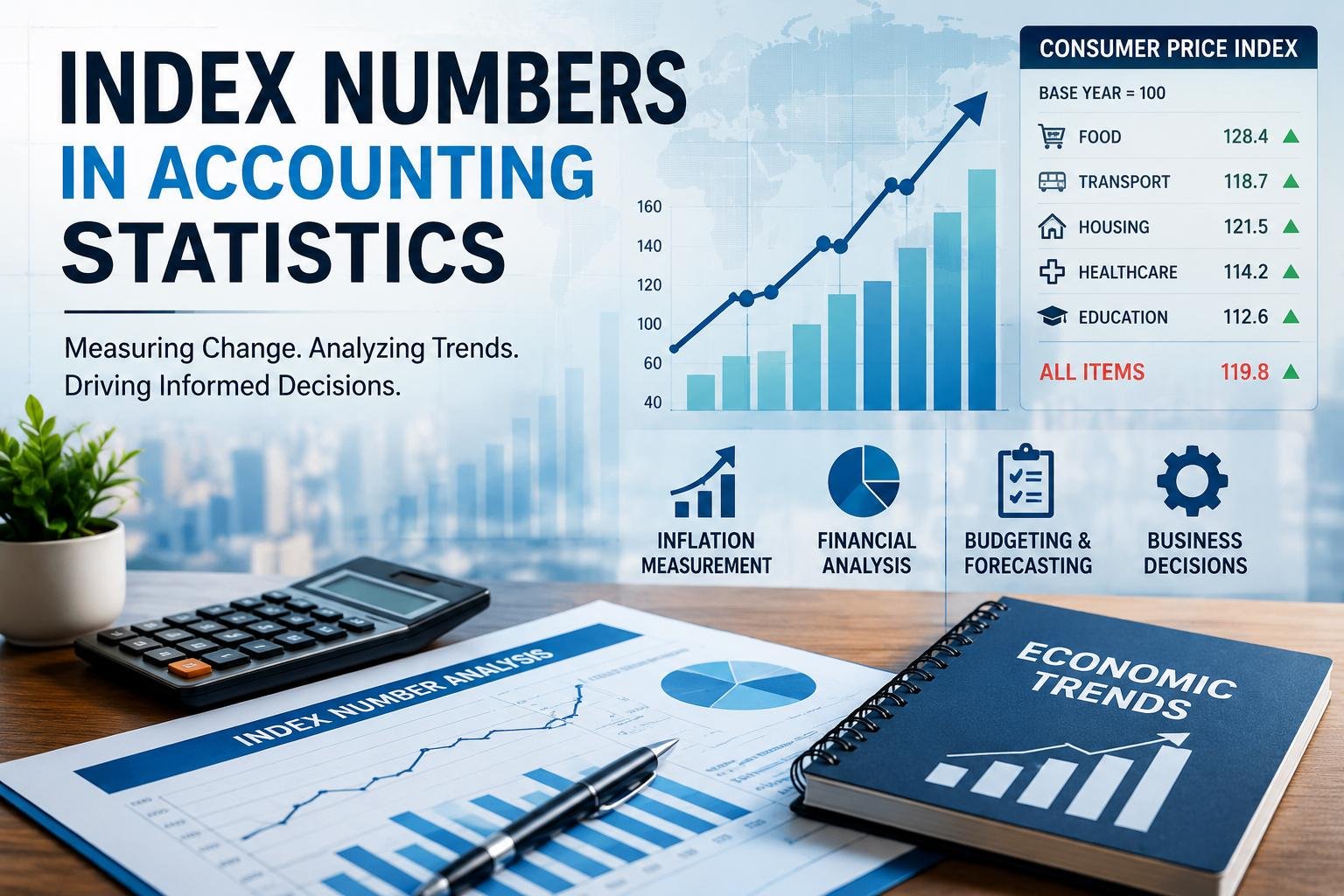
In the field of accounting and economics businesses and governments are constantly dealing with variable prices, changing market conditions, and different types of economic activity. These changes a challenge in the comparison of financial information from one time period to another which is present why we have reliable statistical tools which we use to determine the differences. The primary tool we use for this is the index numbers in accounting statistics. Index numbers help accountants, economists and business managers to see how economic variables change over time. Also they take what is at times very complex financial and economic data and present it in a very simple numerical form which is easy to interpret and compare.
Index numbers are very much used in accounting statistics which they use to determine inflation, purchase power, production levels, market performance, and the value of goods and services which in turn we see play out in the business cycle. In that regard companies use index numbers to study financial trends, put together budgets, see past year’s profit which in some way helps them to do better economic decision making. Also we see that governments use index numbers in the formulation of economic policies and in the evaluation of national performance.
During times of inflation or economic instability the role of index numbers is very much brought into focus. When there is continuous raise in prices the value of money changes so that it is hard to tell what a real increase in income or profit is and what is due to inflation. In such cases accountants use index numbers in financial analysis which they in turn use to present a more accurate picture of how a business is performing.
Meaning of Index Numbers
An index is a statistical tool which reports the relative change in value of a set of variables over time. We choose a base year which is given a value of 100. Other years’ data is then put in relative terms to the base year which also determines if we had growth or decay.
For instance if the price index of a product goes up from 100 to 120 that is a 20 percent increase from the base year. Also should the index fall below 100 it is an indication of value which is less than that of the base year.
Index numbers are important tools in this context as they don’t tell the whole story which raw data does. A company may report growth in sales from one year to the next, but until you factor in inflation and variable market conditions that growth may not necessarily mean the company has improved their performance.
Characteristics of Index Numbers
Indices also have features which make them very useful in accounting, statistics and economics.
- Relative Measurement: Index numbers are of relative terms not absolute. They report on percentage growth or decline over time.
- Use of Base Year: Every year which is used as a base is the normal one which does not include atypical economic changes.
- Simplification of Data: Index numbers present a large set of statistical data in simple terms.
- Comparative Function: They allow for the comparison of economic and financial performance across different time periods or regions.
Types of Index Numbers
There are various types of index numbers based on the info they measure.
Price Index Numbers
Price index values show the variation in the cost of products and services over time. Also they are the most used type of index numbers in economics and accountancy.
Examples include:
- Consumer Price Index
- Producer Price Index
- Wholesale Price Index
These are the measures which report on inflation and changes in the cost of living.
Quantity Index Numbers
Quantity indices report changes in the scale of production, sale, or consumption of goods.
Examples include:
- Industrial production index
- Agricultural production index
- Export quantity index
Businesses use quantity indices to measure productivity and performance.
Value Index Numbers
Value index numbers present changes in the total monetary value of goods or services. They include changes in price and quantity. These are also used for analysis of sales performance and revenue growth.
Importance of Index Numbers in Accounting
Index values are very important in accounting as they enable organizations to accurately interpret financial data.
Measuring Inflation
Index numbers also play a key role in the measurement of inflation. By which we mean that over time we see a sustained rise in the general price of goods and services. Accounting professionals use price indices to measure inflation rates and also to see how inflation is affecting business performance, wage growth, and purchasing power.
Financial Statement Analysis
Inflation distorts financial reports which present assets at historical cost. Money value changes over time which in turn means that which we recorded years ago does not reflect present economic reality. Accountants may use index numbers for better accuracy and comparability.
Budgeting and Forecasting
Businesses apply index numbers in preparing realistic budgets and financial forecasts. As prices and costs fluctuate regularly index numbers which in turn help managers predict the future expenses and revenues. For instance, if inflation sets in businesses may put more into transport, labor, and raw materials.
Wage and Salary Adjustments
Organizations which present see fit to change employee salaries at the time of fluctuation in the cost of living. Price indices report that which in turn may trigger a rise of the wage in an effort to keep up with inflation. In wage negotiations governments and labor unions also use index numbers.
Business Decision-Making
Managers which in turn use index numbers for key decisions related to pricing, investment, production and expansion. If a market index reports that a sector is in decline companies may cut production or try out new strategies to stay competitive.
Methods of Calculating Index Numbers
Different methods are used to calculate index numbers.
Simple Aggregate Method
This present method looks at total price and quantity of chosen items between the current period and base period. Although we can do it easily at times it may not always present accurate results which is because all items are treated the same.
Average of Relatives Method
In this study we report first on the percent change of each item which we then average. This approach produces more balanced results compared to the simple aggregate method.
Weighted Index Method
The weighted index system gives out greater importance to some items than others.
Examples include:
- Laspeyres Index
- Paasche Index
- Fisher’s Ideal Index
Weighted measures are used as they determine that some products and services are of greater value than others.
Consumer Price Index and Its Importance
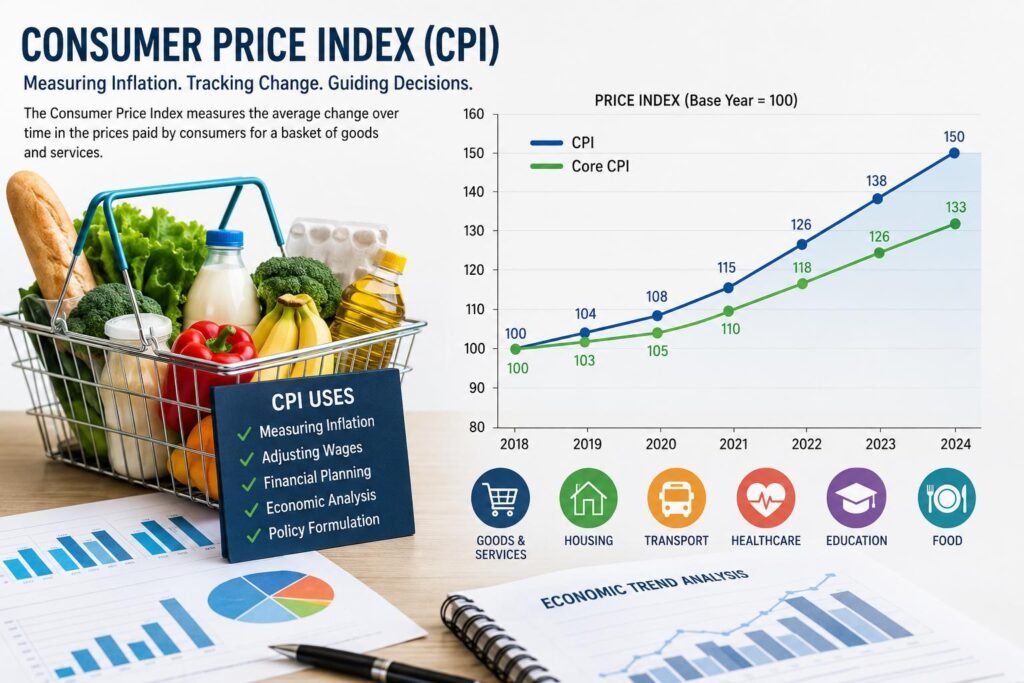
The Consumer Price Index is the most used price index in that which we account and which which we see in economics. It reports on the variation in price that consumers see for a group of products which include food, transport, housing, health care, and education.
Uses of the Consumer Price Index
- Measuring inflation
- Adjusting wages and salaries
- Preparing inflation-adjusted financial statements
- Evaluating purchasing power
- Forecasting future expenses
Businesses and governments pay close attention to the Consumer Price Index which reports on changes in the cost of living.
Index Numbers in Economic Analysis
Economic indicators are used by most in the field of economics to study out to what degree national and international economies are doing.
Measuring Economic Growth
Production indexes which are used to measure industrial and agricultural growth. Also governments use these statistics to report economic progress.
Monitoring Living Standards
Cost of living indices assess changes in household welfare and living standards.
Policy Formulation
Governments use inflation and production indicators in the design of fiscal and monetary policies.
Central banks also look at inflation indicators prior to changing interest rates.
International Trade Analysis
Indexes of trade performance are used to compare export and import between different countries and over time. They play a role in trade balance and international competitiveness.
Advantages of Index Numbers
Index numbers present a number of advantages in accounting, statistics and economics.
- Simplification of Complex Data: They present large sets of economic info in simple terms.
- Easy Trend Analysis: Index numbers are a tool for tracking long term economic and financial trends.
- Better Financial Comparisons: They improve comparison across fiscal years.
- Improved Decision-Making: Managers and policymakers rely on index numbers for economic and business decisions.
- Support for Economic Planning: Governments use index data in national planning, budgeting and policy development.
Limitations of Index Numbers
Although they are useful index numbers also have issues.
- Dependence on Base Year: If the base year is out of the ordinary the index may produce misleading results.
- Changes in Consumer Habits: Consumer tastes change over time which in turn may reduce the accuracy of some indices.
- Difficulty in Assigning Weights
- Selecting the right weights for goods and services is difficult.
- Data Collection Problems: Quality of index numbers is a result of accurate and complete data collection.
- Approximate Measurement: Index numbers give approximations instead of precise values.
Practical Applications in Accounting
Accountancy professionals use index numbers in many fields.
- Asset Valuation: Businesses use price indices for valuing assets at current replacement cost.
- Inventory Management: Indexes of prices and cost are used by companies to track inventory.
- Revenue Analysis: Organizations compare sales over time via value indices.
- Cost Control: Businesses use price indexes which in turn help to identify increasing costs and improve operational efficiency.
- Investment Analysis: Financial market experts use index numbers to assess investment performance and economic conditions.
Technology’s role in Index Number Analysis
Today’s accounting software and statistical tools have improved the calculation and analysis of index numbers. Businesses today use digital tools for collection of economic data, preparation of reports, and tracking trends in real time. Also we see that advanced tech like artificial intelligence and big data analytics which in turn improves the accuracy of economic forecast and financial analysis. Technology has improved the speed and reliability of index number analysis which is also true for organizations all over the world.
Conclusion
Index numbers are out of which are the key statistical tools in accountancy and economics that we use to determine the variation in prices, production, inflation, and economic performance over time. They also put in a simpler form which in turn makes it easy to compare economic performance at different times.
In the field of accounting statistics index numbers are very much used in financial statement analysis, inflation adjustment, budgeting, forecasting, wage determination, and investment analysis. They also put at the disposal of businesses and governments accurate economic information which in turn is used to make informed decisions.
Although there are issues with index numbers it is still the case that the benefits outweigh the drawbacks. As economies grow and financial systems become more complex the role of index numbers in account and economic analysis will see great growth. By understanding what index numbers are and how they work accountants, economists, and business managers are able to better interpret financial info and in turn make better informed strategic choices for the future.’
Get more well researched information about Index Numbers in Accounting Statistics here.