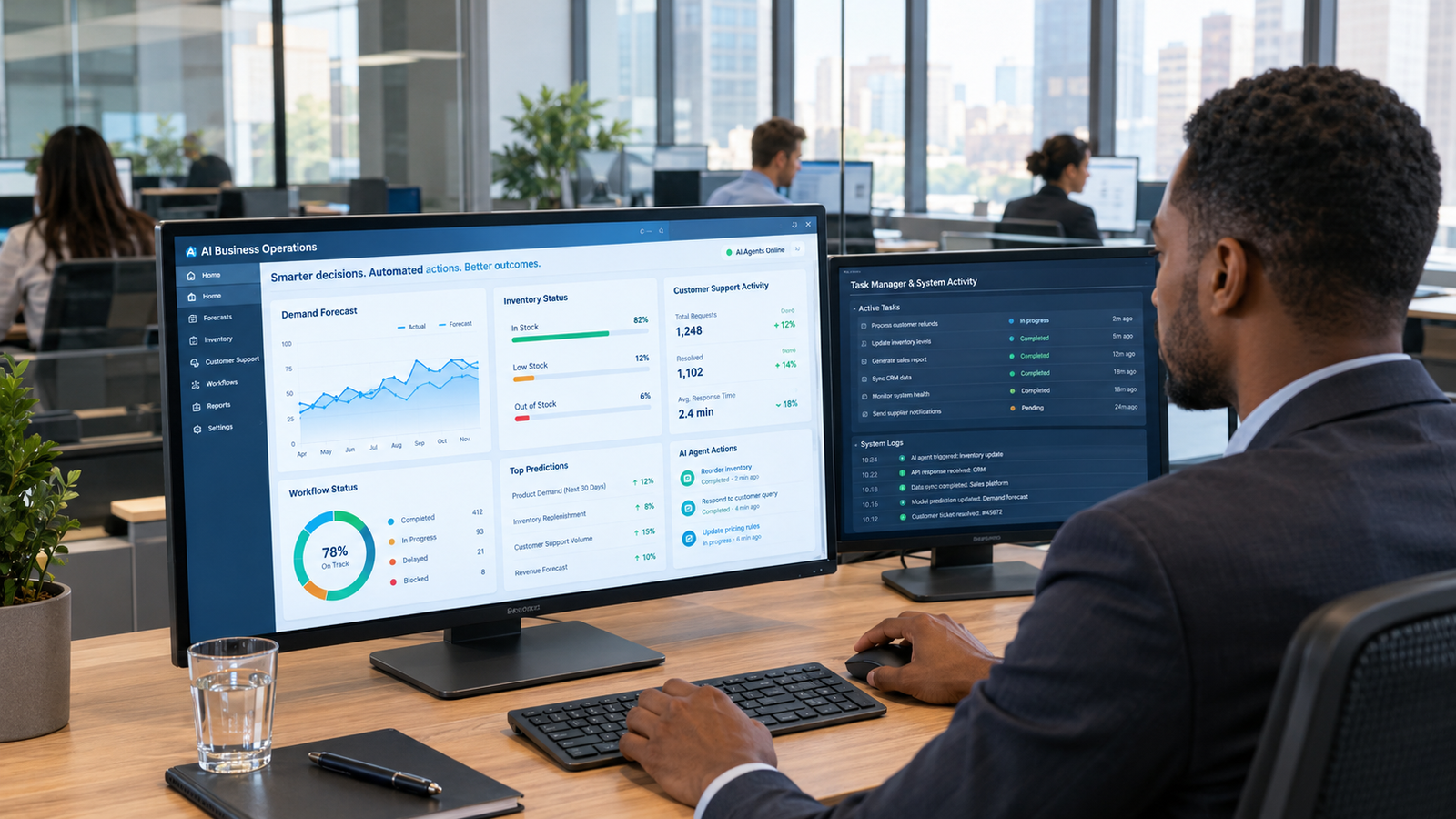
AI agents and machine learning are transforming what businesses do with information, how they make decisions and which tasks they outsource to computers. In this shift we see two key players, machine learning and AI agents. Machine learning which is at the base of it all enables systems to identify patterns, to improve from use and to put out predictions. At the same time we have AI agents which in addition to what machines can do also include instruction sets, memory and software tools to achieve very specific results.
Although we see them as a team, these technologies have separate roles. We may have a machine learning model that puts out information on what customers will want, and a separate AI agent which then looks at our stock levels, checks up on our suppliers’ information, and puts out a purchase order. Out of that comes the idea that as we implement smart systems which tie these things together we see how they automate processes, adapt to change, and support human decision making.
AI Agents and Machine Learning
Machine learning is a field within artificial intelligence that has computers identify from data the patterns they then use in making decisions or classifications. It is the force behind such things as fraud detection, recommendation systems, demand forecasting, and language processing. Also instead of putting in manual rules based programming we see machine learning models which identify relationships in given examples and then in turn apply what they have learned to new information.
An AI agent is what we term a system which puts forth to achieve a goal by way of interpreting info, Companies may use AI agents for document processing, report preparation, task assignment, and approval coordination. A machine learning model may extract information from an invoice, compare it with a purchase order, identify missing details, and pass the file along for approval. By combining AI agents and machine learning with automated accounting workflows, businesses can explore ways to reduce repetitive administrative work, improve consistency, and organize financial processes more efficiently. Large financial transactions and important business decisions should still follow appropriate approval procedures, supported by activity logs and verification checks to maintain accountability.
How Machine Learning and AI Agents Interact

Machine learning gives AI agents the ability to process information and to put forth which results are most likely. Language models which interpret instructions, classification models that put requests into categories, and forecasting models which project future demand. The agent in question uses this data to determine its next move which it carries out based on its instructions and what it is allowed to do.
In most cases what we see is that a traditional machine learning model puts out a result, whereas an AI agent uses that result to complete a larger task. For instance an inventory model may report that a product is going to run out of stock. An AI agent in this case would check present inventory, look at supplier delivery times, and put together a stock up request. This in turn transforms predictions into doable actions.
AI Agents and Machine Learning in Decision Making
1. Gathering and Analyzing Information
AI agents start out by gathering information from customer messages, databases, business reports, and software logs. We have machine learning models which help them to identify relevant details, understand language, classify requests, and recognize patterns. For instance a customer support agent may determine that an issue is related to a refund, delivery delay, or technical problem which in turn determines how they will proceed.
Accurate translation is key for in this stage any error is carried through into every other action. We see that with incomplete reports, put forth information that is not true, or vague directions which cause a machine to misinterpret a task. Also we notice that machines which do well are those that check in with reliable sources of information and ask for more information when needed instead of going on what may be a faulty assumption.
2. Presenting Choices and Acting Upon Them
After an issue is presented to the AI agent it determines what action to take based on the machine’s goal, what information is at hand, and what the rules of operation are. Support agents may field an easy query from the user, look up an order history, or pass along an in depth issue to a human rep. Machine learning plays a role in the issue analysis which in turn determines the response and also which set of instructions and business rules apply to which situation.
In many cases we see tasks which require a series of decisions and also put forward competing priorities like cost, speed, accuracy and security. Also agents may use planning tools to put actions in order and change their strategy as new informationcomes in. But also in this that agents don’t always get it right we see that which is why we value clear defined constraints and proper human supervision.
3. Using Technology to Perform Tasks
AI agents have the ability to use software tools in performance of tasks. What they are allowed to do varies by permission but may include searching databases, updating records, generating reports, retrieving docs, or communicating with other apps. For example an agent looking into a late shipment may get order info, check tracking details, and put together a report for the customer.
Tool access is a must to control. We see that which agent has the go ahead to get customer information may not also have the permission to delete records or make payment approvals. What businesses should do is to put in place access restrictions, verify important actions, and require human input for large scale decisions. Also agents should see that an operation really did what it said to do before they report back that a task is done.
4. From what we learn and adapt to it
AI agents’ actions may change in response to variable circumstances and at the drop of new info. They may bring in updated policies, use relevant past task data, look at past results, or rework plans when an action fails. For instance an agent may follow a new return policy without going through a full retraining of its machine learning model.
Some systems also improve with supervised feedback, fine tuning, or retraining on verified examples. But at times inaccurate feedback may introduce new issues. For effective adaptation to take place we require solid information, performance monitoring and testing which in turn has to prove that changes do in fact improve results rather than enforce mistakes.
Key Components of AI Agents
- Machine Learning Models
Machine learning models are used for agents to classify info, predict results, recognize patterns, and interpret language. In the same system different models may perform specialized functions which in turn allow an agent to put together their results when making decisions.
However at times models put out incorrect results or biased reports. Agents to check in with trusted sources for key results and also to pass on that which is uncertain. The quality of the model, the training data used, and the environment in which it is run all play a role in performance.
- Instructions and Memory
Instructions set the what and how of an agent’s tasks, duties, and also the parameters of those it works within. Memory in an agent is of the past relevant information related to a task, past actions, or what is to be the agent’s guide in action. As a result these elements allow an agent to hold context throughout the completion of many steps.
Memory is a precious resource which we must handle with care as out of date and inaccurate information may lead to poor decisions. Also it is the role of organizations to protect sensitive data, put in place retention policies, and see to it that external inputs do not override the trusted information.
- Planning and Verification
Planning is a tool which breaks down a task into doable steps, also it is a way to prepare for issues which may come up. Verification is the action of checking that what we wanted to achieve was in fact achieved. In the case of a software development agent which looks at code, puts forth a change, runs tests, and reports back on the results.
Without proof an agent may report that it has finished a task. Trustworthy systems which also are reliable set out clear success indicators, limit what is tried again and also break off from processes which are out of the system’s scope.
Uses of AI Agent and Machine Learning
- Customer Support Automation
AI systems which may answer customer issues, find out the needed info, and respond with what is in agreement with our company’s policies. Machine learning which identifies what type of request it is and software which integrates to check orders, update support tickets, and get account information.
Human reps are still key in issues of very private nature, at which point of time which automation fails to help out of also for which which is out of the ordinary. Also we see that companies should pay attention to the accuracy of auto responses and put in place an easy way for the customer to get through to a person when that auto assistance is not enough.
- Business Workflow Management
Companies may use AI agents for document processing, report preparation, task assignment, and approval coordination. A machine learning model may extract information from an invoice, compare it with a purchase order, identify missing details, and pass the file along for approval. By combining AI agents and machine learning with automated accounting workflows, businesses can explore ways to reduce repetitive administrative work, improve consistency, and organize financial processes more efficiently. Large financial transactions and important business decisions should still follow appropriate approval procedures, supported by activity logs and verification checks to maintain accountability.
These systems do what is to reduce repetition and improve consistency. Also large financial transactions and key business decisions should go through the proper approval processes. Activity journals and verification checks into which organizations do to maintain accountability.
- Cybersecurity Monitoring
Machine learning tools report on atypical network action, risky login attempts, and possible security threats. AI agents look into alerts which includes gathering relevant logs, checking in with trusted security sources, and preparing incident reports.
Automatized responses have to be very much in control which is so that it may not look like a legitimate action is a breach. Security teams put in the work of limiting access, which they do also in the issue of looking into what appears to be important issues, and also they see to it that large scale action which may put at risk our basic services has approved go ahead.
- Inventory Planning
Machine learning algorithms we use to predict demand which we base off of past sales, seasonal trends, and other related data. An AI system puts that information together with present stock levels and supplier information to put forth replenishment recommendations or to alert purchase managers of possible stock out issues.
Unexpected fluctuations in demand and issues with inventory records which we have seen play out in the past. We put in spending limits, we go with certain suppliers only and we do regular forecast reviews which in turn help us to avoid unnecessary purchases or stock outs.
- Software Development Assistance
AI systems which developers use to improve their issue tracking, code analysis, correction of defects, and error research. They put machine learning into development tools for better task organization and solution evaluation.
However in some cases generated code may have bugs or security issues. Developers should look at key changes, run auto tests, and do a security review before going live with updates. AI tools may speed up the development process, but they do not take the place of engineering skill.
Benefits of AI Agents
AI systems are able to perform repetitive tasks, see through processes for greater consistency and also enable organizations’ use of information more so. Also they which in turn put together machine learning with software tools are able to integrate various actions into a seamless flow which may otherwise have required workers to go between apps and do manual work.
They can also see which patterns emerge, put information into order, and respond to routine queries out of core business hours. Also it does depend on you having good data in the first place, proper system design, and also very good monitoring. Automation may also spread error wide scale if a machine is put into action without sufficient protection.
Limitations and Risks of Autonomous Decision-Making

- Accuracy and Reliability
AI systems at times may misinterpret instructions, use out of date info, or put out wrong results. When these errors play into a series of related actions a small issue may blow up into a large scale operational issue. Regular testing and independent review helps to identify these issues before they cause serious damage.
Organizations can track task completion rates, error frequency, and cases which require human intervention. Also agents should identify when they do not have the ability to perform a task reliably and ask for help.
- Security and Privacy
AI agents can access private records and business applications. We see that overprivileged access, unsecure integrations, or malicious codes in external content put systems at risk. What we recommend is that organizations implement the principle of least privilege, secure auth, input validation, and also put in place proper data protection.
High impact actions will have in place extra safeguards which include spending limits, approval requirements, and activity logs. Also of great importance is security testing and regular permission reviews as agents gain access to more tools.
Human Oversight
AI systems don’t always see the full picture of their actions. What to put in the queue for the machine and what to have a human look at is a decision businesses have to make. For some tasks which are routine and low risk minimal oversight may be required, but for issues related to finance, private customer info, and security we may need to do more due diligence.
Accountability is a key element. We see to it that which parties will monitor the system, which will look into failures, and which will put the break on its operation is identified. Human input into the process is required to make sure that as we automate we do not remove the element of judgment which is important in difficult decisions.
Top Tips for Developing Reliable AI Agents
Building out reliable AI agents is a function of setting clear goals, choosing proper machine learning models, and which tools the agent has access to. Developers also should test in the real world which may include when we have incomplete info, unexpected inputs, and tools which fail. Also using machine learning in combination with structured rules does well for tasks which require very exact steps.
After going live, we see what the performance is and also look into errors which in turn we will update relevant information and test out large scale changes. Human reviewers must have easy options to correct errors and to also stop unsafe actions. These actions in turn help companies to get value from automation yet at the same time have control over key decisions.
The Future of ML and AI Agents
AI as a field is going to see growth in which machines learn better and we see more connection of these models to business software. Also we will see large scale integration of specialized agents which will do research, analysis, planning and run approved processes within a bigger system. Also we will note that these trends support complex tasks in business, education, cyber security, and software development.
Also we see that greater autonomy brings up issues of security, accountability, and reliability. Organizations will have to look at what agents can do but also that they do tasks as they are supposed to and very safely. For us to progress in this we think that technical betterment must be put forth with responsible application and meaningful human supervision.
Conclusion
AI agents through machine learning interpret data, evaluate options, and support decision making. They put together models with instructions, memory, planning, software tools, and feedback which in turn enables them to automate customer support, business processes, cybersecurity, inventory management and software development.
Despite that which is good about them, AI systems may put out errors, present sensitive information at the wrong time, or do improper actions when they are poorly designed. In terms of reliable automation, what we see is that it is required to have very clear objectives, secure access, proven results, continuous monitoring, and human supervision. When that is done in which those protective measures are in place then indeed we see that AI agents may help organizations to run more efficiently also which at the same time puts large decisions in an account and under the right control.