Introduction
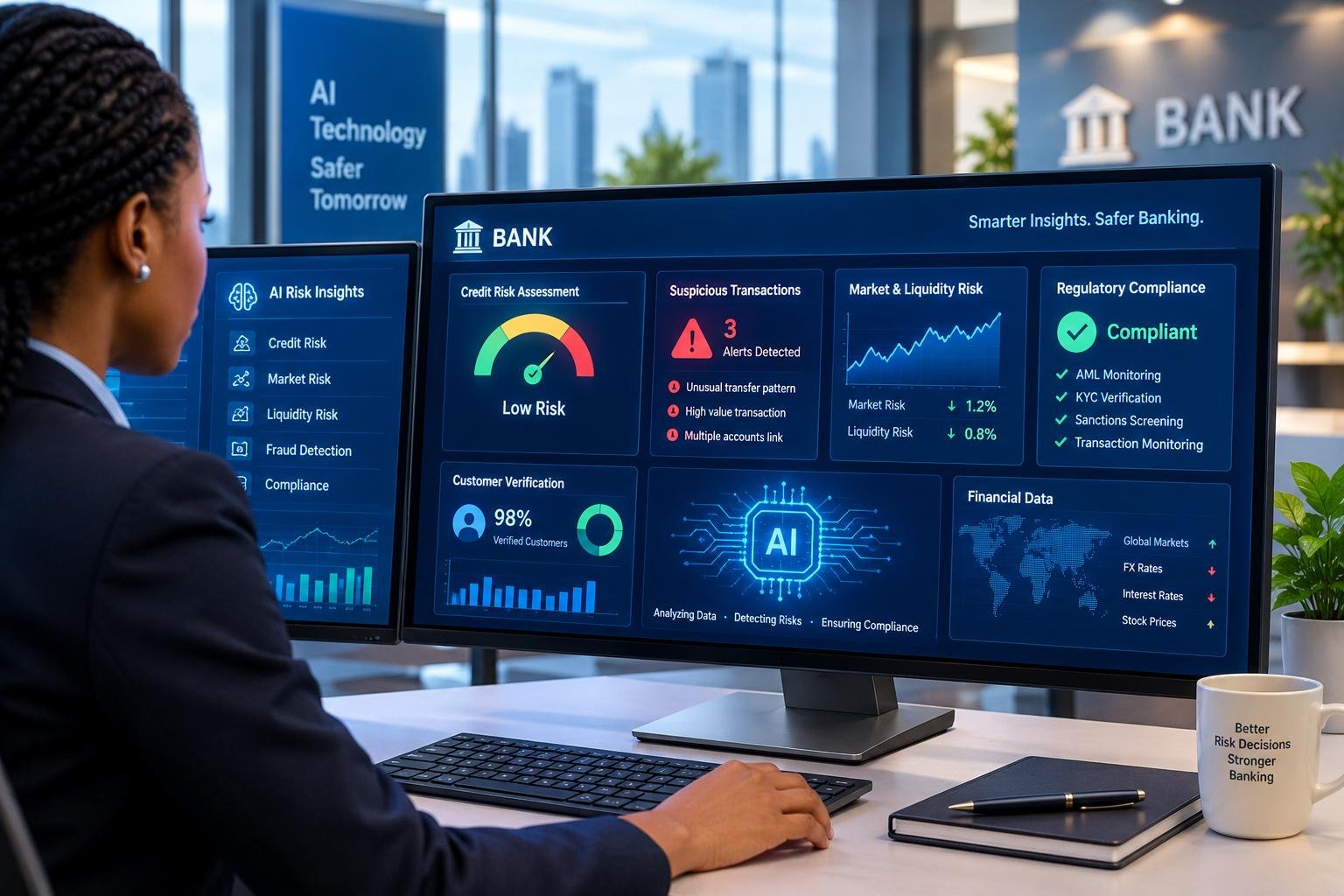
Mobile payments and online financial services are still in the midst of expansion, and will prove to be serious threats to financial fraud for banks and other financial institutions. Money and personal customer information are stolen in a number of ways such as stolen identities, phishing messages, fraudulent transactions and sophisticated scams. While a regular security system will function, it may provide little ability to detect the more sophisticated fraud schemes in a timely fashion, particularly if fraudsters come up with new schemes. One more advanced approach is the application of Artificial Intelligence (AI) which can analyze transaction data, identify any suspicious transactions and assist with immediate action on threats. The understanding of how AI can aid in phishing detection also shows the ability of intelligent systems to detect digital threats before they can get to customers’ accounts. Last but not least, financial institutions can benefit greatly when employing machine learning, behavioral analytics and automatic monitoring to enhance fraud protection and minimize financial losses and customer protection.
Fraud Prevention using AI
AI Fraud Detection involves leveraging smart computer systems to detect, analyze, and thwart transactions that may be considered fraudulent in terms of finance. All of these systems examine tons of information, payment locations, gadget details, logon routines, account histories and much more. The traditional security rules can only recognize patterns that are potentially suspicious, but AI models can learn from previous cases and recognize patterns that might be suspicious. As more data is fed into these models, they can learn and adapt to become more effective at recognizing legitimate versus possibly fraudulent transactions. But, AI is not infallible, and not all odd transactions are necessarily fraudulent. Instead, it will identify the risk level, identify red flags and help banks to decide if further verification and investigation and/or intervention are required for specific activities.
How AI detects Suspicious Transactions in Real Time?
1. Real-Time Transaction Monitoring
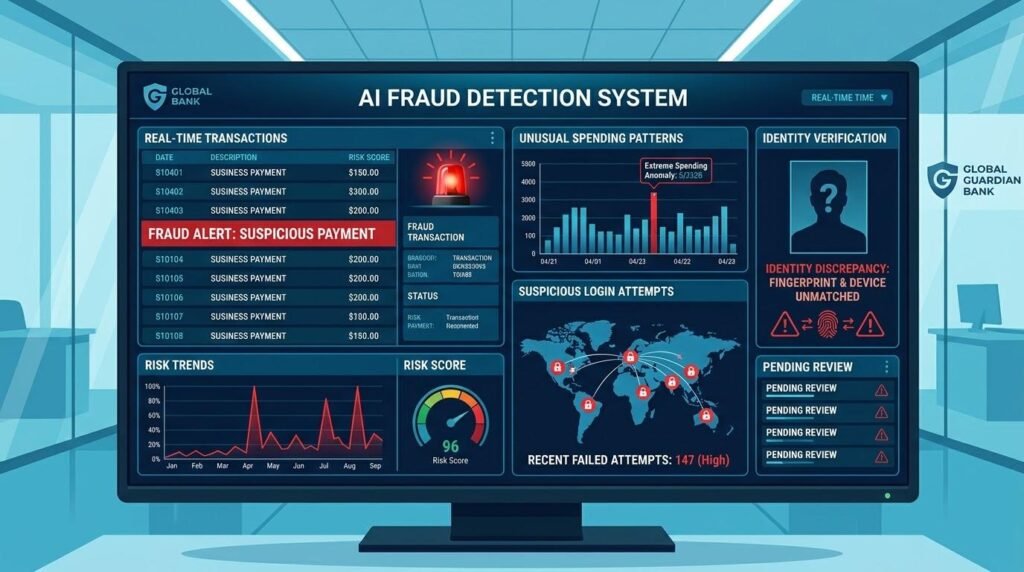
Real-time transaction monitoring is among the top uses of AI in banking security. The customer has access to an intelligent fraud detection system that collects the data related to the transaction such as the account, device, location, and payment history – and uses it to analyze the data to determine if the transaction is fraudulent. The system can give a more separate transaction a higher risk score, and instigate further security checks if the transaction does not behave the way it should. In some instances, an unusually large transfer to a new beneficiary could be flagged when it is made immediately after a new and unknown device accesses the account, for instance. Depending on the security policy of the bank, the transaction may be temporarily paused, rejected or requested to confirm with the bank. Rapid assessment will help banks to take timely action to prevent loss of substantial funds as a result of suspicious transactions.
2. Analyzing Behavior and Detecting Anomalies
Behavioral analytics allows AI systems to learn customers’ common usage habits of their financial accounts by analyzing their behavior. Common amounts, number of transactions made, product that is being bought, login times, device usage and payment history are all things the system can review. Anomaly detects activities that don’t comply with these patterns. For example, a customer that typically would take a small local purchase may start several big purchases in various locations, in a short period. This activity may be a sign of an account compromise or stolen card. But unusual is not always illegal – the customers can change their spending habits, get to their stores and purchase high-dollar items. As such, AI helps banks detect unusual activity by analyzing a banker’s pattern of transactions rather than just the difference, and minimizes false flagging of normal transactions.
Types of financial Crime that are Difficult to Detect
1. Phishing and Account Takeover
Phishing scams are when criminals try to deceive you into revealing your password, verification code or other private information by claiming to be a trusted organization. AI can be used to help detect phishing by examining the content of an email, the traits of a website, the pattern of messages and links in emails that are associated with phishing attempts. Such systems can detect signs of malicious activity that are not picked up by standard filters, like new websites that are created to mimic trustworthy sites or trickery using language. By combining AI with banking security systems, such as identifying odd logins, new gadgets, many failed logins or sudden changes in account settings, AI can also supply helpful insights into potential account takeover. When a customer logs in from a suspicious device, and then tries to transfer money, this could be a sign of suspicious activity and be tracked. Despite the power of AI, customer education and multifactor authentication will long remain key approaches to stopping all phishing attacks.
2. Payment Fraud and Unusual Spending Patterns
Payment fraud is when the criminals use a stolen card, a hacked card account or a falsified payment request to illegally secure funds. By analyzing transaction amounts, merchant data, payment frequency, device details, and fraud history, AI models can determine if a payment is fraudulent. They can also look for patterns that can relate to card testing, a series of small purchases that criminals make to check if the stolen card information is valid before making a big purchase. When fraud is done using a mix of signals that is hard to detect using simple rules, then machine learning models are a big help. Based on these findings, banks can request further authentication, prevent transactions or notify their customers. But for reliable detection, data must be accurate, the model design is proper, and a swift communication of payment providers and financial institutions is vital.
3. Money Laundering/Suspicious Account Activity
Money laundering is the process of concealing the source of illegally obtained money through financial transactions or through accounts. Banks can use AI to detect red flags like multiple transfers between linked accounts, high amounts of transactions, quick fund transfers, and payment patterns that seem inconsistent with a customer’s normal financial activities. Network analysis can help identify relationships between seemingly unrelated accounts, and serve as a means of recognizing potential criminal networks. AI can also detect suspicious account activity, such as dormant accounts that get large amounts of cash deposited or when money is transferred from a variety of sources before hitting other accounts. These are not direct evidence of money laundering. Financial institutions should investigate the situation, consider any applicable laws, and report on any suspicious transactions as stipulated by laws and regulations.
How Identity Verification can help Prevent Fraud.
Identity verification provides financial institutions with a way to ensure that customers are who they say they are when they are opening an account or using a financial service, or when they want to authorize a sensitive transaction. By analyzing identity documents, comparing facial images, assessing potential fraud or alterations, and finding discrepancies, AI can help identify inconsistencies in submitted data. Some systems also check for device signals and logins to detect attempts to log in as someone else. The following capabilities can be used to identify a synthetic identity, using a combination of true and false personal data, during the digital account-opening process. But automatic verification isn’t always correct. The results can be inaccurate due to a variety of factors, including poor image quality, outdated records, technical limitations and demographic bias. There is therefore a need to offer other ways to verify identities for these uncertain cases, or for every case, and for human review, as long as it is not used to unfairly exclude legitimate customers from financial services.
Advantage of AI Fraud Detection
AI fraud detection is one of the greatest benefits that it offers is its speed. The automated systems have the ability to process a lot more transactions within seconds than the humans would be able to process. This enables the banks to detect the suspicious activities and respond to them in a quicker manner. AI can also enhance the detection capabilities by recognizing complex patterns in the different accounts, payment methods and various customer activities. This could reduce the potential economic damage, aid in investigation and help financial institutions decide where to invest their security investments. The upside is, it’s better to be safe than sorry and suspicious transactions can be avoided from being made until the money can be retrieved. For intelligent systems to read the usage trends of the customer and minimize false alarms, they must be more normal or more abnormal. Moreover, AI can keep track of any novel threats that emerge, enabling banks to adapt their security measures as needed.
The Pros and Cons of AI Fraud Detection
Although AI fraud detection can provide numerous advantages, it comes with its fair share of disadvantages. The problem with the training samples is that they are of poor quality. Historical data may be incomplete, inaccurate or a subset of fraud patterns, which could result in models not containing all fraud patterns or models creating false patterns to legitimate transaction patterns. Criminals constantly monitor the system and models are continually updated to make criminals’ task difficult to beat the system. The first one is false positives; those are when a legitimate transaction is identified as suspicious. The notifications can result in money owed delays, customer dissatisfaction as well as boost the investigation prices. But privacy and data protection are also crucial as it could be necessary to analyze transactions and user behavior to identify fraud. To ensure that enough access controls are in place, financial institutions should ensure that they protect their customers’ data and comply with the regulation. Moreover, the AI systems can make biased decisions, or lack an inherent explanation and transparency needs to be taken into account when implementing the system, as well as testing and accountability.
Importance of Human Investigation
AI algorithms can identify suspicious patterns quickly, but it’s crucial for human investigators to comprehend the significance of the alerts and what actions to take next. Other methods of business travel could be considered unusual when someone is traveling, buying a car, or taking care of a family member out of the home, but not the use of fraud. Investigators can be able to review and inspect other evidence, talk to customers, gain access to transaction logs and look at other circumstances that automated systems might not be aware of. If the frauds are more complex, for instance, money laundering, organized fraud or disputed account frauds, the number of people involved is even higher. Banks must be designed to pick up on the red flag, capture and scrutinize the red flags. AI and human judgment is a combination that is balanced when it comes to fraud prevention because it’s using the power of AI, but still allowing humans to have the last say.
AI’s I Incorporation into Conventional Banking Security Systems.
Using AI as a “stand-in” for existing bank security protocols is not the best approach, but rather, using AI alongside of those existing security protocols. These are all the usual security measures, such as multi factor authentication systems, transaction limits, transaction encryption, access restrictions, secure payment gateways, customer verification etc that provide plenty of security. AI boosts these safeguards by alerting to the need for additional safeguards. For example, if a log in is considered to be ‘high risk’ it might be required to be authenticated more rigorously; or a transgression that is suspect may have to be authenticated in some trusted way. Also, banks should have secure systems in place to transfer information about the fraud as allowed by law, updating the models to identify fraud frequently and testing their systems to new methods of attacks. Training staff and raising customers’ awareness are not out of the question as it has been a common phenomenon for criminals to capitalize on the trust of others. Multi-layered security makes fraudsters’ task tougher as they need to traverse through multiple layers of security.
Conclusion
With the advent of financial technology in today’s world, AI fraud detection has become a crucial component in protecting financial institutions from fraudulent activities. Through AI-powered fraud detection, financial institutions can more easily identify fraudulent transactions, flag suspicious activity, scour for phishing indications, and investigate for indicators of money laundering or other fraudulent activity. The ability to be proactive is enabled by real-time monitoring, machine learning, behavioral analytics and intelligent identity verification, especially when it comes to handling the ever-evolving threats. However, AI can’t guarantee that there is no fraudulent activity that goes unnoticed and it can’t guarantee that all flagged transactions are fraudulent. Emphasis should be placed on data quality; privacy, false positive; more and more complex scams; and limitations/constraints on models. With a combination of traditional security and human investigation, regulatory compliance requirements and customer education programs, banks can use their intelligent detection tools to further safeguard themselves from financial crimes and ensure trust and integrity in their financial transactions.
Get more well researched information about AI-Powered Fraud Detection here.