
Much of programming is moving information around, altering information and making decisions on the basis of information. A program may be measuring the total cost of products, verifying a user’s sign-in information, showing data on a webpage, or managing a complex software system—it must have a method for representing and manipulating data. Here are the roles of variables, constants, identifiers, data types, scope, lifetime, expressions, operators and assignment mechanisms. The concepts are used in various forms in nearly all modern programming languages, with the rules and syntax to implement them being quite different for each language. Learning these basic concepts allows students to go beyond syntax and to start to comprehend what is going on in the program while it is executing. These ideas are then easier to learn, as many of the main ideas of various languages are ground in similar places.
What Is a Variable?
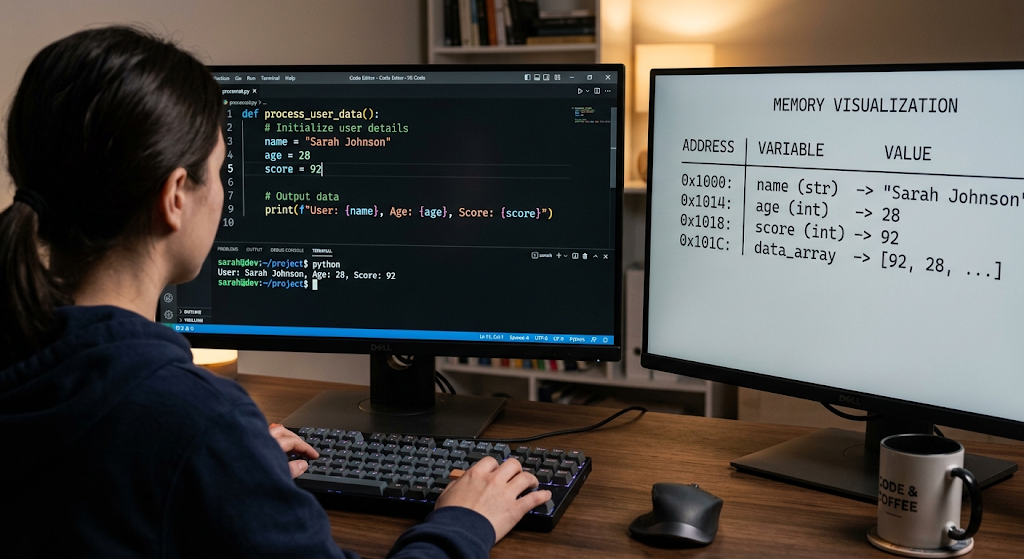
A variable is a name or reference to a place or something that a program uses to hold information that might be required when running the program. The value of a variable can be a number, text, character, boolean value, an object, or an array or collection of data. For instance, it may have a variable named age that stores a person’s age or a variable named totalPrice that stores the outcome of a calculation. The key aspect of a variable is that its value stored in the variable can vary during the execution of the program. A simple program will have one variable assigned a value and then have a different value assigned to the variable from an input, calculation, or some other operation. Variables thus give the programmer a convenient means whereby information about which programs must remember and manipulate can be meaningfully named.
The use of variables is especially helpful, because the programmer typically does not have to deal with data that does not change during the execution of a program. A banking app might need to update an account balance following a transaction, a game might need to update a player’s score following an achievement, and a shopping app might need to update how many products are in a customer’s shopping cart. Programmers do not use each value as a single bit of data, but they give names to values and refer to those names in their programs. How to create a variable will vary depending upon the language being used. For instance, in Python, a variable is created by assigning some value to a name, such as in languages as Java and C, which must provide some information about the type of data to which a name is being attached. Even though these differences exist, the same thing remains true, variables can be used to represent information that can be accessed and, if necessary, modified during the program’s execution.
Declaring and Initializing Variables
Declaring and initialising are two similar, but different, concepts. When you say you declare a variable you are telling the programming language that the variable exists and in many statically typed languages, that the kind of info it is expected to hold. The process of assigning the first value to a variable is called initialization. For instance, in Java, the programmer can write int age = 20; – this is the typical way that variables are created in this language – int is the data type, age is the variable name, and 20 is the initial value.
The same basic concept can be written in Python as age = 20, where there is no type specified. In some languages, it is possible to declare and initialize objects separately, whereas in others it is common for declaration and initialization to occur together. The ability to distinguish between the two enables the learner to appreciate that in order to create a variable, one needs to identify the variable in a program and to decide what kind of information upon which it is based.
Constants and Identifiers

Understanding Constants
Any value that is named and does not change once it has been set. Useful when a program uses the same information more than one time and wants it to not be accidentally changed during the running of the program. This can be any value, such as mathematical values, configuration limits, conversion factors, or fixed application settings. For example, a program to calculate the area of a circle may store the value of pi as a constant, rather than typing it the same number of times. How exactly to define a constant varies from language to language. In some languages, there are special words used to specify that a value should not be altered, and in others, special declarations or conventions are used. The constants make the code easier to read as if a value has a meaningful name one can tell from that name what it represents. They can also decrease the amount of programming errors as there is a possibility of the language automatically preventing accidental reassignment when the constant mechanism would provide that protection.
The distinction between variables and constants is mainly related to whether their values are expected or permitted to change. StudentAge may change when the information changes, but MAX_ATTEMPTS might be a constant that is applied across an application. Appropriate use of constants can help make the source code more maintainable since a programmer can know the intent of a significant fixed value without having to read through the entire program. An alternative to changing the value later, a named constant can be used to change the value from one place. This is usually more readable than littering the same number or text value across a myriad of sections of code. This makes constants not only correct, but readable and maintainable as well.
Rules that Governs the Naming of Identifiers
In programming, an identifier is the name of a programming element, such as a variable, constant, function, class or some other object, depending on the programming language. Identifiers enable the programmer to refer to a specific element without having to describe the meaning of the element over and over again. Typically, programming languages have rules governing identifiers. For instance, for one identifier, it may start with a letter or underscore, and may not have spaces in it. In many languages, there are also some words that are reserved for special uses – they are not available for use as normal variables or function names for the program. The rules vary but a valuable identifier is one that is meaningful, since it helps to make the source code easier to understand. If the value represents the name of a customer, then customerName conveys more meaning than x.
As software projects grow larger, the naming of the identifiers becomes more important. The number of identifiers in a short program is small, but in a professional application, there can be thousands of identifiers spread across many files and components. Clear names make it easier for the programmer to know how various bits of information relate to one another, and minimize the need for comments in the code. Naming conventions also vary from language to language and from community to community. Some programmers prefer camelCase, others prefer snake_case, and capitalized letters with underscores for constants. The key thing is consistency and clarity. An identifier should convey information about the element it represents but shouldn’t be too long or complicated.
Data Types in Programming
Primitive Data Types
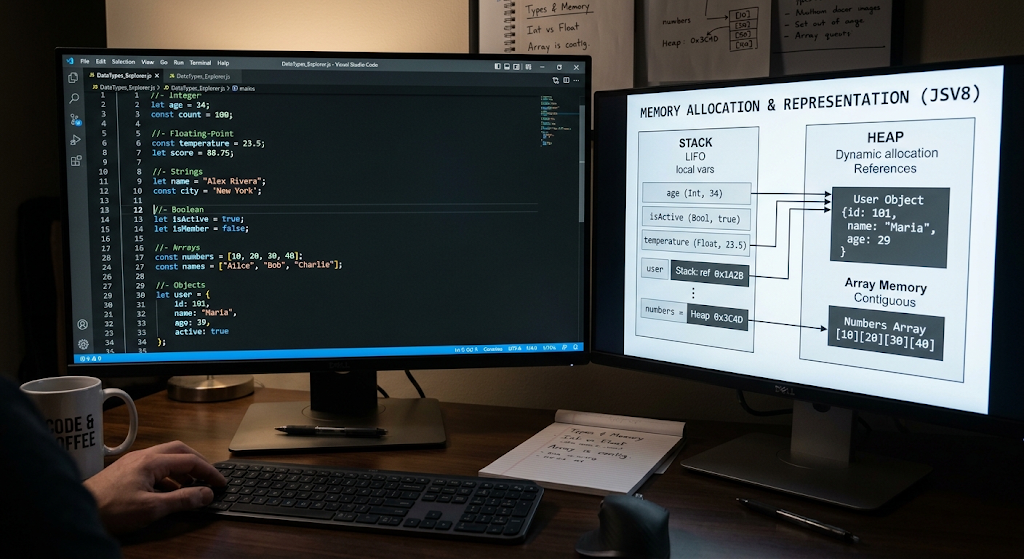
A data type specifies the nature of the information that an expression or variable in a language represents, and possibly how the information is stored, depending on the language. Common basic data types are integers, floating-point numbers, characters, strings and boolean values. Whole numbers can be represented by an integer; a floating-point type can represent numbers with fractional parts. In general, a Boolean is a binary variable that can take one of two values: true or false. Strings are sequences of characters, and are common for names, messages, addresses, and other textual data. Built-in data types vary from language to language, and may have different sizes, ranges and behaviors. Knowing the data types can assist programmers in using appropriate representations for the information the program must process.
Data types also help to avoid some categories of programming errors. A statically typed language has the ability to detect, in many cases, the incompatibility of an operation and type before the program is run by the compiler. For instance, when a variable of type int is declared and then given a text value, this can lead to a compilation error. In dynamically typed languages the type system may be used in other ways, sometimes the type of a value is determined during the execution of the program. While both methods do not 100% eliminate programming errors, each approach offers different methods of manipulating data. Learners with knowledge of data types will be better able to anticipate the behavior of data when stored, compared, combined, or passed to functions.
Composite and Reference Data Types
Programming languages can also be used to encode more complex information. Arrays, lists, records, structures, classes, dictionaries and objects can all contain a collection of related values in one logical entity. For instance, rather than maintaining a student’s name, age, course, and score in separate variables, one can maintain a student as an object or structured record with all those properties. Composite data types are particularly useful in larger applications where they enable the real-world entities to be modeled and related information to be organized. The actual mechanisms differ depending on the language; in general they are meant to enable the representation of increasingly complex data in an organised fashion. This allows software to be developed to interact with customers, products, transactions, employees, messages, and much more.
Some languages differentiate between holding a value and having a reference to an object or data in another location in memory. This difference may impact the behavior of assignment and function calls. A reference to an object is copied, for instance, two variables can both point to the same object—and not two new, completely independent objects are created. A change in one reference may thus sometimes be apparent in the other reference. The details will depend on the programming language and its memory model, so students should not assume that all programming languages have the same model of memory. It’s especially important to know the difference between a value and a reference when passing around mutable objects, collections, function parameters and larger data structures.
Scope and Lifetime of Variables

Local and Global Scope and Block Scope
The scope of a program is where a specific identifier can be used. Global variables can be used in a much wider part of a program, while a local variable can only be used in the function, method or block where it is declared. In addition, some languages have block scope, meaning that a variable is only available within a specific block of code, such as the statements between braces in C, C++, Java, and JavaScript. The scope of a variable determines which statements in a program can access the variable directly. Restricting access, sometimes, can make software easier to understand and aid in preventing inadvertent changes to data by unrelated portions of software.
For instance, if a function is used to determine the cost of an order and the variable total is created as a local variable. If the temporary calculation is not a direct requirement of other parts of the program, then they can be implemented without accessing the temporary calculation. By having the variable in the function, you avoid having unrelated code accidentally changing the variable. While global variables can sometimes be useful, when information actually must be shared throughout the program, too many global variables can make programs difficult to comprehend and maintain. If lots of different pieces of the program can alter the same value, locating the place where an unexpected change took place becomes more complex. Thus scope is used as an organizational mechanism that reduces visibility and allows programmers to manage their program’s dependencies between various components.
Variable Lifetime
While there is a relationship between scope and lifetime, they are not the same thing. Scope defines the extent of access to a variable in the source program, and lifetime indicates the duration for which the variable exists in the running of the program. A local variable might have a short lifecycle and can only be used from the moment a function is invoked to the end of the function (this is the standard case, but may vary in different language and memory models). Dynamically created objects can have a different lifetime to that of the function that created them; if another part of the program is using them, they can live past the end of the function. Lifetime is important because it impacts memory usage and when information is available or can be safely released.
There are different approaches to lifetime management of data in different programming languages. Some languages have explicit memory allocation and deallocation, others have automatic memory-management systems like garbage collection. Some languages use multiple methods and provide control over some types of memory and automatic management for other types of memory. These differences affect the application development and resource management of developers. In this way, a variable that lives longer than it should does not benefit from the necessity of having it alive, and a resource that is released too early can cause errors. Lifetime relates basic programming concepts to issues of memory, performance and reliability.
Expressions and Operators
What is an Expression?
An expression is a string of values, variables, operators, function calls or any of these combined together which can be evaluated to a value. Expressions play a vital role in programming because they enable software to calculate and decide. For instance, price*quantity can return the cost of multiple products, and age >= 18 can return a boolean value that can be used in a conditional statement.
Expressions may be quite simple in some languages and very complex in others, depending on the type of task and language. Knowledge of expressions enables programmers to realize that many programming statements are really statements of information to be evaluated and new value produced. Expressions may also be nested, with the output of one expression being a parameter to another expression.
Arithmetic, Comparison and Logical Operators
Operators provide instructions for actions to take for values. Arithmetic Operators are Add, Subtract, Multiply, Divide and Remainder. The comparison operators compare values and tell whether one value is greater than, less than, or equal to another. Logical operators are used to build combinations or modifications of the Boolean conditions, and are used to build more complex decisions.
For instance, one program may determine if a customer is logged on and if a customer has permission to take a specific action. The concepts are common however, there are slight variations in the use of symbols or keywords in different languages for these operations. So it is essential to know how operators work as these are used all the time in the calculations, conditions, loops, assignment and in many other programming structures.

Operator Precedence
If there are multiple operators in an expression, there must be rules for the order in which they are executed. These rules are called as operator precedence. For many languages, multiplication and division have higher precedence than addition and subtraction, unless they are enclosed in parentheses. An example is the expression 2 + 3 * 4, which is typically interpreted as 2 + (3 * 4).
Parentheses can be used to make the order clear and can make the expression easier to read even if it isn’t needed. Programmers must be familiar with the precedence rules since errors in precedence might lead to erroneous results that are not always apparent. With some expressions it may be practical to reduce confusion by using parentheses to clearly state the intended calculation.
Assignment Mechanisms
Basic Assignment
By giving a value to a variable or changing the value of a variable, we assign the variable. In many languages, the equals sign is used as a simple assignment operator, but it can have slightly different meanings depending upon the context. For instance, if the value 100 is assigned to the variable score, then generally score = 100. Assignments can also be made to an expression, like total = price * quantity, where the right side of the assignment is an expression to be evaluated and used on the left side. This distinction is significant for two reasons: First, the equals sign in an assignment statement does not imply equality, and second, the operator ‘==’ is not necessarily the same as the mathematical operator. In programming it is often a function that alters the data of a variable.
Many languages also have compound assignment operators that are the same as the assignment operator except they perform an operation on the value being assigned. A programmer might be able to write score += 10 instead of score = score + 10. For subtraction, multiplication, division and others, there may be similar operators. These mechanisms reduce the amount of update repetitions, but don’t change the concept of a new value being calculated and assigned. Assignment may also depend on the data types and references to be assigned: for example, the outcome of the assignment may be different depending on how the data types are converted, copied, and referenced when the type is different. Knowledge of assignment is thus crucial to predicting program state modification during program execution.
Assignment and References
Variables that reference objects or other complex data become interesting in relation to Assignment. The assigning of a value to another variable in a value situation can lead to the copy of the value itself. A reference is allowed, however, with a reference the assignment can be made so that two variables point to the same underlying object. If that object is changeable, changing one variable might affect what you see in the other variable.
One of the reasons beginners may get confused with arrays, lists, dictionaries and objects is that they all behave differently in some ways. The programmer can think of two variables as storing different data when in fact they’re really referencing the same structure. Different languages have different rules; the programmer must learn the rules of the language that they are using.
Concepts and How they Work Together
The concepts of variables, constants, identifiers, data types, scope and lifetime, expressions, operators and assignment are not individual concepts. They collaborate on every occasion information is being handled by a program. Let’s say you have an order that calculates the order total. The program can store the value of the product price and quantity in variables, use numeric data types to represent the value of the product price and quantity, and use an arithmetic expression to calculate the value of the total product price and quantity and save that value in another variable. These variables can be in local scope in a function, that is, they are not directly accessible by other parts of the program. The variables are associated with the lifetime of the function or a part of the program where the function is executed. A constant could be a maximum order value or a tax rate. This is a simple example that illustrates how some basic programming principles work together to create useful behaviour.
The same rules also apply to much more complicated applications. A web application can use variables to represent information about its users, data types to differentiate numbers from text, expressions to process requests, and scope to limit the access to specific information in the application. Variables can be used to store player health, player scores, and other similar data. Constants can be used to store the rules of the game. Operators can make calculations. Objects can represent characters and items. A financial system can employ regulated data types and ranges to minimise mistakes in the transaction processing of a financial system. Knowing these building blocks will help learners to grasp how larger programs are built. The development of complex software can involve the organization and predictable ‘composition’ of relatively simple concepts.
Comparing Different Programming Languages
While variables, scope, data types, expressions and assignment are very common in programming, how they are handled differs from one programming language to another. Python is dynamically typed, which means that the type of a value is known at runtime, whereas the other languages mentioned, Java and C#, have static typing, meaning that a large amount of type checking can be done at compile time. Learn how to work with memory and pointers in C; APIs for memory and pointers are built-in in C, whereas in Java automatic memory management provides support for regular objects. There are also variables, variable scope, definition of objects, and type conversion rules that are peculiar to JavaScript, and functional languages might emphasize immutability and an expression-oriented style of programming. These differences are significant because they impact the programmer’s writing, testing, debugging, and maintenance of software. But the common ideas enable students to transfer knowledge from one language to another.
Programming design can thus be found to be similar or different in more than one language. While the syntax or even rules for how to use scope may change, any programmer who understands it in one language will understand it in a different one. Likewise, a person who has knowledge of the purpose of data types can more easily grasp the rationale behind one language having an explicit type declaration and the other having more type inference or dynamic typing. The most important thing to consider is the concept behind the program instead of the syntax. When learners recognize the need for variables, the role of scope in determining access to variables, the purpose of types when working with data, and the purpose of expressions when applying to variables, they will find it easier to understand unfamiliar syntax.
Importance of Variables, Scope and Data Types
These basic ideas are directly related to the reliability, readability, performance and maintainability of software. Bad names for variables can make code hard to understand and the wrong type of data can lead to erroneous calculations or unexpected behavior. If not controlled well, any part of an application that is not related to the scope can interfere with the other parts of the application, thus creating bugs in the application which are hard to trace. Mistakes in assumptions of variable lifetime can also lead to inefficient use of memory or issues when resources are no longer available. Good use of variables, constants, data types, scope and assignment, on the other hand, can make programs more predictable and more easily modified. These are particularly important in situations where a large software program is being developed by many programmers and those programs must be understood and modified by the same programmers over many years.
These concepts are also vital to higher level programming. Functions and methods need variables and parameters, object-oriented programming is very data type and object reference oriented, and data structures require methods for organizing various values. Variable lifetime and references are related to memory management and error handling may rely on the kind of value and expressions to be handled. Decisions on what information is represented, how it is accessed, how it is changed, and how it is shared can be involved in even concepts like concurrency, databases, application security, and software architecture. Therefore, it is important to not consider variables and expressions as “elementary” concepts that are not important later. However, they are always at the heart of programming, whatever the software developed is.
Conclusion
Some of the most important concepts and foundations of programming include variables, constants, identifiers, data types, scope, lifetime, expressions, operators, and assignment mechanisms. Variables are used to store information that may change during a program’s execution, while constants are used to store values to be used throughout the program. Identifiers are used to name programming elements and data types are used to indicate the type of data a programming element represents. The scope indicates where the variable and other identifiers are found and the lifetime refers to the duration of existence of the variable/identifier during program execution. Expressions and operators enable programs to compute values, compare data, and make decisions based on values or comparisons. The state of a program can then be created and updated during the execution of instructions, through assignment mechanisms.
While there are many differences in languages, syntax, rules, etc., these basic concepts are used throughout the programming world. By comprehending them, learners will develop a more solid basis for navigating language translation and advanced concepts like functions, objects, data structures, memory management, and software architecture. More importantly, they help to explain how information is stored, manipulated and organized in programs, instead of teaching the students what commands to type. For a programmer who has a knowledge of these principles, they are able to reason more efficiently about the behavior of the code, detect potential issues and create more understandable and maintainable software. It is thus crucial to have a solid grasp of variables, data types, scope, expressions and assignment before embarking on programming.