Introduction
In accounting and economic fields we see that which variable to play with is not restricted to just one. Companies are constantly to deal with fluctuating prices, production levels, labor costs, taxes, customer demand, and market competition at the same time. Due to this complexity accountants and economists use math tools which in turn analyze many variables at once and which also present how one change plays out against another. We see that among the most important tools used for this purpose are partial differentiation and comparative statistics in accounting.
These concepts which we present help professionals to see how financial elements play out in a business setting. We see very wide use of them in forecasting, budgeting, profit analysis, production planning, and resource allocation. Also by looking at how a change in one variable plays out when we hold all others constant organizations are able to do a better job of financial and operational decision making.
In another domain these methods apply which is that of comparative statistics and marginal analysis which businesses use to study the results of economic changes and to determine the best production or pricing strategies. We see these techniques to be very valuable in looking at cost behavior, revenue growth, and total financial performance.
This article breaks down the concepts of partial differentiation and comparative statistics in an easy to understand way which also we see play out in the import they play in accounting and economics. Also we see how these mathematical concepts support better financial analysis and economic prediction in today’s business world.
Understanding Partial Differentiation
Partial differential calculus is a branch of calculus which looks at functions of more than one variable. In business and accountancy we see that many financial results are a function of many variables at the same time. For example profit may be a function of production level, labor costs, sell price, and operating costs. Partial differential analysis looks at how changes in one variable play out when other variables are held constant. This is useful for accountants in identifying which particular business elements affect performance the most.
For example consider a company that manufactures electronic products. The total cost of production may include:
- Number of workers employed
- Quantity of raw materials used
- Machine operating hours
- Energy consumption
If management is interested in what labor costs due to total production cost by itself, partial differentiation enables analysts to look at labor while we hold other variables constant. This approach works very well as in the real world business systems we see many interrelated variables. Also we see that partial differentiation which in turn simplifies the analysis by which businesses are able to look at one aspect at a time.
Why Partial Differentiation Matters in Accounting
Accounting is more than just record keeping. Today’s accountants are to put financial data in terms that are easy to understand and also to give out strategic advice. Also we see that partial differentiation is a tool which accountants use to study the relationship between variables in detail and also to determine how a change in one variable will play out in the total picture of finance.
Some which will present in the importance of partial differentiation are:
Cost Analysis
Businesses should determine what factors are at the root of increased expenses. We see that partial differentiation which in turn helps report whether it is labor, transportation, raw materials, or production levels which are the primary causes of the increase.
Revenue Forecasting
Revenue is a result of many factors which include price, advertising, customer demand, and market conditions. By looking at each of these elements individually companies are able to determine what changes in pricing or marketing will do for their bottom line.
Profit Optimization
Companies put out to grow their bottom line which in turn sees to reduce unnecessary spending. We see that partial differentiation plays a role in determining the best mix of production elements which in turn will raise profitability.
Financial Planning
Budgeting out comes from accurate forecast of what is to come in terms of costs and revenue. Partial differential equations improve financial forecasting by determining how business results react to changes in the economic climate.
Investment Decisions
Investors and financial managers that use these techniques which in turn support how market variables play a role in investment return. This in turn supports better financial decision making.
Understanding Comparative Statistics
Comparative analysis is what we do when we compare changes in variables which in turn tells us how economic systems react to varying conditions. In economics and accountancy we see that comparative analysis allows businesses to study how change in one economic element plays out in another.
For example, businesses may study how:
- Fuel price increase impacts transportation costs.
- Increased wages influence company profitability
- Tax changes impact consumer spending
- Interest rate changes influence investment decisions.
- Inflation alters production expenses
Comparative statistics looks at relationships between variables which is to say we see how one economic situation measures up to another after changes have taken place. In the world of accountancy this method is very much used for forecasting and in policy analysis which in turn allows companies to see what the future holds for their financial performance in different what if scenarios.
The Relationship between Partial Differentiation and Comparative Statistics
Partial differential and comparative statistics in accounting go hand in hand. Partial differentiation provides the math structure for measuring variable change, and comparative stats puts into economic terms what that change means.
For example consider a company which wants to see how an increase in employee salaries plays out in terms of total profit. We use partial differential equations to determine the rate at which profit drops or grows with respect to salary increase. Also we use comparative statistics to analyze the larger financial picture of that which that relationship presents.
Together, these tools help businesses:
- Analyze financial sensitivity
- Predict market responses
- Estimate economic impacts
- Improve strategic planning
- Support evidence-based decisions
In the absence of these tools businesses would have a hard time with the complex relationships between financial variables.
Applications in Marginal Analysis
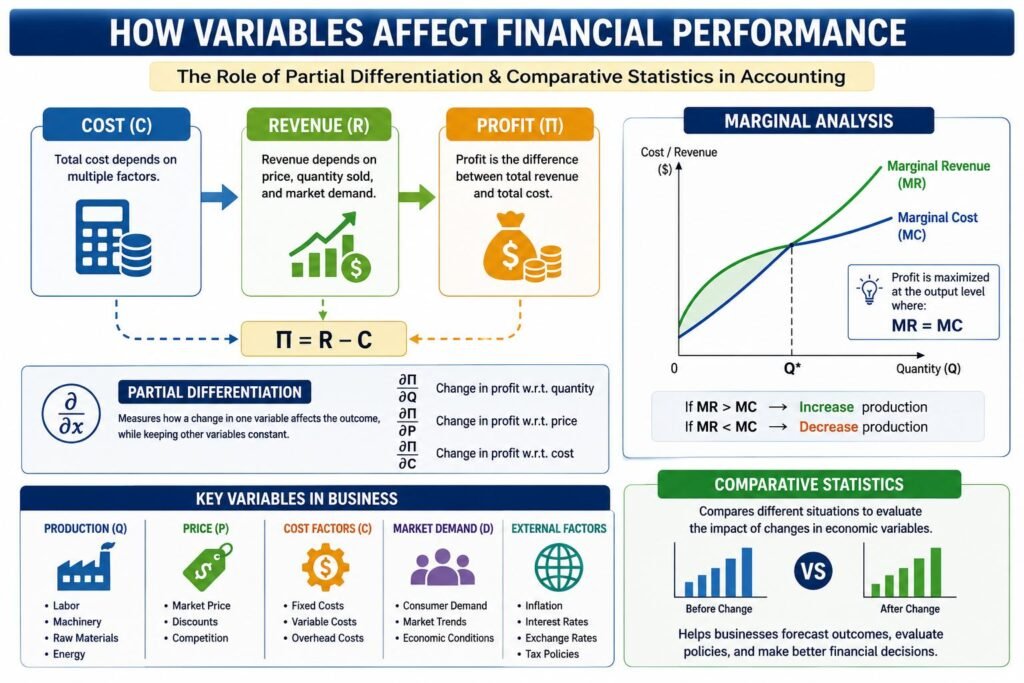
Marginal analysis is also very important in the field of accounting and economics. It looks at the extra benefit or cost of that which is very slight to see how it will play out in the business.
In businesses it is common to use marginal analysis for:
- Marginal cost
- Marginal revenue
- Marginal profit
- Marginal productivity
These concepts also used by companies to determine which between expansion of production or increase in investment will better improve profitability.
Marginal Cost Analysis
Marginal cost is the extra cost which goes up with each additional unit of a product produced. Companies use this in determining the best scale of production. For instance, if we see that the extra units are costing more to produce than they are bringing in in revenue the company may cut back on production. Also should the additional production see a greater return in revenue than the cost the go ahead may be profitable.
Partial differential calculus is used by accountants to determine how costs react to changes in production which in turn may be affected by many variables like labor, machinery and materials.
Marginal Revenue Analysis
Marginal revenue is that which is produced by selling one more unit of a product. Businesses which compare marginal revenue with marginal cost are determining the profitability of producing more. When marginal revenue is greater than marginal cost it is a good sign that production expansion will in fact increase profits.
Profit Maximization
In business a primary goal is profit maximization which we use partial differentiation to determine the production level at which profit is greatest. Accountants and economists look at how slight variations in price, production, or operation costs play out for total profit. Which operating conditions prove to be the most profitable is what they identify.
Applications in Economic Forecasting
Economic prediction is of which we try to determine what the business climate will be like in the future using at our disposal data and mathematical analysis. We use partial differentiation and comparative statistics very heavily in this process.
Businesses apply these in their forecasts:
- Sales growth
- Consumer demand
- Inflation effects
- Production costs
- Employment levels
- Investment performance
For instance a manufacturing company may project out how increasing energy prices will play into future production costs. We look at comparative stats which is past performance versus projected future results and we look at partial differentiation which measures how variable costs react to energy price changes.
This increases the accuracy of plans and also allows companies to prepare for economic changes.
Use in Multi-Variable Financial Models
In today’s financial markets we see a complex web of variables. Also businesses develop financial models which include elements such as:
- Production output
- Marketing expenses
- Tax rates
- Employee wages
- Interest rates
- Exchange rates
Partial differential calculus allows us to see the effect of each variable independently within the context of the total system. For example an international company may look at how exchange rates play out in import prices which at the same time they keep production level the same. This is to help management in setting price and source materials.
Importance in Managerial Accounting
Manager in accounting reports to internal management teams. We see that partial differentiation and comparative statistics play a large role in that. They improve the accuracy of analysis.
These tools help managers:
- Evaluate operational efficiency
- Allocate resources effectively
- Control production costs
- Set pricing strategies
- Prepare financial forecasts
- Improve budgeting decisions
Through analysis of financial data which variables play in relation to each other managers are able to make more strategic choices that in turn improve organizational performance.
Business Decision-Making and Resource Allocation
In a resource constrained environment which is the reality for all businesses we see that they must determine the best use of their labor, capital, and materials. Partial diff of resources is what is used to identify which ones add the most to profit. Also we see that comparative stats play a role in evaluating different business strategies which play out in various economic climates.
For instance a company may compare two production methods:
- Labor-intensive production
- Machine-intensive production
Through analysis of each method’s effect on costs and output management is to choose the best option. In very competitive industries this analysis is of great importance which may see even small efficiency improvements to have large scale effects on profit.
Risk Analysis and Financial Stability
Financial markets change constantly and businesses are exposed to a variety of risks which include inflation, market fluctuation, and change in consumer behavior. Partial out of total differentiation we use to see how business results play out with these risks. Comparative stats we use to look at different future scenarios and prepare for uncertainty.
For instance a business may look at how changes in interest rates play out in terms of loan repayment and profit. This is a way for financial managers to reduce exposure to economic instability. Such analysis in turn improves financial stability in the long term and also supports better risk management.
Comparative Statistics in Economic Policy Analysis
Governments and policymakers also look at partial differentiation and comparative statistics in accounting which they use to study economic behavior.
These tools look at:
- Tax policies
- Subsidies
- Wage regulations
- Inflation control measures
- Monetary policies
For instance it is a practice of policymakers to look at how higher taxes play out in terms of consumer spending and business investment. We see in comparative statistics which economic results played out before and after the implementation of policy. Businesses pay close attention to these issues which is due to the fact that government decisions may in fact determine our bottom line and market demands.
Real-Life Business Examples
Manufacturing Industry
Manufacturers apply marginal analysis for determining optimal production levels. We use partial differentiation to see how labor, energy, and materials play into production costs.
Retail Businesses
Retail companies look at what effects price changes have on customer demand and sales revenue. We use comparative statistics to see how performance varies under different pricing strategies.
Banking Sector
Banks apply these methods which determine the impact of interest rate changes on loan demand and profit.
Transportation Industry
Transportation firms study changes in fuel prices and their effect on operation costs.
Technology Companies
Technology companies look at what they get out of research investment in terms of innovation, sales growth, and long term profitability.
Advantages of Partial Differentiation and Comparative Statistics
Businesses see great value in these analytical methods which they:
- Improve forecasting accuracy
- Support data-driven decisions
- Increase operational efficiency
- Enhance financial planning
- Strengthen profit analysis
- Help manage economic risks
- Improve strategic decision-making
These issues make mathematical analysis a key element in present day accounting and economics.
Limitations and Challenges
While these methods are so in their value, also they have issues.
- Complexity: Financial systems offer present great complexity when many variables interact at the same time.
- Data Accuracy: Forecast reports require accurate data. Poor quality data may yield faulty results.
- Assumptions: Mathematical models often present that certain variables do not change, which may not in all cases represent real world conditions.
- Economic Uncertainty: Unforeseen economic issues like recessions or global crises may affect prediction accuracy.
Although we face these issues partial differentiation and comparative statistics are still very useful in financial analysis and economic planning.
The Growth of Mathematics in Accountancy
As technology progresses companies turn to data analytics, artificial intelligence, and financial modeling software. Also which in turn use partial differential and comparative stats in large scale.
Today’s accounting software is equipped to handle large sets of financial data and perform mathematical analysis automatically. This enables businesses to:
- Detect financial trends faster
- Improve forecasting accuracy
- Optimize operational efficiency
- Reduce financial risks
- Enhance strategic planning
As we see an increase in the value of big data and predictive analytics, it is to the benefit of accountants, economists, and business professionals that they familiarize themselves with these math concepts.
Conclusion
Partial differentiation and comparative statistics in accounting is what businesses use also in economics which in turn helps companies to see how different variables play into financial performance. These methods which we use for analysis of costs, revenues, profits, production levels and economic trends do it better. Through the use of marginal analysis companies are able to make best production choices and see improvements in profitability. Economic forecasting is supported by comparative statistics which in turn does a study of different financial scenarios and which evaluates the impact of fluctuating economic conditions.
Although of a mathematical nature these methods prove very useful in the real world of business. From budgeting and out to investment analysis and risk management partial differentiation and comparative statistics in accounting tools which we use for that they allow companies to base their decisions on data. As companies grow within ever more complex and competitive markets the ability to analyze many variables will be essential to accounting, economics, and financial management.
Get more well researched information about Partial Differentiation and Comparative statistics in Accounting here.