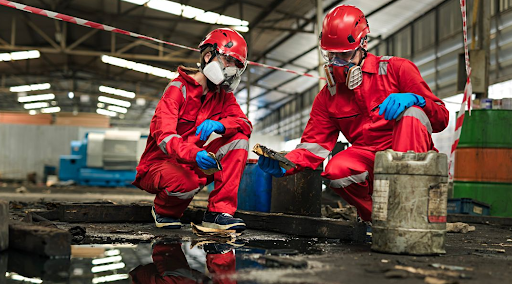
There is a common assumption in many workplaces that a spill kit on the wall and a laminated procedure sheet nearby constitutes a response plan. It does not. When something actually goes wrong — a drum seal fails, a forklift clips a chemical IBC, or a pipe joint gives way during a night shift — what matters is not the poster. It is whether the people present have internalised what to do and whether the right materials are genuinely accessible. Emergency spill response is far more demanding in practice than most businesses acknowledge until the moment they are tested by a real incident.
The First Minutes Are Irreversible
Hazardous liquids do not pause while decisions are being made. Solvents penetrate concrete within minutes. Acids begin corroding drainage infrastructure almost immediately. Fuel reaching a surface water drain can trigger an Environment Agency notification obligation within the hour. The decisions made in the opening moments of a spill — whether to evacuate immediately, which containment product to reach for, whether to call the emergency services — cannot be undone after the fact. Workplaces that rehearse these decisions through realistic drills make them correctly under pressure. Those that have never practised tend to improvise, and improvisation with hazardous materials carries serious consequences.
Wrong Absorbents Make Things Worse
This is something most generic safety content never mentions. Not all absorbents work on all substances. Standard cellulose-based absorbents are entirely unsuitable for aggressive acids or hydrofluoric acid derivatives — they can accelerate spread rather than contain it. Hydrocarbon-specific absorbents repel water, which makes them useless for water-miscible chemicals. Using the wrong product does not simply fail to help — it actively worsens the containment situation. A workplace that stocks only one type of spill kit because it looked sufficient on the shelf has a gap in its response capability that will only become visible at the worst possible moment.
Drainage Is the Critical Vulnerability
In most industrial and commercial premises, the greatest environmental risk during a spill is not the substance itself but the drainage network beneath the floor. A relatively small volume of chemical reaching an unsealed floor drain can contaminate a significant length of sewer infrastructure or reach a watercourse entirely. Emergency spill response professionals prioritise drain sealing before almost anything else in the containment sequence — not as an afterthought, but as the first physical action after personnel safety is addressed. Inflatable drain bungs and drain covers should be stored within reach of any area where hazardous liquids are handled, not in a storeroom three buildings away.
Documentation Protects the Business
When the Health and Safety Executive or Environment Agency investigates a spill incident, the question they ask is not just what happened — it is what the business did in response and when. Timestamped logs, photographs taken at the scene, records of which personnel responded and what actions were taken — these are not bureaucratic exercises. They are the difference between demonstrating a competent, documented emergency spill response and appearing before an enforcement officer with nothing but verbal accounts. Businesses that build incident documentation into their live response process rather than reconstructing it afterwards are consistently better positioned during regulatory reviews.
Reviewing After Every Incident
A leak that was controlled effectively is not merely a relief – it is a source of operational intelligence. Which element of the method performed precisely as expected? Where did personnel hesitate? Was the containment equipment where it was intended to be? Post-incident evaluations conducted honestly, without blame, routinely disclose procedural deficiencies that no audit would have detected. The firms that enhance their reaction capabilities most reliably are those that see every occurrence, however trivial, as a rehearsal criticism rather than a closed chapter.
Conclusion
Most workplace spill events expose preparedness deficiencies that nobody realised existed until the moment they mattered. Emergency spill response is not a static document – it is a dynamic capacity that requires the correct materials, honest training, and intentional evaluation after every test. Businesses that tackle it this way seldom find themselves scrambling. Those that regard it as a compliance checkbox are likely to find its insufficiency at precisely the wrong moment. Real readiness is created quietly, long before anything goes wrong.