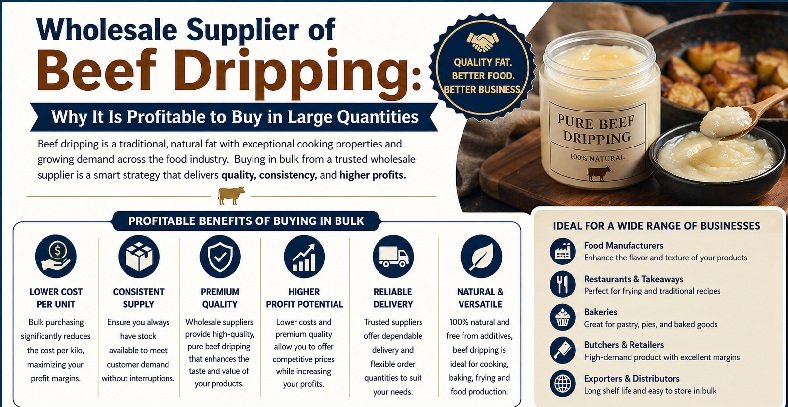
Beef dripping is a traditional animal fat used in professional kitchens, bakeries, butcher shops, and catering companies. It is valued for its rich flavor, stable cooking performance, and suitability for frying, roasting, baking, and ready-meal manufacturing. For businesses that use this ingredient regularly, buying small batches is often inconvenient and expensive. Working with a wholesale supplier and purchasing beef dripping in large quantities can be a profitable and reliable solution.
The first advantage is economy. Wholesale purchasing usually reduces the price per kilogram because larger orders lower packaging, handling, and administrative costs. For a restaurant, bakery, food manufacturer, or fish and chip shop, even a small difference in unit price can become a serious saving over a month or a year. If beef dripping is used every day, bulk buying helps reduce the cost of each portion, product, or production batch. As a result, the business can protect its margin without changing recipes or increasing prices for customers.
Bulk orders also make budgeting easier. Food prices may change because of raw material availability, energy costs, transport expenses, and seasonal demand. A reliable wholesale supplier can often offer volume-based pricing, regular delivery contracts, or fixed-price agreements for a certain period. This gives the buyer more control over costs. Stable ingredient prices are especially important for companies that sell products with fixed menu prices or retail labels. When the cost of a key ingredient changes too often, profit becomes harder to predict.
Another major benefit is supply stability. Companies that depend on beef dripping cannot afford unexpected shortages. A restaurant may need it for signature dishes, while a manufacturer may require it for a fixed recipe or production line. Ordering small quantities from different sellers increases the risk of delays, inconsistent stock, and variable quality. A wholesale supplier usually has stronger access to production volumes, storage facilities, and transport networks. This allows the buyer to receive the required quantity on a predictable schedule and avoid interruptions.
Consistency of quality is just as important as consistency of supply. Beef dripping may vary in color, aroma, texture, purity, and melting behavior depending on the raw material and processing method. These differences can affect taste, cooking results, and the final customer experience. A professional wholesale supplier normally provides standardized batches, product specifications, labeling, and documentation. This helps restaurants and manufacturers maintain stable recipes and predictable results.
Logistics is another reason bulk purchasing is profitable. Instead of placing many small orders, a company can organize fewer larger deliveries. This reduces time spent on ordering, checking invoices, receiving goods, and communicating with suppliers. It can also lower transport cost per unit, because one planned shipment is usually more efficient than several urgent deliveries. For businesses with several locations, a wholesale supplier may coordinate deliveries to a warehouse, central kitchen, or individual branches. Better logistics saves time and reduces operational stress.
Large-volume purchasing also improves stock planning. When a business understands how much beef dripping it uses each week or month, it can build a purchasing schedule around real consumption. This helps avoid last-minute shortages and emergency purchases, which are often more expensive. A planned inventory allows staff to focus on production, cooking, and service instead of constantly reacting to low stock. For manufacturers, reliable inventory is especially important because a missing ingredient can stop production.
However, bulk buying is profitable only when storage is organized correctly. Beef dripping, like any fat-based product, must be protected from heat, light, oxygen, moisture, strong odors, and contamination. Storage conditions depend on the supplier’s specification and on whether the product is delivered chilled, frozen, or suitable for ambient storage. In general, it should be kept in clean, dry, well-ventilated conditions, away from direct sunlight. Containers should remain sealed until use, and opened packaging should be handled hygienically.
Temperature control deserves special attention. If beef dripping is stored too warm, its quality may deteriorate faster. Repeated heating and cooling can also affect texture and performance. Businesses should follow the supplier’s shelf-life instructions and use a first-in, first-out system, so older stock is used before newer deliveries. Clear labeling and batch tracking are useful for audits, traceability, and internal quality control. With correct storage and rotation, buying in bulk does not increase waste; it creates a reliable reserve.
Packaging format should be considered before placing a large order. Wholesale beef dripping may be supplied in tubs, blocks, cartons, buckets, drums, or other industrial formats. The best choice depends on how the product will be used. A restaurant may prefer containers that are easy for kitchen staff to lift and portion. A manufacturer may need larger units suitable for production equipment. The right packaging reduces labor, improves hygiene, and prevents product loss.
Buying in large quantities also reduces dependence on emergency suppliers. When a business runs out of a key ingredient, it may have to buy quickly from any available source, often at a higher price and with uncertain quality. Adequate wholesale stock protects the company from this situation. It is especially useful during holidays, tourist seasons, promotions, or periods of high catering demand. Having enough beef dripping available helps the business accept more orders without supply pressure.
Wholesale cooperation can also create better commercial conditions over time. A buyer that orders regularly in large quantities becomes an important customer for the supplier. This may lead to priority service, flexible delivery schedules, better communication about price changes, and more convenient payment terms. Instead of treating beef dripping as a random purchase, the business builds a stable supply relationship and gains an operational advantage.
In conclusion, buying beef dripping in large quantities from a wholesale supplier is profitable because it lowers unit costs, stabilizes prices, improves logistics, and ensures regular availability. It helps businesses plan production, control margins, and avoid expensive emergency purchases. The key condition is proper storage: clean facilities, correct temperature, sealed packaging, batch rotation, and careful handling. For companies that use beef dripping regularly, wholesale purchasing is not just a way to save money. It is a smart operational strategy.