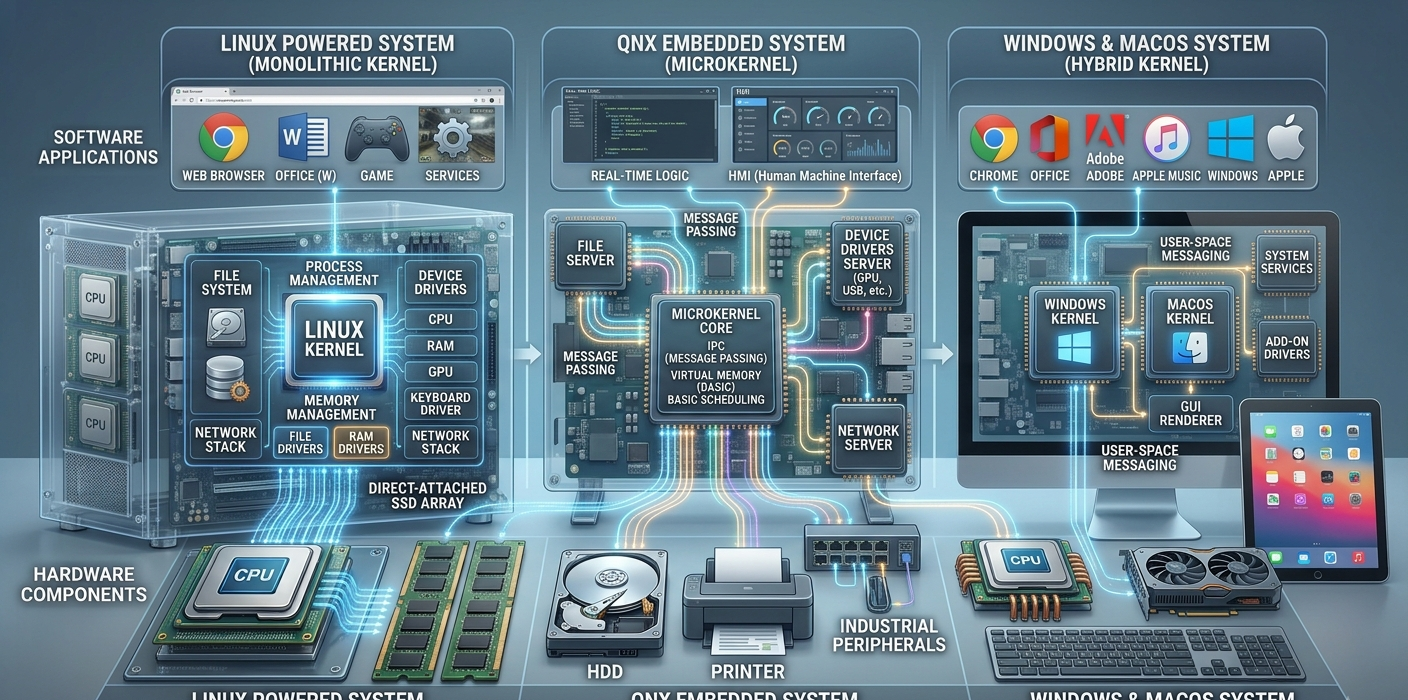
The kernel is the hidden, but very essential part of every computer, smartphone, tablet, and smart device that enables hardware and software to communicate very effectively. While users use applications, interfaces and menus, the kernel performs core system functions without their notice. It’s a link between a device’s physical elements and the applications that people use on a daily basis. If the kernel is not operating correctly, the OS will not be able to use the memory, execute instructions, or control devices and hardware and/or create a stable environment for applications.
While the operating system is the software that controls the computer hardware and offers services needed for applications to run, the kernel is deemed as the most critical part of the operating system. It’s in charge of communicating between applications and the processor, storage devices, and memory. From Windows to Linux, macOS to Android and any other platform, the kernel is at the heart of making everything work together seamlessly.
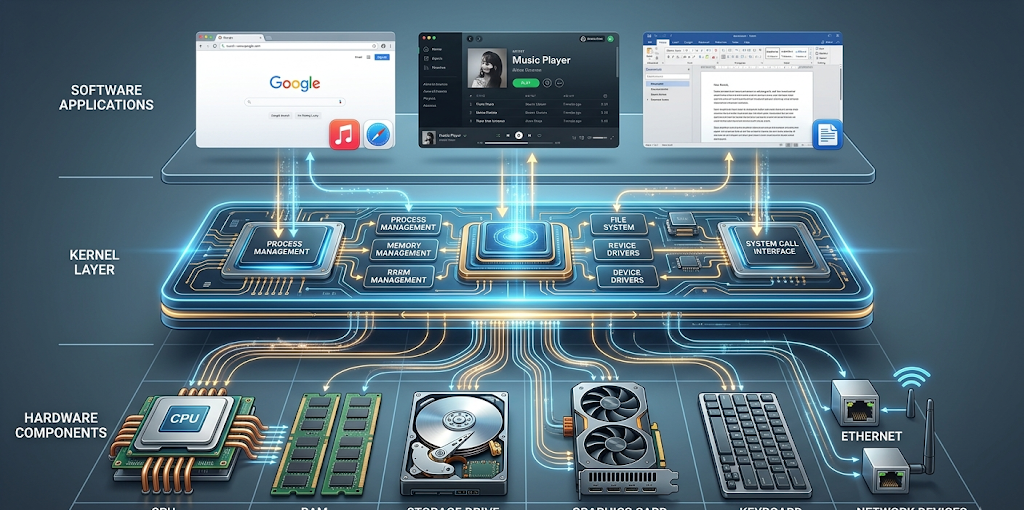
The understanding of how kernels work is useful in understanding why other operating systems work differently, why some are geared towards speed and others towards security, and why developers decide to use different kernel architectures for different things. In computer science there are three main kernel designs that are discussed: monolithic kernels, microkernels, and hybrid kernels. There are pros and cons with each architecture, and they are used in the real world.
What Is a Kernel?
The core of an operating system that manages communication with computer hardware and software. It sits in between applications and the physical elements of a device. Opening a program, saving a file, going online, or printing a document is not directly controlled by a user’s application. Rather, it passes requests to the kernel that takes care of the appropriate resources and accomplishes the task.
The kernel occupies a special position because it runs in a very privileged fashion on the computer system; this is called kernel mode. In contrast, other applications have to use the operating system for access to the hardware, and cannot do some of the critical tasks that the kernel can. This ensures that applications won’t harm the system or disrupt other apps.
For instance, if a music player application requires playing sounds, it will not directly connect with the computer’s speakers. The application makes a request on the operating system, and the kernel passes audio information to the hardware via suitable drivers. It is swift and effective, ensuring users experience seamless operation without having to grasp the intricate dynamics occurring within.
Why is the Kernel Called the Heart of an Operating System?
The kernel is sometimes referred to as the “heart” of an operating system because it is used by virtually all of the essential functions. The kernel distributes resources and instructions throughout a computer system, while the heart distributes blood throughout the body. It guarantees that hardware elements, applications and system services function cohesively.
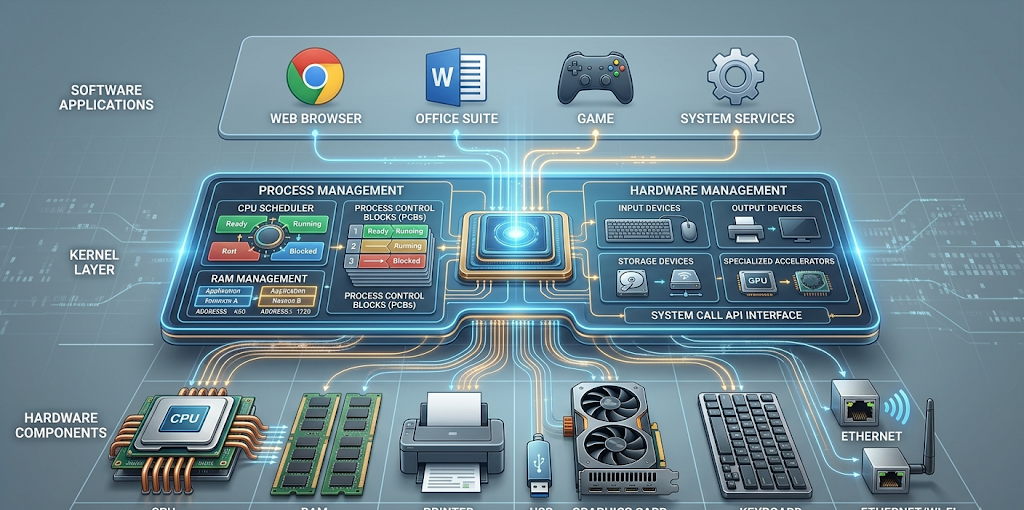
Process management is one of the most crucial tasks that the kernel has to perform. Today’s computers execute several programs concurrently, including background tasks, games, messaging applications, and web browsers. The kernel determines the amount of processor time assigned to each program and is efficient in switching between programs. If no process management were added, one application could waste all of the resources and cause the system to run slowly or become unstable.
Another big task is memory management. A computer has limited memory and there are several applications sharing the memory. The kernel tracks memory usage, allocates memory to programs and prevents programs from using memory allocated to other programs. This helps to prevent system instability and security risks.
Also, the kernel controls devices. Software instructions are required to make the hardware devices like keyboards, cameras, graphics cards, and network adapters work. The kernel’s job is to communicate with device drivers and make sure they run correctly. Otherwise, users would have to manage each device in the computer individually when working at the kernel-level.
Principle Functions of a Kernel
Process Management
Process management enables the operating system to run more than one program at a time. Each running application is a process and each process uses system resources like CPU power and memory. The kernel is responsible for the creation, scheduling and termination of processes as well as providing programs with the resources they require.
Scheduling Algorithms specify which process will be allowed to use the processor at any given time. In modern systems, these occur thousands of times a second, making it seem as though several programs are working simultaneously. Process management is essential for better performance and to avoid system failures due to conflict between the resources.
Memory Management
Memory Management: It refers to the process of controlling the allocation and utilization of memory in a computer system. The kernel maintains information about which parts of memory are being used by the applications and which parts are free. It also allocates virtual memory, which is the ability of the computer to utilize the storage space like a temporary memory if there is not enough physical memory.
This function is particularly significant since it assists in preventing crashes, limiting performance and security issues if not managed properly. The kernel regulates the access to memory, which means that programs do not interfere with each other.
Hardware Management
The kernel offers a communications link between software and hardware. Applications don’t know anything about the workings of all the hardware components, so they depend on the kernel and device drivers to interact with them.
For instance, when a user plugs a USB device into the computer, the kernel detects the hardware, loads the proper drivers and lets applications communicate with the hardware. This makes it much easier for the user in the modern world of computing to not have to know the technical details of communications between the hardware.
What is Kernel Architecture?
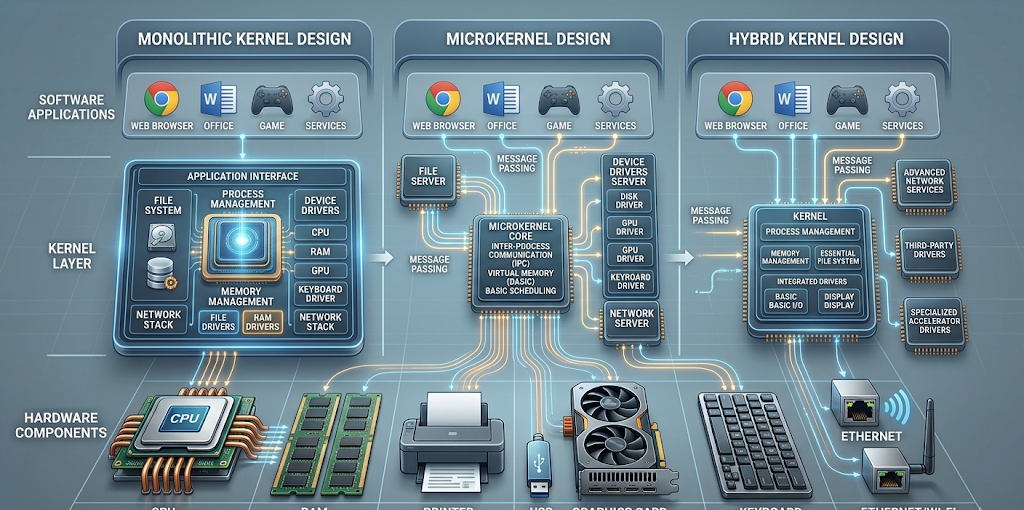
The organization of the various functions of the kernel is known as its architecture. There are many different types of kernels that the developers use to design the operating systems according to their goals. There are people who consider the maximum performance, others who focus on security, reliability, or maintenance.
The three most popular kernel architectures are:
- Monolithic Kernel
- Microkernel
- Hybrid Kernel
Each of these architectures offers a different way of structuring the services within the system and communicating among software and hardware.
Monolithic Kernel Explained
Monolithic kernel is a kernel design that has all of OS services in one monolithic kernel space. The kernel includes all functions such as memory management, process management, file systems and device drivers.
Communication between components is very rapid due to the fact that they share the same space. High performance with the kernel not having to pass messages constantly between various parts.
But there are issues with the monolithic kernel’s size. More than one component is used together, so that if one part of the kernel fails, it could be possible that the whole system fails. Large kernels may cause more maintenance and update complexity due to the interdependency of changes among different kernel components.
Even with all these problems, monolithic kernels are still popular for their efficiency and reliability when they are well developed.
Real-World Examples of Monolithic Kernels
The Linux kernel is one of the well known monolithic kernels. Millions of computers, servers, Android devices and embedded devices all over the world run on Linux. The architecture of Linux is monolithic, but it does have a modular design, meaning that some parts can be added or removed.
Monolithic designs were also employed with traditional versions of Unix. The monolithic kernel is still widely used in many systems, such as servers and high-performance computing environments, where performance and speed are essential.

Microkernel Explained
A microkernel employs the opposite approach: it has as small a core kernel as possible. Few services are in kernel space as opposed to a lot of services. All other services like device drivers, file systems, networking etc. run independently of the kernel in user space.
The primary purpose of a microkernel is to achieve higher security, stability and flexibility. Fewer components running with elevated privilege makes that problems in one service won’t cause the entire system crash. In case of a failure (e.g., failure to transfer to another page), the system might restart that service rather than an overall failure.
The downside to the microkernel design is that communication between components might require extra processing. Services are divorced, and need to communicate with one another via controlled communication systems. This has occasionally been at the expense of performance relative to monolithic designs.
A Few Examples of Real-World Microkernels
An example of a microkernel is the operating system called QNX, which is used in automotive systems, medical devices and industrial devices where reliability has to be extremely high.
MINIX is another small OS that was originally developed to be used in education to illustrate microkernel ideas. In addition, some research operating systems also utilize microkernel designs since they offer greater security and simpler system customization.
Hybrid Kernel Explained
A hybrid kernel is a kernel that is a mix of the monolithic and microkernel designs. It tries to offer the performance benefits of a monolithic kernel and some of the modular and security benefits of microkernels.
In a hybrid, some services will stay in the kernel to improve performance, and others could be isolated to run separately. This way, the developers are more flexible about creating an operating system.
Hybrid kernels are frequently composed because there are pros and cons to using either a pure monolithic kernel or a pure microkernel. The speed of a completely monolithic system might be very high, with the isolation being lower, and the performance of a pure microkernel might be lower, but the security might be higher. Hybrid systems attempt to find a balance between these priorities.
Real-World Examples of Hybrid Kernels
The Windows NT kernel is one particularly popular hybrid kernel implementation, powering modern versions of the Microsoft Windows operating system. It is a mixture of both methods using important services in the kernel and having a modular structure.
The other one is Apple’s macOS, iOS and associated operating systems that use XNU kernel. XNU is a hybrid that uses BSD Unix, the Mach microkernel design that is used in Xerox’s Star.
Monolithic vs Microkernel vs Hybrid Kernel: What is the Difference?
Performance
In monolithic kernels, system components communicate directly in kernel space which gives the highest performance.
Due to communication interfaces by message passing, microkernels can suffer from performance degradation. Hybrid kernels are an effort to be good at both qualities: performance and separation.
Security and Stability
Generally, fewer services are running with full system privileges, making the microkernel more secure.
When many services run together they can be more susceptible to failures in monolithic kernels. Hybrid kernels are a mix of both.
Maintenance and Development
Separate components make microkernels more easily modifiable. Individual services can be updated without updating the kernel.
A monolithic kernel may be more difficult to maintain due to the interconnection of many components. Hybrid kernels offer some flexibility, as they are a hybrid of two or more types of kernels.
What is the Big Deal with Different Designs of Kernels?
It does depend on how you want the OS to be used and what kernel architecture you choose. A gaming computer might focus on performance and speed, and a medical device might focus on reliability and security. A smartphone OS needs to be as efficient as possible, consume as little battery as possible and have to be safe.
There isn’t an optimal kernel design. Different priorities and engineering choices have led to the creation of different architectures. The method is decided by the developer based on the requirements of the users and the environment in which the system is going to be used.
The monolithic approach of Linux has contributed to its success in servers and embedded devices due to its performance and flexibility. Use of microkernels is useful when a system is required to be reliable. Hybrid kernels have become widely used in user consumer operating systems due to their practical balance of speed and security.
Conclusion
One of the critical components of any operating system is the kernel which coordinates communication between software programs and hardware. It manages memory, handles devices, controls processes and allows computers to efficiently perform complex tasks.
Monolithic kernels aim at performance by merging most services in a single entity, whereas microkernels aim at security and reliability by separating services, and hybrid kernels are a combination of both. There are pros and cons to each architecture and the continuation of their use is dependent on the operating system’s mission and objectives.
While most users will never directly engage with the kernel, anything they do on a computer is reliant on it. The kernel’s job is to run all the operations needed to make modern technology possible, without attracting much attention. Learning about kernel architecture gives great insight into the design of OSes and the differences between OSes.