Introduction
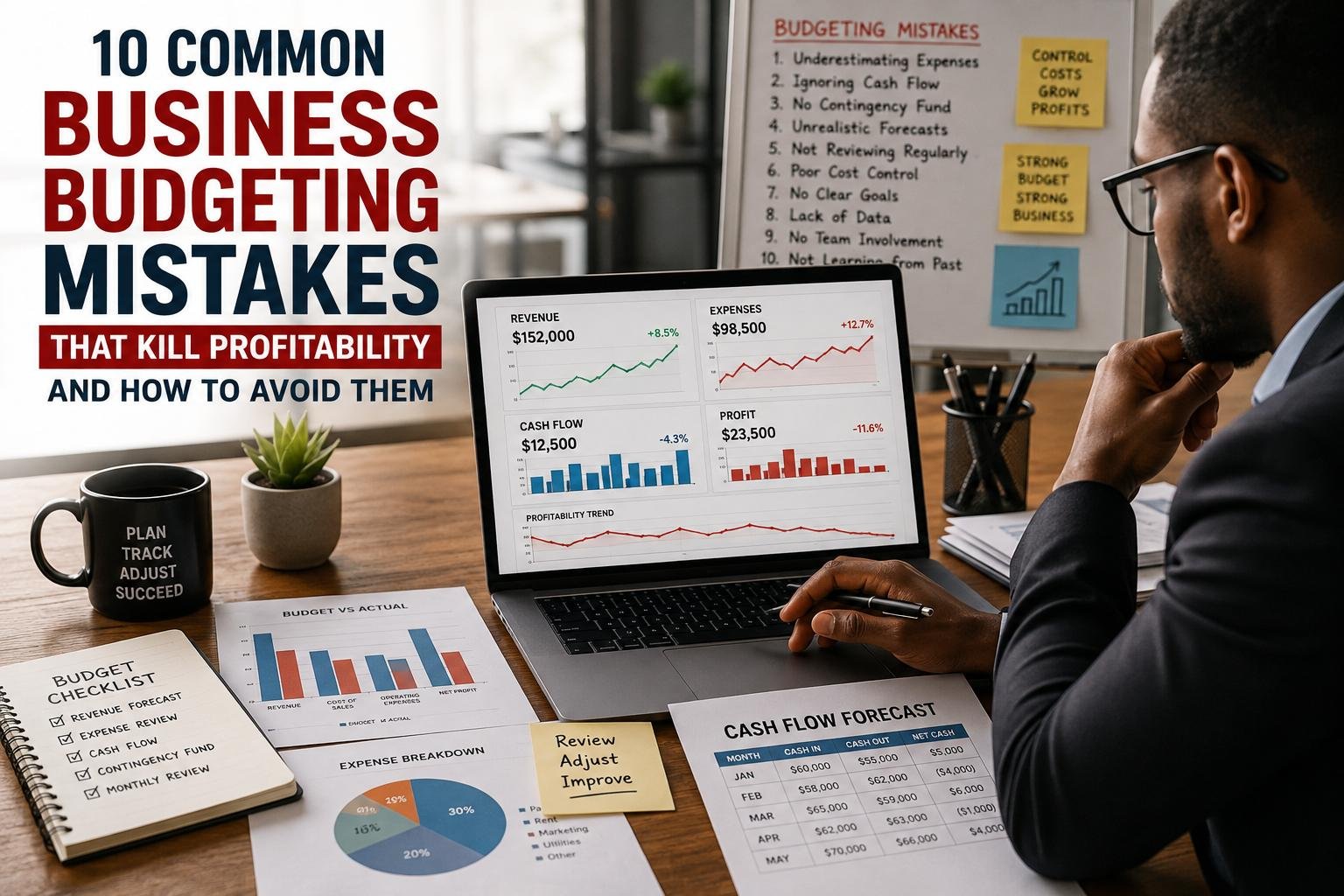
A business budget is more than just a worksheet with a list of what you anticipate to earn and what you anticipate spending. A financial roadmap that can assist the owner(s) of a business in determining the amount of money they can afford, where their money should go, whether they will be profitable or not, and what they must do or not do in the event their financial performance is not where they had hoped. Unfortunately, many businesses put together a budget but are neglectful about plugging in numbers or they don’t adjust the numbers if there is a change in circumstances. This can lead to seemingly small financial oversights becoming larger issues like a decline in profits, trouble with cash flow, too much debt, too many out of control costs, and missed growth opportunities. Thus, it is critical for entrepreneurs, startup founders, managers and small-business owners to know what common budgeting errors to look out for to maintain profitability. A good budget should not just be a forecast of what a company might expect, but it needs to be a realistic plan for monitoring the business for risks, cost control and improving financial decisions during the year.
Why Business Budgeting Mistakes Can be so expensive
Financial decisions are interrelated and can have a negative impact on profitability if there’s a budgeting error. If one expense is underestimated in a business, the impact could be more than just on that line item. An increase in operating costs may be detrimental to cash flow, either because it results in a decrease in cash or a delay in paying suppliers or an increase in borrowing, or a reduction in marketing or investment activities. Likewise, if a company grossly overestimates revenues it may end up hiring workers, adding to available resources, renting up bigger space, or purchasing equipment before it has enough money coming in to honor its obligations. One of the most expensive budgeting mistakes is when business owners don’t see it as a budget to be treated as a financial management tool that requires frequent upkeep. The true value of a budget is when the outcome is compared with the expectation and management digs deeper into significant variations. When businesses understand the most frequent mistakes and what they can do about them, they can create more realistic, flexible and effective budgets to help safeguard their long-term profitability.
1. Underestimating Business Expenses
A frequent budgeting error is having a low estimate of the actual business costs. Sometimes an entrepreneur can be so preoccupied with the big expenses like rent, salaries, inventory, utilities and advertising that they may forget to consider other expenses that might be smaller and not happen on a regular basis but may add up during the course of a year. These range from software costs, equipment repairs, professional fees, bank fees, insurance renewal, transportation, employee training, licenses, taxes and replacement of damaged assets. Another common error is basing costs on old prices or assuming that prices won’t change from the suppliers over the course of the budgeting period. Expenses can vary due to inflation, currency fluctuations, shifts by suppliers and changing customer needs. Businesses can avoid this by analyzing their past expenditure, requesting new supplier quotes (if any), breaking down fixed and variable costs and identifying any costs that are recurring or periodic. Including contingencies for unknown costs can also help to stop unknown costs from taking a toll on profitability right away.
To avoid under-estimating the expenses:
An effective method for refining expense estimates is to review the last three to 12 months of financial information and identify regular, seasonal, irregular and unexpected expenses. Rather than copying last year’s numbers, management should find out why each of these major expenditures was made and if the same expenditure will be made again. Other factors to take into account are anticipated price rises, planned expansion, new hires, new equipment, regulatory changes and changing supplier contracts. Sometimes it’s more useful to have a range of expenses, rather than just a single number, if the expense you’re trying to forecast isn’t exactly measurable in advance. For instance, if actual maintenance costs in the past have ranged from $8,000 to $13,000 a year, the management can develop a more realistic allowance for annual maintenance based on the available data. This method generates a budget that is less susceptible to the effects of normal ups and downs in the business and provides decision makers with insight into the actual cost of conducting the business.
2. Spending money that you don’t have
One of the other big budgeting errors is to think that if the company is profitable, it should have sufficient cash flow to pay its bills. Profit and cash flow are much related but not synonymous. Meanwhile, a business can take a turn for the worse, making good sales and even accounting profits, but not yet be able to meet its needs, such as paying suppliers, employees, lenders, or paying its taxes, because its customers haven’t paid their bills yet. This is a problem that is especially prevalent in businesses that extend credit to customers and/or have large discrepancies between their income and expenses. An income and profit-only accounting system can thus give a false sense of well-being. Businesses should create cash flow forecasts along with their operating budgets to help them determine when cash inflows might not be adequate to meet cash outflows. By tracking receivables, payment terms, inventory purchases, debt repayments, payroll, taxes and other commitments of cash, management can plan ahead for potential shortages to be emergencies rather than actual ones.
How to add cash flow to the budget
A realistic cash flow forecast should be drawn up to indicate where cash will be coming into and going out of the business. In this forecast the timing for the customer’s payment must be taken into consideration and not simply net sales converted into cash on the spot. For instance, a company might sell $50,000 in products during January and the customers would have 60 days to pay, but most of this revenue would probably not be received to pay any of the company’s bills in January. Meanwhile, suppliers might need to be paid in 30 days or less, resulting in a temporary cash shortage. These differences in the timing of cash flow can be identified by a rolling cash flow forecast, which can then help management plan and make decisions accordingly. If there’s a risk of a shortage, the business can be able to discuss the terms with the suppliers, speed up the collections from customers, delay on the purchases of non-essential items or even finance the purchases in advance. Cash flow forecasting is particularly crucial for a startup and a growing company as it can require more cash for inventory, receivables, staffing, and other operating needs.
3. Not having a Contingency Fund,
It’s no secret that businesses are subject to unexpected events, but many budgets are based on the premise that everything will go according to plan. This means that companies can find themselves in a difficult position when they break down, sales aren’t as high as expected, the supplier charges more, the customer does not pay, or any other emergency situation arises that needs an immediate expenditure. If the company relies on a contingency fund, it would be able to liquidate the fund to pay an unanticipated bill, delay critical bills, take out a loan, draw from personal assets or cut essential activities. A contingency reserve offers financial flexibility and helps to make your business more resilient. This will vary based on the size of the company, risk profile, industry, fixed costs and external financing. A company that is small and only in the service industry might have a different need than a company that has more expensive machinery and inventory needs and is in the manufacturing business. The key is to be proactive in setting up a reserve, not taking it for granted that there will be unforeseen expenses that will fall through the cracks in normal operating cash.
4. Using the Budget as a One-time Document.
Another frequent pitfall is to make a budget in the beginning of the year and then forget about it for the rest of the year. The situation of the business may change drastically after the budget has been approved. Sales could be higher or lower than anticipated, costs with the supplier may increase, new competitor(s) may come to market, customers may alter their buying habits, or the management of the company may launch new products and services. Without a change in the original budget it can so easily become detached from reality. A budget should thus be continually reviewed and not be thought of as a prediction for forever. Monthly reviews are especially helpful as it provides management the opportunity to compare actual revenue and expenses to the budgeted amounts and recognizes that there may be significant differences and if so, what needs to be done to rectify. It doesn’t mean that the budget needs to be rewritten month after month. Rather, they are about applying real financial data to make sure that all the original assumptions continue to be reasonable and to make any needed adjustments to the assumptions when conditions have materially changed.
Budget Reviews are a crucial part of financial management and are essential to improving financial control.
Frequent budget audits can help businesses spot issues early and prevent them from turning into costly issues. If a company’s operating expenses are $20,000 each month, but it actually pays $24,000 each month for three consecutive months, what is the average monthly operating expense for the company? If a company normally spends $20,000 a month on operating expenses, but in three months it actually pays out $24,000 each month, what is the average monthly operating expense for the company? The $12,000 annualized over expenditure could grow until the end of the financial year without adequate action. Reviewing the issue each month might show up the issue early and motivate administration to figure out if the climb has been due to rising costs, unnecessary spending, and ineffectiveness in the workplace or a legitimate business change. Variance analysis can then be used to identify favorable from unfavorable outcomes and explore the causes for such outcomes. The regular reviews also bring accountability, as department managers will be able to see how they are spending, and how this compares to the approved plans. This will lead to more accurate budgeting assumptions over time, and enable management to create future budgets based on actual business experience as well as estimates.

5. Unrealistic Revenue Forecasts
It’s just as bad to overestimate revenue as to underestimate expenses. Any entrepreneur would be pleased about his products, services and growth plans but a budget prepared on the basis of unrealistic sales figures can provide false sense of financial security. Management’s expectations of a significant rise in sales may lead to the approval of new employees, to the expansion of inventory, to the expansion of office space, to the purchase of new equipment, or to an increase in expenditure on advertising. When those sales fail to materialize, the company could find that its fixed costs are too high and that it’s not generating enough revenue to cover them. Such revenue estimates must be based upon facts and not on optimism. Past sales data, customer demand, percentages, market trends, seasons, pricing, sales pipelines, and reasonable sales potential should be considered. It is also helpful to create various scenarios for example conservative, expected and optimistic scenarios. This enables management to be aware of the impact of various revenue scenarios on costs, cash flow and profitability before investing.
6. Failing to Separate Fixed and Variable Costs
When management knows that the expenses of a business vary because of the volume of business, and that certain expenses are fairly constant, the budget will be made more useful. The costs may also be either fixed or variable, for example some rent may be fixed, insurance premiums may be fixed, and salaries may be fixed, whilst the raw material, sales commission, packaging, delivery, transaction fees costs may vary depending on sales. It is important to recognize these categories separately so that it will be easier to appreciate the impact of changes in income on profitability. For instance, if a company is growing quickly and feels its sales are proportional to its earnings, it might be the case that it’s actually spending much more money to sell those items, whether it’s money on inventory, delivery or labor. Accurately calculating contribution margins, estimating break-even points, and predicting how much more revenue is needed to cover additional expenses are among the many things a company can do by categorizing the expenses properly. This information can also be found useful in pricing decisions as a manager can decide whether a product or service can contribute to the margin that is required to deliver the product or service.
7. Not Taking Seasonality into Account.
Some companies for example may have a month where they make a lot of money and then another where they have a reduced amount of money, but budgets may assume that the monthly performance is relatively even. Retailers can see an increase in sales on holidays, tourism enterprises can be very seasonal, educational enterprises have academic seasons, and agriculture businesses can have production seasons. These patterns can lead to wrong forecasts and false cash flow considerations. If a business is seeing its performance fall short on a month when it is naturally slow, it may seem like they are doing poorly when in reality they’re doing exactly what they’re supposed to do. On the other hand, if revenues are high in certain seasons of the year, it can mislead investors into thinking that the business would perform in a similar manner all year round. Businesses should review past monthly/quarterly data and look for any seasonal trends that may be present to prevent this. Expected fluctuations should be taken into account in revenue and expense forecasts. Seasonal planning can also help companies anticipate periods of higher revenue and more effectively save cash to handle those leaner times without the need for any extra borrowing or cutting costs.
8. Planning for Unknown Business Objectives
A budget can be ineffective if it is not designed to link budgets to business goals. The mere allocation of figures in between revenue and expenditure categories is not sufficient on explaining the goals of the organization. A more effective budget means that a company’s finances are tied to a quantifiable objective like growing gross profit, customer retention, a new market, cutting manufacturing costs, growing sales, or the efficiency of operations. For instance, a business could choose to raise their marketing spend by 20 per cent but the extra expense should be put towards a specific goal and a quantifiable result. Management should seek to understand what they are investing for and how they will measure the success of their investment. Having clear goals also helps prioritize your spending when there is a limited amount of money available. Management may ask if a proposed expense is going to make a significant impact on a strategic goal or operation, if it does not, it should be removed from the budget. This ensures that financial resources are not allocated due to them being a part of previous budgets.
9. Lack of Skills and Experience
It’s important to never have one person or one department be solely responsible for budgeting. Although the finance and accounting team might be responsible for coordinating the process, department managers and operational staff members may have important information regarding expected costs, customer behavior, staffing needs, supplier changes and any other practical considerations affecting the business. Including these individuals could lead to unrealistic assumptions. The accountant, for instance, might have estimates of last year’s inventory costs and the procurement manager knows that one of the larger suppliers has announced a price increase. Likewise, a sales manager might know about a huge deal with a key client that could drastically influence expected sales figures. Engaging the right parties can enhance the quality of assumptions, and place more accountability on the budget. But careful control of participation is needed. The budgeting process should not be a bargaining method for departments to raise their budgets higher. Management should demand proof, clarifications and quantification of goals for substantial increases in budget.
10. Not learning from past budget performance
The final key error is to develop a new budget without good lessons learned from the previous one. Historical budgets are useful to adjust the accuracy of the management’s financial forecasts, including revenue and expenditures, cash flow, and other financial considerations. This will create the same issues every time the company repeats the same budgeting process if the company is repeatedly under budgeting its ad spend and over budgeting its sales, or omitting annual maintenance expenses. The difference between the budgeted amount and the actual amount should be compared at the end of each reporting period and significant differences should be investigated. The goal is not to point fingers but to learn from the incident what was happening and what the assumptions were that needed to be changed to prevent it from happening again. Management should question why the variance occurred – it may have been because of an incorrect forecast, unforeseen events, cost control, operational inefficiency or a strategic change. The lessons learned should then be a part of future budgets. This then forms a process of continuous improvement, and each budgeting cycle is an opportunity for the next one to be more accurate and useful.
How to Generate a more Reliable Business Budget.
Making budgeting errors is a process one needs to avoid, rather than being the making of more detailed spreadsheets. The first step is for a business to set realistic revenue expectations that consider past performance, market conditions, customer demand, and a realistic growth goal. All expenditures should be carefully classified and backed as much as possible by reliable information. Fixed costs, variable costs, one off costs, seasonality costs and discretionary expenditure need to be distinguished from each other in order to give management insight into the impact of various changes on profitability. A cash flow forecast should be drawn up with the operating budget and there should be a contingency reserve in place to cover any unforeseen events. It is also important for businesses to create a time frame for monthly or quarterly budget reviews and establish the metrics that they will track. They might be revenue growth, gross margin, operating expenses, net profit, cash balance, accounts receivable, levels of inventory, and significant budget differences. The most crucial part of the budget is to link it to the organization’s strategic priorities so that all major spending decisions can be checked against a sense of business purpose.
Conclusion
Business budgeting errors can be covert that gradually diminish profits until management is aware that there is a serious financial issue. Inadequate accounting, cash flow management, absence of a contingency plan, overly optimistic “predictions” in revenue projections, failure to account for seasonality, and not recognizing that the budget is a living document can all affect a company’s finances. You don’t have to have a complex budget with hundreds of financial categories. Rather, it is important to have a practical, flexible and regularly reviewed financial plan, based on real operating conditions. Historical financial data, realistic assumptions, cash flow forecasting, scenario planning, contingency reserves and variance analysis should all be used to bolster the budgeting process for entrepreneurs and startup founders. If things don’t go as planned the goal should be to find out why and take prompt action. A managed budget is then no longer a forecast of income and expenditure, but a true planning and management tool for managing costs, maintaining margins, planning for uncertainty and enabling sustainable business growth.
Get more well researched information about Business budgeting mistakes here.