Introduction
A modern software application should be able to run several processes efficiently, be responsive and reliable. In more complex use cases, having to do each step one at a time could be a performance bottleneck, particularly if programs have to handle large volumes of data, serve multiple users or run multiple operations at the same time. The answer is to manage multiple tasks in a single process, which is achieved by multithreading and concurrent programming.
In operating systems that are based on UNIX, developers typically use the POSIX threads (pthreads) to create and manage multiple threads of execution that run concurrently and share memory and other resources of the process. To create responsive, scalable and efficient applications, it is crucial to understand how threads work, how they communicate and how shared resources are protected.

What is Multithreading in UNIX
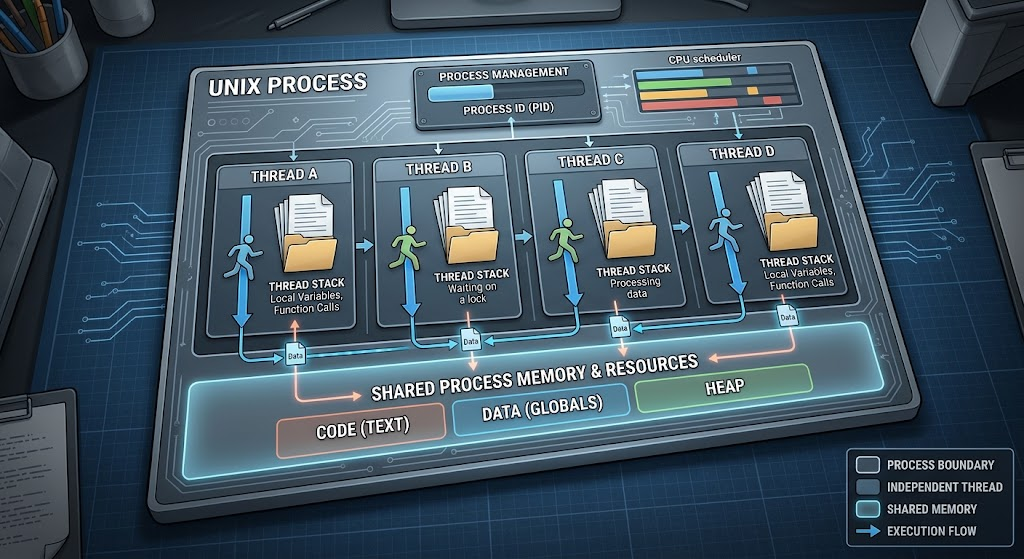
Multithreading is a programming paradigm that lets multiple threads of execution execute inside of a single application, or process. Each thread is a collection of instructions that can carry out a specific operation. Although each thread runs in its own program address space (and therefore has its own virtual memory address space), there are also shared resources such as global variables, heap memory, and open file descriptors. Each thread, however, is assigned an execution state, such as a stack and the processor registers. The shared-memory approach allows communication between threads to be fairly efficient since the common data can be shared without the need for more costly interprocess communication mechanisms.
Multithreading is beneficial in UNIX systems because it enables to run different operations in an application without waiting for the operations to be completed. For instance, the web server may have separate threads to handle incoming client requests and another thread to do background maintenance. Likewise, a database application can process queries, manage transactions and perform background operations simultaneously. In modern multi-core processors, multiple threads can be executed concurrently and in systems with one processing core, the core can execute multiple threads, switching between them to create the illusion of parallel execution. While multithreading might enhance the performance and responsiveness of the application, it requires good coordination of access to shared resources among threads to avoid unpredictable behavior.
The Concepts of Concurrency and Parallelism
Concurrency and parallelism are two closely related topics in programming that are distinct in the way they are executed. Concurrency as used in computer science refers to the overlap of execution for a number of tasks over a period of time. This can be accomplished in an operating system by switching between threads, giving each thread processor time based on scheduling decisions. This is especially useful for applications that access the network, access files, query databases, etc., that commonly block until they receive an external response.
Parallelism instead, means having multiple tasks running in parallel on different processing units or processor cores. For instance, a computer with 8 CPU cores could run multiple concurrent threads where the operating system and application scheduling permits. For tasks that require a lot of computation, parallel processing can potentially decrease processing time. But concurrency does not necessarily mean parallelization or better performance. Concurrent applications need to be designed taking into account processor availability, workload pattern, synchronization needs and overheads associated with creating and managing threads.
What are the POSIX Threads (Pthreads)?
Portable Operating System Interface (POSIX) is a standardized threading interface known as pthreads, or more popularly as “POSIX threads. They offer the functions which enable developers to create, manage, synchronize and terminate threads on compatible operating systems. UNIX-like systems such as Linux and Mac OS support pthread programming and are a popular method of creating a multithreaded program in C or C++. Developers may choose to share memory and other process resources by breaking an application into smaller execution units with pthreads, instead of having to create separate processes for each operation.
Some of the important functions in the pthread library are pthread_create(), pthread_join(), pthread_exit(), pthread_mutex_lock(), and pthread_mutex_unlock(). These functions enable the control of the execution of threads and coordination of access to shared resources. Pthreads also have additional synchronization tools like condition variables and thread attributes that affect the creation and management of threads. Many Linux systems include pthread functionality in the system’s C library, and can access the POSIX threading interface by including the pthread header file and linking to the pthread support option during compilation.
Essential Features of the POSIX Threads Programming Standard.
Pthreads can be used in UNIX application development for the following reasons:
- Shared memory: threads in one process can access shared global variables, dynamically allocated memory and other shared resources.
- Independent execution: Each thread has its own execution state and can do different things.
- Thread synchronization: Mutexes, condition variables, and other synchronization mechanisms are used to coordinate access to shared resources.
- Portability: Many UNIX-like systems support the POSIX standard for a consistent interface to threading.
- Shared memory: Threads can communicate through shared memory without having to use separate interprocess communication mechanisms.
- Flexible management: Developers can make, join, detach and terminate threads as per application needs.
These are all features that are useful in the development of an application that has to deal with multiple operations efficiently.
Creating and Managing Threads in UNIX
One of the primary concerns of programming with multiple threads is thread creation. C uses the pthread_create() function to create a new thread in an existing process. The function takes a pointer to the thread identifier, optional thread attributes, a function to run in the new thread and an argument to pass to it. Once created, the new thread will start running its function independently from the calling thread. This enables an application to break up its work into different operations rather than running them one after another.
The developers have to include the pthread header file prior to using the pthread functions. They should also make sure that the compiler uses the proper threading support for the application. The following example shows how to write a simple thread that will run a different function.
Using pthread_create() to create a Thread Example:
#include <stdio.h>
#include <pthread.h>
void *print_message(void *arg) {
printf(“Hello from the new thread!\n”);
return NULL;
}
int main() {
pthread_t thread;
pthread_create(&thread, NULL, print_message, NULL);
pthread_join(thread, NULL);
printf(“Main thread finished.\n”);
return 0;
}
If you’re compiling on Linux, do so using the following:
Run: gcc thread.c -o thread -pthread
To execute it:
./thread
In this case, pthread_t is storing the identifier of the newly created thread, and pthread_create() is starting the print_message() function in that thread. The pthread_join() function makes the main thread wait until the new thread finishes execution. This is significant because if the main program terminates before the created thread does the work assigned to it, this thread will be left hanging. The example illustrates the simplest form of pthread programming, but in a real application, you may have multiple threads and each thread processes a different argument.
Understanding Thread Termination
An application may terminate in various ways or have several points of termination. A thread typically ends its execution at the end of the function to which it was assigned, but it may also end its execution explicitly by calling pthread_exit(). The other thread can be blocked for completion with pthread_join(), enabling the application to gather the termination status of the other thread and coordinate the application. A thread can also be detached from via pthread_detach(), which will free up its resources when it has completed its execution automatically without having to join it with another thread.
Care needs to be taken in selecting an appropriate termination strategy to ensure no resource leaks or unexpected behavior of the application. The joining of joinable threads should be done eventually, so that the resources can be recovered. Detached threads are useful when there is a task running in the background that does not need another thread to get back to it. It’s also important to developers to realize that killing a thread does not mean all shared resources are safe. A thread may leave a shared data inconsistent or be holding a mutex when it exits, leading to synchronization issues for other threads. Therefore, resource management should be a part of the thread lifecycle design for the application.
How Multiple Threads are Executed in C Program
A big advantage of pthreads is that multiple threads can be created and each one will execute a different task in the same application. Developers can split the work into multiple threads, rather than all in one execution sequence. It can be helpful in applications where the data is independent and not being used by another program, for background processing, or when multiple requests are being handled. For instance, one program may spawn three worker threads: one of which performs one task, another another task, and the third a different task, with the main thread managing the sequence in which the tasks are processed.
The next example shows an example of multiple threads performing the same function simultaneously.
For instance, creating Multiple Threads.
#include <stdio.h>
#include <pthread.h>
void *worker(void *arg) {
int id = *(int *)arg;
printf(“Thread %d is running”,”d”, id);
return NULL;
}
int main() {
pthread_t threads[3];
int ids[3] = {1, 2, 3};
for (int i = 0; i < 3; i++) {
pthread_create(&threads[i], NULL, worker, &ids[i]);
}
for (int i = 0; i < 3; i++) {
pthread_join(threads[i], NULL);
}
printf(“All threads have finished.\n”);
return 0;
}
In this program, three threads are created by using a loop. Identifiers are assigned to each thread of execution and the worker function is the same for each. The main thread then issues pthread_join(), calling each one of the three threads it created, to make sure all three threads complete before the program terminates. The sequence of the messages will not be preserved because the operating system decides when each thread will be given processor time. One of the key points of concurrent programming is that the threads are not necessarily executed in a particular order; for instance in this example, thread 2 may finish before thread 1.
The Locks in a Thread
Memory sharing may provide better responsiveness in an application, but presents problems for developers. If access to a variable or data structure is not properly coordinated, then the operations of multiple threads can interfere with each other. An example of this is two threads that try to update a shared counter at the same time, which results in one update being overwritten. Synchronization offers methods for managing the access of threads to shared resources and allows operations to take place in a safe and predictable way.
Mutexes, condition variables and semaphores are some of the synchronization mechanisms that can be implemented using posix threads. Each mechanism is able to solve specific coordination needs. Mutexes are used to safeguard critical sections, condition variables are used to wait for particular conditions, and semaphores can be used to control access to a limited resource or to coordinate operations. Depending on the application’s design and the nature of interaction between the threads, the right synchronization mechanism must be selected. Even a program that runs successfully during initial tests can give varying results when it is subjected to heavier usage or other test conditions without proper synchronisation.
Understanding Race Conditions
A race condition is when the outcome of a program relies on an unpredictable sequence or timing of operations by concurrent operations of multiple threads. It is often caused when threads are using shared data concurrently and at least one thread is changing the data without proper synchronization. For example, let’s use a common counter that starts with the value of zero. Two threads could read the initial value for the counter before one thread writes its increment and the other writes its increment. This means that the last counter could end up as a single counter rather than two counters.
Identification of the races is challenging because they may not show up regularly. A program may run properly for one test but fail for another, due to the different scheduling of threads. Examples of these problems are especially critical in financial transactions, database records, inventory systems and other applications where the consistency of data is critical. To minimize race conditions, developers can recognize variables that are shared, protect critical sections, minimize unnecessary shared state, and employ proper synchronization techniques. Other debugging tools and thread sanitizers can also be used to help find unsynchronized memory accesses during development.
For shared data, use Mutexes to protect it.
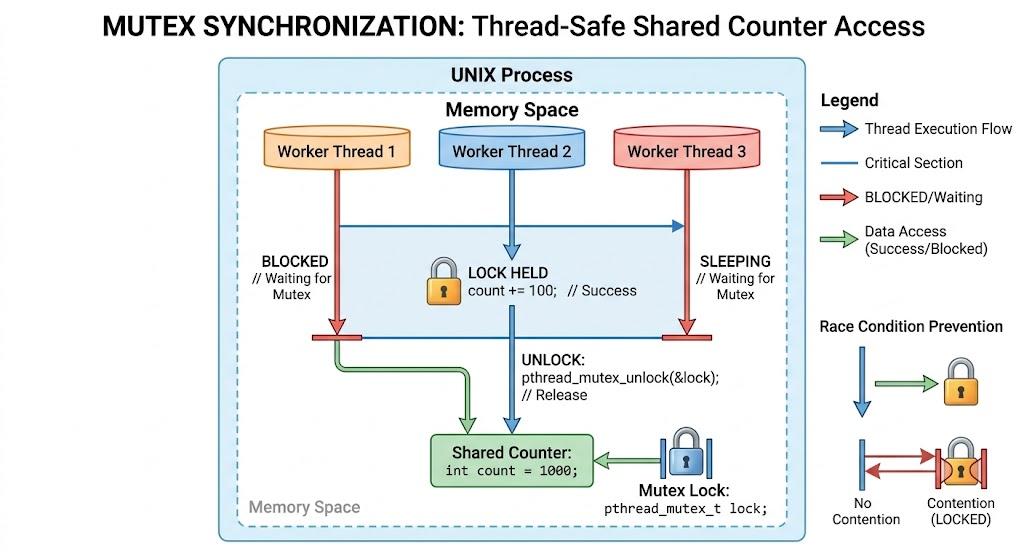
Mutex (mutual exclusion): This is a synchronization mechanism which ensures that only one single thread can access a protected critical section at a time. If a thread is able to lock a mutex, other threads trying to lock it are blocked until the current thread unlocks it. This is to avoid the possibility of two or more threads simultaneously updating data to which they have access protection and to ensure consistency. POSIX threads offer functions to use for managing mutexes during an application’s life cycle, including pthread_mutex_init(), pthread_mutex_lock(), pthread_mutex_unlock(), and pthread_mutex_destroy().
Mutexes are especially useful for use when multiple threads are trying to update a common counter, modify a common data structure, or access a resource that is not able to accept simultaneous access. Note however that critical sections should be as short as they can be reasonably made since other threads may still be blocked while another thread is holding a mutex. Having a mutex for long periods of time when unnecessary can have a negative impact on how concurrent an application is and how it performs. Also it is necessary to make sure that each mutex successfully acquired is released in a proper manner including in case an operation fails.
The Mutex can be used to protect a shared counter.Example: Protecting a shared counter with a Mutex.
#include <stdio.h>
#include <pthread.h>
int counter = 0;
pthread_mutex_t lock;
void *increment(void *arg) {
for (int i = 0; i < 100000; i++) {
pthread_mutex_lock(&lock);
counter++;
pthread_mutex_unlock(&lock);
}
return NULL;
}
int main() {
pthread_t t1, t2;
pthread_mutex_init(&lock, NULL);
pthread_create(&t1, NULL, increment, NULL);
pthread_create(&t2, NULL, increment, NULL);
pthread_join(t1, NULL);
pthread_join(t2, NULL);
printf (“Final counter value: %d\n”, counter);
pthread_mutex_destroy(&lock);
return 0;
}
This is an example of two threads repeatedly incrementing the same counter. If not synchronized, there may be an overlap and they may yield a wrong outcome. The mutex will stop both threads trying to modify the counter at the same time so that each one can modify the counter before the other thread enters the protected section. Each thread is supposed to be doing 100,000 increments, and the total should be 200,000. The example illustrates one of the simplest synchronizations that can be used to ensure that shared data stored in a multithreaded application is not accessed in a “race condition”.
Understanding Condition Variables
Condition variables: Synchronization mechanism(s) used to wait for a condition to be met. Condition variables are used for coordinating communication between threads, unlike mutexes which are mainly used to protect shared resources. They are generally used when one thread generates data that is required for another thread to use. For instance, a worker thread may block until a task arrives, and another thread may notify that new tasks are queued up in a common queue.
The pthread_cond_wait(), pthread_cond_signal(), and pthread_cond_broadcast() functions are provided by POSIX threads to work with condition variables. A condition variable typically works in conjunction with a mutex due to the fact that the condition being checked must be immune to concurrent modification. If called by a thread, pthread_cond_wait() atomically unlocks the thread’s corresponding mutex and waits for a notification to occur. Once it receives a signal it reacquires the mutex before continuing. When writing inside a loop, always verify the real condition inside the loop as the threads may wake up in an unexpected way or receive notifications that the condition is no longer true.
Consider the following example to use a Condition Variable.Example: Using a Condition Variable.
#include <stdio.h>
#include <pthread.h>
pthread_mutex_t mutex = PTHREAD_MUTEX_INITIALIZER;
pthread_cond_t condition = PTHREAD_COND_INITIALIZER;
int ready = 0;
void *worker(void *arg) {
pthread_mutex_lock(&mutex);
while (!ready) {
pthread_cond_wait(&condition, &mutex);
}
printf(“Worker got the signal.\n”);
pthread_mutex_unlock(&mutex);
return NULL;
}
int main() {
pthread_t thread;
pthread_create(&thread, NULL, worker, NULL);
pthread_mutex_lock(&mutex);
ready = 1;
pthread_cond_signal(&condition);
pthread_mutex_unlock(&mutex);
pthread_join(thread, NULL);
pthread_mutex_destroy(&mutex);
pthread_cond_destroy(&condition);
return 0;
}
In this case the worker thread is waiting on the shared ready variable to become true. The main thread acquires the mutex, changes the variable, and releases the mutex and signals the condition variable. Upon notification, the worker recovers the mutex, then tests the condition and proceeds. The pattern is helpful in producer-consumer architectures, queues, and systems that process in the background where threads need to wait for specific events instead of continually polling for work.
The Concept of Semaphores in Multithreaded Programming
Semaphores are synchronization mechanisms that use a counter to control access to shared resources or synchronize operations among threads. A counting semaphore is similar to a mutex as it normally allows only one thread to possess the resource, but can also be made to allow multiple threads to access the resource as long as the number of threads does not exceed a defined limit. A semaphore with five elements can be used, for instance, to prevent any more than five workers acquiring the same set of five database connections simultaneously, if the application has five such connections.
The <semaphore.h> header file implements semaphores in POSIX. Some of the important operations provided are sem_init(), sem_wait(), sem_post(), and sem_destroy(). A thread uses sem_wait() to run a semaphore unit and sem_post() to give up a unit for other waiting thread(s) to run. Once the counter is empty, other threads need to wait for the creation of a unit. Semaphores can be used for resource management, producer-consumer coordination and to restrict concurrent operations. The important thing to note, however, is that semaphore units have to be released appropriately as otherwise threads may deadlock or may be allowed to use limited resources too often.
Deadlocks in Multithreaded Applications.
A deadlock is a situation in which two or more threads are waiting for each other indefinitely for a resource. This can occur if the application has several mutexes and different threads obtain them in reverse order. For instance, one thread could have resource A locked, and wait for resource B, and another thread could have resource B locked and wait for resource A. Neither thread is able to go on because each has waited for the other to free its resource.
Though an app’s various threads may be running according to their instructions, a deadlock can render it unresponsive. Developers can minimize the chances of deadlocks by implementing some “rules of order” for how the locks are acquired, avoiding unnecessary “nested locking”, and minimizing the time that resources are locked. Most importantly they should think carefully about what they want to do when adding new features, as they may cause new locking dependencies if they introduce a new mutex. A suite of deadlock detection tools, thread debugging facilities, and well-thought-out resource-management strategies can be used to help detect and prevent these issues before an application is deployed.
Common Causes of Deadlocks
Several conditions can contribute to deadlocks in multithreaded programs:
- Mutual exclusion: A resource can be accessed by only one thread at a time.
- Hold and wait: A thread holds one resource while waiting for another.
- No forced preemption: Resources cannot always be taken away from the threads holding them.
- Circular waiting: Threads form a cycle in which each waits for a resource held by another.
Preventing circular waiting through consistent lock ordering is one of the most practical ways to reduce deadlock risks.
Common Challenges and Limitations of Concurrency
Although concurrency offers significant advantages, multithreading is not automatically beneficial for every application. Creating and managing threads introduces overhead because the operating system must allocate resources, schedule execution, and switch between threads. When an application creates too many threads, scheduling overhead and memory consumption can increase significantly. Additionally, if most threads spend their time waiting for the same mutex or resource, adding more threads may not improve performance because they cannot make useful progress simultaneously.
Another limitation is that not every workload can be divided into independent tasks. Some operations depend on the results of previous calculations, making parallel execution difficult without introducing synchronization overhead. Multithreaded applications are also more complicated to develop, test, and maintain because thread scheduling can make bugs difficult to reproduce. Furthermore, applications may experience cache contention, memory bandwidth limitations, and other hardware-related bottlenecks. Developers should therefore measure actual performance improvements rather than assuming that adding threads will always make an application faster. Effective concurrency requires careful workload analysis, appropriate thread counts, and efficient synchronization.
Debugging and Testing Multithreaded Applications
Debugging concurrent programs requires a different approach from debugging ordinary sequential applications. Because multiple threads execute independently, problems may depend on timing, processor scheduling, and the order in which shared resources are accessed. A race condition that appears during heavy testing might disappear when debugging tools slow down execution. Similarly, deadlocks may occur only when several threads attempt to access resources in a particular sequence. Developers must therefore use tools and testing strategies designed to identify synchronization problems and understand thread behavior.
Several tools are useful when developing and debugging pthread applications. GDB allows developers to inspect running programs, examine individual threads, and investigate execution states. ThreadSanitizer can detect many data races during testing, while Valgrind’s Helgrind tool helps identify synchronization errors and potential threading problems. Developers can also use logging, performance profiling, stress testing, and controlled test environments to investigate unexpected behavior. These techniques help identify problems that may not appear during ordinary application execution.
Useful Debugging Techniques
1. Thread inspection with GDB
GDB supports multithreaded debugging and provides commands for examining thread execution. Developers can use commands such as info threads to list active threads and thread to select a particular thread for inspection.
2. ThreadSanitizer
ThreadSanitizer is a runtime analysis tool that detects many data races in supported C and C++ programs. Developers can enable it during compilation using:
gcc -fsanitize=thread -g program.c -pthread -o program
This allows the program to be tested for certain concurrency-related memory access problems.
3. Valgrind Helgrind
Helgrind is a Valgrind tool designed to detect threading-related errors, including certain data races and synchronization problems. It can provide useful information when investigating complicated pthread applications.
4. Stress testing
Stress testing involves executing an application under demanding conditions, such as many simultaneous requests or repeated operations. This can expose synchronization problems that may remain hidden during ordinary testing.
5. Logging and performance profiling
Developers can add thread identifiers and timestamps to application logs to understand execution sequences. Profiling tools can also reveal whether performance is limited by processor usage, synchronization overhead, or excessive waiting.
Combining these techniques provides a more reliable approach to diagnosing and improving multithreaded applications.
Real-World Applications of UNIX Multithreading
Multithreading is widely used in modern software because many applications must handle multiple operations without delaying other tasks. UNIX-based operating systems provide an environment where developers can use pthreads to create scalable applications that process concurrent workloads.
From database management to financial computing, threads help applications organize independent operations, improve resource utilization, and respond efficiently to incoming requests. However, the exact implementation depends on the application’s requirements, hardware resources, and synchronization needs.
1. Database Management Systems
Database systems frequently use multithreading to manage concurrent queries, transactions, and background operations. When several users access a database simultaneously, the system must process their requests while maintaining data consistency. Separate threads can handle different client connections, execute queries, manage background maintenance, and perform other database operations.
Synchronization mechanisms help prevent conflicting modifications to shared database structures and internal resources. Multithreading also supports efficient resource utilization when database workloads involve a combination of computation, disk operations, and network communication. However, database systems must carefully coordinate transactions and locking mechanisms to prevent inconsistent data and excessive contention.
2. High-Performance Web Servers
High-performance servers use concurrency to handle multiple incoming connections and requests. A server may assign individual threads to client requests or use a managed pool of worker threads to process incoming tasks. This allows the application to serve multiple users without requiring every request to wait for the previous one to finish.
Threads can handle network communication, process request data, and coordinate background operations. However, creating a separate thread for every connection may become inefficient when a server handles thousands of simultaneous connections. For this reason, developers often combine multithreading with event-driven programming, asynchronous input and output, and thread pools to balance responsiveness with resource consumption.
3. Financial Applications
Financial systems depend on accurate and timely processing of transactions, market information, account updates, and analytical calculations. Multithreading can help these systems perform independent operations concurrently, reducing delays when processing large volumes of information. For example, different threads may handle incoming market data, calculate financial indicators, update application interfaces, or process separate requests.
However, financial applications require particularly careful synchronization because incorrect access to shared information can produce inconsistent account balances or transaction records. Developers must ensure that operations requiring atomicity and consistency are properly coordinated. Effective thread management allows financial applications to process workloads efficiently without sacrificing the reliability of critical operations.
4. Scientific and Computational Workloads
Scientific applications often perform calculations involving large datasets, simulations, numerical models, and mathematical operations. Many of these workloads can be divided into smaller independent tasks that execute concurrently. For example, a scientific program may assign different portions of a dataset to separate threads for processing. On multicore processors, these threads can execute simultaneously and reduce the time required to complete computationally intensive operations.
Multithreading is also useful in image processing, machine learning, engineering simulations, and data analysis. However, developers must identify dependencies between calculations and minimize unnecessary communication between threads. When workloads can be divided efficiently, pthreads provide a practical way to take advantage of available processing resources.
Best Practices for Writing Efficient Multithreaded Programs
Writing a reliable multithreaded application requires more than simply creating multiple threads. Developers must design the program around clear responsibilities, controlled resource access, and predictable synchronization behavior. Poor thread management can introduce unnecessary overhead, increase application complexity, and create difficult-to-diagnose bugs. Following established programming practices helps improve performance while maintaining application stability.
Some important practices include:
- Create threads when necessary: Avoid creating excessive threads when a smaller number of worker threads can handle the workload efficiently.
- Protect shared resources: Use mutexes or other suitable synchronization mechanisms whenever multiple threads access mutable shared data.
- Keep critical sections short: Avoid performing lengthy operations while holding locks because this prevents other threads from accessing protected resources.
- Establish consistent lock ordering: Acquire multiple mutexes in a predictable order to reduce the possibility of deadlocks.
- Manage thread lifecycles: Join joinable threads or detach independent threads appropriately so resources can be reclaimed.
- Reduce shared state: Design tasks to use independent data whenever possible, minimizing synchronization requirements.
- Test under realistic workloads: Evaluate applications with different thread counts and concurrent request volumes.
- Measure performance: Use profiling tools to determine whether multithreading actually improves execution time and resource utilization.
These practices help developers create applications that benefit from concurrency without introducing unnecessary complexity.
Conclusion
UNIX multithreading and concurrency are important techniques for developing responsive, efficient, and scalable software applications. Through POSIX threads, developers can divide application workloads into independent execution units, allowing multiple tasks to make progress within the same process. Functions such as pthread_create(), pthread_join(), and pthread_exit() provide essential thread-management capabilities, while mutexes, condition variables, and semaphores help coordinate access to shared resources. Understanding race conditions, deadlocks, and synchronization is equally important because poorly managed concurrency can introduce unpredictable behavior and compromise application reliability.
Multithreading supports many important areas of modern computing, including database systems, high-performance servers, financial applications, and scientific workloads. However, developers must recognize that concurrency introduces overhead and additional complexity, meaning it should be implemented according to the application’s actual requirements. By applying appropriate synchronization strategies, using debugging tools, minimizing shared state, and measuring performance carefully, developers can build reliable multithreaded applications that make effective use of modern multicore processors. A strong understanding of pthreads provides a valuable foundation for anyone developing advanced software on UNIX and other POSIX-compatible operating systems.