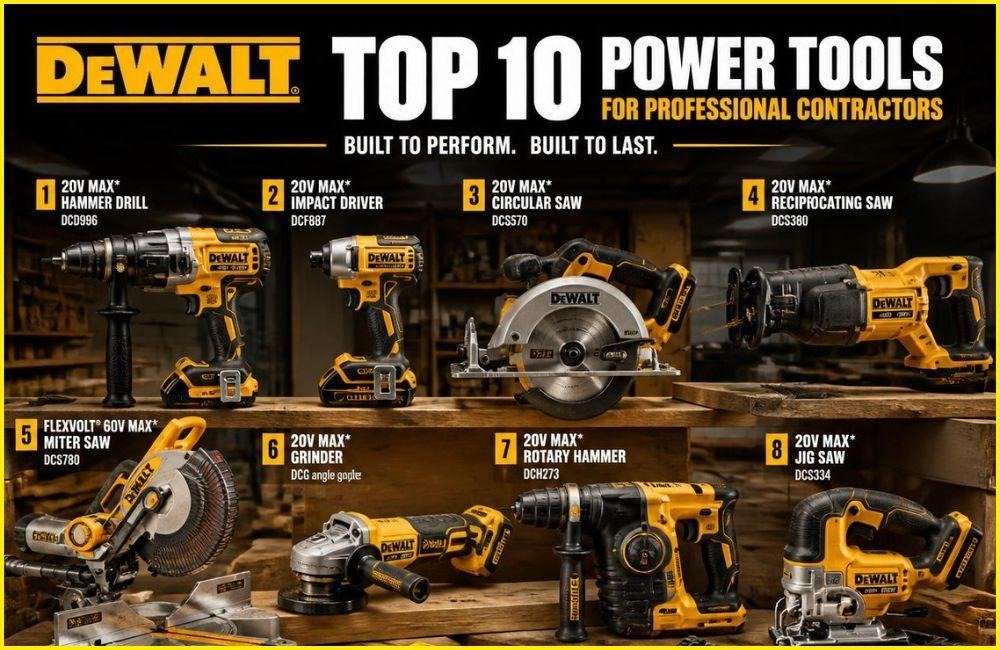
For professional contractors, the right power tool can make a noticeable difference in how efficiently a job gets done. Construction, renovation, installation, woodworking, metalworking, and maintenance projects all place different demands on equipment. A tool that works well for light drilling may not be suitable for concrete, while a heavy demolition hammer would be unnecessary for routine cabinet installation.
That is where choosing tools according to the application becomes important. DEWALT has built a broad professional tool range covering drilling, fastening, cutting, grinding, demolition, drywall work, and other demanding applications. Its cordless platforms also give contractors more flexibility when moving between job sites.
Below are ten DEWALT power-tool categories worth considering for professional contractors. Rather than focusing only on raw power, this list looks at versatility, practical applications, mobility, durability, and how each type of equipment can fit into a professional toolkit.
1. DEWALT Cordless Drill/Drivers
A drill/driver is one of the most useful tools a contractor can have because it can handle a wide variety of everyday tasks. From drilling pilot holes to installing screws, assembling components, and completing general maintenance work, it often becomes one of the most frequently used pieces of equipment on a jobsite.
Cordless models are particularly useful for contractors who move between rooms, buildings, or outdoor work areas. Without a power cord restricting movement, workers can quickly position themselves wherever the task requires.
For professional use, it is worth considering factors such as torque, speed control, chuck design, battery capacity, weight, and overall ergonomics. A compact model may be ideal for cabinetry and installation work, while a more powerful version may be preferable for demanding construction applications.
Best suited for: general construction, installation, carpentry, maintenance, assembly, and everyday drilling.
2. DEWALT Hammer Drills
When a project involves masonry or similar materials, a conventional drill may not provide the performance required. A hammer drill adds a percussion action to the rotating motion, making it more suitable for drilling into harder surfaces.
For contractors, this versatility can be valuable because construction jobs rarely involve only one material. A professional may need to drill through wood in one part of a project and masonry in another.
A hammer drill can therefore serve as a practical middle ground between a standard drill and a dedicated rotary hammer. The right choice depends on the size and frequency of the drilling work.
When selecting one, contractors should pay attention to impact performance, torque, variable-speed control, grip, weight, and battery runtime if choosing a cordless model.
Best suited for: masonry, installation work, construction, renovation, and general-purpose drilling.
3. DEWALT SDS-Plus Rotary Hammers
For contractors who regularly work with concrete and masonry, a rotary hammer can provide a significant step up from a standard drill.
SDS-Plus rotary hammers are designed around compatible SDS-Plus accessories and are particularly useful for drilling anchor holes, installing fixtures, and carrying out electrical or plumbing work in concrete and masonry.
Their dedicated hammering mechanism makes them better suited to repeated work in hard materials than a conventional drill. This can be particularly important for professionals who spend a large portion of their working day drilling into concrete.
The key is to match the tool with the scale of the job. An SDS-Plus machine can be highly practical for many installation and renovation tasks without necessarily requiring the size and impact capability of heavier demolition equipment.
Best suited for: concrete drilling, masonry, anchors, electrical installations, plumbing, and renovation.
4. DEWALT SDS-Max Rotary Hammers
When the job becomes more demanding, contractors may need equipment designed for larger and heavier applications. SDS-Max rotary hammers are intended for tougher work where greater impact capability and larger accessories are required.
These machines can be useful for drilling larger holes and handling challenging materials such as heavy concrete and masonry. They are particularly relevant to contractors involved in major construction, infrastructure, and renovation projects.
The distinction between SDS-Plus and SDS-Max is important. A contractor should not automatically choose the larger system simply because it offers more power. Bigger equipment can also be heavier and less convenient for smaller jobs.
For professionals regularly tackling substantial concrete work, however, the additional capability can justify having an SDS-Max machine in the equipment lineup.
Best suited for: heavy concrete drilling, large anchor holes, demanding masonry work, and major construction projects.
5. DEWALT Demolition Hammers
Some construction projects involve more than drilling. Removing concrete, breaking masonry, stripping surfaces, and preparing areas for renovation can require dedicated impact equipment.
Demolition hammers are designed specifically for this type of demanding work. Instead of focusing primarily on rotary drilling, their main purpose is delivering repeated impact through an appropriate chisel or related accessory.
For contractors involved in demolition and remodeling, having the right hammer can save considerable effort compared with attempting to perform heavy breaking work with a general-purpose drill.
However, demolition equipment should be selected carefully. The size and impact level should correspond to the material and scope of the job. Using equipment that is unnecessarily large can make handling more difficult, while undersized equipment may slow the project down.
Best suited for: concrete breaking, masonry removal, demolition, surface preparation, and renovation.
6. DEWALT Angle Grinders
An angle grinder is another highly versatile tool for professional contractors. Depending on the accessory used, it can be employed for cutting, grinding, deburring, and surface preparation.
For metalworkers, fabricators, maintenance professionals, and construction crews, this versatility makes a grinder particularly valuable. One tool can support several different operations, provided the correct disc or accessory is selected for the material and task.
Cordless grinders can be especially convenient on active jobsites because there is no power cable to manage. This freedom can make it easier to work around structures, scaffolding, machinery, and other obstacles.
Professional users should consider disc size, motor performance, ergonomics, safety features, battery capacity, and the type of materials they typically process.
Best suited for: metalworking, cutting, grinding, fabrication, maintenance, and construction.
7. DEWALT Oscillating Multi-Tools
Not every contractor needs a large, high-powered machine for every task. Sometimes precision and accessibility are more important than maximum power.
An oscillating multi-tool can be extremely useful for these situations. With suitable accessories, it can perform tasks such as cutting, scraping, sanding, and trimming. Its compact form also allows it to reach areas where larger tools may be difficult to position.
This makes it particularly useful during renovation and finishing work. Contractors may encounter situations where an exact cut has to be made around an existing fixture, pipe, frame, or other obstruction.
The multi-tool can also reduce the need to carry several specialized small tools for occasional tasks. For professionals who handle varied projects, that flexibility can be valuable.
Best suited for: renovation, finishing, trimming, detail work, scraping, sanding, and restricted-access areas.
8. DEWALT Drywall Cut-Out Tools
Drywall installation involves repetitive cutting and fitting, particularly when openings are required for electrical boxes, switches, fixtures, and other installations.
A dedicated drywall cut-out tool can make these operations faster and more controlled than relying on manual methods for every opening. This is particularly relevant to contractors who regularly work on interior construction or remodeling projects.
The value of specialized equipment becomes clearer when a task is repeated dozens or hundreds of times. Even a modest reduction in the time needed for each cut can translate into meaningful productivity gains over a large project.
For professionals working across multiple trades, a drywall tool can also complement other equipment used for electrical, plumbing, and finishing work.
Best suited for: drywall installation, interior renovation, electrical work, remodeling, and finishing.
9. DEWALT Magnetic Drill Presses
Metal fabrication and structural work can require a different approach to drilling. A magnetic drill press is designed for applications where stable positioning on an appropriate metal surface is important.
For contractors working with steel structures, fabrication, industrial maintenance, or heavy metal components, this type of equipment can provide capabilities that a standard handheld drill cannot easily replicate.
The magnetic base helps secure the machine to a suitable ferrous surface, allowing the operator to perform specific drilling operations with greater stability.
This is a more specialized investment than a conventional drill, so it may not be necessary for every contractor. For companies regularly involved in structural steel or industrial work, however, it can be an important addition to the professional toolkit.
Best suited for: steel fabrication, structural work, industrial maintenance, metalworking, and heavy-duty drilling.
10. DEWALT Cordless Tools with Brushless Motors and Advanced Battery Platforms
For many modern contractors, the most important development is not one particular tool but the evolution of cordless technology.
DEWALT’s cordless range includes tools designed around brushless motor technology and battery platforms such as XR and FLEXVOLT. These systems are intended to provide professionals with greater mobility while supporting different levels of power and runtime.
Brushless motors can offer advantages in efficiency and durability compared with traditional brushed designs. Meanwhile, a well-planned battery system can allow contractors to operate several compatible tools without maintaining a completely separate power source for every machine.
FLEXVOLT is particularly relevant to users who need higher levels of energy for demanding cordless applications, while more compact battery options may make sense for lighter equipment where reducing overall weight is a priority.
The biggest benefit comes when a contractor builds a coordinated cordless setup rather than buying individual tools without considering compatibility.
Best suited for: mobile jobsites, contractors using multiple cordless tools, construction crews, maintenance teams, and professionals who prioritize flexibility.
How Should Contractors Choose the Right Tools?
A professional toolkit should be built around the work rather than the brand name alone. Before purchasing equipment, contractors should consider what materials they work with most frequently and which tasks consume the greatest amount of time.
For example, a carpenter may prioritize drills, drivers, saws, and finishing equipment. A concrete contractor may need rotary hammers and demolition equipment. A metalworker may get more value from grinders and magnetic drilling equipment.
The working environment matters as well. Cordless equipment can be particularly useful where electricity is unavailable or where cables create obstacles. On the other hand, corded equipment may still make sense for stationary applications or extended periods of continuous operation.
Weight and ergonomics deserve equal attention. A tool can have excellent specifications yet still be uncomfortable if it is used overhead or continuously throughout a working day.
Battery Compatibility Can Make a Difference
For contractors building a larger cordless collection, battery compatibility is worth considering before buying individual tools.
A shared battery platform can simplify equipment management and reduce the number of chargers and battery types required on a jobsite. It can also make it easier to rotate charged batteries between tools as work progresses.
However, contractors should always confirm compatibility between the exact tool, battery, and charger rather than assuming every cordless product uses the same system.
Don’t Overlook Accessories
A professional power tool is only part of the equation. The correct drill bit, blade, disc, chisel, sanding accessory, or cutting attachment can have a major effect on performance.
Accessories should be selected according to the material and application. A bit designed for masonry should not be treated as a universal solution for wood and metal, just as a cutting disc should be appropriate for the material being processed.
Using suitable accessories can improve results and help prevent unnecessary wear on both the consumable and the tool.
Final Thoughts
Professional contractors need equipment that matches the reality of their jobs. There is no single power tool that can handle every construction, maintenance, renovation, or fabrication task efficiently.
The ten categories above cover many of the situations professionals encounter, from everyday drilling and fastening to concrete work, demolition, metal fabrication, cutting, drywall installation, and detailed renovation work.
DEWALT’s broad range makes it possible to build a toolkit around specific trades and applications rather than purchasing a one-size-fits-all collection. Cordless systems can add mobility, brushless technology can support demanding everyday use, and specialized equipment can improve productivity when a particular task is performed repeatedly.
Ultimately, the best investment is not necessarily the most powerful tool available. It is the tool that fits the contractor’s workload, materials, working environment, and frequency of use. By choosing equipment based on those factors—and pairing it with appropriate accessories and a practical battery strategy—professionals can create a more capable, efficient, and dependable jobsite toolkit.