
Introduction
Creating what works for you is the most important study skill which any student can develop in today’s fast paced academic setting which includes balanced academic and personal life as well as extracurricular activities. Many students begin with the best of intentions, they design ideal timetables which look great at first but fall by the wayside in a few days because what they put down is either too much to handle or not flexible enough.
A robust study plan is not about over filling each hour with tasks; it is about creating a structure that is also balanced and consistent which in turn makes the study a manageable and not an overwhelming task. When students learn to manage their time well they are more likely to retain what they study, they in turn will see a reduction in stress levels and do better in their exams. This article will go into how to make a practical study timetable which includes how to assess your available time, use priority methods, apply good scheduling practices and to also stick to it without burning out.

Why a Study Schedule Matters
A study schedule is a personal tool which goes beyond what the school requires or a productivity trend; it is a system which puts the student at the center of his or her own academic growth. Without a definite plan, it is too easy to waste time, put things off till later, or to get stuck in a rut of too much focus on some subjects and not enough on others. That imbalance we see to cause poor performance and great stress as exams approach.
A well thought out study schedule will have a student’s work balanced out over the week which in turn makes for more regular and less stressed out revision. Also it brings a sense of responsibility as the student has a clear picture of what they need to do and when. Over time what we see is that this structure brings out discipline, improves memory through the practice of regular review, and also helps students to develop time management skills that will take them into higher education and into their career.
Understanding Your Time Baseline
Before you create a useful study timetable it is key to first look at how you spend your time daily and weekly. Many students do not account for how much time is lost to things like social media, unintended naps, or large breaks between tasks. To develop a practical schedule you must track your routine which includes school hours, travel time, homework time, chores, extracurriculars and rest.
Once you have that out it is easier to see what study blocks you have which are realistic and sustainable. Also a good study plan does not leave out rest and personal needs which tank when tiredness sets in. By looking at your time use baseline you may be able to make a timetable that fits into your life instead of one that is unrealistic which breaks down after a few days.
Time-Blocking Techniques for Effective Study Planning
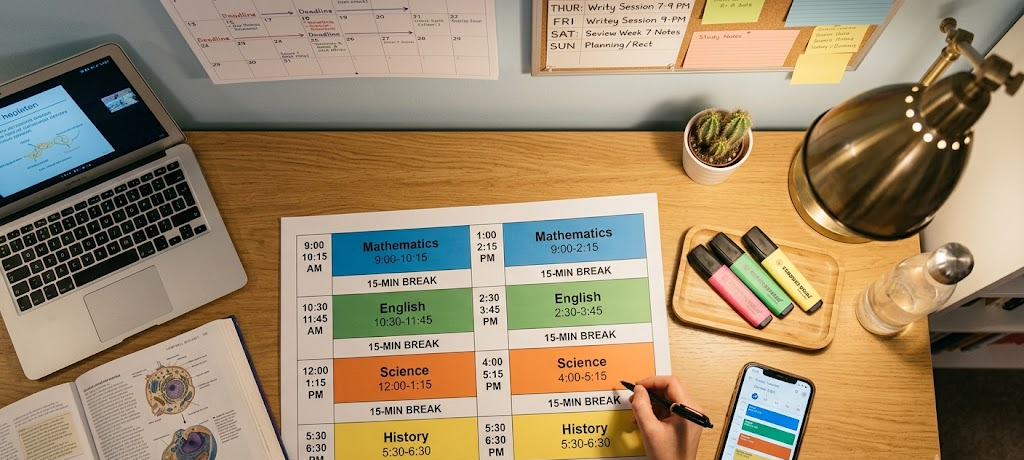
From 00 pm to 5:00 pm, also we will take a short break and then into English comprehension practice. Over time what we see is that this routine instills in students a great discipline and consistency which in turn helps to develop a strong academic routine that in turn improves productivity and also reduces to the last minute cram before exams.
How time blocking increases focus and performance in learning.
Time out is a proven method not for its organizational benefits alone but for what it does for the brain’s performance in study. We see that when students jump from task to task without a set structure the brain has to constantly reorient which uses up energy which in turn drops performance and increases mental exhaustion. But by breaking up study into dedicated sessions the brain gets in the routine of deep focus which in turn leads to better absorption and recall.
Also this approach lessens the issue of putting things off because each task has defined parameters of time which in turn makes it easy to get started without over analysis. Also time out method puts into place a work rest balance which is key to run at full capacity all day. By including set in stone study blocks with in between break times what we do is prevent burn out at the same time as covering a great deal of material.
Prioritization Methods for Better Academic Results
In not all subjects and tasks are equal which is the reason why we put forward the idea that prioritization is a key part of making a good study plan. Students must learn to tell the difference between what is urgent like coming exams, soon due assignments, or topics they have trouble with. Also a simple way out is to put tasks in to high, medium, and low priority categories. High priority tasks must go in when concentration is at its peak, where as low priority tasks can wait for less intense study sessions.
This in turn will see to it that important work is done on time and under no unneeded pressure. Also by the process of which they choose to put some things first and some later students may end up spending too much time on what they do well and not enough on what they struggle with. By putting more energy into the hard topics students may see great improvement in performance and also achieve a more even score across all subjects.
Balancing Extracurricular Activities and Personal Time
A good study plan should also include time for what goes on beyond the classroom in addition to academics. Many students do not do well in academia not because of a lack of effort but because they do not get enough break from it all which in turn leads to burn out. We see that in sports, music, clubs, and creative hobbies which although out of the academic world play a great role in developing skills which the classroom does not always provide also in the reduction of stress. Also personal time is a must which in turn gives the brain a break and in that rest we see improved focus in the academic setting.
As they make out their timetable students should see to it that they do not pack in too much study that the other important areas of life are pushed out. What we are after is a balanced approach which sees academic work, extra curricular activity, and personal rest time all included in the mix. That balance in the end will support a more sustainable way of living that in turn will promote long term academic success without at the same time draining them of emotion or health.
Building Consistency in Your Study Routine
Consistency is a key element in academic success which at the same time is the hardest to maintain. We see that a study plan is effective only when it is followed over the long term and not just during exam times. To build this consistency students should start with what they are able to do daily even on very busy days it is better to study a little every day than to burn out by studying for long stretches that you won’t keep up.
Also it works well to set up routines around study times, like right after school or at the same time each night. That which in turn makes the brain expect to study at those times thus it is easier to stick to it. In the long term consistency turns study into a natural part of a student’s routine which you do without much thought or effort.
Issues that Students Have with their Study Schedules.
Many students don’t benefit from what they put into study timetables which is mostly due to avoidable errors in the planning. We see that students create very full on schedules which do not have break in them or which have very little room for the time which tasks will actually take. Also it is very common for students to pay no attention to flexibility which in turn makes the schedule hard to follow when the unexpected happens.
Also some students do not go back to review or change their timetable when it is obvious that it isn’t working. A study plan should be a live document which improves over time. Also what we see is that many students don’t put enough value in rest which in turn causes them to pack in back to back study sessions with no recovery time which leads to burn out. By avoiding these mistakes what we see is that the schedule becomes more practical, balanced and easy to maintain and in turn this increases the chance of long term academic success.
Example Format for a Great Weekly Study Plan.
An effective weekly study routine which includes a balance of school hours, revision sessions, extracurricular activities, and rest periods that are even throughout the week is what you should aim for. For example week days may be filled with school hours followed by intense evening study sessions by subject which you2019ll break up a bit on the weekends which you may use for in depth review and to finish off assignments.
Put the hard subjects early in the week when your energy is at its peak and save the easy review work for the end of the week. Also in between each study session put in a break to avoid burn out and which also will enhance retention. We are not talking about filling up each and every available hour but rather to put in place a routine that is practical and will last. A well balanced weekly plan will have the student doing well in academics but also have time out for rest, socializing and personal interests.
Conclusion
Creating perfect study schedules is a thing of the past, what works best is consistency, balance and real world planning. As students learn to better manage their time, to put forward what is most important and to use tools like time blocking they see great results which in turn reduces the feeling of being overwhelmed. A strong timetable which is adhered to goes a long way in reducing stress, improving focus and in turn building discipline which extends beyond the classroom.
Also the base of any study plan is it’s flexibility and sustainability, a plan which you can’t keep is of no use. By including academic, personal and extracurricular in to the mix students can achieve a health at home and at school. In the end what really counts in school is how you use the time you have, not how much of it you use.