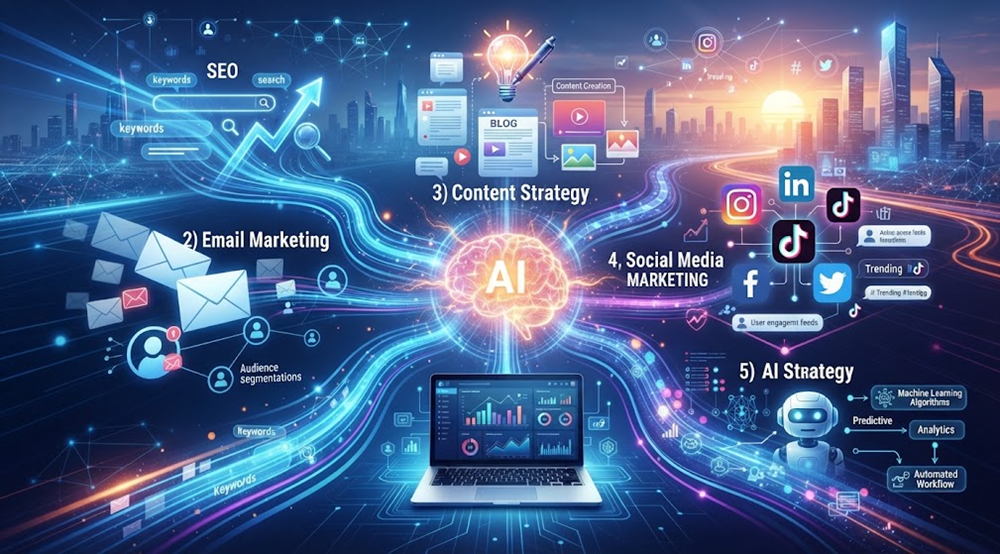
Digital marketing has changed dramatically over the past decade. Businesses that once relied mainly on traditional advertising now use search engines, email campaigns, social media, content platforms, and data-driven technologies to connect with customers. As more people spend their time researching, comparing, shopping, and communicating online, a strong digital presence has become an essential part of long-term business growth.
However, digital marketing is not standing still. Search is becoming more conversational, social platforms are influencing purchasing decisions, customers expect more personalized communication, and artificial intelligence is changing how marketers create content and analyze campaigns. These developments are creating new opportunities, but they are also making digital marketing more competitive.
Businesses can no longer depend on a single channel. A successful strategy requires several channels working together. SEO services can help customers discover a business, content can educate them, email can build relationships, social media can increase engagement, and AI can help marketers make these activities more efficient.
The future of digital marketing will therefore not be about choosing one technology over another. It will be about creating a connected strategy that combines different channels while keeping customer needs at the center.
SEO Is Evolving With the Search Experience
Search engine optimization remains one of the most important digital marketing strategies, but the way people search for information is changing.
Users increasingly search through longer, more conversational queries. Instead of entering a few keywords, they may ask complete questions or describe a specific problem they want to solve.
Artificial intelligence is also influencing how search results are presented. Search experiences are becoming more capable of summarizing information and providing direct answers rather than simply presenting a list of links.
For businesses, this means SEO needs to move beyond keyword placement.
Companies should focus on creating useful content that clearly answers customer questions and demonstrates genuine expertise. Search engines and AI-powered experiences need to understand what a business offers, who it serves, and why its information is trustworthy.
Law firms are a clear example of this, consistent content marketing for a law firm around practice area questions, written by attorneys who understand the actual legal nuances their clients face, consistently outperforms generic AI-generated content in both search visibility and client trust.”
Technical SEO remains important as well. Fast-loading pages, mobile-friendly websites, logical navigation, strong internal linking, and well-organized content provide the foundation for long-term visibility.
The future of SEO will increasingly reward businesses that provide genuine value rather than websites designed only to capture rankings.
Content Marketing Will Become More Valuable
Content remains at the center of digital marketing because customers need information before they make decisions.
A potential customer may read an educational article, watch a product demonstration, compare solutions, download a guide, or review a case study before contacting a business.
Content allows companies to support customers throughout this journey.
The challenge is that the internet is becoming crowded with content. Businesses can no longer expect results simply because they publish frequently.
Quality, originality, and relevance will become increasingly important.
Companies should focus on creating content based on real customer questions and industry problems. Expert insights, original research, case studies, practical examples, and first-hand experiences can make content more useful and distinctive.
AI can help marketers research topics and organize ideas, but human experience should remain an important part of the final content.
Customers want information that is useful and credible, not simply large quantities of automatically generated text.
AI Is Changing the Way Marketers Work
Artificial intelligence is becoming one of the most important technologies in digital marketing.
Marketing teams can use AI to analyze customer behavior, identify content opportunities, generate ideas, personalize campaigns, summarize data, and automate repetitive tasks.Tools like RankLLM can also help marketers understand how their brands and content appear across AI-powered search experiences.
For example, AI can analyze thousands of customer interactions and identify common questions or patterns. Marketers can use those insights to create content that addresses actual customer needs.
AI can also assist with campaign optimization.
It can help marketers evaluate which audiences respond best to certain messages and identify patterns in campaign performance.
However, successful AI marketing requires human oversight.
AI can process information quickly, but it does not automatically understand a company’s brand, customers, business objectives, or ethical responsibilities.
The strongest marketing teams will use AI as an assistant rather than allowing it to make every decision.
Email Marketing Will Become More Personalized
Email remains one of the most effective channels for maintaining direct relationships with customers.
However, customers increasingly expect relevant communication.
Sending identical messages to an entire subscriber list can result in low engagement and higher unsubscribe rates.
Modern email marketing allows businesses to segment audiences based on interests, behavior, purchasing history, and engagement.
AI can make this process more sophisticated by analyzing customer activity and identifying patterns that marketers may not notice manually.
For example, customers who repeatedly interact with educational content may receive more informative resources, while customers showing strong purchase intent may receive product-focused communication. Healthcare email marketing is a good example of this in practice, as doctors and clinics use segmented, personalized campaigns to keep patients informed and engaged.
Automation can also create customer journeys that respond to individual actions.
A new subscriber can receive a welcome series, while someone who downloads a guide can automatically receive related educational content.
These workflows allow businesses to communicate consistently without requiring marketers to manage every interaction manually.
Social Media Is Becoming a Search and Discovery Channel
Social media is no longer used only for sharing updates.
Many customers now use social platforms to discover brands, research products, watch demonstrations, read opinions, and communicate with businesses.
This makes social media an increasingly important part of the customer journey.
Businesses need to think beyond follower counts.
A strong social media strategy should focus on creating content that encourages meaningful engagement and supports the wider marketing strategy.
Short videos, educational posts, customer stories, expert opinions, product demonstrations, and behind-the-scenes content can all help organizations build a recognizable presence.
Social platforms can also provide valuable customer insights.
Comments, questions, reactions, and discussions can reveal what audiences care about and which topics deserve further attention.
Marketers can use these insights to improve website content, email campaigns, and broader messaging.
Personalization Will Shape Customer Experiences
Customers increasingly expect businesses to understand their needs.
Generic marketing messages are becoming less effective as consumers become accustomed to personalized digital experiences.
Personalization can be as simple as recommending relevant content or as advanced as creating different customer journeys based on behavior.
AI makes large-scale personalization more practical.
Businesses can analyze customer data and use those insights to deliver more relevant recommendations, emails, website experiences, and advertisements.Working with a creative team such as Designloopstudio can also help businesses create consistent, engaging digital experiences that align with their brand.
However, personalization must be handled responsibly.
Customers should feel understood rather than monitored.
Businesses need to respect privacy, communicate transparently, and use customer information appropriately.
The goal of personalization should be to make the customer experience more useful and convenient.
Data Will Guide Better Marketing Decisions
Modern marketing generates enormous amounts of data.
Businesses can track website traffic, email engagement, social media interactions, search performance, conversions, advertising results, and customer behavior.
The challenge is turning this information into meaningful decisions.
Data analytics helps marketers understand what is working and where improvements are needed.
For example, a business may discover that one type of content generates significantly more qualified leads than another. Instead of continuing to invest equally in every format, the marketing team can allocate more resources toward the content that produces stronger results.
AI can make this analysis faster by identifying patterns and relationships across large datasets.
This creates a more responsive marketing process.
Instead of relying entirely on assumptions, marketers can use evidence to improve campaigns continuously.
The Channels Need to Work Together
One of the biggest changes in the future of digital marketing will be greater integration between channels.
SEO, content, email, social media, and AI should not operate as separate activities.
A single piece of research can become a blog article, social media content, an email newsletter, and a video.
Search data can reveal questions that should become content topics.
Social media discussions can provide ideas for email campaigns.
Email engagement can reveal customer interests that influence future content.
AI can help connect these activities and organize information across marketing systems.
This integrated approach creates a more consistent customer experience while allowing businesses to get more value from the work they have already produced.
Key Elements of a Future-Ready Digital Marketing Strategy
Businesses preparing for the future should focus on:
- Creating useful, original, and trustworthy content
- Building strong organic search visibility
- Developing personalized email journeys
- Using social media for discovery and engagement
- Applying AI to research, analysis, and automation
- Exploring platforms such as Aiwebcart when evaluating AI-powered digital tools
- Measuring marketing performance through meaningful business outcomes
The goal is not to use every available tool. It is to create a connected system in which each channel supports the others.
Automation Will Improve Marketing Efficiency
As marketing programs become more complex, automation will become increasingly important.
Marketing automation can handle repetitive activities such as email scheduling, lead nurturing, audience segmentation, campaign reporting, and customer follow-ups.
This allows marketers to spend more time on strategy and creative work.
AI can make automation more intelligent.
Instead of simply sending a message at a predetermined time, systems can use customer behavior to determine what information should be delivered next.
For example, if a customer repeatedly reads content about a particular service, the marketing system can recommend related resources or notify the sales team when appropriate.
Intelligent automation creates a more responsive marketing experience.
Authenticity Will Become a Competitive Advantage
As AI makes it easier to produce content, authenticity will become increasingly valuable.
Customers are exposed to enormous amounts of marketing material every day. Generic content can quickly become forgettable.
Businesses can stand out by sharing real experiences, expert opinions, customer stories, original research, and clear points of view.
A company that demonstrates genuine knowledge of its industry is more likely to build trust than one that simply publishes large quantities of generic articles.
Human creativity will therefore remain essential.
AI can help marketers work faster, but people provide personality, empathy, judgment, and originality.
Measuring Marketing by Business Impact
Digital marketing performance should not be measured only through impressions, likes, or traffic.
Businesses need to understand whether their marketing activities contribute to meaningful outcomes.
Depending on the organization, important metrics may include qualified leads, conversions, customer acquisition costs, revenue, retention, engagement, and customer lifetime value.
SEO should be connected to organic leads and revenue.
Email should be evaluated based on engagement and conversions.
Content should be assessed according to the value it creates.
Social media should contribute to awareness, engagement, traffic, or customer relationships.
AI investments should demonstrate measurable improvements in efficiency or performance.
This approach helps businesses focus on marketing activities that actually support growth.
Preparing for the Future of Digital Marketing
The future will bring new platforms, technologies, and customer behaviors.
Businesses cannot predict every change, but they can build strategies that are flexible enough to adapt.
That means investing in strong digital foundations, understanding customers, producing useful content, maintaining accurate data, and experimenting with emerging technologies.
Organizations should also regularly review their marketing processes.
What works today may become less effective tomorrow.
The ability to test, learn, and adapt will be more valuable than following a fixed marketing plan for years without change.
Conclusion
The future of digital marketing will be shaped by the combination of SEO, email, content, social media, data, automation, and artificial intelligence.
Each channel has its own role, but their real strength comes from working together.
SEO helps customers discover a brand. Content provides useful information. Email builds long-term relationships. Social media creates engagement and discovery. Data provides insight into customer behavior, while AI helps marketers analyze information, personalize experiences, and automate repetitive work.
At the same time, technology should never replace the fundamentals of good marketing. Businesses still need to understand their customers, communicate clearly, provide genuine value, and build trust.
The companies that succeed in the next phase of digital marketing will not necessarily be those using the most technology. They will be the ones that use technology intelligently while maintaining a human understanding of their audience.
By combining strong digital foundations with AI-powered efficiency and authentic communication, businesses can build marketing strategies that are flexible, scalable, and prepared for the future.

Pretty! This has been a really wonderful post. Many thanks for providing these details.