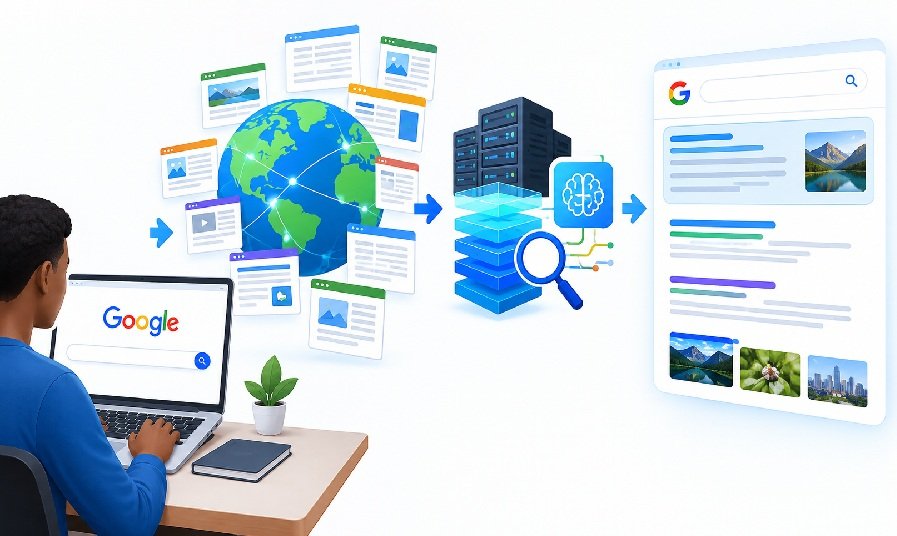
Google Search can make the web feel like a single, orderly library, but each results page is assembled from a vast and constantly changing collection of information. Understanding how that process works helps readers judge what they see and helps website owners make useful material easier to find. Google Search does not simply scan the live web each time someone types a question. It relies on systems that discover pages, organize their contents, and select results that appear relevant to the query.
A closer look at how Google Search works reveals why visibility depends on more than inserting popular words into a page. Search combines automated discovery, large-scale indexing, ranking systems, and features that interpret the purpose behind a query. Each stage affects what users see and how they move from a question to a useful source.
How Search Engines Discover Pages
Google uses automated programs, often called crawlers, to find publicly available web pages. They follow links from pages they already know, revisit sites to check for changes, and may discover URLs through submitted sitemaps. A page with clear links pointing to it is generally easier for automated systems to find than an isolated page with no paths leading to it.
Crawling does not mean every page is guaranteed to appear in search results. Site owners can restrict access to parts of a site, and technical problems may prevent a crawler from loading a page. Pages that repeat existing material or offer little useful information may also be less likely to be included in the index. Good site structure supports discovery, but it cannot substitute for content that serves a real purpose.
What Happens During Indexing
After a page is discovered, systems analyze its content and other information about it. They may consider the text, images, video, page title, links, and how the page is organized. This information is processed and stored in an index, a large collection that allows Google to retrieve potentially relevant pages quickly when a search is made.
Indexing is different from ranking. A page may be included in the index without appearing prominently for a particular query. The process also involves interpretation: systems work to understand what a page covers, not just which terms it contains. Descriptive headings, specific explanations, and a coherent structure help both people and automated systems understand the subject.
How Results Are Selected and Ranked
When someone searches, ranking systems sort through eligible pages and estimate which ones best address the request. Relevance is central, but it can involve meaning and context rather than an exact phrase match. A query such as “how to secure a home router” may lead to pages that explain practical steps even if they use different wording.
Other considerations can include the usefulness and reliability of information, the page’s usability, and the context of the search. For example, location can matter for a request about nearby services, while freshness may be important for a developing news story. There is no single ranking factor that guarantees a top position in every search. Results are produced by many systems working together, and their assessments can differ depending on what the user appears to want.
Search pages can also include features such as maps, image results, featured answers, or video listings. These formats are designed to make certain kinds of information easier to use. A person looking for a definition may prefer a concise explanation; someone learning a repair technique may benefit from a demonstration. The layout of a results page can therefore shape how users find and consume information, not only which website they visit.
Why Useful Content Matters
For publishers and businesses, the practical lesson is to create pages that answer clear questions thoroughly. Start with the reader’s needs, explain key ideas in plain language, and organize related information so it is easy to scan. Accurate titles and headings set expectations, while fast-loading pages and mobile-friendly layouts reduce friction. These steps improve the experience for visitors and make a site’s purpose easier to understand.
Search visibility is not a substitute for trust. Readers benefit from checking who created a page, whether its claims are supported, and whether the information is current enough for the topic. Website owners can likewise use performance data to see which pages attract visits and where readers may need clearer answers. Search systems change over time, so a durable approach is to improve usefulness rather than chase every rumored adjustment.
Search Is One Part of Online Discovery
People do not rely on search alone to discover ideas, products, and services. Social platforms, newsletters, recommendations, and video can all play a role. Short-form video, in particular, can present a quick demonstration or explain a product in a format suited to mobile viewing. Businesses considering that channel can explore why short-form video matters in 2026 as one part of a broader content plan. Osdire, a freelance marketplace with categories including video and animation, is one place businesses may encounter when looking for independent creative help.
Google Search turns an enormous body of web pages into results tailored to a particular query, but the process is not a simple list of matching words. Crawling makes pages discoverable, indexing organizes their contents, and ranking systems estimate which results will be most helpful. For readers, knowing these stages encourages thoughtful evaluation. For publishers, it points to a practical goal: make information accessible, clear, and genuinely valuable wherever people encounter it.