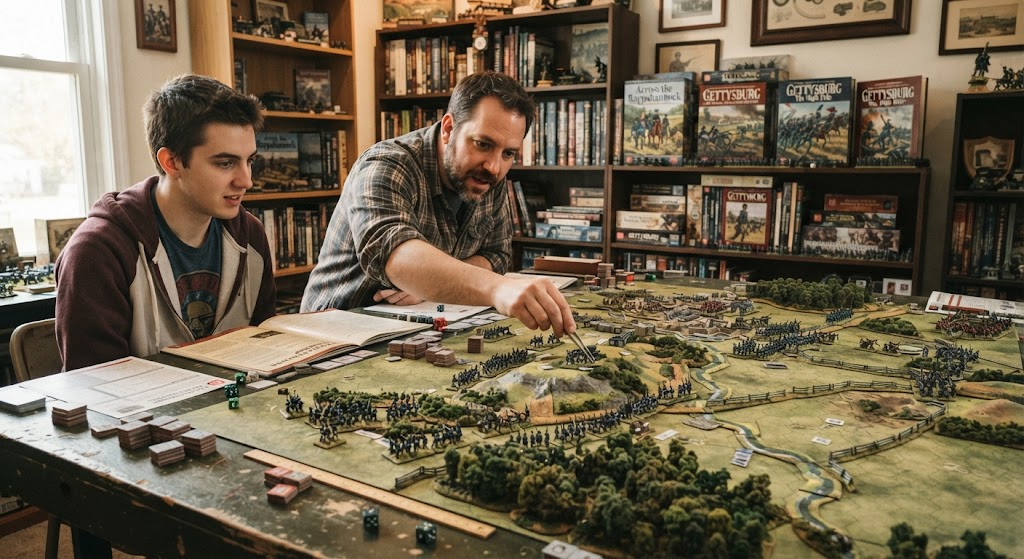
Tabletop strategy fans are returning to Civil War battle simulators because these games reward careful orders, terrain awareness, and patience. Digital maps reproduce the scale of major engagements, while campaign systems connect separate battles into longer decisions.
Players can study historical situations, test alternate plans, and learn how timing affects an army’s position. The best starting point is a simulator that explains its scale clearly and supports both short scenarios and extended campaigns.
Why Civil War Simulators Still Matter
A serious Civil War simulator turns battlefield history into a sequence of practical decisions. Players choose where units move, when artillery fires, and how reserves respond to changing pressure.
The civil war simulator game for history enthusiasts collection organizes titles around campaigns from across the conflict. Each game uses 125-yard hexes, 20-minute turns, and units usually shown at regiment or battery level. That scale gives every order a clear historical purpose without reducing the battle to a simple board-game exchange.
The collection includes stand-alone battles and linked campaign games. A stand-alone scenario suits a focused evening, while a campaign carries results into later engagements. Scenario and campaign editors also let experienced players adjust situations or build new ones.
Scale Creates Better Decisions
The 125-yard hex scale keeps terrain relevant without forcing players to manage every individual soldier. A ridge, road, bridge, or wooded area can influence movement and firing positions across several turns.
Twenty-minute turns create a useful pace for command decisions. Players have time to read the map, issue orders, and consider the likely response. The system still punishes delayed action, especially when an exposed unit waits too long for support.
Regiment and battery-level units also keep command choices readable. A player can see which formations hold a line, which batteries threaten an approach, and where a reserve can change the battle’s direction.
Campaigns Add Historical Context
Linked campaigns connect tactical decisions with operational consequences. A costly attack in one battle affects the force available for the next engagement, so players must consider preservation as well as immediate gains.
The collection covers campaigns including Antietam, Atlanta, Chancellorsville, Chickamauga, Gettysburg, Petersburg, Shiloh, and Vicksburg. Other titles examine the Peninsula, Shenandoah, Overland, Corinth, Franklin, and Ozark campaigns.
This range gives history enthusiasts different settings and command problems. Eastern Theater battles often involve larger actions, while several early-war and Western Theater scenarios use smaller forces. Each title still includes a mixture of small, medium, and large scenarios.
Starting With the Right Scenario
New players should begin with the free Civil War Battles Demo. The demo requires checkout to issue a download link and serial number, but the listed price is $0.00.
A tutorial scenario introduces the interface and basic play methods. After that, a smaller battle provides a better first test than a massive engagement with several moving fronts.
Players should learn movement, line of sight, and morale before choosing the largest scenarios. Those systems shape every later decision, including whether a unit can reach support, hold a position, or continue attacking.
Why Replay Value Matters
Historical scenarios gain replay value when different orders produce different results. A commander who attacks early might seize ground but lose cohesion, while a slower plan preserves strength and creates another opportunity.
“What if?” situations and battle variants add further choices without abandoning the historical setting. Players can compare an actual decision with a different deployment, altered timing, or changed operational priority.
The editors extend that value for players who want custom scenarios. They can adjust campaigns, test specific tactical questions, or build a situation around a particular battlefield problem.
Reading Before Playing
Each product page provides an overview of its included content, covered battles, technical specifications, and system requirements. The collection also links documentation for deeper study.
The series User Manual explains shared systems, while each title includes a Getting Started Guide.
That documentation suits players who want preparation before their first campaign. It also gives history readers a way to connect map decisions with the constraints commanders faced during the Civil War.
Conclusion
Civil War battle simulators reward players who enjoy history through decisions rather than passive reading. Their regiment-scale units, 125-yard hexes, and 20-minute turns create a practical link between battlefield geography and command timing.
Campaign links add consequences beyond one scenario, while editors support continued experimentation. A sensible next step is to begin with the free demo, complete its tutorial, and then choose a smaller campaign before tackling a major engagement.