Introduction
Businesses are making the most use of artificial intelligence (AI) in managing financial information, and accounting is certainly one of the areas seeing more significant changes. Accountants and bookkeepers have been using spreadsheets, accounting software, paper records, manual data input and redundant checking procedures to ensure financial records are kept accurate for years. These techniques are still relevant, but AI is creating quicker means for processing, structuring, analyzing and interpreting financial data. AI can automate the process of transaction classification and detect irregularities, thus minimizing repetitive tasks for accounting professionals. If you want to learn more about the overall application of technology, you can check out a few articles on AI in accounting to discover how AI is integrated into today’s business processes. This isn’t just about quicker bookkeeping, it’s about a step-by-step transformation to accounting systems that learn from financial data, identify patterns, assist in decision making, and enable professionals to concentrate on higher-value tasks.
AI is ushering new opportunities for accountants, not rendering them obsolete. Rather it is transforming the nature of their work. Many times, traditional bookkeeping involves a professional having to put in a lot of time to enter in transactions, match the invoices, reconcile, check records, and provide information for financial reports. Many of these repetitive tasks can be accomplished by using AI, which can process vast amounts of information and draw correlations that could take a human a lot longer. While doing the same, there is a need for judgment, professional knowledge, ethical responsibility, communication and knowledge of a business situation in accounting. While AI can aid with these roles, it’s essential to remember that it cannot replace human oversight. The central issue for accountants and business owners as they confront the age of AI in business is, however, not so much whether AI will replace accountants as much as how they can harness the capabilities of artificial intelligence safely and effectively to enhance financial management processes.
Automated Transaction Categorization
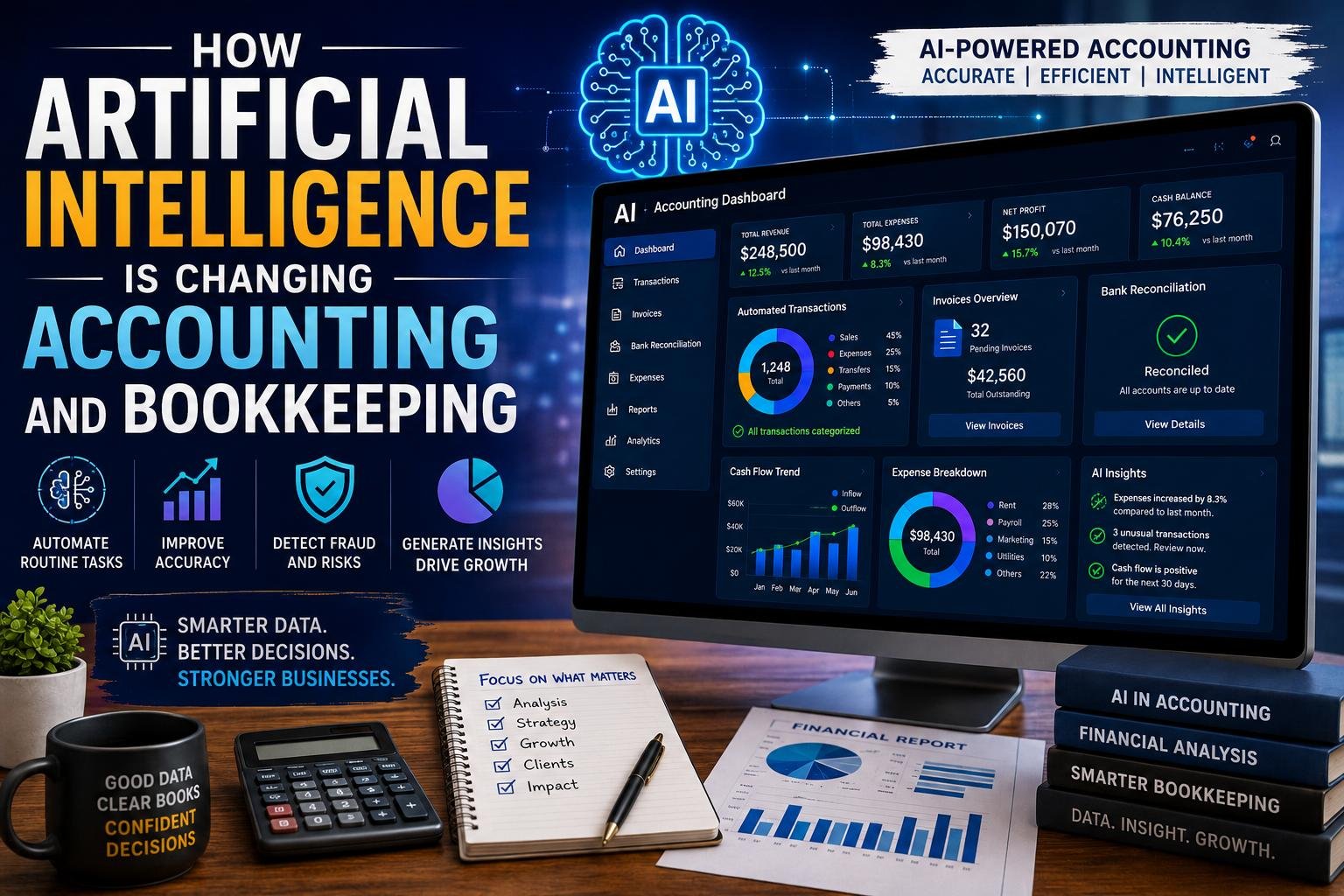
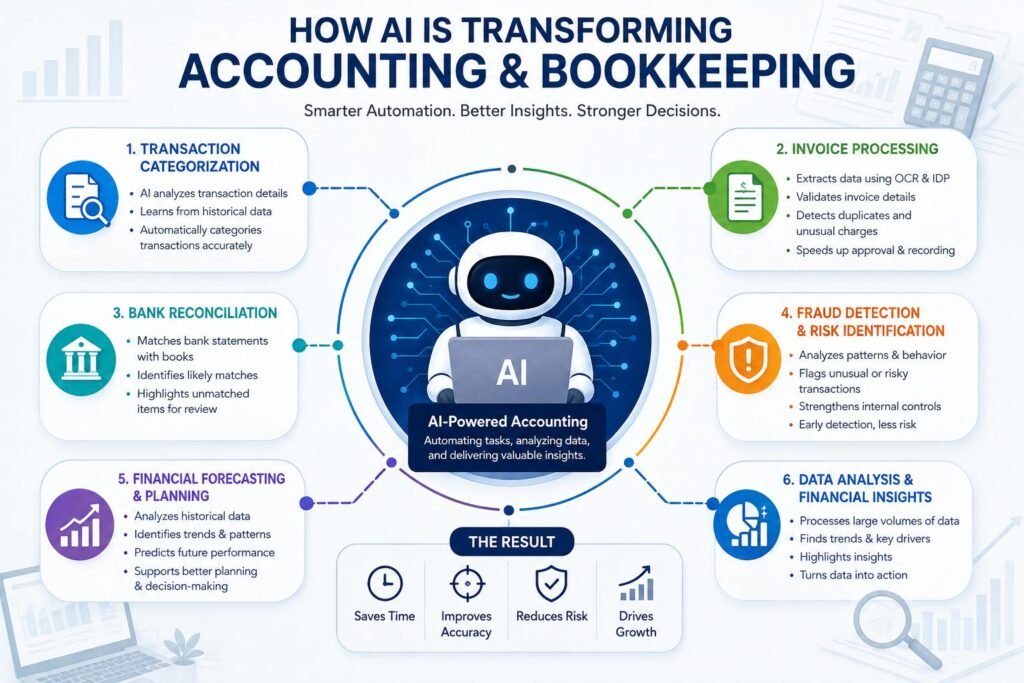
Automated transaction categorization is one of the most useful ways AI is being used in accounting. Financial Transactions are the transactions that a business undertakes during its operations such as making purchases, sales, bank transactions, subscription payments, payroll, expenses, travel and more. A bookkeeper may have to review every single transaction and determine which account it goes to—office supplies, advertising, transportation, rent or professional services, for example. AI accounting systems can analyze the details of the transactions, such as their descriptions, amounts, and past accounting decisions, in addition to other patterns, and make suggestions or automatically categorize them. If system has access to past records, it can identify repeating transactions and improve its ability to accurately classify transactions of similar nature. This can help to minimize double entry data and make bookkeeping a great deal easier, specifically for small enterprises that conduct hundreds or even thousands of transactions monthly. Unusual transactions and incorrect suggestions will, however, need to be reviewed as automated categorisation can be wrong if descriptions are unclear or there are changes in circumstances.
Faster Invoice Processing
Another area where AI can greatly help cut down on manual accounting is in invoice processing. Another area where AI can help cut down on manual accounting is through invoice processing. Suppliers and service providers send businesses invoices in a variety of formats, such as PDF, scanned invoice, email or digital file. An AI-powered solution can leverage OCR and other IDP technologies to detect key data on invoices, such as supplier names, invoice numbers, dates, taxes, payment terms and total amounts. The software can help to extract the relevant information and prepare them to be recorded, rather than having to be manually copied by an employee into an accounting system. AI can also verify that there are no discrepancies between the invoice and the purchase order, or historical data, such as duplicate invoices, unusual charges, or unexpected amounts. This can speed up the processing time and decrease the chances of any simple data entry mistakes being made. Human intervention is still important, especially when handling high dollar invoices or transactions outside of the norms.
Automated Bank Reconciliation
The main reason why bank reconciliation is so important is that it serves to match a company’s books with the records provided by the banks. If there are numerous outstanding items or multiple bank accounts, or a large number of transactions, the manual reconciliation can become time consuming. AI can assist by linking bank statements to the appropriate accounts in the bookkeeping system. Intelligent systems can determine likely matches from transaction amounts, dates, descriptions, suppliers, customers, and from prior to the matching. Transactions that don’t match can then be pulled apart for further investigation, without the accountants having to dig through each and every line. This can be a huge time saver, and enable accounting professionals to focus on exceptions and discrepancies. Improved reconciliation also facilitates more accurate financial reporting as errors, missing transactions and duplicate entries can be spotted sooner. However, accountants need to check exceptions very carefully and not take anything for granted when automatic matches contain exceptions.
Fraud Detection & Risk ID
AI is also increasingly proving to be a valuable tool in detecting potentially fraudulent or suspicious financial transactions. Rules-based controls are usually based on rules that have been established, for instance flagging transactions with quantities over a specific limit, or requiring approval for specific buying. AI can aid these measures by sifting through vast amounts of financial data and identifying abnormal trends. For instance, an intelligent system can detect transactions that are happening at unusual times or payments that are very different from the usual pattern, or repeated transactions with similar properties or spending patterns that seem to be unrelated from previous transactions. Machine learning systems can process the current transaction in comparison to past patterns and mark the exception, which would be investigated by humans. This does not imply that AI can make a definitive conclusion on fraudulent activity. Rather, it can serve as a red flag that will inform the accountant or manager about the need to look into a transaction. Businesses can identify potential issues earlier and possibly take corrective measures and investigate irregularities to reinforce their internal financial controls.
Financial Forecasting and Planning
AI can also offer significant assistance in financial forecasting. Businesses make a lot of estimates about their future income, expenses, cash flow and financial performance. Spreadsheets, historical averages, assumptions, and manually created scenarios may be important components of conventional forecasting models. AI can process more data than humans can and find patterns in past financial data, customer behavior, seasonal trends, expenses, and more. These observations can be used to make predictions and to think about other scenarios. For instance, predictive analysis tools powered by AI can analyze how fluctuations in sales or operating expenses might impact future cash flow for a business. This can be especially helpful to small businesses that may not have the resources to keep a full-time staff member on hand. However, forecasts are still estimates rather than guarantees.
AI-Powered Bookkeeping
Artificial Intelligence is slowly revolutionizing bookkeeping from manual to automate. Intelligent accounting software can help with transactions and receipts categorize spending, match payments, monitor the status of invoices and flag transactions that need attention. Bookkeepers can increasingly look after automated workflows and dig into exceptions without having to dedicate a lot of working time to routine data entry. This can make bookkeeping more efficient and leave more time for professionals to spend reviewing the books, talking to clients, helping with financial decisions and control. AI can also assist companies in maintaining their financial records more current, as transactions can be processed continuously instead of waiting for a bunch of data to be entered manually. AI-powered bookkeeping really shines with growing businesses that are seeing more transactions than there are bookkeepers. Despite this, it’s crucial that businesses set up the correct review processes as the automated bookkeeping is only as accurate as the information, rules and systems used.
Data Analysis and Financial Insights
There is a lot of data produced by accounting, but it doesn’t mean much having financial information. AI can assist accountants and business owners in interpreting financial data and uncovering trends that may not be apparent to them. An intelligent system can analyze the patterns of revenue, the flow of expenses, the payment habits of customers, cash-flow, profitability and more. AI-powered analytical tools can assist users in detecting any unusual shifts and points of interest that warrant deeper exploration, rather than just providing a report with numbers. A business owner may find that a specific type of operating costs has skyrocketed over a period of months or that some customers may be paying late more often than others. These observations can help to make better decisions for planning and management. AI can thus shift accounting beyond being a mere record of already done to insights that guide businesses to question what is going on behind the numbers and what options they may want to explore.
Advantages of AI for Accountants and Businesses
Efficiency of artificial intelligence in the field of accounting is one of its major advantages. Intelligent automation can potentially make repetitive processes that would have taken many hours easier and faster to do manually. This can decrease administration loads and enable bookkeepers to focus on exercises that involve expert judgment. AI can also enhance consistency, as it can follow patterns and rules to a large volume of transactions. Businesses may get financial information quicker, which can benefit managers in ensuring that they keep track of the performance of the business and make necessary adjustments based on the new trends and changes. The other advantage is: scalability. Intelligent systems can process a larger amount of financial information by a small accounting team. Another potential application of AI is in detecting errors and inconsistencies in transactions, which can be flagged for review if something appears unusual. But these advantages are most pronounced when AI is part of an integrated accounting system, not a standalone solution to replace the need for human accountants.
Obstacles and Constraints of AI in Accounting
While AI has many benefits, it also presents some drawbacks that need to be taken into account by businesses and accounting professionals. Data quality is one of the most critical issues as poor data quality can cause poor results. In addition to privacy and security, businesses should also take into account accounting systems, which store sensitive financial data regarding any businesses, their employees, suppliers and customers. The other is ‘over dependent’ use of automation. When employees don’t review AI-generated classifications, reconciliations or recommendations for accuracy, errors may go unnoticed, which can impact financial reports. AI systems could also encounter situations that are out-of-the-ordinary, evolving business conditions, unclear descriptions, or those that demand expert judgment. Moreover, organizations should consider investing in the proper software, training and system integration, and security controls before they can reap the optimal benefits from AI. The constraints illustrate the need for both technical proficiency and practical oversight of AI systems to ensure their effective implementation.
Accountants and their Roles
The AI-driven shift toward automating repetitive tasks in accounting will likely drive more of accountants’ focus toward analysis and interpretation, controls, communication, and support in the strategic decision-making process. Professionals might find that they are spending a lot more of their time with financial data automatically generated, with exception analysis, financial trend analysis, with business owners, and with checking to see if accounting information meets applicable requirements, rather than spending much of their time entering financial data. This change is going to require accountants to acquire along with their accounting knowledge the technological expertise. Knowing how AI systems function, the processing of financial data, how automated decisions should be reviewed, and the impact of technology on internal controls is all skills that can be beneficial to business. However, certain aspects of providing professional advice that are integral to the human accounting process and beyond the scope of automation, such as accounting professional judgment drawn from business context, ethical considerations, experience or interaction with people, will remain. The future accountant will thus be a financial professional, a tech user, a data analyst, as well as a business adviser.
How Businesses Can Prepare for AI Adoption
The first step for businesses taking the plunge into AI-driven accounting is to identify repetitive tasks that can offer tangible benefits from automation. There are some areas like expense management, reporting, reconciliation, invoice processing and transaction categorization that make good sense to check. In turn, organizations should review the quality of their current financial information and then assess if their accounting platforms can connect with AI-powered tools. Staff should be well trained and informed about the technology’s capabilities and limitations. Clear approval procedures should also be put in place to identify those activities that are fully automatable and which ones need human review. Regulate the performance of the systems at regular intervals and troubleshoot for errors instead of taking automation for granted to always get things right. Security and access controls are equally vital since monetary data should be safe from being accessed by those who aren’t eligible. By taking a gradual approach, organizations can start using AI in specific accounting tasks, evaluate the outcomes, identify areas for improvement, and scale up AI implementation when it shows promise.
Conclusion
AI’s impact on accounting and bookkeeping is evident in its ability to streamline repetitive tasks and deliver valuable financial insights in a timely manner. Manual transactional tasks such as automated transaction categorization, invoice processing, bank reconciliation, fraud detection and forecasting, bookkeeping, and data analysis can ease manual workloads and enable businesses to process financial information with greater efficiency. But remember that AI is not an accounting replacement; it’s a resource to enable a stronger accounting function. But there is still a need for human supervision in reviewing unusual transactions, understanding financial data, upholding ethical standards, safeguarding sensitive information and making decisions that depend on professional judgment. The integration of AI with robust accounting practices and the expertise of professionals could offer businesses a competitive advantage in optimizing operations and decision-making. With the continued advancement of intelligent technology, AI will likely prove to be a powerful tool for businesses to leverage in order to enhance efficiency and make informed decisions. The future of accounting is not one of purely manual or purely automated; it’s one of intelligent technology and people helping each other to make financial processes more efficient, accurate and insightful.
Get more well researched information about AI in accounting and bookkeeping here.