
Introduction
Artificial intelligence is playing a key role in science and technology. We see present-day AI, which is able to study large datasets, identify trends, make predictions, and support scientists in very complex research issues. We also have the concept of Superintelligent Artificial Intelligence (ASI), which is put forth as an AI that will outperform people in intellectual tasks across fields like science, innovation, and problem-solving. While we haven’t seen this in practice yet, the possibility of its development has already raised questions about what discoveries may be made, what issues may be brought up, and how fast technology may progress.
Superintelligent AI may play a role in the hard questions that researchers put forth to study, which include the development of drugs and our discovery of new materials. It may also play a role in the improvement of software and in the study of complex natural systems. What we see is more large-scale research support, from issue identification through to the design of experiments and analysis of results. It may also connect knowledge across disciplines, which in turn may cause scientists to note relationships they may not have noted before. But we also see that these benefits are to be had in proportion to the quality of the evidence put forth, the care put into the testing, and responsible development rather than computing power alone.
Potential Applications of Superintelligent AI
Automated Experimentation and Scientific Discovery
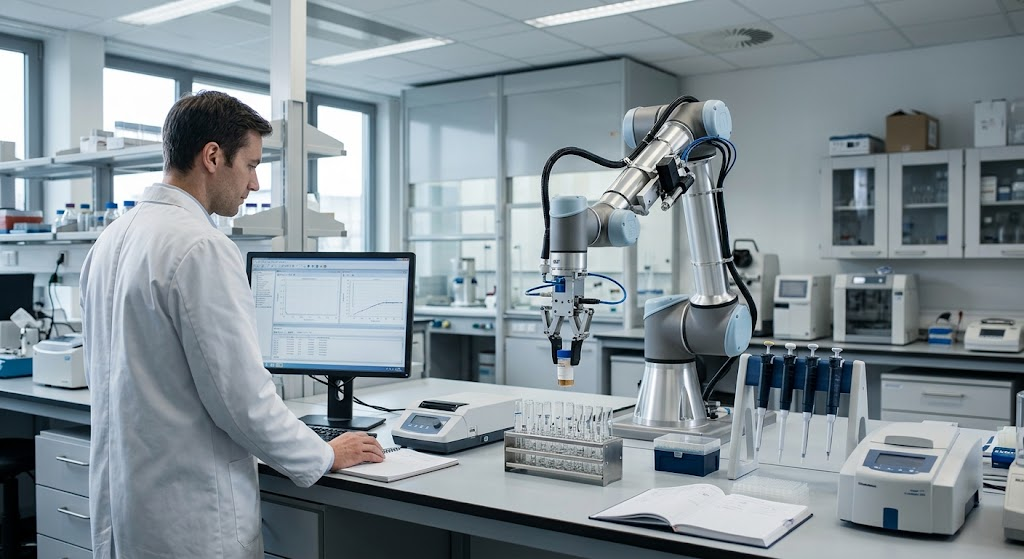
One of the primary options is automated experimentation. In the past, researchers had to prepare samples, do the experiments, take notes of the results, and repeat actions to get reliable data. With advanced AI at hand, we see that it is possible for the system to run lab robots, choose what to put in which condition, analyze the results, and also determine what the next experiment to do is. This will go on and on, allowing researchers to look at a larger number of variables in less time, which in turn reduces the amount of routine tasks they have to do. This will allow human researchers to put more time into coming up with research questions, looking at which results are of great importance, and making scientific decisions.
Another aspect is that we are able to learn from failed experiments. When an experiment does not turn out as expected, a superintelligent system may adjust its algorithms and put forth a different try. It may put forth a number of what-if scenarios, determine what information is missing, and choose the next step that is most to the point in terms of improving the picture. Also, it may do this in a more efficient way, which in turn may see scientific research speed up, especially in fields which depend heavily on expensive or complex experiments. At the same time, though, we must see to it that we have very reliable equipment, safe operating procedures in place, and independent verification to ensure that the results are in fact correct and can be reproduced.
Drug Discovery and Materials Science
Super intelligent AI may play a large role in medicine by assisting researchers in the study of diseases and putting forth the best treatment options. We know that a disease a person has is a product of genes, proteins, cells, and the environment, which in turn form a complex web of interactions. An elite AI may look at this data, determine root causes of illness, and put forth biological elements to target for more study. Also, it may assist scientists in comparing drug compounds and determining which ones to take into the lab for testing. By doing so, it may also reduce research costs and see that resources go to the best uses. Readers can also explore how AI in healthcare is supporting medical research and drug discovery today, while super intelligent AI could potentially advance these capabilities further in the future.
However, we see that while a researcher may hit upon a great drug prospect, this is just the start of the development journey. At that point, they still have to prove its safety and that what they have is in fact the breakthrough they think it is, and that it performs as expected. This will require running the proper clinical trials before they can put it to medical use. Also, in materials science, we see the same issue play out, in which researchers are after certain improved properties in their materials. With superintelligent AI, we may have a tool that helps design better-performing batteries, more efficient semiconductors, and even materials that are environmentally friendly. By using computation to predict outcomes and do preliminary work, followed by a hands-on experiment, scientists may put together a package that supports better practices in manufacturing, healthcare, and renewable energy.
Mathematics, Software Engineering, and Complex Simulations
Mathematics is the base for many scientific breakthroughs. Superintelligent AI will assist researchers in solving complex equations, recognizing patterns, putting forth possible solutions, and developing new methods to put their ideas to the test. We see such advances in physics, engineering, chemistry, and computer science. Also, a machine may point out that mathematical concepts which may seem unrelated are in fact related, thus giving researchers new ways to look at present problems. At the same time, mathematical proofs must still be rigorous, and scientific theories must be supported by data that show their predictions play out in the real world.
Software development and simulation may also benefit from what more advanced AI has to offer. In software engineering, we do the design, the build, the test, and the maintenance of reliable software. What we may see is that AI helps developers identify bugs in the code, improve algorithms, create scientific applications, and develop tools for large-scale engineering projects. Also, it may put models at the disposal of researchers for the study of molecular interactions, physical systems, and industrial processes. In that way, by putting forth different sets of variables and looking at what plays out, these systems may help researchers look at problems that are very hard to look at head-on. But it must be kept in mind that what the AI produces in terms of software and simulations will still have to go through very in-depth testing, as incorrect code or assumptions that are out there in the open may produce results which are not what we are looking for.
Climate Research and Robotics
Climate research focuses on the interactions between the atmosphere, oceans, ecosystems, and human activities. We see that super intelligent AI may assist researchers in the analysis of satellite data, in improving weather forecasts, in studying environmental changes, and in the evaluation of what solutions work best for climate-related issues. Super intelligent AI may also do a better job at comparing renewable-energy technology, improving power systems, and studying ways to reduce industrial emissions. By analyzing large-scale environmental datasets, a top-tier system may put together key patterns and, at the same time, put forth different future models more effectively.
Robotics may also see growth when put together with advanced AI reasoning. Robots may provide support in laboratory settings, inspect infrastructure, study ecosystems, and explore sites which are hard for people to get to. An AI may coordinate these functions, analyze the info collected, and put forth suggestions for further study. In manufacturing, we may see robots which test production methods and improve output consistency. In space exploration, autonomous systems may play a role in research and study when communication with Earth is delayed. Though there are these opportunities, robots will still require solid hardware, appropriate sensors, and very clear safety parameters to prevent unexpected actions which may cause harm.
Challenges and Responsible Development
Despite what it may achieve over time, superintelligent AI presents us with great issues. Poor-quality data, faulty assumptions, or poor predictions can lead to false science. Even at a very advanced stage, superintelligent AI may present very convincing results which are not supported by enough evidence. At the same time, we may see superintelligent AI produce results that look good at face value but which do not stand up to analysis. Researchers will thus have to check results, run experiments again, put forth other theories, and report the processes which led to a given conclusion. While greater intelligence in machines may bring about more efficient research, it also does not do away with the need for scientific skepticism and independent assessment.
Another issue is which elements of what advanced AI has to offer will be made available to all. As we develop very powerful systems which require great computing resources, expensive hardware, and specialized knowledge, these resources may end up in the hands of a few organizations and countries. If that happens, many research groups and communities will see little benefit. Also, as AI systems grow in their capability to operate lab equipment, control robots, or change software on their own, safety becomes a greater issue. We will need to put in place what it takes for proper operation and to carry out ongoing reviews of their performance. Also, a large role for human input is required. We should aim to report quickly on what we are learning that is of value, but at the same time, put in place measures to protect people and the environment.
Conclusion

Superintelligent AI will transform science and technology by automating experiments for researchers, discovering new medicines, developing advanced materials, improving software, and studying complex systems. It may also put forth the most valuable contribution of all, which is to put into play a connection between the stages of research, which in turn will see scientific theories, experimental results, and data inform each other in a more timely fashion. Also, it will support progress in healthcare, manufacturing, renewable energy, environmental protection, and many other fields.
However, at present, these are only possibilities which may play out in an unknown way, and it is important to recognize that advanced AI does not remove the role of human judgment, the use of reliable evidence, or careful experimentation. We still have to see the results of scientific research, evaluate tech systems for safety issues, and account for large-scale decisions. In what is to come, we see a role for the combination of advanced AI and human expertise, along with responsible oversight, which may in fact increase the chance that future breakthroughs improve our everyday lives. Also, it must be the case that we measure the success of superintelligent AI by how well it puts forth ideas that stand the test of time and which in turn better the human condition.



zeiniez.fashion