
Introduction
Students and lifelong learners who develop the habit of reading will develop the foundation for continued growth, discovery, and personal improvement. Regular reading enhances academically, builds a vocabulary, strengthens communication ability, stimulates creativity and deep thinking. Today’s world is an ever-changing one and it is important to be able to learn without the assistance of other people, by reading. But many have trouble with establishing a steady daily reading habit due to distractions, lack of time, or finding books that are suitable for their interests and learning objectives. Building good reading habits is a conscious process of planning and conscious effort to make reading a habit. Knowing how to establish effective routines, how to choose helpful resources and how to enhance comprehension can turn reading into a valuable habit that will help learners to build knowledge, foster curiosity and develop their minds.
For instance, they might not realize how vital it is to develop good reading habits.They may not know, for example, how important it is to develop good reading habits.
Understanding the Importance of Building Strong Reading Habits
Good reading skills are very important in the development of a person to learn and to understand the world around him. Reading provides students with new ideas and viewpoints and information they might not be able to find in classroom instruction or their textbooks. Reading regularly will help students to improve their academic performance with enhanced understanding of text books, instruction following, writing and answering questions. Reading for the lifelong learner offers chances to practice skills, delve into new areas of interest and stay current on topics. A person who has formed a consistent reading habit forms a stronger bond with the knowledge because he or she learns constantly, not just at the time of formal education. Reading, too, can help foster patience and concentration, attributes that are valued in a digital world that can shorten attention spans.
Reading habits can’t be developed in a day, but they can be developed through repeated habits and good routines. It is often said that successful readers are just “bookish,” but good reading skills are typically a product of discipline and practice. If a learner reads for a short time each day, they can slowly develop the skills of focusing on the text for longer and comprehending more advanced texts. It’s all about starting with realistic objectives and establishing a fun and easy environment for reading. The key is building a habit of reading, whether it’s in the form of reading novels, books for education, articles, research materials or any other written material. With time, it can enhance knowledge, confidence and critical thinking skills.
Practical Ways to Build Consistent Reading Routines
Establishing a secure reading habit is one of the best methods to turn it right into a long lasting habit. A good practice to practice regular reading habits is to have a time and place for reading. This way the brain will identify reading as a meaningful activity throughout the day instead of only during free time. Early in the morning may be more conducive to learning by some students while evening reading may be better for others after they have done their daily duties. The length of time doesn’t matter, it can be a concentrated reading session of 15 – 30 minutes that, when done consistently, can make a meaningful difference. Creating a less-distracting, adequately-lit environment for reading, as well as making materials accessible, can also make the habit more manageable. There are other steps to take to develop a good reading habit that can be found in these practical ways to build consistent reading routines.
Another good way to develop a reading habit is to create achievable and measurable goals. Some students are discouraged because they have set themselves impossible goals, like reading a large number of books in a short amount of time, which they can’t meet, and then give up on the reading habit the next day. Readers should, however, set smaller objectives in order to make consistent advancements. For instance, a student could choose to read a specific number of pages a day, one chapter a night or one learning article a week, etc. Use of a reading journal or digital reading tracker can be motivating and help learners to see their progress over time. Small successes lead to confidence, and confidence can help to reinforce the habit.
Another thing to consider is to minimize the distractions. While modern technology has a number of advantages, continuous notifications, social media platforms and entertainment apps can disrupt focus. Having a dedicated time slot for no digital distractions gives readers the opportunity to delve deeper into the content. Students can put their phones out of sight of their reading, turn off distractions, or use digital tools that don’t allow for distractions. Technology should not be rejected, as electronic books, learning websites and the Internet could complement learning. The aim is to get by means of technology but not to sacrificing precious reading time.

Selecting Appropriate Reading Materials for Successful Learning
It is important to choose appropriate reading materials as the quality and relevance of the reading directly impact on one’s learning. Students and lifelong learners should select materials that are appropriate to their current understanding as well as provide them with a challenge. Materials that are too challenging can cause frustration and materials that are too simple can not stimulate growth. Learners’ knowledge is developed by using a balanced range of books, articles, essays and other resources to develop their knowledge in a progressive way. The topics being selected could also be related to the interests of students, which would also boost student motivation, since when students are interested in a topic, they tend to be more motivated to read it.
Resources for education should be chosen to meet clearly stated learning objectives. For instance, books, revision guides, and academic articles on subjects could be useful for a student preparing for exams. For the person with an interest in enhancing creativity, biographies, science publications, history books, or literature presenting new perspectives might be appropriate. Lifelong learners have access to a variety of information about professional topics, skill development books and topics of personal interest. Materials should be selected based on the purpose of reading as different resources have different purposes. A good reader realizes that each book or article should help him or her to acquire knowledge, skills, or ideas.
Reading multiple materials and not just one type of material is also beneficial. There are variations in skills cultivated with various types of writing. Fiction can help to enhance imagination, emotional understanding, and storytelling skills; nonfiction can provide an increase in knowledge and analytical thinking. Newspapers, research papers, essays, etc., and educational websites can provide information on issues that are current and promote awareness of the world. Through various reading materials, learners develop a flexible thinking style and can analyze information from various angles.

Building Reading Comprehension Skills
Reading comprehension is the ability to grasp the meaning, understand and apply the information in written texts. Reading words on a page does not necessarily mean learning – effective readers interact with what they are reading. Asking questions before, during and after reading is one of the ways to enhance comprehension. Learners can consider what they know about the text topic and what they want to learn before beginning the text. They can make connections and think about the writer’s message when reading. Following reading, they will be able to summarise and think about what they have read and how it links to what they already know.
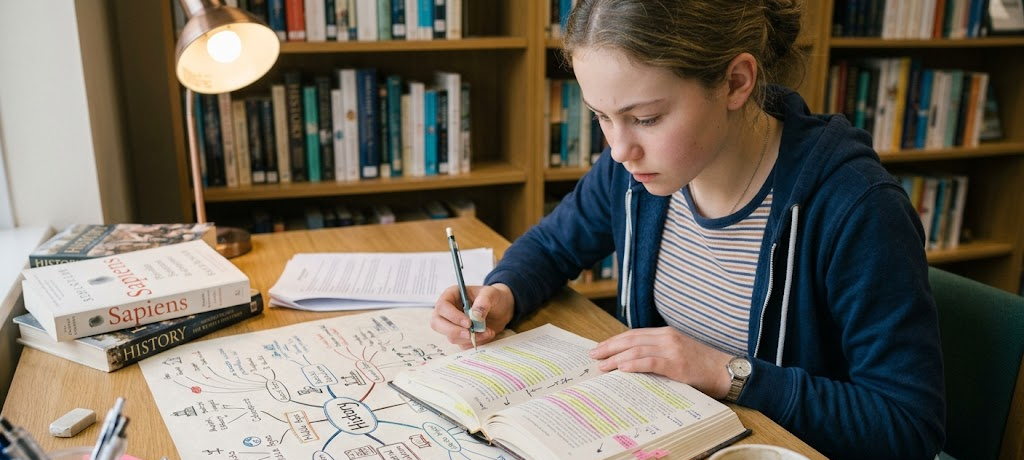
Noting is another great memory, understanding-enhancing tool. Note taking, new vocabulary, examples, and reflections promote active learning. Note taking enables learners to process ideas more deeply than passive reading and forgetting. This can be done in a variety of ways, e.g. outlining, writing summaries, outlining using mind maps or highlighting key parts. It’s not to duplicate what is in the text, but to get the information that will be most useful for later review.
Developing vocabulary is also closely connected with reading comprehension. By engaging learners in reading on a regular basis, they will be exposed to various words and writing styles, which will enhance their language skills naturally. Readers should not skip words they do not know, but should look them up. Rather, they can employ context clues, dictionaries, or other sources to decipher meanings. The use of a vocabulary notebook that captures new words and their definitions over time can help reinforce language development. Having a larger vocabulary helps readers to be able to read more complex texts and write more complex texts.
Developing Critical Thinking Through Reading
Reading is not just gathering information, it’s also learning how to analyze and evaluate when you read. Strong readers don’t take information at face value. They consider arguments, compare opinions and consider the evidence behind the various claims. The ability to question and analyze information is referred to as critical thinking, and is a skill that is important to academic success and everyday decision-making.
Questions that learners should ask to build their critical thinking in reading include: What is the text’s main argument? Are there enough reasons to believe that the author is providing adequate evidence for the conclusion? Are there other perspectives? What are the connections to what I have learned? The following questions have been designed to help students delve deeper into texts. In addition to simply recalling facts, readers are taught to understand information and to make informed judgments.
Books and articles are also good discussion topics that can help develop critical thinking. Learners who join reading groups, take part in classroom discussions or share ideas with friends get to hear other points of view. Discussions around text can lead to new understanding and interpretations. Reading can be more meaningful and enjoyable when shared with others.
How to Sustain Reading Motivation Over Time
One of the most difficult things to do when becoming a lifelong reader is to stay motivated. Many learners are enthusiastic at the start of their learning, but find that afterwards their time commitments become too heavy or they find concepts too challenging. Readers must keep in mind the reasons for establishing the habit to keep them motivated. It can be a goal for better academic achievement, acquiring knowledge, fostering creativity, or discovering new interests; the point is to have a clear objective to stay motivated.
Fun is key to success in the long run, as well. It is not always a duty or task; reading is something that should be enjoyable. Reading things in different genres, looking at interesting topics and leaving time to enjoy the reading can build a positive relationship with books and other learning resources. If children learn that reading is a pleasurable activity that invites exploration then they will be more likely to practice reading for the rest of their lives.
Avoiding the negative feelings that can come from failure is also a way of keeping yourself motivated. It is good to complete a book, understand a difficult subject or learn some new words. Small successes in learning inspire learners to keep on improving. With patience, a good habit will be established and become a natural routine.
Conclusion
The habit of reading is an important investment in lifelong learning because reading brings many benefits in terms of knowledge, vocabulary, understanding, and critical thinking. It takes dedication to establish a consistent schedule, but taking small steps and setting intentions will have a big impact over time. A student can develop a passion for learning through realistic reading objectives, appropriate reading selections, minimizing distractions, reading and comprehension strategies, and curiosity.
Reading is not just an academic need, it is a way of developing oneself, creativity and understanding the world. If people make reading a habit, then they learn how to keep learning, adapting and discovering new ideas in their journey.