Introduction
While exams are a crucial component of all students’ educational experiences, many students find themselves feeling unduly stressed when they wait until the last few days before undertaking any serious study. Cramming can lead to anxiety, lower focus and concentration and poor retention of important material during tests. Crimp cramming hours of study just before the test is taken does not result in real learning but only in memorization. It is better to create a structured revision plan where there is sufficient time allocated to revisiting topics, practicing skills, identifying weaknesses and gradually building confidence up. Student preparation for exams over a period of weeks enables them to be organised, well informed, calm and focused when they sit the exams.
There is more to successful exam preparation than just spending more time with your books; it’s about employing effective strategies that make it easier and more meaningful to learn. Students must have a knowledge of their subjects, learn to actively participate in the learning process and to regularly check their learning. Having a realistic revision timetable, practising techniques for active learning and monitoring their progress, will help students to make learning to improve something they can manage rather than something that is stressful. A well planned revision routine also facilitates long term learning by helping to transfer information from short to long term memory. Early-bloomers are more likely to enter the examination room prepared, confident, and ready to perform at their best.
Learn Why Cramming Is Not Effective
Cramming is a common way for many students to learn as they think that the pressure makes them learn better. They might read a ton of information just a few nights before a test and think that if they remember so much when they start the test. But this approach can cause issues because the brain requires time to process, organize and store new information effectively. If students are trying to learn several topics in a short time they might end up getting overwhelmed and not know what is most important. This may lead to confusion, lack of focus and exam anxiety.
The other problem with cramming is that it is mostly working with short-term memory and not long-term. Pupils can learn the definitions, formulas or facts for a short time and forget them soon after the test. Learning is best achieved through repetition, practice and the opportunity to apply knowledge in new contexts. Taking several weeks to revise enables the brain to consolidate links between concepts and make them stronger for recall. Rather than “stuffing” the brain with knowledge all at once, students need to develop good study habits that will lead to steady improvement and better grades.
Develop a Revision Schedule Several Weeks Prior to Exams

Examine the Examination Schedule and Establish Clear Goals
The first step in preparing well for exams is to have a clear academic plan and know the timing of the exams. Students are advised to start by making a list of all examinations, subjects, topics and important dates that are to come up in the near future. This will help them understand how much work is involved and help them not spend too much time on one subject and neglect others. Once learners know their responsibilities, they are able to break down larger topics into smaller parts such as manageable tasks. A student might, for instance, set targets to review cells, genes or systems of the human body, if they wish, on specific days rather than planning to “study Biology.”
It also helps motivate students by setting realistic goals, as students can track their progress and make improvements throughout the revision period. Goals need to be specific, attainable and related to the examination requirements. A student studying for a mathematics exam might decide to work through 20 problems of algebra each week, whereas a student studying literature might aim to analyze one “big idea” from a novel every 2 days. Clear objectives give direction and minimize feelings of being overwhelmed. Revision is easier when students have a clear idea of what they want to accomplish.
Develop a Balanced Weekly Revision Timetable
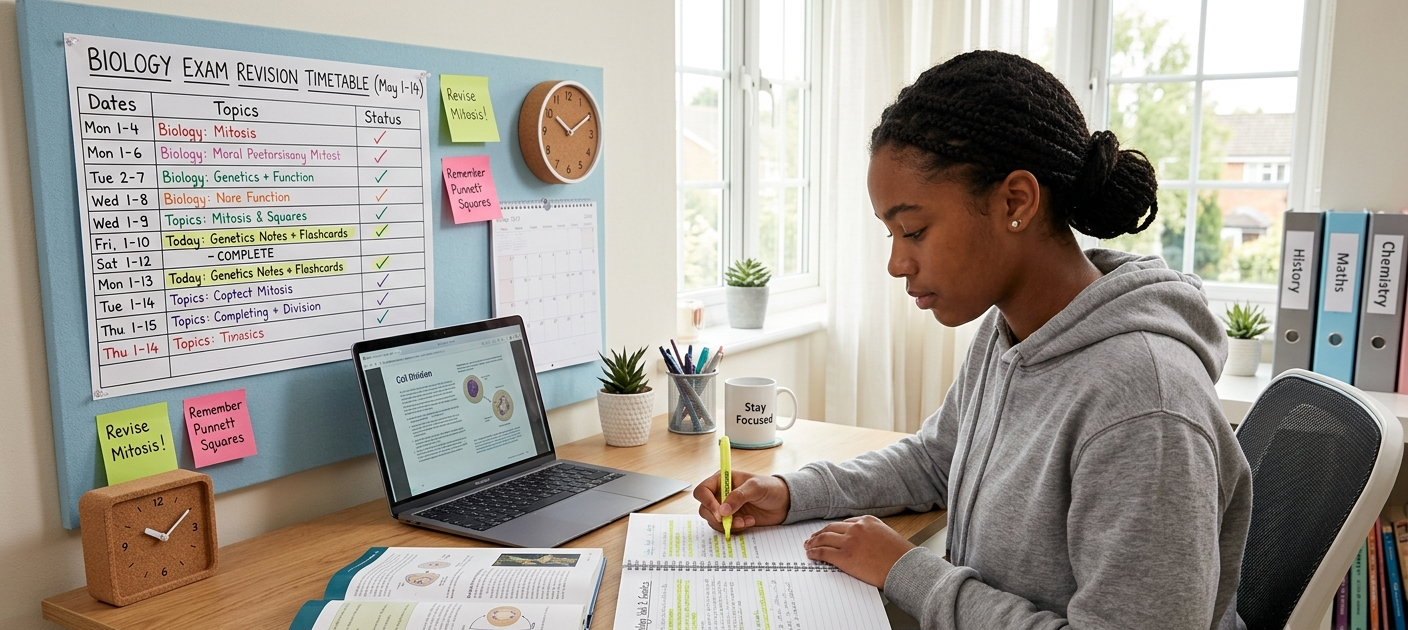
One of the best resources to use to prevent last minute preparation is a revision timetable. Students can plan the subjects/tasks to be learned on different days of the week prior to exams rather than studying at random. The timetable should cover all subjects and regular breaks and allow for adequate time for revision and practice and time to rest. It is crucial to develop a realistic schedule instead of an impossible schedule. Studying for very long hours each day also can be tiring and not as productive.
Students should work in a priority way on difficult subjects/topics or topics that need more attention or focus and they should also review the topics where they are competent. A balanced timetable might mean longer sessions of study throughout the week instead of a long session prior to an examination. This approach enables students to study information on a regular basis which helps to reinforce memory. Well planned revision can also benefit students’ knowledge retention by promoting regular revision practices. Students may look into other learning tools to reinforce memory and understanding by using the guide on how to improve knowledge retention.
Use Active Learning Techniques Instead of Passive Reading
Use Retrieval Techniques to Self-Test
An effective method of preparation for examinations is to reinforce and remember information, rather than repeating notes over and over. Passive reading can often give the impression of understanding, but does not necessarily convey whether the student can recall and use the content on their own. Retrieval practice is the method of testing yourself and involves answering questions, explaining concepts from memory or doing exercises without referencing your study materials. This is a method for reinforcing the brain’s memory of the information at the time of the actual test.
There are various ways for students to practice retrieval, such as with flash cards, past examination questions, quizzes and students’ own questions. For instance, following a chapter in history, a student might close the book and recall the key events, causes and consequences. They can review their answers in the activity with their notes, and find out what they may have missed. Self-testing regularly will enable the student to identify key areas of weakness and redirect revision to those areas as a priority.
Create Summaries, Mind Maps and Explanations
Making summaries and visual learning aids can help make revision more effective because they will help students to arrange information into their own words. Rather than copying whole pages of text from the books, students should be taught to identify the key ideas, important examples and relationships between ideas. To write summaries, students need to show their level of thinking by identifying what information is important and how it relates to one another.
Mind maps are another helpful tool as they allow information to be presented visually in structure. They enable students to link similar ideas with branches, keywords, and short explanations. This may be particularly useful for topics with lots of ideas, processes or classifications. Another effective way is to teach it to others. Students’ explanations are also used to check their understanding and occasionally they find that they have things to rewrite.

Do Small Chunks of Revision
Apply Time Management Strategies in Study Time
Study sessions can be lengthy, which may make them less effective and cause students to lose focus. Rather, students should break up their revision into discrete study blocks, separated by short breaks. It is beneficial to work in small increments, as this will help to keep focus and will not exhaust the mind. Each session should have a clear goal, whether it be finishing a topic, practicing questions or going over mistakes from the last session’s work.
Time management is another consideration; students need to have responsibilities outside of school. They require adequate sleep, eating, exercise, time with family, and to relax. Balancing well helps the concentration to grow as well as emotional stability. A well-coordinated overall routine facilitates students revising freely and attentively. The idea of preparation is not around the clock learning but around good use of learning time.
Avoid Distractions During Revision
Today’s technology can distract people in numerous ways from learning. Interruptions to studying through social media alerts, phone use and the distraction of internet entertainment can diminish study time. Students should make revision as a way to concentrate by avoiding distraction during revision sessions. This can range from putting phones on mute to studying in a quiet place, or with apps that block access to distracting sites.
A focused environment can enable students to finish their work quicker and eliminate the need to study late at night. It is important to note, however, that there needs to be some respite from time to time. Not getting any rest can result in stress and fatigue. The aim is to foster a healthy relationship with technology; to use technology as a learning tool and not to get in the way of learning goals.
Check Progress Prior to Exam Day
Note Any Completed Topics and Highlight Any Weaker Areas
Progress monitoring is an integral component of effective test preparation as it will help students know what they have accomplished and what remains. Students can make a checklist of topics they have completed, practice activities and topics that require additional practice. It is an easy technique that gives them a good idea about how well they are being prepared and that they won’t forget crucial parts of a topic.
There are also regular progress checks to allow students to adjust their revision plans. If a student identifies that one area of learning is challenging they can allocate further time to practicing and revisiting this. If they have already mastered a topic, they can reduce the amount of time spent on it and focus on more challenging areas. This is more efficient as revision is based on needs instead of assumptions.
Take Practice Papers: Past Papers and Mock Papers
Answering previous exam questions is a great way to get ready for the actual exam. Students learn the structure of examinations, familiar with the common patterns of questions, and how to manage time, from past questions. They also tell us if pupils can use knowledge or if they can only recall it.
Wherever possible mock tests should be taken in a similar environment to the actual test. Students should aim to restrict their time, refrain from taking notes and then go over the answers. Failure should not be considered a failure but as a chance to get better. Feedback is given on each incorrect answer on areas that need more practice. Regular Practice Tests help to familiarise pupils with expectations for examinations and build confidence.
Maintain Exam Stress Management With Healthy Habits
Studying for exams isn’t just about revision, it’s about looking after yourself physically and emotionally as well. Not sleeping enough, eating poorly, and experiencing chronic stress can have a negative impact on concentration and memory. Students are expected to have healthy habits by getting plenty of rest, eating well-balanced meals, drinking adequate water intake and taking breaks during study periods.
Positive thinking in reducing exam anxiety is also very important. Students should concentrate on progress in relation to themselves and not others. Nerves before exams are not uncommon, but can be managed and reduced by preparation. If pupils are aware that they have made a revision plan, practised regularly and their understanding has developed as a result, they will be more likely to have a positive attitude towards examinations.

Conclusion
Last minute studying is not enough to prepare for exams; it takes planning, consistency and good study habits. Students can reduce the stress that may arise if they start their revision at least some weeks before exams, plan their work in a balanced way and have clear academic objectives. Strategies of active learning like self-testing, summarizing, explaining concepts and practicing past questions deepen understanding and memory. The progress monitoring process during the revision period enables students to recognize their strengths and weaknesses and correct them before the day of the examinations so that they can start with a good position.
Examination results are not about panic-studying but about continuous preparation and the learning style. Students can develop confidence and perform well in tests and examinations by managing time, minimizing distractions, keeping a healthy schedule and by reviewing regularly. An effective revision process is not merely about improving grades but about cultivating life-long learning skills that enable students to learn more independently, organized and more successfully.