
Databases are used heavily in modern business environments to manage various pieces of information. Two main types of databases exist; SQL (relational) databases and NoSQL (non-relational) databases. Despite having a common aim, these two database types can differ substantially in terms of their architecture, structure, query language, scalability, consistency, and performance. Understanding these differences enables database administrators to determine which database type is best for given applications.
In this guide we will look at 12 key differences between SQL and NoSQL databases, some popular examples of SQL and NoSQL databases, and consider in what situations each database is most appropriate to implement. Understanding SQL vs NoSQL Databases enables businesses to design databases effectively with good performance, reliability, flexibility and scalability.
1. Data Representation
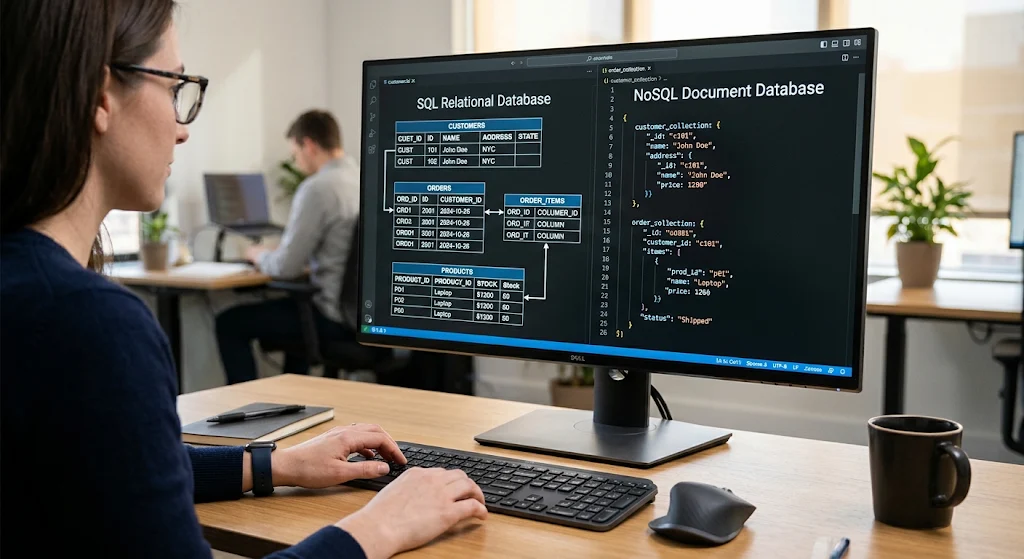
A key difference between SQL and NoSQL databases is how data is represented. SQL databases follow a relational data model. Information is represented within tables, with rows and columns. Each table represents a different entity, and within the columns information about that entity is held. Each row represents a piece of individual information. For example, a table containing information about customers might have columns for customer ID, name, email address and telephone number. This structured format means that information can be easily managed in an application where clear relationships between different pieces of information exist. Rules can be added to ensure that information is stored appropriately to reduce inconsistencies between data within business systems.
On the other hand, information in NoSQL databases can be stored in a wide variety of formats. Depending on the database, information can be stored in document format, key-value pairs, wide column format, or graph format. MongoDB stores information in flexible documents whilst Redis stores data in a key-value format. This makes it easy for applications to manage information in various formats. NoSQL databases can be very useful if information frequently changes, or if data comes from multiple sources, or is complex in structure. Despite this flexibility, information within NoSQL databases still has some organisation. Each database type has methods in place to manage, index, validate and retrieve information.
2. Schema
Within SQL databases there is typically a fixed schema. During the creation of the database, administrators determine the table and column names, data types, constraints and relationships. For example, if an employee table was created, within the table every row may be required to have an employee ID, name, department, and date joined. If a new column is required within the database, administrators may be required to modify the table’s schema before using it to store any information. The strict format of SQL databases ensures data is consistent across the database, meaning that it can be reliably managed. This is particularly useful in applications where data follows well defined rules within a business. Examples of this include banking, accounting, payroll systems and stock systems.
With NoSQL databases there is typically more flexibility. Many NoSQL databases allow entries to have varying fields. In document databases like MongoDB, each customer document may contain different information. For example, one customer may have extra contact details, whilst another may have different preferences. This means that developers can add new functionality within an application without needing to change the entire database schema. Flexible data structures can be very useful within applications that are quickly developed, content management systems, or databases receiving information from multiple sources. However, care must be taken to manage this flexibility effectively. If data is not appropriately validated, data may become inconsistent and difficult to manage. Therefore, administrators must put appropriate rules in place for data in order to ensure that the database remains high quality and reliable.
3. Query Language
Within SQL databases, Structured Query Language is used. Queries can be implemented in SQL to create tables, insert data, update data, delete data and retrieve data. Advanced query commands can be used to produce joins, aggregations, filters, sorted data and sub-queries. This enables information from multiple tables to be retrieved together. Within an online retail business, SQL could be used to join customer data, product information, and sales data together to produce detailed business reports. Many SQL databases exist, including MySQL, PostgreSQL, Microsoft SQL Server, and Oracle Database. Additional features have been built into each database.
Different NoSQL databases do not use a standard query language. Instead, queries depend on the data model and database type. MongoDB contains queries for document data. Redis contains commands for key-value data. Apache Cassandra uses a query language called Cassandra Query Language (CQL). This query language is similar to SQL, however it operates differently to SQL. Amazon’s DynamoDB has APIs and other database operations to enable records to be accessed. As a result, each database can be optimised for the type of data it is being used for. However, if multiple NoSQL databases are in use, administrators will have to learn different query methods for each, increasing complexity in managing multiple databases.
4. Relationships
Relational databases are designed to manage relationships within data. Primary and foreign keys can be used to link data from different tables. For example, in an online shop database, there may be separate tables for customers, products, orders, and payments. Customer ID’s can be used to link which order belongs to which customer, and product ID’s can be used to link order details to products. SQL joins can be used to retrieve related data from multiple tables without duplicates in the data. This means the data is well organised and avoids unnecessary duplication. As a result, relational databases are a good option for applications with complex relationships and interlinked transactions.
Depending on the data model, relationships can be managed differently in NoSQL databases. Some applications store related data in the same document, or store references to related data, or use graph data. For example, MongoDB can be used to store a customer’s address and preferences in the same document. This means related data can be easily retrieved. However if the data is split across different collections, the developer may need to make further queries in the application to bring the data together. This can improve performance for some applications. However, it may cause duplication, or create additional management requirements. NoSQL databases can be useful if related data should be stored together. However, traditional relational databases may be more convenient if complex relationships and frequent joins are required.
5. Scalability
Scalability refers to how well a database can scale to manage large volumes of data, users and requests without compromising performance. SQL databases can be scaled upwards (vertically). Resources can be added to the database server to increase capacity. Additional processing power, memory and faster storage can be added to increase capacity within the database. Some SQL databases can also be scaled by implementing replication, clustering, partitioning, and distributed databases. This can greatly improve performance in databases used for established enterprise applications. However, if a large relational database is distributed across multiple servers, additional complexity may be introduced depending on the database and workload. Businesses should consider what level of growth they expect, what cost implications scaling may have, and what performance requirements they have to determine the best scalability option.
NoSQL databases may be designed with horizontal scalability in mind. Horizontal scalability means that data and workloads are distributed across multiple servers. Sharding and partitioning can be used to separate data into chunks to be managed by different nodes. For example, data in Apache Cassandra is distributed across different nodes, and MongoDB supports sharding in large distributed databases. Amazon DynamoDB has infrastructure in place to manage varying workloads. Horizontal scalability can be very useful in applications with large user bases and growing volumes of data. However, data must be carefully distributed between nodes, and network communications, replication and consistency must be considered to ensure reliability in performance.

6. Transactions
SQL databases are well known for supporting ACID transactions. Acidity refers to Atomicity, Consistency, Isolation and Durability. Together, these ensure transactions can be reliably processed even if issues occur. Atomicity ensures that the whole transaction is performed as one unit. Consistency ensures that transactions maintain the rules set in place within the database. Isolation prevents issues arising from multiple operations running simultaneously. Durability ensures changes made in committed transactions are saved. These properties are very important within banking, payments, accounting and other applications – as incomplete or incorrect transactions can cause serious issues. Transactionality can be implemented within many relational databases, including PostgreSQL, MySQL (InnoDB), Microsoft SQL Server, and Oracle Database.
Transactionality in NoSQL databases varies depending on the database. Some prioritise availability and performance in distributed environments, whereas others do provide strong transaction guarantees in certain operations or multiple records. MongoDB and Amazon DynamoDB both provide multi-item ACID transactions. Redis provides commands related to transactions. However, its transaction model differs to that of SQL databases. Therefore, NoSQL databases should not be assumed to be unsuitable in applications requiring reliable transactions. Administrators must consider what transactional capabilities, isolation, consistency, and restrictions that a database provides. Rather than assuming based on general categorisations, understanding what integrity requirements exist in the application will help determine which database to implement.
7. Consistency & Availability
Consistency refers to how accurately information is maintained across the database. In SQL databases, strong consistency is commonly maintained. If a transaction is successfully committed, any following operations should see the changes made in line with the isolation and consistency provided. This is important in applications where data must be accurate and up to date. For example, in a financial institution, account balances should be accurate when processing transactions. Consistency depends on transaction isolation, replication and database design. Not every relational database will provide the same guarantee of consistency in all situations. As a result, administrators must understand how consistency is handled in their chosen database when handling concurrent operations, or distributed data.
Depending on the design of a NoSQL database, different levels of consistency can be provided. Some NoSQL databases provide strong consistency, whilst others provide eventual consistency or configurable consistency. Eventual consistency means that replicated data may be inconsistent for a time, however once updates have been successfully applied the data should be consistent. This can improve availability and performance in certain distributed scenarios. For example, Apache Cassandra allows administrators to set different consistency levels. Amazon DynamoDB also provides consistency options for supported read operations. Depending on how quickly updates should be seen in an application, and how it should run when there are network issues or failures in distributed systems, a suitable consistency option can be picked.
8. Architecture
SQL databases generally adopt a relational database management system design. Within this design, information is stored in tables, along with indexing, constraints and relationships. Different internal storage engines are used to manage the storage and retrieval of the data. Whilst there are variations in how this is implemented across different databases, relational databases typically have well defined transaction handling, data integrity, and query optimisation. MySQL uses the InnoDB storage engine to support transactional processing. PostgreSQL provides an extendable relational database, with advanced data types and indexing. Microsoft SQL Server and Oracle Database provide advanced database management capabilities for complex business applications. These are often set up in centralised or clustered architectures, depending on requirements.
NoSQL databases have different architectures depending on how data is stored. Document databases store information as documents. Key-value store databases relate values to a unique key. Wide column stores organize information in flexible column families. Graph databases represent information in nodes with relationships, and so are ideal for applications with interlinked entities. This means that NoSQL databases can be optimised for certain workloads. MongoDB provides document storage. Redis is optimised for in-memory data storage. Cassandra is a distributed wide column store, and DynamoDB provides a managed key-value and document database. Knowing the differences in architecture between these databases can help administrators decide which to implement depending on what is needed from the application, how data will be accessed, and infrastructure limitations.
9. Performance
The performance of a database depends on multiple factors, including complexity of queries, indexes, storage, resource availability, and workload. SQL databases can perform extremely well with complex queries and structured data from multiple tables. Query optimization techniques are implemented within the databases to determine the most efficient method of retrieving requested data. Performance can be improved by using appropriate indexing, optimising queries, partitioning data, and utilising caching. However, inefficient queries, or excessive indexing and joins, can cause increased resource usage. Monitoring performance regularly is important to ensure reliable operation. Relational databases are very efficient in applications requiring complex reporting, analysis, and transactional processing of interlinked data.
NoSQL databases can often perform very well as they are optimised for specific data retrieval methods. Redis stores data primarily in memory, therefore is very useful in cache solutions and real time applications. MongoDB provides efficient querying and indexing for flexible data. Cassandra is optimised for large distributed workloads, and DynamoDB provides managed data access for applications with varying traffic. However, NoSQL databases do not always outperform SQL databases. How well these databases perform will depend on how the data is structured, queries are designed, and how the database is implemented. To determine whether a database is suitable for a workload, realistic workloads should be tested.
10. Security
Security is an important consideration when choosing a database. SQL databases often include features to improve security. User authentication, role based permissions, permissions, encryption, and auditing can be implemented. The administrator can manage which users can access certain databases, tables or operations. For example, a member of staff creating financial reports may only have read permissions to certain records. Different SQL databases have different security features. Oracle Database, Microsoft SQL Server, PostgreSQL, and MySQL all have differing security features that can be set up to suit an organisation’s requirements. Appropriate security measures must be taken to secure connections to databases, install updates, monitor suspicious activity, and ensure reliable back-up processes.
Security features are also available in NoSQL databases. However, the security features vary depending on the database. MongoDB provides user authentication, role based permissions, and encryption. Redis provides user authentication and permissions. Amazon DynamoDB works with AWS Identity and Access Management (IAM) to provide security permissions in line with cloud policies. Cassandra also includes security features to allow control over database resources. However, as NoSQL databases can be flexible in design, and distributed, additional security considerations may be required. All nodes within the database, connections to applications, and administrator interfaces should be appropriately secured. Just because a database falls into one category does not mean it is more secure than another. Proper security features must be implemented, monitored, and consistent security practices must be followed.
11. High Availability, Fault Tolerance & Replication
High availability means that the database can remain available despite problems with individual components. Multiple methods can be implemented to increase availability in SQL databases. Replication, clustering, and automatic failover, and recovery from backups can be implemented to reduce downtime in services, and protect important business data. For example, PostgreSQL supports streaming replication, Microsoft SQL Server provides Always On availability for supported configurations, and Oracle Database provides enterprise level technologies to allow database availability and disaster recovery. However, to provide high availability, infrastructure must be set up with redundancies. The health of systems should be monitored, recovery procedures should be tested, and suitable back-ups should be scheduled in order to limit disruption.
NoSQL databases are often designed to be distributed, with data replicated across multiple servers or locations. This provides additional copies of data. Fault Tolerance can also be provided to ensure operation continues if nodes within the system become unavailable. In Apache Cassandra information is distributed across a cluster, with configurable replication. MongoDB provides replica sets to provide multiple copies of data, and automatic failover. Amazon DynamoDB is a managed solution to provide highly available databases. As a result, NoSQL databases can be very appealing for applications requiring high availability and distributed processing. However, risks cannot be completely eliminated. Administrators should understand recovery options, data replication time frames, reliance on networks, and potential consequences of infrastructural failures.
12. Applications
SQL databases are well suited to applications with structured data, reliable transactions and complex relationships. They are often used in banking systems, accounting systems, customer relationship management systems, Enterprise Resource Planning systems, and Stock management systems. For example, a banking system may use a relational database to manage customer accounts, transaction data, loan information and payment history, whilst ensuring important rules in data integrity. An online retail system may also use SQL databases to link customer, product, order and payment data. MySQL, PostgreSQL, Microsoft SQL Server, and Oracle Database all provide differing functionalities to suit these requirements. Relational databases are often chosen if data is predictable in structure, reliable transactions are required, and complex queries are needed.
NoSQL databases are often a better choice for applications with flexible data, large distributed workloads, and specific data access requirements. Social media platforms, real time messaging systems, content management systems, Internet of Things, gaming systems and large scale websites may benefit from NoSQL databases. MongoDB is useful for flexible data in applications, Redis is useful for caching and real time data, and Cassandra is useful for large distributed workloads. Amazon DynamoDB is also useful in applications requiring manageable database infrastructure and scalable data access. However, just because these examples have been given does not mean that all modern applications require NoSQL databases. The best choice of database will depend on the data structure required, transaction requirements, expected workload, budget for operation, and long term development plans.
SQL or NoSQL?
Depending upon what information needs to be stored in your database, and what relationships exist in your records, along with consistency requirements, you can choose whether to use SQL or NoSQL. If there is clear structure within your data, strict consistency requirements in your transactions and a requirement for complex queries across multiple tables in your application, using a relational database (SQL) may be appropriate. Storing financial data, customer data, employee data and inventory transactions within a relational database can be beneficial due to its organisation. Additionally, SQL databases provide good management functions, complex transactions and standard querying methods. Therefore, if your application requires structure within data and reliable transactions, SQL can be very valuable.
If your application requires flexible structures, distributed data, quick development or specific performance requirements, NoSQL may be suitable. If you have large amounts of user generated content, real time events, connected devices or distributed services, then using NoSQL can be advantageous. However, since different NoSQL databases have different purposes (MongoDB, Redis, Cassandra and DynamoDB), database administrators should consider each individually. Cost of infrastructure, required skillset, backup requirements, security and complexity of maintenance should also be considered. Certain NoSQL databases may not be appropriate depending on the requirements of the application. Therefore, it is very important to test possible database options in line with realistic application requirements to ensure that the right choice is made for the future.
Increasing Use of Hybrid Databases
Many companies have found that using a combination of SQL and NoSQL databases in a hybrid database system can be very useful. For example, in an e-commerce application, customer information, payment and ordering information may be stored in PostgreSQL, but frequently accessed information may be cached in Redis. Product catalogue information may be more flexibly stored in MongoDB. Alternatively, other specialised databases may be used for analysis. This means that you can take the advantages of multiple different technologies, and avoid forcing data into a certain format. However, hybrid systems must be carefully planned. Using multiple databases adds complexity to integration, monitoring, security and maintenance.
As cloud computing, microservices, distributed applications and real time analytics become more popular, there has become increasing interest in combining different databases. Furthermore, modern databases have started to overlap in functionality. Relational databases allow JSON data, complex indexing and distributed systems. Some NoSQL databases allow more complex transactions and querying. Therefore it can often be difficult to determine whether a database is SQL or NoSQL. Database administrators must look at the features of each database. Just because a database belongs to a certain category does not mean it will be identical to another database in the same category. To create efficient hybrid databases, make sure to choose databases that suit specific needs of applications, and implement clear data management strategies.

Conclusion
There are a variety of differences between SQL and NoSQL databases. SQL databases provide clear structure, relational properties, standardised querying and mature transaction handling. Therefore they are particularly useful for applications with complex data relationships and important data integrity. On the other hand, NoSQL databases allow flexible data structures and alternate solutions in distributed applications. Different relational databases (MySQL, PostgreSQL, Microsoft SQL Server and Oracle Database) can be used for a wide variety of relational database requirements. Similarly, different NoSQL databases (MongoDB, Redis, Cassandra and Amazon DynamoDB) provide different non-relational capabilities. Depending on the data being stored and requirements within the application, neither category of database is better than the other.
Understanding these 12 differences is very important for database administrators to create reliable and scalable data management systems. Consider what data structure is required, what transaction requirements are needed, scalability requirements, security requirements, performance goals, and resources within technical skill sets. If your application requires structured transactional data then SQL is a great option. However, if there is a requirement for flexible data structures or distributed applications, NoSQL can be a very useful resource. In many cases, creating a hybrid system using both databases can be very efficient and flexible. As database technologies continue to change and improve, having knowledge of the advantages and limitations of different databases will enable database administrators to make informed choices to best support business processes. It will allow for database systems to be created which can be easily adapted to meet changing business requirements.