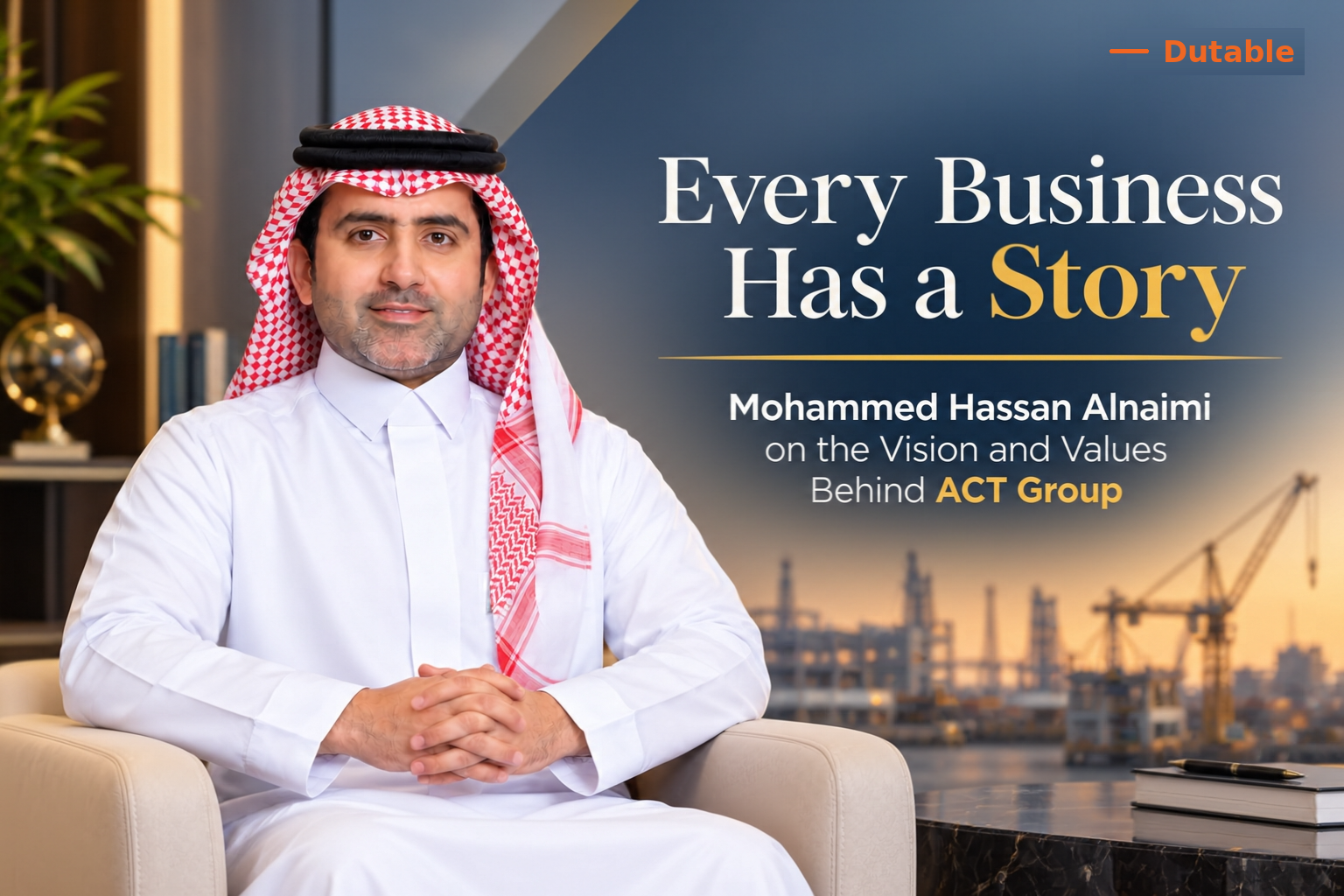
The Group CEO of Arabian Consolidated Trading Group on why a company’s character is built in its daily habits, not its slogans.
Ask most executives about their company and they will start with numbers. Ask Mohammed Hassan Alnaimi, Group CEO of Arabian Consolidated Trading Group (ACT Group), and he starts with a different question: what do people say about you when you are not in the room?
“A company’s story is not what we write on the website,” he says. “It is what a client remembers after the project is over.”
A leader who treats reputation as a daily task
For Alnaimi, a reputation is never finished. It is built or weakened every day, in small decisions that rarely make the news: whether a promise was kept, whether a call was returned, whether a problem was raised early. He describes his role as looking after that story, making sure that what ACT does on an ordinary Tuesday matches what it says about itself.
This outlook shapes his priorities. His professional approach emphasizes business development, operational reliability, customer satisfaction and long-term relationships, and he treats them as chapters of the same story rather than separate goals. A strong commercial result that costs a client’s trust, in his view, is a bad trade.
Values that have to survive a busy week
Many leaders list their values. Alnaimi is more interested in whether those values still hold when the schedule is tight and the pressure is on. He describes a simple test he applies to any decision: would we be comfortable explaining this choice to the client, in plain words, a year from now?
That test favours honesty over convenience. It means saying what can be delivered and what cannot, and accepting that a realistic answer today builds more trust than an impressive one that falls through later. “Clients forgive a hard conversation,” he says. “They rarely forgive a surprise.”
Vision without noise
When Alnaimi talks about vision, he avoids dramatic language. His version is practical: be the company clients think of first when something important has to be done well, and keep earning that position project after project. He is wary of vision statements that sound inspiring but give a team nothing to do on Monday morning.
Instead, he links vision to behaviour. Growth is considered where the group’s strengths already apply. New ideas are welcome, but they need to make the business more dependable, not just more ambitious. It is a measured philosophy, and he believes it is what lets a company grow without losing its identity.
In conversation: two questions on vision and values
Q: If ACT’s story had one theme, what would it be?
“Dependability,” Alnaimi says. “Everything else is detail. If clients can predict how we will behave, they can plan their projects around us, and that is the most useful thing a supplier can offer.”
Q: How do you make values real for people who never sit in a boardroom?
He says it starts with example. “People watch what leaders do when it is inconvenient,” he says. He prefers short, direct conversations with teams, clear expectations and recognition for the people who do the careful, unglamorous work well. “Values are not taught in one meeting. They are repeated until they become habit.”
Leading by staying close
Alnaimi is known for preferring direct understanding over distant reports. He values hearing from the people who run the work, and he applies the same thinking to partners and clients. When ACT representatives visited Tadano’s manufacturing facilities in Japan in January 2024, following the delivery of 18 rough-terrain cranes, it reflected a belief that you learn more about a business by seeing it first-hand.
The story he wants to be told
Asked what he hopes people will say about ACT in ten years, Alnaimi keeps it short. “That we were reliable, that we treated people well and that we left the industry a little stronger than we found it.”
The company behind the story
ACT Group was founded in Saudi Arabia in 1986 and is headquartered in Jubail, with offices in Riyadh, Dammam, Yanbu and Dubai. Its core business is mobile crane and heavy equipment rental, with lifting capacities of up to 1,200 tonnes, alongside forklifts, telehandlers and generators. The group also provides logistics and transportation, industrial maintenance, industrial waste management, rig-moving services, manufacturing solutions and trading of industrial products, serving oil and gas, petrochemicals, construction and infrastructure.
Today ACT operates around 250 cranes with roughly 1,000 people. It reported a Saudisation rate of 25% within ACT Cranes in 2023, with close to 400 Saudi employees across its divisions.
Connect with Mohammed Hassan Alnaimi
Readers who would like to follow his professional activity can connect with Mohammed Hassan Alnaimi on LinkedIn and Instagram. To learn more about the company, visit actgroup.com.sa.