A typical two-week payday loan that charges $15 for every $100 borrowed works out to an annual percentage rate of about 391%, according to the Consumer Financial Protection Bureau. That single price is why payday loan laws by state matter more than a national headline. The same short cash advance can be a legal, very expensive product in one state and effectively unavailable next door.
What changes a borrower's outcome is not the word "legal" on a summary chart. It is the fee formula, the size cap, the term, and the rules on taking another loan before the first one is paid. A permissive statute can leave a triple-digit APR in place. A tight cap can take the storefront product off the market even when the statute never uses the word "ban."
This guide sorts states by how those rules work, shows sample price and size limits, separates a federal floor for covered servicemembers from ordinary state law, and walks through how to confirm the current statute before you sign.
Table of Contents
- Why Payday Loan Rules Differ Across the United States
- Payday Loan Laws by State at a Glance
- Price Limits and Loan Size Rules in Example States
- Federal Protections That Apply in Every State
- How to Verify a State's Current Payday Loan Rules
- Checking Your State Rules With BadCreditMD
- Which Rules Actually Change Borrowing Patterns
- Borrowing Across State Lines and From Online Lenders
- Adjacent Products That Fill the Gap
- Recent Changes and Bills to Track in 2026
- Decide Whether to Borrow or Choose an Alternative
Why Payday Loan Rules Differ Across the United States
Cross a state line and the same two-week loan can go from a legal, expensive product to one with no lawful path at all. Payday lending is regulated state by state, with no single national statute setting the price. Published figures show the spread: a typical charge runs $15 per $100 borrowed, roughly a 391% APR, while state fee schedules commonly land anywhere from $10 to $30 per $100.
Some jurisdictions prohibit the product outright or cap rates so low that storefronts cannot cover their costs. Others permit it under fee formulas, size limits, and term rules that vary widely. The balance between those two groups has drifted toward restriction over time. Counts of "permitting" states disagree with each other because every publisher draws the line around "payday loan" differently, so any snapshot is a starting point rather than a statute.
Three terms do most of the work:
- Fee per $100: The dollar charge on each $100 of principal, often the actual price of a two-week loan.
- APR: That fee restated as a yearly rate, which is why a modest-looking charge becomes triple digits.
- Rollover: A new loan, or an extension, taken before the old balance is cleared. Repeat use is where total cost usually grows.
The label on a state matters less than the access it produces. A rate cap can remove the storefront product even where no statute uses the word "ban," while a permissive law leaves borrowers paying triple-digit APRs on a legal product. The fee rule decides which of those outcomes a borrower faces.
Payday Loan Laws by State at a Glance
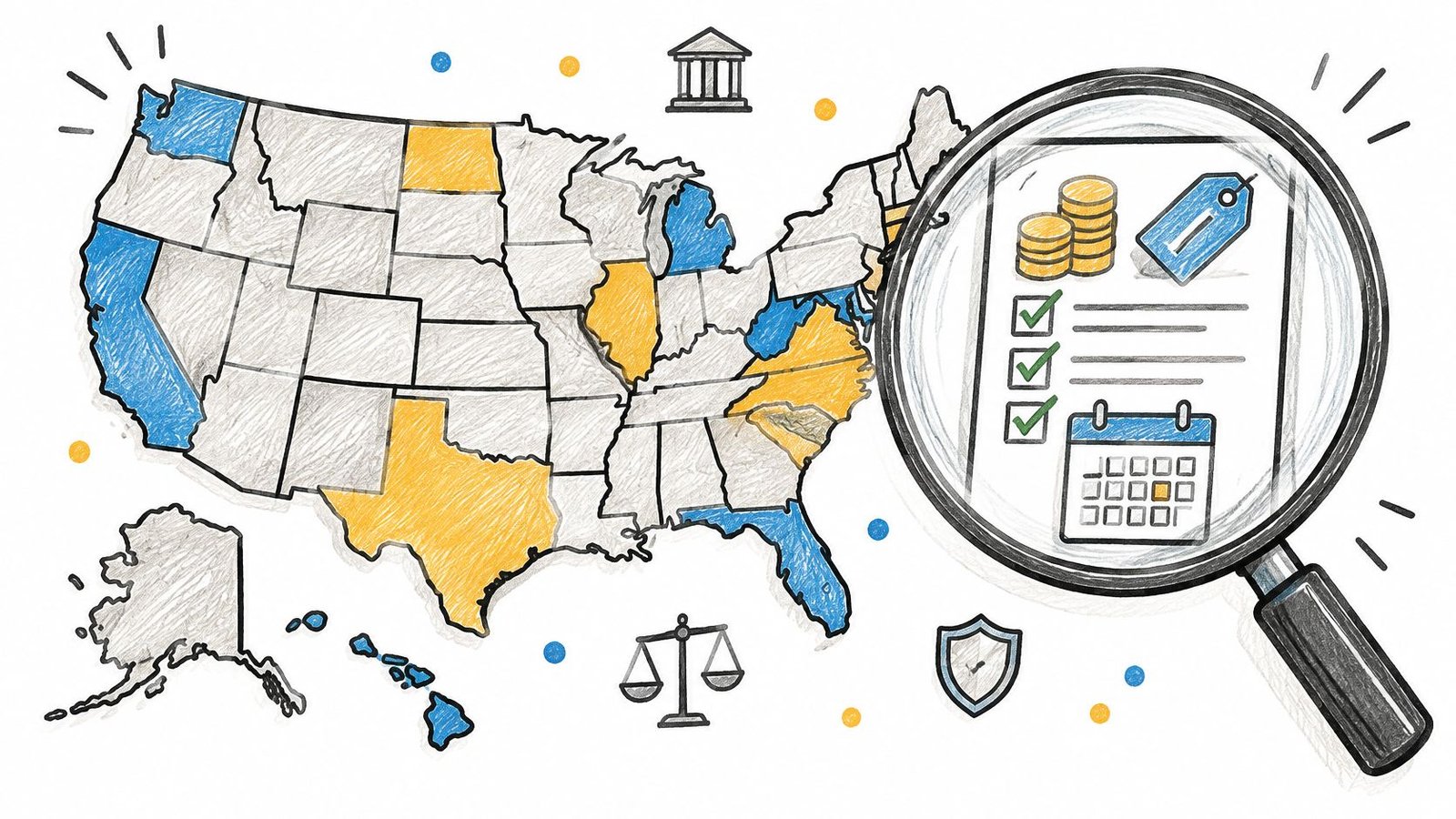
A state can permit payday lending on paper and still make it unprofitable to offer. Read the rows by what the rule does to price and availability, not by whether the statute uses the word "legal."
| Category | States | Typical rule | What to verify |
|---|---|---|---|
| Prohibited or priced below practical cost | New York, New Jersey, North Carolina, Pennsylvania, Georgia, Maryland, Massachusetts, Montana, New Hampshire, Vermont, West Virginia, District of Columbia | Ban, or an APR ceiling low enough that lenders stop offering the product | Current statute and effective date |
| Permitted with fee or APR caps | Oregon, Florida, California, Mississippi, Virginia | Fee per $100, APR ceiling, maximum loan size, or total-cost limit | Fee formula and maximum loan size |
| Permitted with few or no fee caps | Delaware, Idaho, Nevada, South Dakota, Texas, Utah, Wisconsin | Fees uncapped or silent in federal summaries | Confirm with the state banking or financial regulator |
| All other states | Any state not named above | Confirm the category with the state regulator before you rely on a summary | Rules from the state banking or financial regulator |
Use the table as a starting map, not as a legal opinion. The rows group states by how their rules work in practice, and any state left off the named rows stays unconfirmed until a regulator or the statute says otherwise.
Prohibited or priced below practical cost means a lender cannot run a storefront payday loan at the prices that make the product work. The named group is New York, New Jersey, North Carolina, Pennsylvania, Georgia, Maryland, Massachusetts, Montana, New Hampshire, Vermont, West Virginia, and the District of Columbia. A later federal count of prohibitions and impractical rate caps is larger than this named list. Any restrictive state that is not printed here belongs in the unconfirmed row until you verify it.
Permitted with fee or APR caps covers Oregon, Florida, California, Mississippi, and Virginia. A fee formula, an APR ceiling, a dollar cap on principal, or a total-cost limit is doing the regulatory work. The loan is legally available in these states, yet still small, short, or tightly priced, so access exists on narrower terms than the word "permitted" suggests.
Permitted with few or no fee caps is the group federal summaries describe as uncapped or silent on fees: Delaware, Idaho, Nevada, South Dakota, Texas, Utah, and Wisconsin. Legal availability here is real and prices can run high, so treat the row as a prompt to read the statute before borrowing.
Practical rule: If your state is missing from the named rows, call the banking or financial-institutions department and read the deferred-deposit or small-loan statute before you borrow.
Price Limits and Loan Size Rules in Example States
Oregon shows how several price controls can apply to the same loan: Pew's state rate-limit analysis summarizes a $10 fee for each $100 borrowed, a $30 ceiling on that fee, and a separate 36% interest rate. A borrower can therefore face both a fixed charge and interest on one contract.
A state's effective rule usually combines a pricing formula, an interest ceiling, a maximum principal amount, and limits on the term or repeat borrowing. Legal permission alone says little about how much cash a borrower receives or how much the loan ultimately costs.
| State or group | How the price is limited | How loan size is limited | What the rule does in practice |
|---|---|---|---|
| Oregon | Flat fee plus interest | Fixed charge has a separate ceiling | Fee and interest can apply to the same loan |
| Florida | Percentage fee plus a database charge | No separate principal limit stated in that fee rule | Cost rises with the amount borrowed |
| California | Fee counts toward the dollar maximum | Fixed-dollar ceiling includes the fee | Cash received is lower than the legal loan maximum |
| Nevada | No statewide fee ceiling identified in the federal summary | Limit is based on gross monthly income | Maximum loan size varies by applicant |
| Mississippi | Fee schedule changes by loan size | Fixed-dollar maximum | Borrowers near a tier boundary face different marginal pricing |
| Virginia | Interest ceiling plus a recurring maintenance fee | Combined-cost ceiling | Total repayment depends on both principal and duration |
| Delaware, Idaho, Texas, Utah, Wisconsin | Fee limit absent or unspecified in the federal-summary grouping | No common principal ceiling stated | Legal availability does not establish a predictable price |
These structures separate formal legality from practical access. California's rule limits the total loan and consumes part of that maximum with the fee, so the approved amount overstates the cash delivered. Nevada produces a different ceiling for borrowers with different incomes. Mississippi's tiered formula makes the price sensitive to the requested amount.
Virginia shows why a single headline rate can understate cost. Interest, maintenance charges, and the combined-cost limit have to be read together. Florida's percentage-based fee likewise scales upward as principal rises, which makes a small loan and a maximum-sized loan very different products.
How to read a high limit
A large principal ceiling does not make a loan affordable. Compare the fee, any interest, and recurring charges against the cash deposited. A low price ceiling can also make storefront lending commercially unavailable, turning formal permission into practical prohibition.
The comparison should end with total repayment and the cost of a second loan. That reveals more about real access than whether the state labels payday lending legal.
Federal Protections That Apply in Every State
Federal law sets a floor for a defined group of borrowers even when state law allows high fees. The centerpiece is the Military Annual Percentage Rate (MAPR) cap of 36%, plus other federal restrictions, for covered servicemembers and their dependents.
Who is covered
Coverage is a federal status, not a state license category. It reaches active-duty service members and eligible dependents. Rank, duty station, and family status all matter, and a lender's marketing page is a weak place to settle them. Confirm eligibility with the lender and with official Department of Defense guidance before you rely on the cap.
Say you are covered and you live in a state that still allows a high storefront fee. The state's permissive schedule does not erase the MAPR. The lender has to price the loan inside the federal ceiling for you, even if a civilian neighbor can be charged more.
The MAPR folds in most fees and add-on charges, not just the interest line. Compare the disclosed MAPR with the advertised fee per $100. A small-looking fee can still push the MAPR over the cap once verification charges and finance charges are included.
The federal cap protects covered borrowers. It does not make a permissive state's rules safe for everyone else in that state.
Ask the lender, in writing, whether MAPR protection applies to your contract, and keep the disclosure with the loan papers. If the answer is vague, do not treat a verbal "we work with the military" as compliance.
How to Verify a State's Current Payday Loan Rules

A state can call payday lending legal and still leave you holding a loan you cannot repay. Pew treats payment-to-income limits, full cost disclosure, and enforceable principal and fee caps as the core reform tools, and its research indicates that monthly payments above 5% of gross monthly income are generally unaffordable. On a paycheck of $1,000 gross, that benchmark is a payment no higher than $50.
The label "legal" hides a wide spread. Some states, Virginia among them, combine an interest cap, a capped monthly maintenance fee, and a ceiling on total cost. The statutes cited in this guide's state tables identify six states, Delaware, Idaho, Nevada, Texas, Utah, and Wisconsin, that cap no payday fee or say nothing about fees. A larger group of states plus the District of Columbia goes the other way, prohibiting payday lending or setting rate caps low enough to make the product impractical. Two borrowers in two "legal" states can pay very different prices for the same-sized advance, which is why verification beats labels.
Eight fields to record
- Find the agency that licenses small-loan or deferred-deposit lenders, usually the state banking or financial-institutions department. That office, rather than a lead generator, holds the enforcement record.
- Open the governing statute or regulation and note the effective date and amendments. An old blog summary can cite a repealed fee.
- Write down the maximum APR or fee per $100 and the maximum principal. Those two numbers set the cash you can receive and the price of it.
- Record the minimum and maximum term. A longer minimum can change how fast the fee comes due.
- Check rollover rules and any cooling-off period before a new loan. These often move total cost more than the headline fee, because they interrupt repeat borrowing.
- See whether the lender must check a state database and whether a verification charge applies. A database is how some states stop a second loan you cannot see on the contract.
- See whether you can request an extended payment plan, and on what terms. A repayment right is useful only if you know the deadline to ask.
- Run the affordability test against that 5% benchmark before you look at the APR. A legal loan can still be a payment you cannot clear.
Statutes change. Run this checklist against the current text, and treat the regulator's own reading of your contract as the last word.
Checking Your State Rules With BadCreditMD
The question that matters once you are already borrowing again is which rule stops the next loan, not which chart calls the product legal. A state guide that only says "allowed" leaves that question open. Payday loan laws by state on BadCreditMD is built as a reference for that gap: an informational site, operated by BadCreditMD, LLC, that explains borrowing options for people with imperfect credit and points readers to state-specific rules and free local help.

BadCreditMD is not a lender or a broker and does not make credit decisions. A separate lending-network partner may pass a request to third-party lenders where that is offered. Lenders set their own rates and approve or decline on their own. Request forms are turned off where a loan type is prohibited.
What you can actually use
The useful pieces for this topic are the state guides and the off-ramps, not a lender ranking.
- State guides: All 50 states and the District of Columbia, with permitted loan types, statutory or regulatory limits, a worked cost example, and contacts for complaints. Each state-law statement links to a statute, a regulator, or another cited source, with a last-checked date.
- Loan explainers: Personal, installment, emergency, payday, and title loans, with typical costs, who they fit, and the main risks.
- Alternatives: Credit union payday alternative loans, credit-builder loans, secured cards, and payment plans with utilities, medical providers, and creditors.
- Help directories: 211, nonprofit credit counseling, legal aid, public-benefits portals, and the CFPB complaint process.
The editorial team chooses topics and does not vet or rank individual lenders. Reading the guides does not affect your credit. A credit check happens only if you submit a request through the partner. Potential referral compensation is disclosed and is not supposed to change the write-ups. Selected pages are also in Spanish.
It is a fit when you need the cap and the complaint path for your own state, or when you want a lower-cost alternative spelled out before you talk to a lender. It is the wrong tool if you want someone to shop or approve a loan for you.
Which Rules Actually Change Borrowing Patterns

Most state roundups stop at legal or illegal. That label says nothing about whether borrowers take a second loan, how long the first one lasts, or whether the product stays on offer. Federal Reserve research covering more than 56 million loans in 26 states is one of the few studies that separates those effects.
A borrower near a state line can face a tight fee schedule on one side and none on the other. Both statutes read "allowed." Repeat use still differs between them, because the rules that bind differ.
| Rule | Documented effect | Limitation |
|---|---|---|
| Price caps (fee per $100 or APR) | Generally binding; often decided whether loans were offered | Can end the product instead of lowering its price |
| Loan-size caps | Less effective at changing outcomes | A smaller principal still carries the same fee rate |
| Minimum-term rules | Changed loan duration | A longer term does not by itself cap total fees |
| Maximum-term rules | Often did not change duration | Says nothing about how soon a borrower can return |
| Rollover bans and cooling-off periods | Reduced repeat borrowing | Some reforms cut lending volume and raised delinquency in at least one case |
The pattern matters more than any single row. A binding price cap works on the lender's side of the counter: below a certain fee, the loan stops being worth offering, so the product exits instead of getting cheaper. The disruption results run the other way. Where reforms reduced repeat borrowing, at least one also produced lower lending volume and higher delinquency, meaning some restricted borrowers went without the loan and others fell behind on payments they already owed. Legal availability and practical access pull apart here. A statute can leave payday loans lawful while a binding cap makes them rare.
If you are already in repeat use
When the next loan is the problem, rollover bans and cooling-off periods matter most. Repayment-plan rights come next, because they give a path off the cycle without a new advance. A fee cap still matters, though it may remove the product instead of softening it. A size cap, on this evidence, is the weaker lever.
Legal availability and practical access are different things. A loan can stay on the books and become uneconomic once a binding cap is in place. A state with no ban can still change the size, the term, and whether you can borrow again next Friday. Compare the rules that bind. The permitted-or-prohibited label is only where the analysis starts.
Borrowing Across State Lines and From Online Lenders

Borders and websites create a second map. You might live in a capped state and click a lender chartered somewhere else. Banks, storefront deferred-deposit shops, and online lenders do not all sit under the same cap, and a contract can name a governing law that is not your home state.
Three checks before you sign
- Governing law: Ask which state's law the contract uses, and whether that choice matches the state that licensed the lender.
- Your own cap: Put the total dollar cost and the APR next to the limit in the state where you live. A lower fee at home is useless if this contract ignores it.
- Immunity claims: Treat any pitch that the lender is "exempt from state law" as a warning, not a feature. Tribal and unlicensed lenders are a known substitute when storefront credit is restricted, and they often sit outside the licensing file you would normally search.
Say one state caps the fee at $10 per $100 and the state across the highway sets no fee cap. Driving over, or applying online to a lender based there, can produce a loan your home state would not allow a local storefront to make. The cash is real. So is the dispute about which statute applies if you cannot pay.
If you cannot match the lender to a record at a state regulator, treat the loan as high risk. Get advice before you sign, from the regulator, a legal-aid office, or a consumer attorney. A polished app is not a license.
Adjacent Products That Fill the Gap
A common worry is that a payday ban only pushes people into something equally harsh. Payday-lending prohibitions were associated with a 90% reduction in consumer-finance complaints in county-level complaint research from the Kansas City Fed. Fewer than 1% of that decline came from payday-lender complaints. Credit-reporting complaints accounted for 89% of the reduction. The same research found less reported difficulty covering emergency expenses, and less payday-loan use, among low-income, less-educated, and minority households in prohibited states.
That is not proof every prohibition works the same way. It does undercut the idea that restriction only relocates the harm. Each substitute has to be judged on its own terms.
| Product | How it differs | What to check |
|---|---|---|
| Bank overdraft | Fee charged when the account goes negative | Per-item fee, daily limits, and opt-in status |
| Installment loan | Repaid in scheduled payments over months | APR, total cost, and state licensing |
| Credit card cash advance | Borrowing against the card limit | Cash-advance APR and upfront fee |
| Earned-wage-access product | Advance on wages already earned | Whether the state treats it as a loan, and all fees |
| Credit union small-dollar loan | Lower-cost loan from a member credit union | Membership requirement and rate |
| Informal, unlicensed, or tribal lender | Often outside state licensing | License record, contract terms, and governing law |
Names are not legal categories
State regulators and attorneys general have treated some earned-wage-access products as payday loans, so the label on the app does not settle the product's legal status. The test is the state's definition of a loan: the fees charged, who advances the money, and when repayment comes due. An overdraft, an installment contract, and a wage-access advance can all put cash in the same account on the same day and still sit under three different rules.
Legal availability and practical access also split here. A credit union small-dollar loan can be the cheapest option on paper and still require a membership you do not hold. A credit card cash advance works in any state where the card works, priced by the cardholder agreement rather than the payday statute.
Published research does not supply a state-by-state map of these substitutes. Whether one of them is the safe choice depends on its own fee structure and license status, not on what happened to storefront payday lending.
Recent Changes and Bills to Track in 2026
Rules move. In 2025, at least 10 states had pending payday-lending legislation during their sessions, according to the National Conference of State Legislatures. Any table you saved last year can be stale by the next session.
A bill that amends one line can change what borrowing looks like on the ground. A lower fee cap can shrink the number of licensed storefronts, while a new database rule can limit how often the same borrower returns. Legality on paper and access in practice move separately, and pending legislation shifts both.
Three tracks worth watching
- State bills: Watch changes to fee or APR caps, loan terms, database rules, and repayment or extended-payment rights. A one-line amendment to a rollover ban can matter more than a new title on the act.
- Newer products: Enforcement against earned-wage-access and similar advances can reclassify a product as a payday loan without a new storefront statute.
- Charter and preemption fights: A live question is whether your state's cap reaches a lender chartered in another state or operating through a bank partner. That reach is contested and depends on facts specific to the contract. Do not assume a cap binds a particular bank or online lender without legal advice.
For tracking, use your legislature's bill search, the NCSL legislation pages, and notices from the state regulator. The current statute, with its effective date, is the document that counts.
Decide Whether to Borrow or Choose an Alternative

Decide from three notes you can write on one page: your state's category, the cap you verified, and the total dollar cost of each option in front of you.
- If your state prohibits payday lending or caps it below a price lenders will offer, skip the storefront loan and compare substitutes.
- If your state caps the fee or the APR, price at least two alternatives in total dollars before you sign.
- If your state does not cap the fee, treat the loan as high risk and test the payment against a small share of gross monthly income before you go further.
- If you are a covered servicemember or dependent, get written confirmation that the MAPR protection applies to this contract.
- If the lender is online or across a border, confirm governing law, licensing, and your home-state cap before you continue.
In capped states, the main remaining risk is repeat borrowing. Read the rollover and cooling-off rules before you agree to any renewal. This is general information, not legal advice. Take a dispute to the state regulator or a consumer attorney.
Write down the category, the verified cap, and the total cost. Then choose.
Before you apply, pull the current deferred-deposit or small-loan statute from your state regulator and match it to the fee, size, and rollover terms on the offer. For more plain-language explainers on consumer finance and everyday money decisions, browse the latest guides on Dutable.