
Information is the lifeline of a software system, and databases have been essential to modern software applications as a means of reliably storing, organizing, accessing, and modifying information. No matter what type of website is being developed, from a webstore to a banking app, a social network, a school management system or a mobile app, the structure and access to information behind the scenes depends on the database. There are two main types of databases: NoSQL and relational. Relational databases have structured tables that consist of rows and columns, and NoSQL databases employ multiple models to accommodate various types of data and application needs. It’s crucial to be aware of this distinction because there is no one perfect structure for a database that fits all situations. The decision to use one or the other will depend on what the information is, how it needs to be used, how fast the system needs to return the information, how much the data will be expanded, and how consistent the data needs to be.
The easiest way to see the difference is to think of two ways to present information to the beginning user. A relational database is similar to a well-structured group of spreadsheets, with each spreadsheet representing a table with a specific function, and links establishing connections between related data. For instance, in an online store, the customer, product and order tables could be maintained separately, and linked using customer id, product id and order id. NoSQL databases have a more flexible perspective, storing information in the form of documents, key-value pairs, wide columns or graphs. IBM defines NoSQL as a variety of database technologies that store and retrieve information in ways other than the relational structure that most traditional databases rely on, and the decision for relational versus non-relational databases depends on the application and its needs.
What Is a Relational Database?
A relational database is a database system that stores information in tables with rows and columns. Typically, each table corresponds to a specific type of data, like customers, products, employees, or transactions. The rows refer to a single record, the columns refer to a particular aspect of a record. If you have a Customers table, for instance, it may have Customer ID, Name, Email and Phone Number fields and each row would be one instance of a Customer. Tables are related via keys, particularly primary keys and foreign keys. The primary key is a key which is used to uniquely identify a record in a table, and a foreign key is a key that can be used to link a record to another table. The following are some of the advantages that relational databases have: These structures are very useful when information has clear relationships, and when applications require reliable rules for the relationship between different data elements.
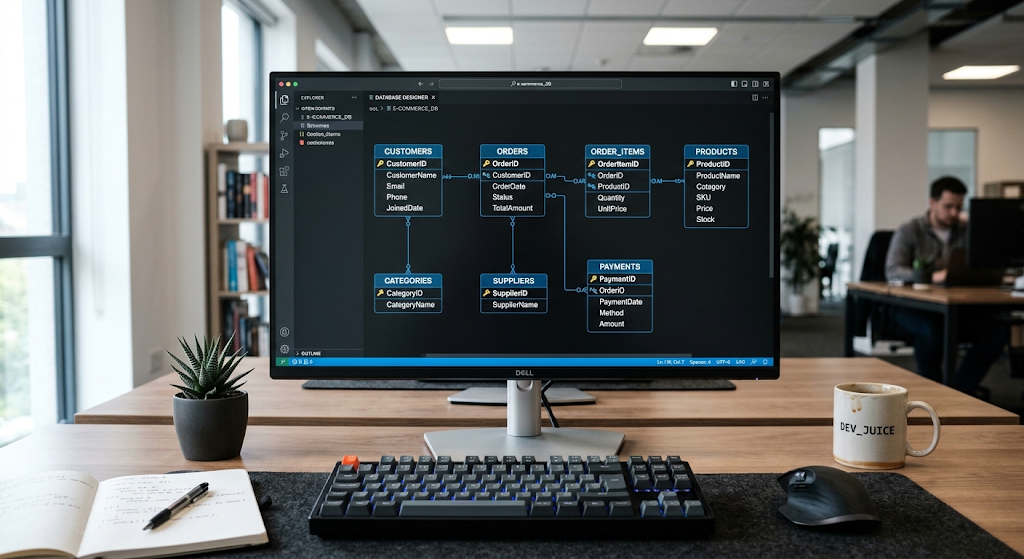
Structured Query Language (SQL) is a popular software language used to create tables, add records, retrieve, modify and perform other software activities on a database. With SQL, the developers and database administrator can filter, sort, join, calculate, and use complex queries to get records. One of its significant features is that it supports joins, which enable you to get related information from various tables. For instance, you may store the information about customers separately from the information about orders at an online store, and use a query to retrieve the orders for a specific customer. This segregation can help avoid redundant data, and it allows for structured data to be easier to maintain. Thus, relational systems are particularly beneficial when data integrity and rigorous relationships, as well as complex queries are critical needs.
What are NoSQL Databases?
NoSQL databases are databases that are not based on the relational table model. It’s often used in the context of “not only SQL” (or “non-relational”) and refers to more than one database model (and technology). Many NoSQL systems allow for data to be stored as structures that are more appropriate for documents, rapidly changing data, large distributed workloads, or highly connected data, as opposed to every record having to follow exactly the same set of columns. IBM classifies NoSQL models into the following: key-value stores, document databases, wide-column stores, and graph databases. Every model structures data differently and has a specific structure of storing and retrieving data.

NoSQL databases may benefit applications that manage data that varies in content and frequency of updates, or data that does not adopt a naturally defined table structure. For instance, a person’s information in a document database can be stored as a single document that includes details regarding the customer, such as address, telephone number, preferences, and more. A different NoSQL system may have a shopping cart stored as a key, with the collection of products stored in the value. People, products, locations, or organizations could be represented as nodes in a graph database with their relationships represented as links between these nodes. There is a variety, that’s why NoSQL is not just an alternative version of any relational database. Rather, it is a general term for a group of approaches to database construction that provide various methods by which information can be organized to meet application requirements.
Data Structure: “Tables” or “Flexible Models.”
The largest difference between relational and NoSQL databases is how it stores data. In a relational database, tables are used, each having a predetermined column set, and are connected by relationships. Developers typically create a schema that outlines the structure of the data to be stored in tables and the relationships between them, before the data is inserted. This is a structured approach which has value as it provides clear expectations of the form and content of stored information. For instance, an employee table might include an employee ID, name, employee’s department, and date of employment for employees. These rules can be used by applications to create and retrieve records from the database, if the database is properly designed. Relational databases are especially well suited for systems where the data is clearly related and the relationships between the data records are significant.
More flexible data structures can be employed in NoSQL databases. In document databases, records are typically stored as documents, typically in a format like JSON or some other equivalent representation. A key-value database is a data store that organizes data into key-value pairs. WCB databases store data by columns and column families; graph databases store entities and relation with nodes, edges, properties. NoSQL can be beneficial when data attributes are different in various records, or when the structure of data evolves over time. Flexibility does not mean there are no rules or structure in NoSQL systems, however. The difference from the traditional relational database is that the data models are not based on the same table-and-relationship structure, but each individual NoSQL technology offers other features such as validation, indexing, consistency mechanisms, and data modeling practices.
Methods and Data Access.
The relational databases have been closely linked to SQL which is a standard language used to interact with structured data. SQL statements allow developers to perform a wide variety of operations, such as selecting records, filtering information, joining tables, grouping data, computing values and updating data. Some of the best features of SQL are the things it can do to express complex relationships between tables. A business may have tables of “Customers”, “Orders”, “Products”, and “Payments”, with “Orders” being joined to the other tables to get the information across the tables. This can be especially helpful in reporting, analyzing, financial applications, inventory applications and other areas where users require answers to specific questions about related data. The relationships and data structure are typically well specified, which allows developers to build the queries around a known model.
There isn’t one standard query language for NoSQL databases, as different NoSQL models have different data structures. The database could be a document database that enables queries that search content in documents, or it may be a key-value database, where a document is accessed by its key. Wide-column systems support access patterns that are appropriate for large distributed datasets, while a graph database employs techniques for traversing relationships between nodes. In other words, typically the data model is created based on the queries that the application will require. It’s important to note that each NoSQL system offers tools designed for specific access patterns, not a single technology. When the database structure is well suited to the needs of the application, it can be efficient to retrieve the data.
How to Achieve Scalability Either Vertically or Horizontally.
Scalability refers to the capacity of a database system to manage data, users and requests as they grow. In the past, relational databases have been scaled up by simply attaching more memory, memory sticks, and storage to an existing server. But it’s not to say that relational systems can’t be scaled in other ways, such as replication, partitioning, clustering, and more. However, some large-scale distributed designs may be more complicated because they rely on some centralised or tightly coupled database systems. If an application has a clearly specified workload and transactional needs, a relational system can be effective and can be scaled by using hardware and by structuring the database.
A lot of NoSQL databases are horizontally scalable. Horizontal scaling involves adding additional servers to the system to share the data and workload, rather than depending entirely on one high-performance server. Data can be partitioned across a number of machines, replicated across a number of servers, etc. According to IBM, NoSQL databases are frequently used to support distributed architectures and that horizontal scaling can split up the workload between multiple servers. It may be beneficial for applications with a high number of users, a quickly expanding dataset or workloads that are distributed among several locations. But the horizontal scaling adds more architectural issues, such as data distribution, replication, failure management and consistency.
Consistency and Transactions
Another important factor to consider when comparing relational and NoSQL databases is consistency. The four properties of atomicity, consistency, isolation and durability are typically associated with transactions in a relational database. With these properties, you can guarantee that a well-defined set of database operations are performed in a consistent manner. For instance, when transferring money from one account to another, there are a number of changes to make: money has to be taken out of one account and put into another. A transaction system can be used to make sure that the operations are performed as a single unit, instead of leaving the database in an incomplete state. For systems like banking, accounting, payments and inventory management, which can lead to major data issues if updates are not done properly, strong transactional guarantees are especially crucial.
The consistency models supported by NoSQL systems vary based on the NoSQL database and configuration. Some prefer to have high consistency, and others use eventual consistency or a specific consistency level to provide better availability or performance – or to make distributed operations easier. Eventual consistency is the property that replicas may temporarily have inconsistent information, but they are supposed to be consistent when the updates are eventually propagated. It may be acceptable in some applications where everyone can’t agree at once is less critical than availability and dealing with lots of requests. It is important to note that NoSQL is NOT a synonym for weak consistency. Each type of NoSQL technology offers some variation in design and is able to provide transactions and more robust consistency guarantees. The question to ask is what does the application need from the database’s consistency?
Flexibility and Schema Design.
In most relational databases, the structure of tables and columns is predetermined – that is, it is designed first, before data is added to the tables. This can be a major benefit as the schema gives consistency and makes relationships easier to understand. If an organization requires consistent and predictable fields for its records, a good schema can minimize the chances of bad or inconsistent data entering into the system. If you have a large body of data or dependent queries in an application you may need to plan a change to a relational schema. This can, however, also give discipline and make long-term data management more predictable.
NoSQL databases can frequently offer more flexibility in ways data can be represented. For instance, in a document database, two documents might have completely different fields, but the data collection doesn’t necessarily need to have the same structure. This can be beneficial if applications are changing frequently, or when incoming data has different properties. But flexibility can generate new obligations for the developers, since the application should have some uniform rules as to how the data is to be interpreted. If data is not carefully structured, flexible structures may lead to problems of maintenance and query. So, the difference is not just that RDBMS is rigid and NoSQL is flexible. Rather, each one puts structure in various portions of the system and offers different methods of handling changes.
Types of NoSQL Databases
Document Databases
Document databases contain data in the form of documents, not rows of data in relational tables. A document may contain many related fields and may contain nested information, which makes this model convenient to use for applications where the objects or JSON-like data would occur naturally. For instance, a user profile could include a name, contact information, preferences, and a list of settings in one document.
This can minimize the need to go back to several tables to get related information when the application normally accesses them at the same time. Typical applications for document databases include content management, product catalogs, user profiles, and applications with evolving data structures. They are useful if access patterns to the application are appropriate and if the documents are designed appropriately.
Key-Value Databases
Key-value databases are the simplest of data types, where each piece of data is stored with a unique key. The application can use the key to retrieve the value, especially for simple and fast lookups. Typical data which can be stored here is session data, cached results, configuration values and shopping cart info. The simplicity of the model can make it very efficient, if a workload consists primarily of operations that retrieve information based on a key that already exists in the model.
Key-value systems are less naturally suited, however, when an application is required to search many unrelated records, often in a complex way. They are based on easy-to-follow patterns, not complex relational analysis.
Wide-Column Databases
Wide-column databases are data storage systems that use columns and column families to store data, and are optimized for large distributed data sets. Unlike traditional relational tables, these systems can be built around specific access patterns and workloads. They are customary to systems that require to share data among several servers and handle with big volume.
For some analytic, telemetry, time-series and high volume applications, wide-column databases can be beneficial, but they typically need to be well structured. As the database design is tightly linked to how the information will be used, the developer needs to know how the information will be queried and distributed.
Graph Databases
Graph databases are designed for information in which relationships are as important as the individual data items. Graph databases do not focus on storing data in rows and columns, but rather entities as nodes, relationships as edges, and properties as attributes that are attached to the nodes and/or edges. For example, a social network allows people to be nodes and friendships or professional connections to be represented as an edge.
Recommendation systems, fraud analysis, knowledge graphs, and network analysis can also be applied to similar applications. If the application requires to explore more than one relationship between entities, the graph model can be used right out of the box to directly represent those relationships rather than using traditional tables and joins.
Applications of Relational Databases
Applicantations which require structured information, reliable transactions and clear relationships will often rely on relational databases. Applications like banking or financial data, where the value of an account, transactions, and customers each have a defined relationship, and where transactional guarantees are often required, are typical examples. Relational structures can also be useful for inventory systems, as there is a need to maintain consistency of products, suppliers, warehouses, orders, and stock movements.
SQL can also be useful for business applications when producing detailed reports, as analysts can join data from different tables in the database and use advanced query features to make calculations. In these cases, the database is not just a data repository, it is the keeper of valuable relationships and rules that are integral to the application. When the information of this type is structured, it can be represented in a natural way in a relational model.
Applications of NoSQL Databases
NoSQL databases can be beneficial for applications that require flexible data models, distributed implementations, specific access patterns, or high-volume workloads. Content platforms, product catalogs, user-profile systems may be considered use cases for document databases, which are used to store related information in the same repository. Key-value databases can be used for caching, session management, and other workloads that require quick access to data.
For applications that produce large amounts of information or for a large distributed data set, wide-column systems may be helpful. Graph databases work well for applications that focus on relationships, such as recommendation systems, social networks, fraud detection, and knowledge graphs. Other distributed applications, real-time analytics, ecommerce, social networking, low latency workloads, and large data volumes are other IBM use cases.
Relational vs. NoSQL: A Practical Comparison
The problem with relational and NoSQL databases is not that one is “outdated” and the other is “up to date.” Relational databases are based on structured tables, pre-defined relationships, and SQL, while NoSQL databases offer a variety of models that can be structured around documents, key-value pairs, wide columns, or graphs. Relational systems can be a natural choice for applications where relationships between data elements are a key feature, complex queries are important, and transactional integrity is a critical requirement. Applications with flexible structures, specialized access patterns, or distributed scaling can benefit from the use of NoSQL systems. The decision, therefore, should start with what the application needs to do and what data is involved, rather than which of the two technologies is considered to be the best. Questions that are important include: What type of relationships exist between the data, what type of queries must be allowed to be done, how quickly the system can respond, how much the data may change, and what guarantees of consistency are necessary.
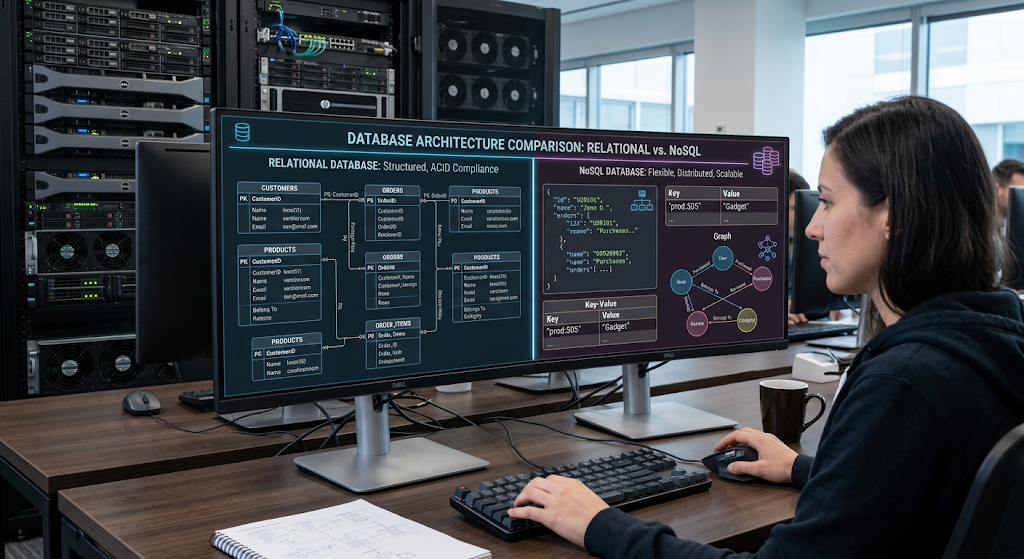
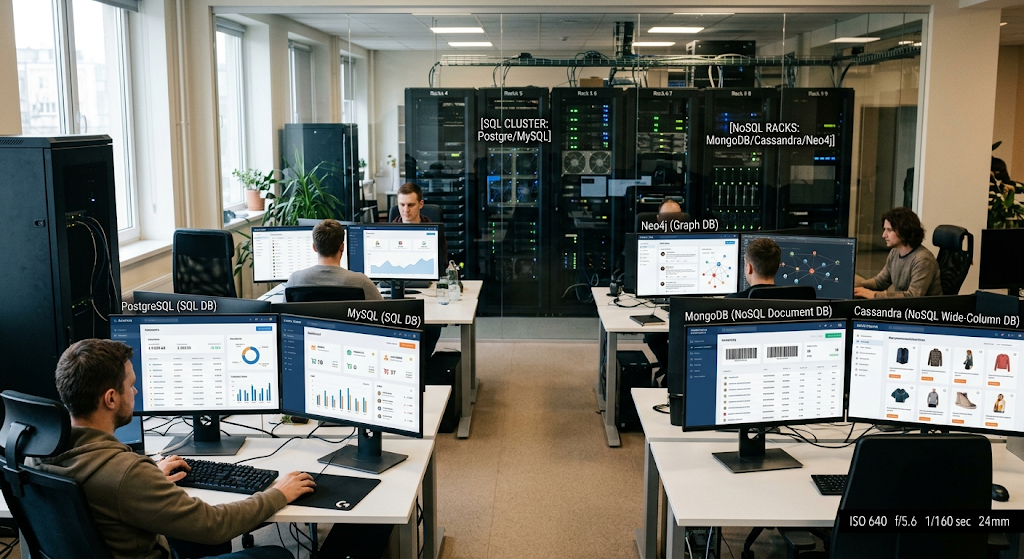
A single application can also be based on both relational and NoSQL technologies. Modern systems can often employ multiple databases, each with a distinct data model, for various aspects of an application, instead of forcing all workloads into a single data model. A business application could have several data stores, such as a relational database for financial transactions and customer accounts, and a key-value store for caching or a graph database for analyzing relationships. This is sometimes referred to as polyglot persistence, since different data are persisted with different technologies that serve their needs. In architectures with varying data models and requirements, relational and NoSQL databases can be used side by side, IBM says.
When to use Relational or noSQL
The decision shall not be based on the popularity of a particular technology, but rather on the requirements of the application. When there is a stable database structure, relationship between records is important, SQL queries are significant and transactions require a high level of assurance, then a relational database might be appropriate. NoSQL databases can be used if the application’s data is naturally stored as documents, key-value pairs, wide columns, or graphs, or if flexibility in data structures and distributed workloads are essential.
Operational considerations, team expertise, security, backup requirements, monitoring, expected growth, hosting, and the database consistency and transaction capabilities are also potential factors for developers to take into account. When making decisions for performance or scalability only, you could come up with an incomplete decision due to the fact that database design has an impact on application development, application maintenance, reliability of the applications, and how applications communicate with the data.
Conclusion
There are two technologies that can address the same general business problem – storing and reliably retrieving information for applications – Relational and NoSQL databases. Relational databases store structured data in tables, have relationships and provide a powerful way of accessing data through SQL to make queries and transactions. NoSQL databases come in a variety of forms such as document stores, key-value stores, wide column stores, and graph databases, giving developers the freedom to select the model that best suits specific use cases.
While relational systems might be ideal for highly structured data and complex relationships, NoSQL systems can offer some flexibility and distributed designs to certain workloads. Both methods do not necessarily work for all applications. Important factors are the type of data, what types of queries the application must support, the consistency required, the scale of the data, and the environment in which the application will be deployed. Knowing these differences is a basis for determining a database architecture that matches real needs, instead of assumptions.