Scalability is one of the major reasons why brands fail. If your brand logo isn’t scalable, it won’t last long.
The logo is the first impression of every brand. It shows up everywhere, from websites to mobile apps, to social media profiles, and every digital platform you can name.
For this reason, having a scalable logo design is no longer optional; it is a must.
A scalable logo allows you to adapt to any size without losing clarity, impact, or meaning. It is also known as a versatile logo that works across various backgrounds, contexts, and media.
But why is a scalable logo becoming a core of branding?
Let’s break down why your brand needs a versatile logo, its qualities, and how to build a flexible branding system that is captivating for your audience.
What Makes a Logo Scalable?
A scalable logo maintains its integrity, readability, and visual appeal at any size, whether it’s on a tiny app icon or on a massive billboard; a scalable logo fits well irrespective of the platform.
Here are the core elements that you should consider for a scalable logo:
- Use of Vector Graphics
Using vectors like SVG, AI, or EPS make it easier for logos to be enlarged or reduced infinitely without pixelation. Unlike raster formats (PNG or JPEG), vectors are shapes, which keep your scalable logo design working fine for every resolution.
- Simplicity in Form
Overly detailed logos can lose their clarity when shrunk. A scalable logo helps avoid fine lines, intricate textures, or busy elements. Take an example of global brand logos like Nike, Chanel, and Coca-Cola, simple, strong icons that are easy to recognize right away.
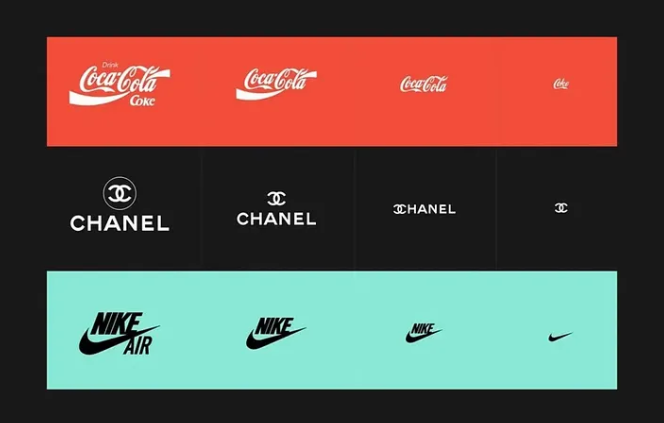
These brand logos are scalable and easily fit the screen size. If you’re a startup and looking for quick inspiration for your brand logo, then here is a perfect template to get started.
- Strong Contrast and Readable Typography
Scalable logos use high-contrast color schemes and clear fonts that remain readable even at small screen sizes. Thin fonts or overly stylized lettering can look less appealing.
- Clear Symbolism
A logo should communicate your brand message irrespective of the size. Shrinking isn’t an option. Make sure you redesign your logo for better scalability.
A scalable logo ensures consistency. It builds brand recognition and trust. You need to ensure it has key elements to make it a flexible branding.
Why Scalability Matters Across The Platform (Print, Digital, Merchandise)
Scalability is just one part of the equation; true branding success comes from versatility. A versatile logo is built to work in different environments and across a wide range of applications. This means logo adaptability is important to scale your business.
- Digital Platforms
Your logo is most likely to appear on websites, mobile apps, email signatures, and social media platforms. It requires different dimensions and, often, different color palettes (e.g. dark mode vs. light mode).
- Print Materials
Print a logo means you need different and high-resolution formats as compared to digital platforms. Logos should be adaptable for business cards, letterheads, flyers, posters, and packaging. This often means having versions that translate well in CMYK and grayscale formats.
- Merchandise & Apparel
Brand logos are printed on t-shirts, mugs, hats, or corporate gifts. Make sure your brand logo is adaptable for every size. Keep it bold, recognizable, and adaptable, even when used as a single-color imprint.
- Horizontal, Vertical, and Icon-only Version
The key elements of a versatile logo include:
- A full primary logo
- A simplified mark or symbol
- Horizontal and stacked versions
- Monochrome and negative-space variations
For example, if you’re planning to launch a brand in a competitive market, you should seek assistance from a professional. Get quick assistance for logo design in Dubai and leverage the power of adaptable logos.
However, it’s important to ensure your brand remains consistent across luxurious digital campaigns and premium promotional materials.
Common Design Mistakes That Reduce Scalability
Even the most creative logo can fail if it isn’t built for adaptability and scalability. Here are the most common design pitfalls that hinder scalability and versatility:
- Overly intricate designs
Too many lines, shadows, patterns, or tiny details can be lost when minimized. Minimalism often works better if you’re looking for smooth scalability.
- Relying solely on color effects
Gradients, glows, and textures may not reproduce well in print or in black-and-white applications. A logo should work without relying on special effects.
- Weak typography
Fonts that are too thin, overly decorative, or not properly spaced can become when shrinked.
- Ignoring different background contexts
If the logo only looks good on one background color and has no alternative versions, it limits usability.
- No consideration for real-world applications
You must test out mockups such as social icons, signage, or merchandise that can result in costly rebranding later.
Avoiding these mistakes helps ensure your design meets modern branding standards for scalable logo design and long-term logo adaptability.
Best Practices For Creating a Versatile Logo
To build a brand that thrives across every touchpoint, you need a logo system that’s agile, smart, and future-ready. Here are industry-approved strategies:
- Start with vector design
When starting to design a logo, it’s important to create a vector design. Skilled designers use Adobe Illustrator or Figma to ensure the logo has a perfect resolution.
- Adopt a modular approach
Design a logo suite that includes:
- Primary logo (complete design with text and icon)
- Secondary logo (horizontal or stacked)
- Symbol-only version (icon or monogram)
- Wordmark-only version
- Light and dark versions
- Monochrome versions
These pointers ensure logo adaptability is more important to fit at every platform.
- Embrace minimalist design principles
A cleaner logo is easier to scale, easier to recognize, and consistent. Minimalism doesn’t mean boring or not creative enough; it simply means the logo is easily scalable and works across the platform.
- Test across multiple mediums
Your logo is not only meant for your brand website. Testing out your brand logo on multiple platforms is important. Preview the logo on:
- App icons
- Social media profile pictures
- Business cards
- Billboards
- Website headers
- Product packaging
- Merchandise
This holistic approach reflects real-world usage and promotes flexible branding.
- Develop brand guidelines
Before you start designing a logo it’s important to define your brand guidelines. Make sure it clearly states your logo usage rules, white space, minimum size requirements, color palette, and incorrect usage examples. This ensures consistency in every application.
Final Word
A well-designed logo isn’t just about aesthetics; it’s about functionality, consistency, and longevity.
A scalable logo design ensures clarity and recognition across the platform. A versatile logo ensures seamless integration across platforms, products, and campaigns.
And for that, it’s important to partner with a professional logo designer in Dubai. Only a professional knows how to ensure logo adaptability.
To compete in markets like Dubai, make sure your brand logo is adaptable, better positioned for sustainable growth, offer stronger visual identity, and offer maximum impact.
Because the loudest, consistent, and adaptable logos wins by all means. Build your identity on a foundation that is scalable, flexible, and versatile, no matter what the trend is.