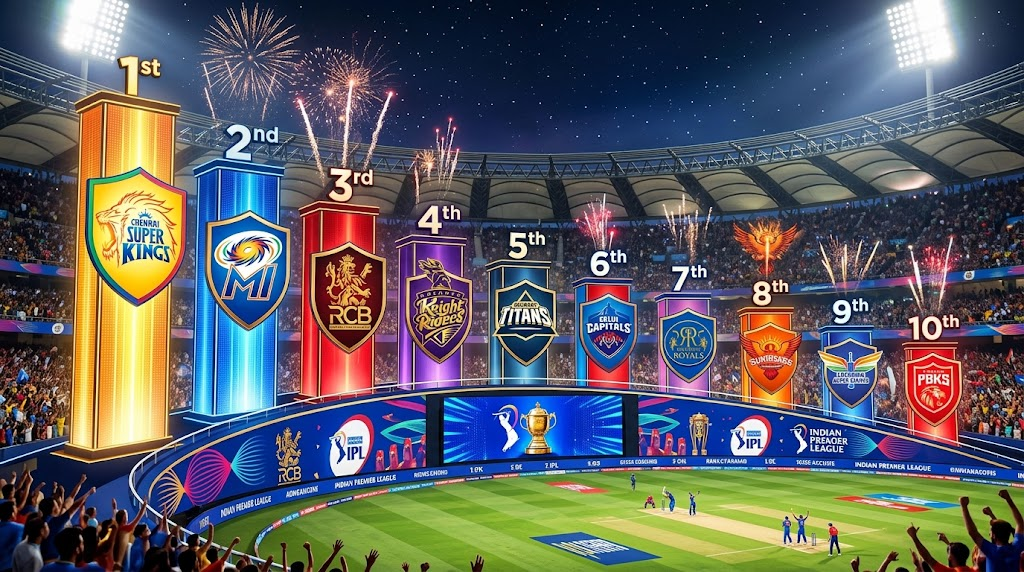
IPL franchise brand value is not the same as a team’s annual revenue, profitability or sporting record. The clearest reported 2026 benchmark placed Royal Challengers Bengaluru first, with a brand value of US$312 million, according to Cricbuzz. However, a complete, like-for-like public ranking of every IPL franchise by valuation, revenue and year-on-year growth is not available in the material published alongside that headline. That limitation matters: different business measures answer different questions.
Why an IPL brand-value table needs careful reading
A brand valuation estimates the financial contribution of a name, reputation, fan association and commercial appeal. It does not simply state how much a franchise owner could receive in a sale. Nor does it represent the cash a team earned during one season. Revenue, meanwhile, describes money coming into a business, while profit depends on costs that may not be publicly reported in comparable detail.
This distinction can easily be lost when franchise rankings are discussed. A club may possess a powerful brand because of its long-standing fan community, recognisable identity and national visibility, even if a particular season’s on-field campaign was disappointing. Conversely, a strong league finish may boost attention without immediately producing a fully revised valuation.
For followers looking at fixture context, team form and pre-match discussion, a page focused on today match prediction 100 sure may sit alongside the broader conversation. But a match prediction and a brand valuation should be treated as separate exercises: one concerns a forthcoming contest, while the other estimates longer-term commercial strength.
Royal Challengers Bengaluru led the reported 2026 measure
Cricbuzz reported on 29 July 2026 that Royal Challengers Bengaluru became the first IPL team to reach a brand value above US$300 million. The reported figure was US$312 million, putting RCB at the top of the franchise brand-value measure cited in that report.
That outcome is significant because brand strength is built over many seasons rather than one short tournament cycle. A franchise’s commercial identity can draw on fan engagement, visibility, sponsorship appeal, player association, merchandise potential and sustained media presence. These factors are related to cricket performance, but they are not identical to it.
RCB’s 2026 title also provided a major sporting moment. The official IPL website stated that Royal Challengers Bengaluru defeated Gujarat Titans by five wickets in the 2026 final. Such a result can add momentum to an already prominent brand, although it should not be assumed that the final alone explains a valuation figure.
The league’s expansion provides the wider setting
The franchise valuation story sits within a larger IPL business story. Cricbuzz reported that the IPL was worth US$20.6 billion in 2026. That league-level estimate should not be divided across teams or treated as a sum of individual franchise brand values. It is an ecosystem figure and reflects the wider value attached to the competition.
At league level, value may be connected to media rights, the tournament’s audience, sponsorship demand, matchday activity and the ability of clubs to build commercial programmes around the season. Franchise brands operate inside that environment but retain their own identities and commercial strengths.
It is also worth noting that published IPL valuation figures can differ sharply depending on the firm, definition and year used. One 2025 report indexed by Brand Finance described the IPL ecosystem value as US$9.6 billion, down from US$12.0 billion in 2024. That is not directly comparable with the US$20.6 billion league value reported by Cricbuzz in 2026 because the underlying methodologies and measures may differ.
Why revenue rankings are harder to establish
A revenue ranking requires comparable annual income figures for each franchise over the same accounting period. That normally means knowing how a club’s income has been recorded across central league distributions, sponsorship, ticketing, merchandise, licensing and other activities. Public reporting does not always provide this information in a uniform format for every team.
As a result, a headline that claims to rank every IPL franchise by revenue may create a greater appearance of certainty than the available information supports. Without a common reporting basis, a list can mix estimates from different years, currency conversions and calculation methods. It may also confuse franchise-level turnover with the overall IPL’s commercial value.
The sensible conclusion is not that revenue is unimportant. It is central to the health of every sports organisation. Rather, it is that readers should ask three basic questions before accepting a revenue ranking: what period is being measured, which income streams are included, and whether the same method has been used for each franchise.
Valuation is not sale price
A reported brand value measures the contribution of a brand under a particular valuation framework. A sale price would reflect negotiations between buyer and seller, ownership terms, assets, liabilities and expectations of future income. The two figures can be related, but they cannot automatically be substituted for each other.
Growth needs a consistent starting point
Growth is meaningful only when the beginning and ending values use the same methodology. If one estimate is a brand-value figure and another is an ecosystem valuation, the percentage movement does not describe franchise growth. Similarly, comparing figures from different assessors can produce misleading conclusions because each may define value differently.
Sporting performance still shapes commercial attention
Cricket success can amplify a franchise’s visibility, particularly when it produces decisive moments that become part of the team’s story. RCB’s five-wicket victory over Gujarat Titans in the 2026 final was one such moment. For established clubs, high-profile wins can reinforce supporter loyalty and generate fresh commercial interest.
Yet cricketing success alone does not settle brand rankings. Mumbai Indians’ official website describes the franchise as a five-time IPL and two-time CLT20 champion. That record demonstrates the depth of its sporting history, but the available material does not provide a 2026 brand-value figure that can be compared directly with RCB’s US$312 million estimate.
Chennai Super Kings also illustrates why sporting and commercial analysis should not be reduced to one season. The available 2026 information states that CSK finished eighth with six wins from 14 matches. A single tournament position says little by itself about the full strength of a team’s established identity, supporter base or commercial arrangements.
A more useful way to compare IPL franchises
Instead of forcing every team into an unsupported combined ranking, readers can separate the discussion into three layers:
| Measure | What it indicates | What it does not prove |
| Brand value | Estimated commercial strength of the team name and identity | Annual cash income or sale price |
| Revenue | Income generated over a defined period | Profitability or long-term brand strength |
| Growth | Change over time using a consistent measure | A universal comparison if methods differ |
| Sporting performance | Results achieved on the field | Complete commercial value |
This approach helps prevent a familiar error: treating one prominent number as the final verdict on an entire franchise. A team can lead a brand-value study, another can have a distinguished trophy record, and another can be developing rapidly in commercial reach. All three statements may be true at the same time.
What can be stated with confidence
The available 2026 reporting supports two clear conclusions. First, Royal Challengers Bengaluru led the reported IPL franchise brand-value measure at US$312 million. Second, the IPL’s overall commercial scale remained substantial, with Cricbuzz reporting a US$20.6 billion league value.
What cannot be stated reliably from the available figures is a definitive, audited ranking of every franchise by annual revenue and valuation growth. Those require comparable team-by-team disclosures and a shared methodology. Until such data is published comprehensively, brand-value tables should be read as specific assessments rather than complete financial league tables.
IPL franchise value is therefore best understood as a combination of cricket, culture and commerce. RCB’s reported 2026 lead offers a clear benchmark, but the wider comparison remains more nuanced than a simple list of ten teams and one number each.