Introduction
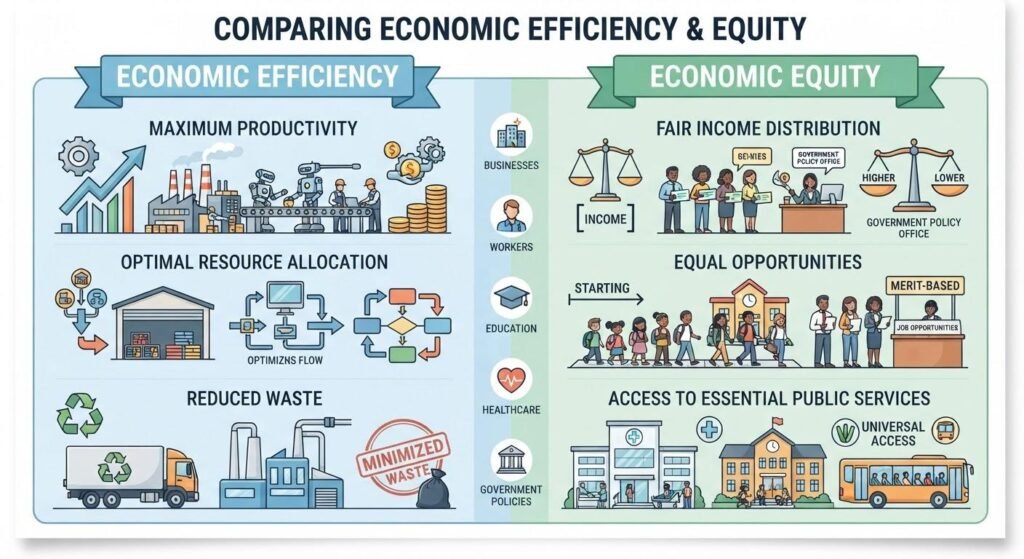
Economic efficiency and equity are key ideas and are key to the way in which a society manages and distributes economic gains. Decisions must be made to prioritize and optimally utilize available resources so that many differing wants and needs can be met. An economy will strive to both fully utilize resources and enhance economic welfare. Alongside this, an economy should endeavor to meet consumer and societal demands in a fair manner. Economic equity relates to the extent to which income, wealth and opportunities are fairly distributed. Although there is often close association between economic equity and efficiency, the two can at times lead to distinct outcomes. There may, for example, be both high economic output and great wealth within an economy and yet some sections of society may still be negatively affected. Therefore, it is crucial to understand the link between economic efficiency and equity in order to effectively analyze economic policy and ensure that governments can enhance economic welfare, as well as uphold social justice.
Understanding Economic Efficiency
Economic efficiency refers to how resources (such as land, labor, capital and entrepreneurial skills) are optimally managed to maximize economic gain. Within an economy, resources should ideally be used in such a way that ensures that there is minimal wastage. Businesses and governments can both work to maintain economic efficiency. Companies can for instance, make quality products and effectively manage resources, so that there is minimum unnecessary spending. Furthermore, governments can ensure economic efficiency by allocating state money to schemes that offer considerable advantages to society. Given the scarcity of resources, economic efficiency is a key area as inefficient management can cause increased costs and hinder productivity and so an economy will seek to effectively manage resources in order to fully realize its economic potential.
Types of Economic Efficiency
There are several forms of economic efficiency. Firstly, productive efficiency occurs when outputs are created at the lowest possible cost, utilizing current technologies and resources. Secondly, allocative efficiency is achieved when resources are distributed in line with consumer and societal demand, so that products and services are optimally valued for the costs incurred. Finally, dynamic efficiency is concerned with the enhancement of productivity through innovation, as well as through research and investment. Although these three types of economic efficiency differ, an economy must strive to both efficiently produce goods and services and ensure that what is produced aligns with consumer and societal demand. Moreover, it must continue to develop. Although businesses may successfully implement productive efficiency in order to lower their production costs, they may still fail to effectively manage resources if they are not producing what is required by consumers.
Pareto Efficiency
Pareto efficiency is an important idea that can be applied to economic efficiency. It is named after the Italian economist, Vilfredo Pareto. An economic situation can be deemed to be in a state of Pareto efficiency if it is not possible to improve one person’s position without worsening the status of at least one other person. This is a helpful concept as it can assist in analyzing whether an economy is efficiently managing resources. It highlights that further enhancements may not be able to be enacted without adversely affecting someone. For instance, if two people were sharing a given amount of food and other resources and all resources had already been distributed, then it may be in a state of Pareto efficiency as one person’s situation could not be enhanced without compromising the other person’s. Crucially, however, the notion of Pareto efficiency does not assess whether an economic distribution is fair. It is possible for one member of a society to hold a vast majority of resources and for another to have minimal resources and yet for this still to constitute a Pareto efficient economic distribution.
Economic Equity
As previously mentioned, economic equity relates to the fair distribution of economic resources, opportunities, income and wealth. Whereas economic efficiency mainly analyses the efficiency with which resources are managed, economic equity recognizes that individuals and groups may be in differing situations and works to alleviate any unjust disadvantages that they may experience. By providing inexpensive education and healthcare, for instance, equity can be enhanced as even those from less well-off families can then access services that they may otherwise be unable to afford. Although equity does not necessarily entail all members of a society receiving identical income or wealth, it acknowledges that people can be in differing situations and may therefore require differing levels of support to ensure that they can effectively utilize economic opportunities.
Equality and Equity
Whilst equality and equity can often be used interchangeably, they represent differing approaches to ensuring that a situation is fair. Typically, equality entails treating and providing people with identical resources and/or opportunities. By contrast, equity acknowledges that people can be in differing situations and takes action to rectify unjust disadvantages. Providing all pupils with the same educational resources is an example of an equal approach. Equitable action would then be to provide additional support for students with disabilities and/or those from less well-off backgrounds. Both equality and equity can be employed to enhance society. However, whereas equality fails to recognize the obstacles that can hinder people’s ability to equally utilize resources, equity does take these into account. It is key for governments to recognize this difference when formulating economic policy. Simply providing all members of society with the same level of support may not successfully resolve economic inequalities. Consequently, governments analyze economic aspects such as income, employment and access to key services, as well as wider social issues, in order to formulate policies that can work to engender a more just society.
Relationship between Economic Efficiency and Equity
Both economic efficiency and equity are highly relevant as they affect the general welfare and progression of a society. Even if an economy can successfully and lucratively produce goods and services, if only a select few gain the resulting economic gains, then extensive societal poverty and discontent can persist. Likewise, ineffectively devised economic equity enhancing policies can incur extra costs and deter investment and production. Therefore, it is vital to strike a suitable equilibrium between encouraging people and businesses to remain productive and ensuring that both economic opportunities and economic gains can reasonably readily be accessed. This relationship is frequently analyzed within economics, especially in relation to the distinction between economic efficiency and equity. Having an understanding of economic efficiency and equity thus provides useful insight as to why economic efficiency does not always equate to economic equity.
Why Economic Efficiency does not Always Lead to Economic Equity
Although economic resources can be efficiently managed, this does not always result in economic equity. Usually, a market will distribute income in accordance with a range of factors such as an individual’s skill set, productivity and asset ownership together with labor demand and access to capital. Hence, people with desirable attributes, such as good qualifications and/or significant assets may earn more than those who lack such economic advantages. Although this may accurately mirror market demand and the productive skills of individuals, it can also give rise to large disparities in living standards. Within a highly lucrative economy, for example, business owners and highly skilled individuals may have plentiful economic opportunities available to them. Conversely, those in lower income groups may encounter financial hardship in relation to housing, education and healthcare. Thus, it is evident that economic efficiency alone cannot always ensure economic equity. To enhance equity, governments may need to devise policies that alleviate disadvantage and further enhance access to key economic opportunities. However, these policies should be formulated so as not to unduly impede the economic processes that drive employment, investment and economic progression.
Efficiency Versus Equity
Government economic policies can often cause tension between economic efficiency and equity. For example, governments can raise taxes for specific income groups so that they can fund public services and social welfare. Yet, if taxation levels are too high, they may act as a disincentive to investment, enterprise and/or employment, as they can greatly diminish the economic gains that can be accrued from economic processes. Governments can also subsidize goods and services in an effort to decrease their costs. Again, however, ineffectively targeted subsidy provision can stimulate unwarranted consumption and unduly strain public finances. In addition, if markets are not sufficiently regulated, income inequality can rise and members of less well-off societal groups can be further disadvantaged. Rather than simply having to decide between economic efficiency and equity, it is crucial for governments to analyze the various economic and social implications of alternative economic policies and identify ways in which equity can be enhanced, as well as continuing to sustain productivity and optimally manage resources.
Government Economic Equity Enhancing Policies
As previously noted, governments have key roles in ensuring that both economic efficiency and equity are effectively attained. Markets can sometimes fail to sufficiently protect less well-off members of society. Through taxation, subsidies, welfare and public services, governments can influence the economic distribution of income and opportunities. Policies can be formulated to both alleviate poverty and enhance access to key resources and to further assist those suffering from economic and/or social disadvantage. Efficiently devised economic policies are however crucial so that public money is effectively managed and so that the economic gains gained from them outweigh their economic costs. Governments must also analyze their financial capability, economic environment and administrative processes, as well as consider the potential economic impacts of their policies on both businesses and households. The following list exhibits examples of the diverse ways in which public bodies can enhance equity and also facilitate economic efficiency.
1. Taxation
Governments can utilize taxation to influence economic equity and to obtain money to fund public services. Progressive tax involves charging those in higher income groups relatively greater taxation. Revenue can then be used to fund areas of the economy such as education, healthcare, transport infrastructure, security and social welfare – all of which can benefit the community. For example, taxation from highly profitable businesses and high income individuals can be used to financially support schools, hospitals and affordable housing provision. Such economic expenditure can enhance living standards and furthermore create further economic opportunities for those who may otherwise lack access to key services. Nonetheless, taxation must be effectively devised so as not to disincentivise economic processes. Likewise, an inept taxation collection mechanism can also deter economic productivity. Appropriate tax provision should therefore optimally raise public money and motivate economic productivity and investment.
2. Government Subsidies
Governments can provide subsidies to people, businesses and/or economic sectors in order to lower costs, stimulate production and/or enhance access to key goods and services. Such subsidies can enhance equity as they can lower the price of fundamental items and services, such as food, transport, electricity, education and farming goods. Farmers can for example, be subsidized so that they can purchase improved farming commodities (for example, fertilizer and advanced seeds) and so boost food output. Transport subsidies can also assist in alleviating travelling costs for employees and students. Unfortunately, poorly targeted, overpriced and/or unreviewed subsidies can however lead to economic inefficiencies. They can stimulate excessive consumption, inappropriately advantage more well-off individuals and engender reliance on governmental subsidy. Therefore, government subsidy provisions should be clearly aimed, utilize appropriate financial mechanisms and regularly reviewed to enable an assessment to be made regarding whether they are effectively generating favorable economic and social outcomes.
3. Social Welfare
Social welfare schemes are governmental initiatives that are designed to aid members of society who are in deprived, unemployed, disabled and/or elderly groups, as well as those facing other economic issues. These can comprise elements such as unemployment and pension provision, cash for work schemes, food, housing and support for other vulnerable groups. Fundamentally, such schemes exist to offer a basic standard of economic wellbeing and to prevent people from experiencing severe poverty. Unemployment benefits can for instance, provide people with money so that they can financially sustain themselves during periods of job-hunting. Social welfare can also enhance economic efficiency. Good nutrition, education and health all contribute to a productive workforce. Efficiently devised social welfare provision is however essential. It must be effectively financially resourced, administered and subject to suitable review in order to both limit fraudulent behavior and economic waste and to ensure that those who most require social welfare can access it.
4. Public Services and Equal Opportunity
Public services are key in facilitating economic equity as they allow people to develop and participate within the economy. Government-backed services such as education, healthcare and transport infrastructure, alongside sanitation, electricity and transport can all enhance living standards and alleviate the negative effects of economic deprivation. Low-cost education allows children from a variety of income backgrounds to obtain vital knowledge and skills which in turn can enhance their economic opportunities. Facilitating easy access to healthcare can also sustain a healthy workforce. In a similar fashion, transport infrastructure can enable people to attend educational and working environments as well as to access business opportunities. Public services can further enhance economic efficiency as, in general, healthier, better educated and more mobile people are better placed to participate in and stimulate economic progression. Again, though, public services must be adequately financially resourced, effectively administered and monitored to guarantee that they are of good quality and that they are accessible. Poor administration and/or infrastructure and uneven distribution of services can impede the efficacy of public services.
Difficulties in Attaining Economic Efficiency and Equity
It is highly complex for governments to formulate economic policy that simultaneously enhances economic efficiency and equity. They must weigh up multiple interests and work within financial restraints. An important issue is to appropriately determine the degree to which income redistribution should occur and to ensure that this does not impede economic productivity. Providing disproportionate financial support without stimulating employment and/or skills acquisition can engender long-term dependency. Conversely, if insufficient support is offered then less well-off groups may not be adequately protected. Furthermore, governments can face challenges in ascertaining which individuals and economic sectors require support. This can be particularly problematic in economies where there are poor data regarding income and/or ineffective administration. Governments must also consider financial, inflationary, unemployment and corruption issues, as well as fluctuating economic environments. Clearly then, there is no single policy that can perfectly engender both economic efficiency and equity. Successful economic management is thus dependent on continual analysis, access to accurate information and transparent administration and furthermore on adapting to society’s requirements.
Assessing the Success of Economic Policy
Governments require suitable procedures to analyze whether their economic policy is successfully fulfilling its aims. Indicators of economic efficiency encompass productivity, production costs, employment statistics, economic growth and the effective use of resources. Economic equity can be analyzed by assessing income distribution, poverty prevalence, access to education and healthcare, employment availability and living standards all for varying segments of society. Whilst a government may successfully observe positive economic growth, for example, it may also identify that income inequality is continually increasing. This suggests that not all societal groups are benefiting to the same extent from economic development. Moreover, although a welfare scheme may successfully alleviate poverty, if the financial costs of running it are not effectively controlled, then it may become economically unsustainable. Assessing both economic and social factors is hence key. It allows governments to identify areas for improvement and to make well-informed decisions about where to allocate public money. Adopting such a holistic strategy therefore helps to ensure that economic development is translated into real, positive impacts upon people’s lives.
Conclusion
Both economic efficiency and equity are integral in helping to comprehend the economic resource allocation and advancement processes of a society. Economic efficiency is concerned with the optimum economic benefits that can be realized from limited resources. Economic equity stresses the importance of an equitable distribution of income, wealth and opportunities. As illustrated through the concept of Pareto efficiency, it is feasible for an economic distribution to be economically efficient, but still be unjust. Consequently, it is not ideal to solely depend on market processes to manage resources. Governments can develop policies that enhance economic equity and facilitate access to key economic opportunities. However, these policies must be competently formulated so as not to incur unwarranted economic costs, impede economic productivity and/or become financially unsustainable. Ideally, economic policy should therefore seek to both efficiently manage resources and to further equally distribute the economic gains that arise from economic progression. Effectively accomplishing this is key to not only furthering social justice but also to diminishing poverty and bolstering economic stability. It also contributes to the formation of a society in which people can effectively enhance their lives.
Get more well researched information about Economic efficiency and equity here.