Introduction
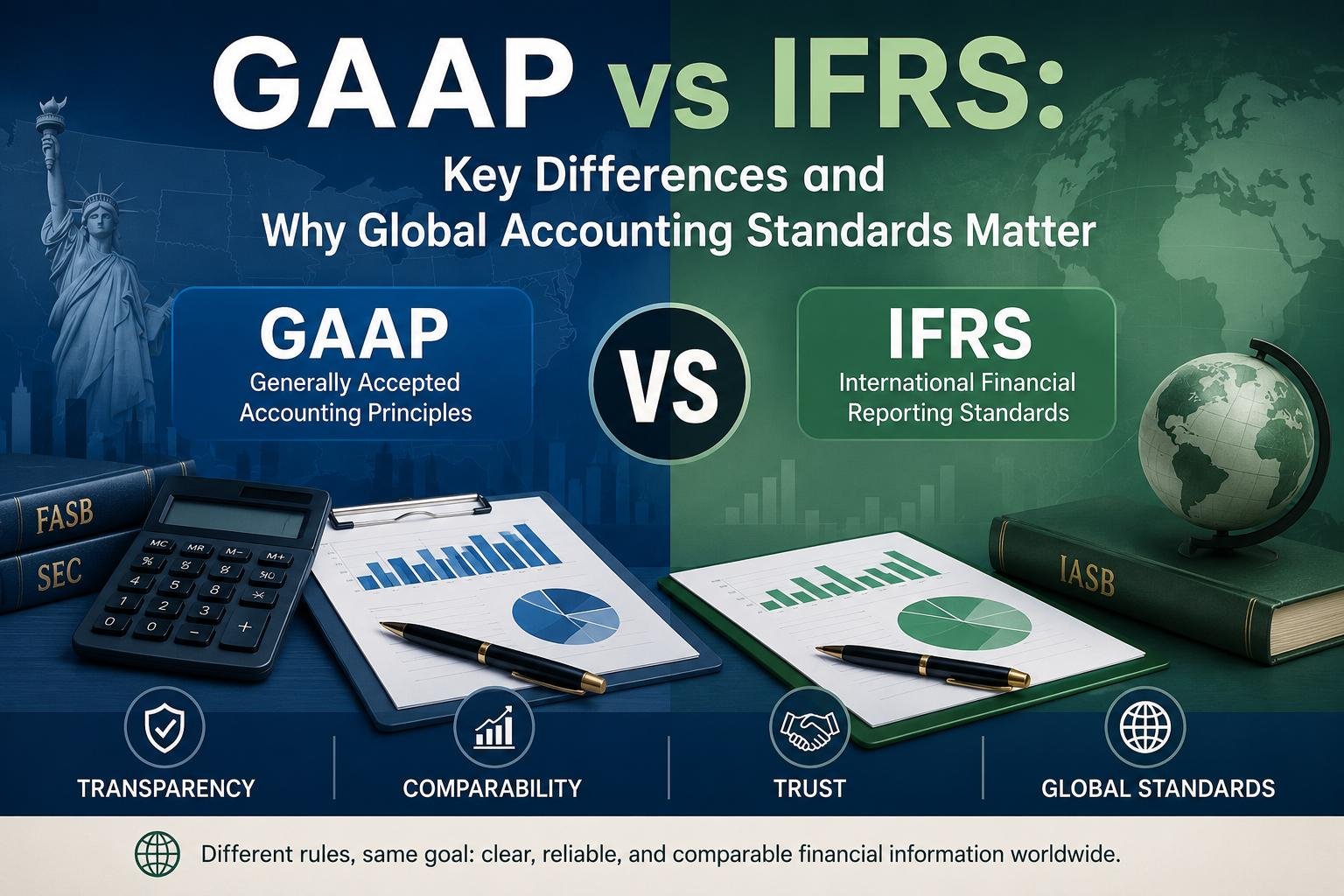
As a result, accounting is referred to as the language of business since it enables investors, managers, creditors, governments and other stakeholders to comprehend the financial well-being of an organization. But, financial statements can only be useful if they are prepared on consistent and reliable basis. If the rules governing accounting were not standardized, it would be difficult and misleading to make comparisons of the performances of different businesses or between different countries. That’s why there are accounting rules like the Generally Accepted Accounting Principles (GAAP) and the International Financial Reporting Standards (IFRS) are necessary. They provide a common set of rules to record, measure, present and disclose financial information so that the information in financial reports is accurate and transparent and can be compared.
In today’s globalized economy, it is becoming crucial for accounting students, business owners, and financial professionals to grasp the distinctions between GAAP and IFRS. Many businesses are expanding overseas and drawing foreign investors, or have overseas subsidiaries, so it is important to have knowledge of both standards. Both frameworks have the same goal of promoting high-quality financial reporting, but have some major differences, such as inventory, revenue recognition, asset measurement, and financial statement presentation. If you are interested in learning more about Generally Accepted Accounting Principles, you will find a link to an explanation in the Appendix of this Guide before you begin using it.
Understanding Accounting Standards
Accounting standards are formal statements which set out the rules to follow on how financial transactions are to be recorded and displayed in the financial statements. They offer uniformity in the accounting system so that users of financial reports can use them for making informed decisions on the basis of reliable information. If there were no rules, businesses could book different transactions using various methods – a situation that would make it hard for investors, lenders, regulators, and other parties to make a fair comparison of financial performance. Another benefit of standardized accounting is that it makes it easier to avoid fraud, as it sets expectations on reporting and draws organizations into reporting more. Accounting standards facilitate investors and business associates across the globe to assess the financial information of companies irrespective of their geographical location. In a more globalized business world where companies have to deal with businesses spread across various jurisdictions, accounting standards help investors and business associates to analyze the financial information of the business irrespective of location. They also facilitate regulatory compliance, enhance corporate governance, and boost the trust in financial reporting, providing an integral backbone to the present day functioning of businesses.
What Is GAAP?
Generally Accepted Accounting Principles (GAAP) are a comprehensive set of accounting rules, principles, standards and procedures that are mostly followed in the United States. GAAP sets rules for the recognition of revenue, asset valuation, liability reporting, expense accounting and the financial statement. This framework aims to have consistency, transparency and accuracy in financial reporting, to enable investors and regulators to compare companies on the same accounting language. Financial statements are prepared using GAAP for public companies in the United States, and many private companies choose to prepare financial statements using GAAP for the credibility and acceptance. The Financial Accounting Standards Board (FASB) is the entity that determines and changes GAAP and the Securities and Exchange Commission (SEC) is responsible for the financial reporting requirements for publicly traded companies. Since GAAP has detailed rules covering many accounting situations, it reduces the ambiguity and offers more guidance in the case of a complex business transaction.
Main Principles of GAAP
There are a number of principles underlying GAAP on which financial reporting is based. These principles involve adhering to a consistent set of accounting rules (regularity), using a consistent accounting method over time (consistency), reporting in an honest and unbiased way (sincerity of reporting), the meaningful comparison of financial reports from one period to the next (permanence of methods) and a careful and honest approach to financial reporting (ultimate good faith). When applied together, these principles enable financial statements to project an accurate picture of an organization’s financial condition, and inspire investor confidence, creditors, and regulators in the financial information provided by financial statements.
What Is IFRS?
The International Accounting Standards Board (IASB) has established a framework for accounting known as International Financial Reporting Standards (IFRS) which are recognized around the world. While the focus is on the United States with GAAP, IFRS has been adopted or allowed in over 140 countries, such as the United Kingdom, Canada, Australia, South Africa and many countries in Europe and Asia. The purpose of IFRS is to create a common accounting language, which would be more consistent and comparable in the international financial markets. IFRS do not set out to give detailed rules for all accounting situations; instead, through the use of broad accounting principles, IFRS encourage application of professional judgment, relying on the economic substance of the transactions. This is a principles-based approach and this gives flexibility whilst still retaining high standards of financial reporting. The importance of IFRS is growing as multinationals want to raise funds from the global investor community and operate in several countries, meaning that today more than ever it is essential to have internationally comparable financial statements.
Objectives of IFRS
The main purpose of IFRS is to develop high quality, understandable, enforceable and accepted accounting standards, which will enhance transparency and accountability. The aim of IFRS is to build investor confidence by taking a more holistic perspective on the financial statements, and making sure that they provide a true and fair view of the economic reality. It also allows cross-border investments as investors can review financial statements of companies in different countries without extensive re-statements. Furthermore, IFRS facilitates effective international capital markets by putting an end to differences between reporting and improving the ability of international capital markets to communicate financial information. These goals help to achieve economic integration and inform better business, investor and regulatory decisions around the world.
Major Differences between GAAP and IFRS
While the ultimate aim of GAAP and IFRS is to provide the same objective: clear and reliable financial information, there are some important differences between the two that impact the results of financial reporting.

The difference between Rules-Based and Principles Based Approach.
There is one major difference in the philosophy that they offer. GAAP is based on rules and offers a comprehensive set of rules for many of the many accounting situations it addresses and does away with uncertainty by setting rules for many transactions. IFRS use a principles-based approach that emphasizes the economic substance of transactions, rather than simply following detailed rules. This means that in some cases, IFRS can be more complex and accountants have to make more decisions on how to apply the standards, while GAAP gives more guidance. There are pros and cons to each: GAAP provides detailed guidance which could result in more consistency, while IFRS gives more flexibility which could be more appropriate to the realities of the various business activities.
Inventory Valuation
Another area of distinction between the two accounting frameworks is the inventory accounting system. Apart from First-In, First-Out (FIFO) and weighted average cost method, GAAP allows the use of Last-In, First-Out (LIFO) inventory costing method. IFRS does not allow the use of LIFO because the principle does not necessarily reflect the physical movement of inventory, and can mislead investors in times of inflation. In this case, the multinational companies changing their reporting from GAAP to IFRS may need to change their inventory valuation procedures, which may impact on their reported profits, taxes, and inventory levels.
Asset Valuation
The accounting method for long-term assets varies between GAAP and IFRS. IFRS allows companies to revalue any specific fixed assets (e.g. land and buildings) after initial recognition to reflect fair value. This enables financial statements to reflect more up to date asset values, when market conditions vary considerably. Historical cost is generally the basis for the accounting for assets in accordance with the GAAP, except in certain situations where the basis for accounting for assets is different, such as impairment or other accounting guidance. It can lead to significant differences in the asset value, equity positions and financial ratios between companies applying the two frameworks.
Revenue Recognition
Over the last few years, in collaboration, the IASB and FASB have developed a common approach to revenue recognition, so that the principles in both frameworks are now much more similar. However, there are some variations on key aspects of the implementation, disclosure and practical use. IFRS can be more judgmental in determining the timing and measurement of revenue while GAAP provides more specific guidance and other requirements to implement certain transactions that are not addressed in IFRS. These differences may have an impact on when revenue and profit is recognized in complex contracts.
Development Costs
IFRS allows companies to capitalize development costs if certain criteria are met that establish that the costs will provide future economic benefits. The amounts of these costs are capitalized and spread out over the asset’s useful life. Typically, research and development costs are expensed as they are incurred under GAAP. Under GAAP, R&D costs are usually written off as they are written up with few exceptions. This disparity can have a big impact on a company’s reported earnings and asset values, especially for tech, pharmaceutical and manufacturing firms that invest heavily in product development and innovation.
Financial Statement Presentation
Both standards include the core financial statements (balance sheet, income statement, cash flow statement, and statement of changes in equity), but the terms and the requirements for their presentation are different. The general format and order of the financial statements are more flexible under IFRS, compared to GAAP. Such discrepancies can shape the way users of financial information from different jurisdictions interpret and organize financial information when making comparisons.
The Accounting Rules that are applied between GAAP and IFRS.
GAAP is mainly used in the U.S. and issued by the Financial Accounting Standards Board for publicly traded companies to prepare financial statements. There are also many private companies, non-profit organizations and government bodies that use GAAP due to its credibility and acceptance as a regulatory standard. In contrast, IFRS is the main accounting system around the globe and is now the international standard for accounting. IFRS for publicly accountable entities are either required or allowed for issuers in many European, Australian, Canadian, South African and many Asian and African countries. IFRS have been implemented in some countries with some local adaptations and in others with standards very similar to IFRS. In the context of multinational organizations, investors considering overseas companies and accountants handling international finance, determining the governing framework of a specific jurisdiction is vital.
Why Global Accounting Standards Matter
Global accounting standards are important to support international business and investment because they enable international financial statements to convey information at a consistent level from country to country. Standardized reporting allows investors to compare companies in various countries without having to fear that the differences in accounting practices are the only reason for the differences in financial results. Uniform reporting provides the benefit to lenders to better assess the credit risk associated with extending credit in overseas markets. Accounting standards are regulations that enhance the oversight, identification of irregularities and confidence in the financial market. Companies also gain in terms of less reporting when going global, attracting foreign investment and having a smoother mergers and acquisitions process with companies from different accounting jurisdictions. Standardized accounting systems contribute to trust and transparency and the mitigation of uncertainties in financial decision making, contributing to the ever increasing interconnectedness of the economies.
Issues with the Convergence of GAAP and IFRS
Although there has been much work done to achieve convergence of accounting standards, full convergence between GAAP and IFRS is difficult. How accounting standards evolve in each country is affected by various legal systems, taxation laws and regulations, and business practices. The rate of convergence is also influenced by political factors and interests. The move from one framework to another can be a very costly process, especially for organizations undergoing such a transition with significant changes in staff, systems, policies, and financial reporting. Even if standards are the same, there will be differences in interpretation and professional judgment that may lead to variations in reported financial information. Despite this, the IASB and FASB have recently been able to bridge gaps in several key areas, with continuing efforts to converge on accounting standards to improve consistency, and this illustrates that they are committed to this task.
Selecting the Right Accounting Frame of Reference
The decision of to use GAAP or IFRS is typically made based on regulations and not by the preference of the organization. Financial statements are usually prepared under GAAP for companies listed on U.S. stock exchanges, and for companies operating in countries that have adopted IFRS, it is required to follow IFRS financial statements. Multinational corporations might require knowledge of both systems as they prepare consolidated financial statements may have foreign subsidiaries or may borrow in more than one capital market. CPAs versed in both GAAP and IFRS will have transferable skills that will broaden their career pathway in auditing, financial reporting, consulting, taxation, corporate finance, and international business management. With the constant growth of businesses across the globe, having knowledge of both these accounting frameworks comes as a great help especially for organizations and finance professionals.
Conclusion
GAAP and IFRS are two accounting frameworks that are the most influential in the world, and they aim to help make sure that there is transparency, consistency, and reliability in financial reporting. While they are different in how they are applied, interpreted and account treated, their focus is both the same and to ensure that financial reports give investors, creditors, regulators, and business leaders meaningful information. The knowledge of their similarities and differences are very important to accounting students, accounting professionals and organizations involved in domestic and international business operations. The greater the degree of interdependence in world economic markets, the more important it will be to have common accounting principles. Regardless of the accounting framework used, preparing financial statements in accordance with generally accepted accounting principles (GAAP) or IFRS (International Financial Reporting Standards) instills confidence, creates greater comparability, facilitates informed decision-making and boosts trust in the financial reporting system, globally.
Get more well researched information about GAAP vs IFRS here.