Introduction
Among the most important accounting tasks that a small business has to do is to have an income statement prepared. It’s good to boost sales, but it’s better to get to know if the business is profitable after expenses have been paid. Also known as a profit and loss (P&L) statement, an income statement clearly summarizes the revenues, costs, and expenses of a company during a particular accounting period. It aids in analyzing the financial performance of a business, determining cost-saving opportunities, and making strategic decisions.
Creating an income statement is a helpful skill to have in the accounting field, small business management, and finance as it will help you manage your finances better and report the company’s income. The net income (profit) of the business will be reflected in the income statement, after the cost of goods sold and the operating expenses and taxes have been deducted. It is also one of the most important financial statements lenders, investors and tax agencies will want to see because it gives a snapshot of whether or not the business is profitable. This complete guide to the income statement is easy to follow and clearly explains each line item, so you understand how each line item provides a measure of business performance.
What is the definition of income statement?
An income statement is a financial statement that reports the revenues, expenses, gains and losses of a business for a particular period (usually for a month, a quarter or a fiscal year). The income statement is a business’ financial performance over time, whereas a balance sheet is a snapshot of a business’ situation at a particular time in time. It is mainly used to determine the profit or loss of the business during the reporting period. The sum of each of the data items listed on the statement is utilized to make the final total amount of net income and is one of the most prominent strategies employed to decipher profitability. The income or profit and loss statement is a crucial financial statement that provides valuable information about a business’s operations, profitability, and financial well-being, and it is an important tool for business planning, financial analysis, and decision-making.
Why an Income Statement is important for Small Businesses?
It might be difficult for small businesses to do financial monitoring, especially when they have limited resources. The business owner will get an accurate picture of the business’ income and expenses from an income statement. Business owners can get a better sense of profits rather than just the cash flow or sales data, by looking at all costs and expenses. This data can be utilized to enhance budgeting, pricing, inventory management and control expenses. It also helps to identify trends that may lead to a decline in profitability or increase in operating costs that can pose serious financial problems before the fact. Furthermore, companies that need funding from outside the organization can find it useful to keep their income statements current as it is likely that the company’s lenders and investors will look at them when applying for a loan.
Income Statement Information:
It is crucial to know the key components of an income statement before creating a statement of income. Each section contributes to the company’s bottom line, and provides multiple views of the company’s financial result.
Revenue
Revenue is the total amount of money received from selling products or rendering services in the period of the transaction. The first item in an income statement since it’s used to calculate profitability. All revenues from the normal operations of the business should be included in the revenue and expenses should not be included. By ensuring that the right revenue is recognized at the right time, accurate revenue recognition helps to ensure that financial statements accurately reflect the company’s performance and adhere to the accepted accounting principles.
Cost of Goods Sold
Cost of Goods Sold (COGS): All of the costs incurred directly in the production of the product sold or in obtaining the product sold in the reporting period. The costs can be for raw materials, inventory, manufacturing labor, packaging and production-related costs. Services companies may not have any inventory cost, but rather direct labor cost, or project costs. Correctly determining COGS is crucial, as it influences gross profit, and indicates production efficiency.
Gross Profit
The Gross profit is the revenue less COG. It is based on the effectiveness, efficiency and productivity of the business in producing or delivering products, but outside of administrative and operating costs. A steady gross profit is a good indicator that a business is setting their product prices and cost management.
Operating Expenses
Running expenses are costs that are used to conduct the day to day operations of the business. These costs generally encompass the salary of the employees, office rent, utilities, insurance, office supplies, advertising, software subscription, depreciation, repairs, and professional services fees. Operating expenses are costs which are not directly associated with the production of specific products and services but are required to be incurred to sustain normal business operations, unlike COGS.
Operating Income
Operating income is also the remaining profit from the company’s core business after subtracting operating expenses from gross profit. It excludes taxes, interest and other non-operating expenses to show a more true and accurate view of operational efficiency and management performance.
Other Income and Expenses
There are many businesses that have financial activities which are not related to their business operations. This could be interest on investments, interest paid on business loans, loss from the sale of equipment or loss from the disposal of assets. The disclosure of these separately makes it easier to understand the financial statements and enables users of them to separate operating performance and non-operating events.
Net Income
Net income is the total income minus the operating expense, interest expense and taxes. The bottom line, also known as net income, is a measure that shows if a company had a profit or loss over the reporting period. This number is a sensitive one because it is a barometer of the success of the company’s finances and will drive investment, growth and dividend payout.

Step 1: Select the Accounting Period
The initial phase of creating an income statement is to pick the reporting period. The typical small business will generate income statements monthly to track business finances regularly and quarterly and annual income statements are typically generated for tax reporting, investors, and lenders. Using the same reporting period makes it easier to compare the results of the different months or years, and to identify financial trends and seasonal variations. Make sure all sales, purchases and expenses for the chosen period have been accurately documented prior to the start of the statement to ensure the statement accurately represents the company’s financial performance.
Step 2: Calculate Total Revenue.
After the reporting period has been determined, work out the total revenue during the reporting period. All income generated from the primary business activities of the company including sale of product, service charges, commission and income from subscription, if any, should be treated as revenue. Revenue reports can typically be generated automatically in accounting software used by businesses, while manual bookkeeping systems need to be meticulously reviewed to pull together a report on revenues. The best way to record the income is to be sure that it is recorded correctly because all subsequent calculation for the income statement goes from this income. Lack of transactions or duplicates can have a huge impact on profitability and financial decisions.
Step 3: Calculate COGS
Once the revenues have been recorded, determine the cost of goods sold by adding up all the direct costs incurred in the period to manufacture or purchase the goods sold during the period. COGS is typically determined by adding beginning inventory, purchases, and ending inventory, with retail businesses, and adding raw materials, direct labor, and production overhead, with manufacturers. Direct project cost is the typical method used to determine costs in service businesses rather than inventory costs. Good inventory management and record-keeping of inventory assist in ensuring that Cost of Goods Sold is accurately determined, thus ensuring that gross profit is calculated accurately.
Step 4: Calculate Gross Profit.
To calculate gross profit, you need to take away the Cost of Goods Sold. This measure is the amount of income that is left after deducting the direct costs of the goods sold from the income earned. An understanding of gross profit gives a good idea of how efficient production processes, supplier relationships and prices are. If gross profit margins are falling over the years, owners would consider looking into possible issues that may be occurring such as rising material costs, giving out more discounts, production inefficiencies, or falling prices of the goods sold. Keeping an eye on gross profit regularly offers businesses a way to maintain healthy profit margins, and enhance operational performance.
Step 5: Record Operating Expenses
The next step is to determine and add up all the operating expenses for the reporting period. These costs are related to rent, salaries, utilities, office supplies, insurance, advertising, depreciation, maintenance, travel, software subscription, and professional service fees. Recognition of operating expenses in a consistent fashion will enhance financial reporting consistency and facilitate meaningful comparisons. Having organized accounting records all year round makes it much easier to compile accurate income statements, as well as to ensure that there are no expenses that are not accounted for or double counted.
Step 6: Calculate Operating Income
Subtract total operating expenses from gross profit to get operating income. Represents the profitability of the company’s business operations prior to financing costs and taxes. Operating income reflects the operating efficiency, as it does not include non-operating items. Continuously improving the operating income is a good indicator of cost management, pricing strategy and effective utilization of resources which leads to a long term financial success of any business.
Step 7: Other income and expenses are added
Once you have calculated the operating income, write off any extra income or disbursements that don’t belong to the core business. These usually consist of interest income, interest expense, gains on sale or losses on equipment, investment income and foreign exchange gains or losses. The inclusion of these separately enhances transparency by creating the possibility for readers to separate out the performance that is recurring from the unusual performance that is a one-time occurrence. This separation may be significant for the assessment of business sustainability, financial results, and for comparing the results from different reporting periods.
Step 8: Calculate Net Income
The last step in preparing an income statement is to determine net income. Start by operating income, add other income and deduct other expenses including interest and income taxes. The end result is the company’s net profit or loss for the reporting period. Net income means that the total revenues were greater than the total expenses (a positive net income) or that the total expenses were greater than the total revenues (a negative net income). Net income is often used by business owners as a measure of profitability, to identify reinvestment opportunities and to compare the performance of business strategies from one period to another.
Example of Preparing an Income statement
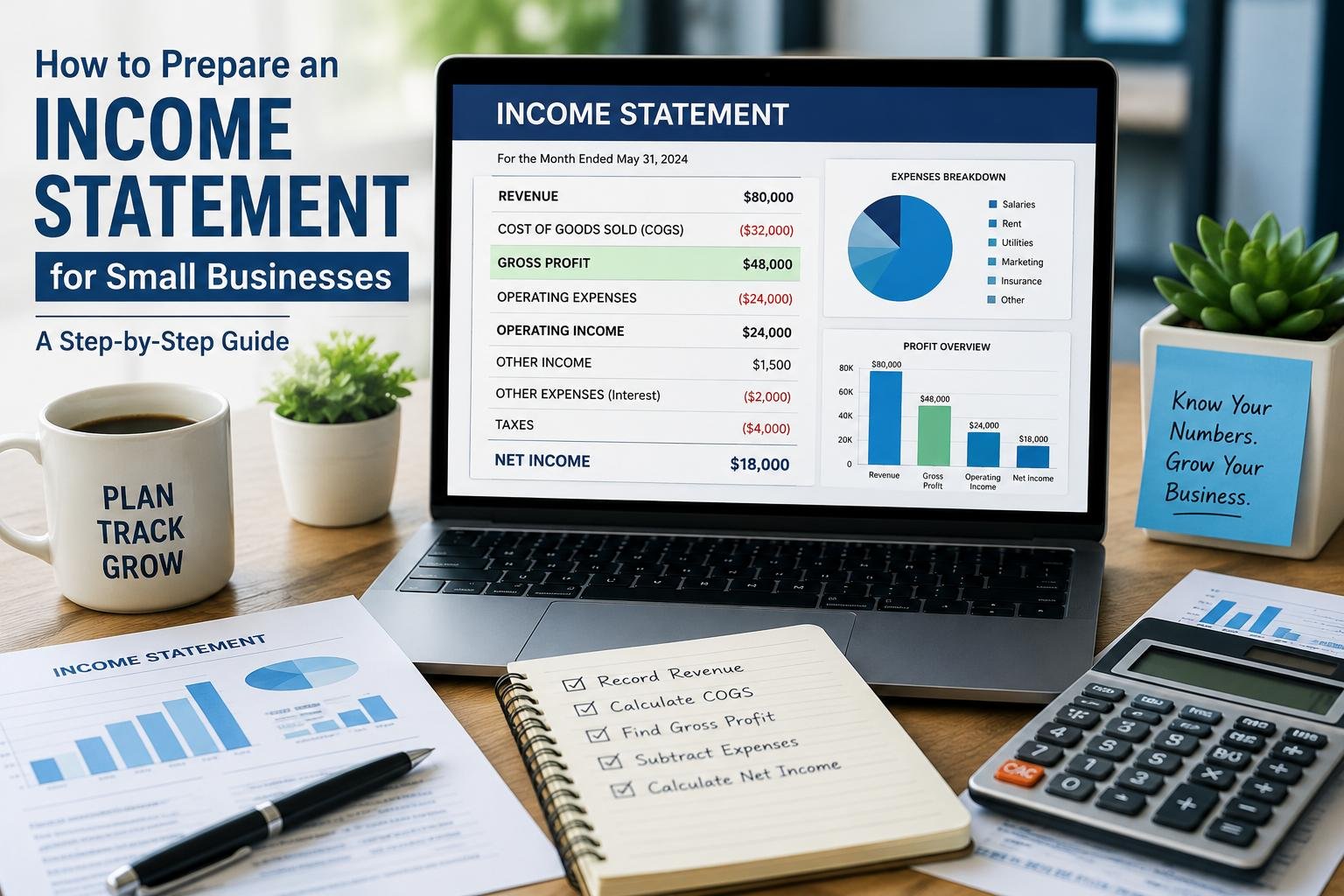
Now suppose that a small clothing store had total sales of $80,000 for the month. The actual price of the items sold was $32,000. The business has a gross profit of $48,000 after deducting the Cost of Goods Sold from the total revenue. The business’s gross profit is $48,000, after subtracting the Cost of Goods Sold from the total revenue. The business also had operating costs of $24,000 during this month, which comprised employee salaries, rent, electricity, insurance, marketing and office supplies. The operating income (EBIT) is $24,000 after these operating expenses are deducted. The business then pays $2000 interest on a business loan, and $4000 income taxes. These other expenses are taken away and the company shows a net income of $18,000 for the month. The example will show how each of the items on the income statement is related in order to come up with the ultimate profit of the company.
Common Mistakes to avoid when creating an Income Statement
If accounting practices are not followed correctly, it’s easy to have a lot of mistakes in the income statement that can impact the accuracy of the record. The most frequently committed error is to accrue revenue before it’s earned or to not accrue expenses when they should be. The incorrect figures in inventory can also result in incorrect Cost of Goods Sold figures, directly impacting gross profit and net income. A few business owners incorrectly include capital expenditures in their operating costs, which results in the understatement of profits. Some neglect to account for depreciation, accumulated expenses, or loss of interest on the funds, and leave out this information from their financial reports. These errors can be minimized and the accuracy of financial reports enhanced by regular account reconciliation, organized bookkeeping and careful review of financial records.
Best Practices for Preparing Accurate Income Statements.
To prepare accurate income statements, consistency, detail and effective accounting records are essential over the entire accounting period. It is important for businesses to process transactions in a timely manner, keep their bank accounts balanced on a regular basis, have their inventory records up to date, and have all supporting documents for financial transactions in order. Accounting software can streamline accounting calculations, reduce human error, and facilitate financial reporting. Business owners should also be looking over their income statements monthly in order to find any unusual trends, investigate any unexplainable variations and make corrections as soon as possible. When business grows and financial transactions increase, having trained accounting experts to help when needed further enhances the accuracy and credibility of the financial statements.
Conclusion
One of the most basic accounting tasks is to create an income statement for a small business, and it provides a measure of the company’s profitability, an indicator of performance, and a source of business decisions. The revenue is recorded systematically, Cost of Goods Sold calculated, Gross Profit determined, Operating Expenses recorded (including non-operating items) and Net Income is calculated, giving business owners a clear picture of business operations. Accurate income statements are a key factor in budgeting, tax preparation, financing applications, and offer valuable insight to enhance efficiency and increase profits, all of which can be done regularly. From the entrepreneur managing his or her first business to the accounting student developing practical skills, to the finance professional looking to enhance financial reporting, preparing an income statement is a critical step to long-term business success.
Get more well information on How to Prepare an Income Statement for Small Businesses here.