Introduction
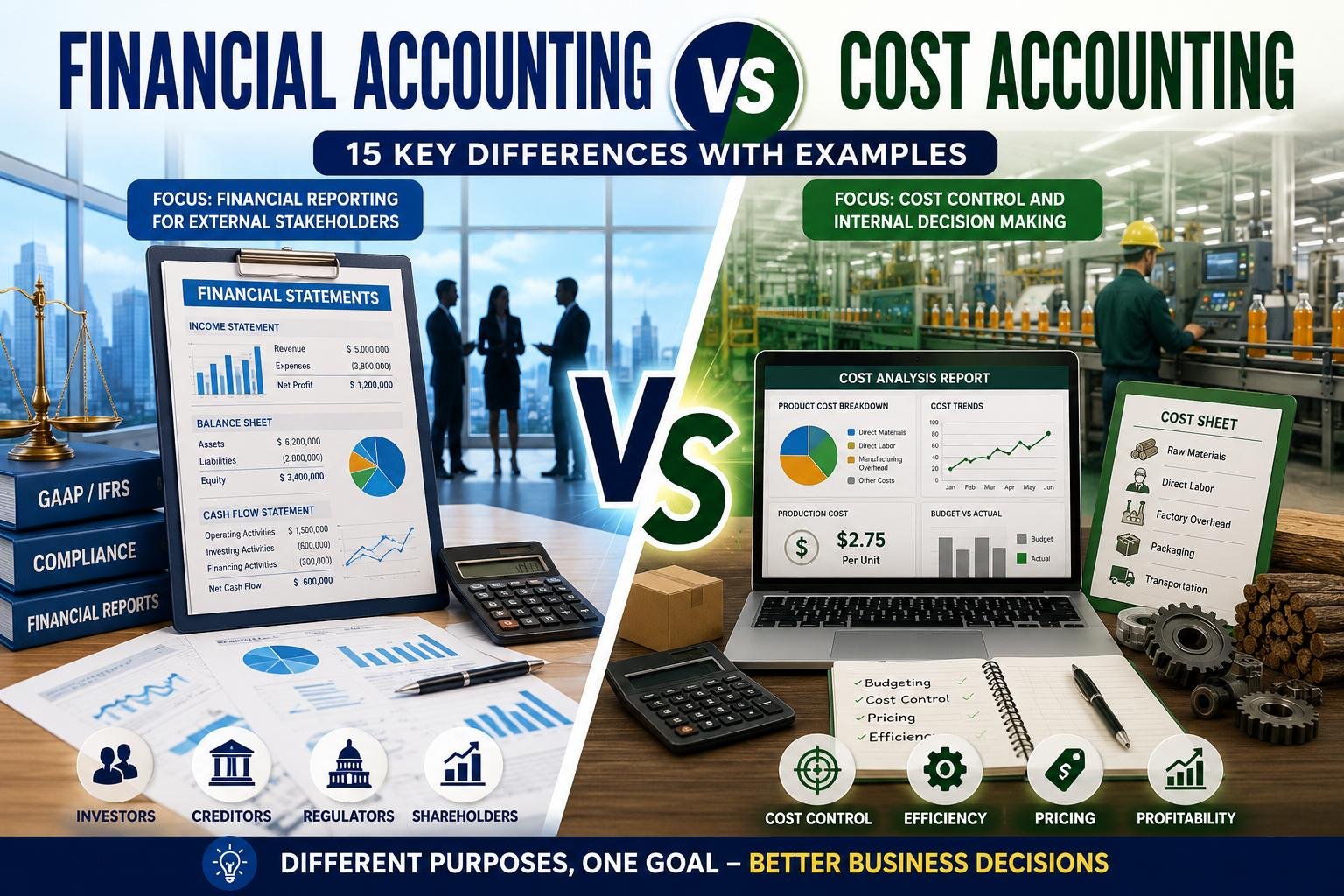
Financial accounting vs cost accounting are the two branches of accounting, which have a broad significance in accounting but are least understood. In fact, students, business owners and even new accounting professionals often think that they are the same when they’re involved with financial information. They are similar but have different uses and different kinds of information. Financial accounting is mainly concerned with the preparation of reports for external parties like investors, creditors, regulators and tax authorities. Cost accounting is, on the other hand, intended to help management to understand the cost of production, control their cost and make their operation more efficient.
When you are looking for the difference between financial and cost accounting, the difference in their purpose, users, reports and uses will become more apparent. In this guide, you’ll find 15 useful examples, along with a description of each accounting branch, to help you appreciate the distinct purposes of each branch and recognize when a business needs to use one or the other for success in the long run.
Financial Accounting
Financial accounting is the accounting field that documents, compiles and presents the financial transactions of a business within a set time frame. The main objective is to produce standardized financial statements which offer a clear and true view of a company’s financial position and performance. These reports consist of the income statement, balance sheet, statement of cash flows and statement of changes in equity. They are mainly designed for the outside stakeholders such as shareholders, investors, creditors, government authorities and financial institutions. These reports are often used for investment purposes and regulatory compliance, and are subject to accounting principles and standards, such as the International Financial Reporting Standards (IFRS) or Generally Accepted Accounting Principles (GAAP). The focus of financial accounting is to be consistent, reliable and transparent so that the financial statements can be fairly compared with other organizations. In fact, when a manufacturing company is listed on the stock exchange, investors will look at the financial statements of the company to find out its profitability, liquidity and financial stability before buying stocks in the company.
Cost Accounting
Cost accounting is a specialized area of accounting which deals with the identification, measurement, recording and analysis of the costs of producing goods or services. It is not for external users like financial accounting, but for internal management. Cost accounting information is used by managers for controlling cost, enhancing efficiency, creating budgets, deciding product prices, assessing department performance and boosting profitability. Cost accounting focuses on the cost of all business activities such as direct materials, direct labor, manufacturing overheads and indirect costs. Job costing, process costing, standard costing, activity-based costing are very few types of costing systems which can provide the accurate cost of production to a business. For example, the cost accounting system can be used by a furniture manufacturer to find the precise cost of making a dining table by estimating the cost of timber, labor hours, machine usage, electricity costs in the factory, and the packaging costs. The information enables management to determine if there should be any changes in production methods or adjustments in product prices.
Why Students Often Confuse Financial Accounting and Cost Accounting
The issue of financial accounting vs. cost accounting often stems from the fact that both accounting areas involve accounting for financial transactions and analyzing business activities. They, however, answer different business questions all together. Financial accounting is a question of how the business operated financially over the period reported. Cost accounting asks the question, “How much was it to produce this product or service?” Financial accounting emphasizes the business as a whole while cost accounting delves deeper into the aspects of operations efficiency and cost behavior. Both are commonly based on the financial data, but process and present it in different ways, depending on its purpose. For example, a manufacturing firm might keep books to report information to its external users, but wage costs could be studied in cost accounting to determine the labor cost to produce any particular product. Being aware of this difference will enable students to value why there is a requirement for both accounting systems rather than opting for one or the other.
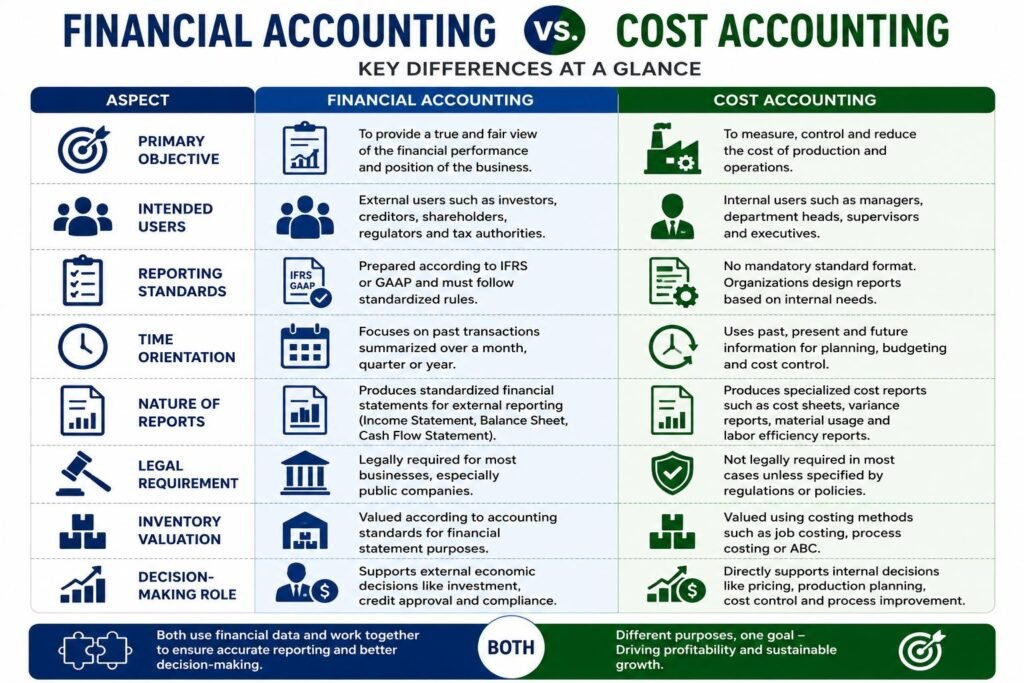
Financial & Cost Accounting: Difference between Financial Accounting & Cost Accounting.
1. Primary Objective
The main purpose of financial accounting is to provide a true and fair financial performance and financial position of an organization. Cost accounting is, however, about measuring, controlling and reducing production and operating costs. For instance, financial accounting can determine that a company made a net profit of $2 million over a year and cost accounting can show that by cutting raw material waste by five percent, the company could be earning much more money in the future.
2. Intended Users
Financial accounting is used by external users, like investors, lenders, shareholders, taxing authorities and regulators, who require reliable information relating to the finance of the entity for decision making purposes. Cost accounting is used to provide cost information for internal managers, departmental managers, production supervisors and executives who need detailed cost information to improve business operations. The target group has a great impact on the kind of information each accounting department delivers.
3. Reporting Standards
Financial accounting is conducted in a way that is consistent, comparable and compliant with the established internationally accepted accounting principles (IFRS) or the generally accepted accounting principles (GAAP). Cost accounting doesn’t really take a single standard reporting structure due to the fact that organizations set up their costing systems as per their business requirements. This can help companies customize reports that produce the best management data without being impeded by outside reporting regulations.
4. Time Orientation
Financial accounting primarily provides financial information of past transactions in the form of summarizing over a month, quarter or year. Cost accounting, however, is a mix of past, present and future data that aid in planning, budgeting, forecasting and cost control. The estimated production costs are often used by managers prior to the start of a production process to make strategic business decisions.
5. Nature of Reports
Financial accounting generates financial statements using standardized formats and reporting that are used for external reporting. Cost accounting creates various customized cost reports like departmental cost reports, variance analyses, material usage reports, labor efficiency reports and budget performance reports. The format is entirely dependent on the management’s information needs.
6. Legal Requirement
Numerous businesses, especially public listed companies, are legally obliged to create accounting reports of their finances and present those reports to regulatory bodies. In most industries, cost accounting is not mandatory unless mandated by guidelines or policies. Most manufacturing companies have adopted cost accounting due to its many management advantages even if it is not required in their operations.
7. Focus of Information
Financial accounting is focused on the overall financial performance of the organization, with a focus on overall revenue, expenses, assets, liabilities and equity. Cost accounting is concerned with the cost of a product, department, project, production process or a service line. This detailed analysis facilitates management to determine the profitable and unprofitable operations.
8. Level of Detail
Financial accounting is a summary of the transactions in general categories that can be used in financial reporting. Cost accounting gives detailed information, by segmenting a cost into direct material, direct labour, variable overhead, fixed overhead and other cost segments. The detail helps in making better managerial decisions.
9. Decision-Making Role
Financial accounting provides information to external economic decisions for credit approval, regulatory and investment analysis. Cost accounting directly influences business decisions such as pricing decisions, production planning, inventory management, outsourcing decisions, process optimization, etc. Cost accounting reports are important to managers when they are considering introducing new products and/or increasing production capacity.
10. Cost Classification
Financial accounting captures expenses based on accounting categories like Administrative Expenses, Selling Expenses and Operating Expenses. Cost accounting categorizes costs according to managerial usefulness such as fixed and variable costs, direct and indirect costs, controllable and opportunity costs. These classifications help to be better able to understand costs and assess performance.
11. Inventory Valuation
Financial accounting values inventory as per accepted accounting principles for the financial statements. Cost accounting involves determining the production cost of inventory using one of the following costing techniques: standard costing, process costing, job costing or activity-based costing. The bottom-line is that accurate inventory costing ensures that accurate financial reporting is made possible.
12. Frequency of Reporting
The time interval at which financial accounting reports are prepared is typically predetermined, like monthly, quarterly or annual. Cost accounting reports can be done on a daily, weekly, monthly or even real time basis, depending on management needs. Regular reporting gives managers the opportunity to react promptly should the production costs rise unexpectedly.
13. Confidentiality
Financial accounting reports are frequently disseminated and made available to shareholders, investors, creditors and regulators. Cost accounting reports are kept confidential since it includes certain information that is relevant to the operations, like production costs, supplier pricing, labor efficiency and internal performance information which can be used by a competitor.
14. Performance Measurement
Financial accounting is the process of assessing the performance of the entire business based on profit, liquidity, solvency and financial position. Cost accounting techniques provide operational efficiency by means of cost variances, production efficiency, reduction of waste, utilization of machine and labor productivity. These performance indicators enable management to increase their profitability as the business grows.
15. Practical Business Application
Financial accounting is used to show a company’s financial health to banks when they are looking to loan money to them or money is being sought by investors. Cost accounting can be used to work out if the production of a product is profitable once the material cost, labor cost and manufacturing overhead has been taken into account. A baker, for instance, can track the annual earnings on the bakery’s profit and loss statement, and yet at the same time could monitor the cost of making each loaf of bread and determine ways to cut down on waste in ingredients for the product.
Practical Business Example: Financial Accounting vs. Cost Accounting in Action
Think of a company that makes juice that comes in bottles. The company has $5 million in total revenues and $3.8 million in total expenses during the financial year, leaving a net profit of $1.2 million. Financial accounting keeps track of all the business transactions as they happen over the course of the year, and presents the results of these transactions in a way that is understandable to investors, tax authorities, lenders and shareholders. These reports provide a measure of the company’s profitability, financial standing and cash flow, allowing outside parties to assess the company’s financial performance and then make decisions about investing, lending or complying with regulations. Financial accounting would be difficult for the organization to manage without; the organization would not be able to satisfy legal requirements for reporting or keep stakeholders’ confidence.
Cost accounting is also different from one business to another, when it comes to looking at the cost of producing individual bottles of juice. It determines the cost of fruits, sugar, bottles, packaging materials, man power, electricity, machine maintenance and transportation in the production process. If there is a marked rise in the cost of packaging in the past six months, management can renegotiate with suppliers, redesign the packaging or change the product price to ensure profitability. While this information is not presented in the published financial statements, it is needed for day-to-day decision making. The two accounting systems complement each other, not compete, and access the same financial information, answering different questions about the business.
Which is More Important?
The question which financial accounting or cost accounting which is needed for a business is like asking which is needed – map or compass. Financial accounting is essential as it provides a legal reporting requirement, creates investor confidence and external stakeholders can see financial performance. Cost accounting is also beneficial since it enables administration to cut expenses, boost efficiency, maximize pricing strategies and eventually enhance profits. A company specializing in financial accounting might not know whether it made a profit or not, but may not be able to explain why it costs more to produce products. On the other hand, a firm that uses only cost accounting would not have an integrated set of financial statements needed for investors, lenders and regulators. Therefore, those organizations are successful in incorporating both systems of accounting together for compliance, operational excellence, and strategic growth.
Conclusion
Financial accounting and cost accounting are two different concepts and it is important to understand the difference between them as it is essential for accounting students, business owners and managers and for anyone who aspires to know how organizations make financial decisions. The function of financial accounting is to provide standardized financial information to external users, in a way that is transparent, accountable and meets accounting standards. There are, however, other types of cost accounting, such as cost accounting uses which focus on measuring and controlling the cost of production to enable management to make informed operational decisions, improve efficiency and minimize waste. While both reporting formats have distinct roles, their underlying principles for reporting, to whom they are given, and how they are used are all different, they both rely on accurate financial information and complement each other in every successful business. Understanding each of the accounting areas’ strengths will give an accountant a strong base for more effective financial reporting, informed financial management and increased future business success.
Get more well researched information about Financial Accounting vs Cost Accounting here.