Introduction
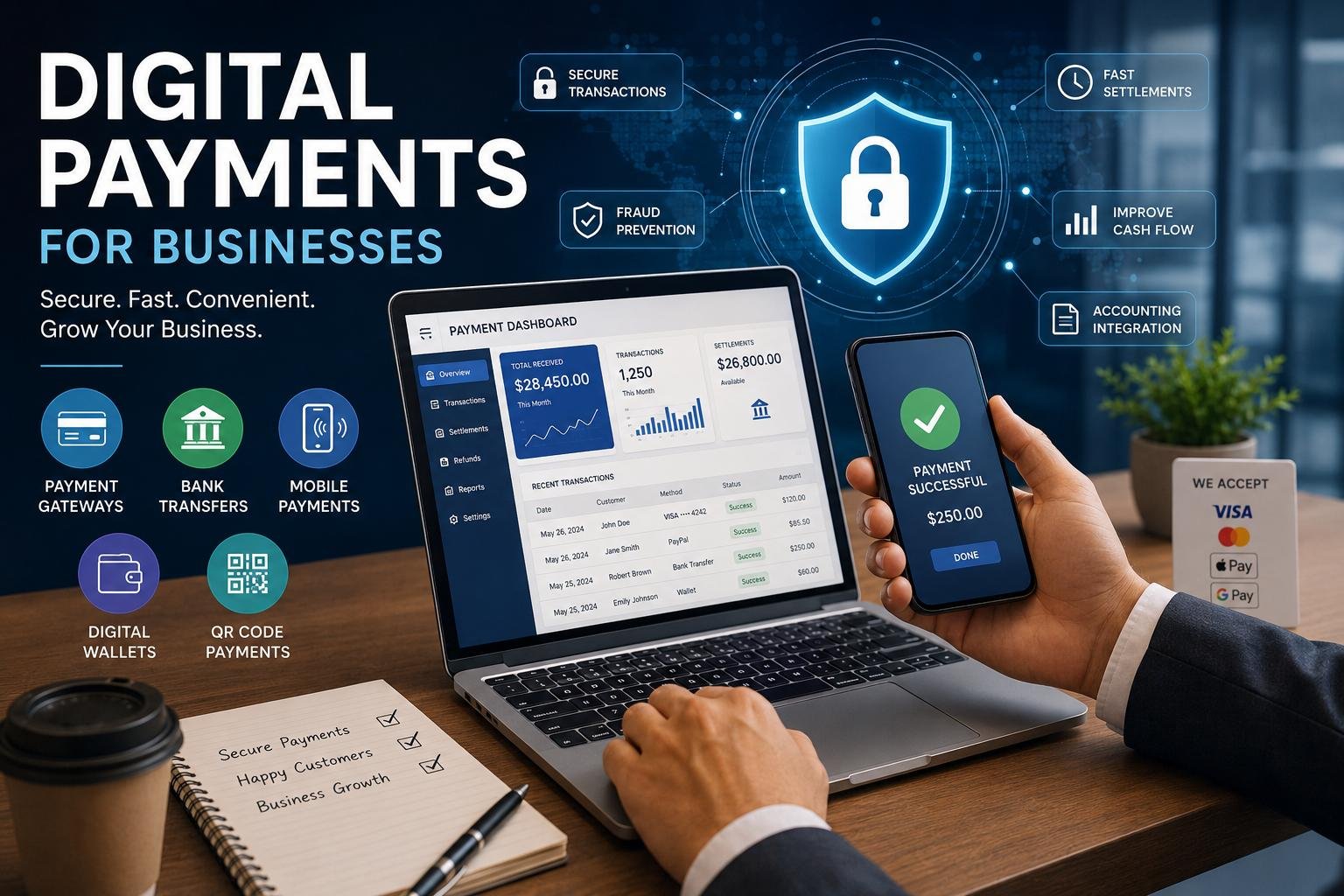
With the rising demand from customers for speed, convenience, and security in paying for products and services, digital payments have emerged as a vital component of any business these days. Payment methods have also evolved from just cash or traditional banking systems to cards, bank transfers, mobile, digital wallets and online payment platforms. The knowledge of the various digital payment technologies can help businesses choose the payment methods that best suit their customers, business model and financial goals. These technologies can help to improve the ease of cash collection, document transactions, handle cash flow and deliver a smoother customer experience. Other factors for businesses to take into consideration are transaction fees, settlement times, cyber threats, fraud prevention, and integrating payment data with accounting and financial management tools.
What is a Digital Payment?
Digital payments are any payment made involving the transfer of money from a customer or payer to a business where there is no physical exchange of cash. They can occur via web sites, mobile apps, bank sites, point-of-sale applications, payment links or other electronic means. The customer may use a debit card, direct bank transfer, a QR code or a digital wallet on a smartphone to pay for an online transaction. The biggest benefit for businesses is that these transactions are able to be processed and recorded electronically, which significantly lessens the workload of collecting and tracking payments. Digital payments technologies also can render businesses more accessible to customers who are not in their local area, such as those who order online or via social media platforms, markets or mobile apps.
Types of Digital Payments for Businesses.
Payment Gateways and Online Card Payments
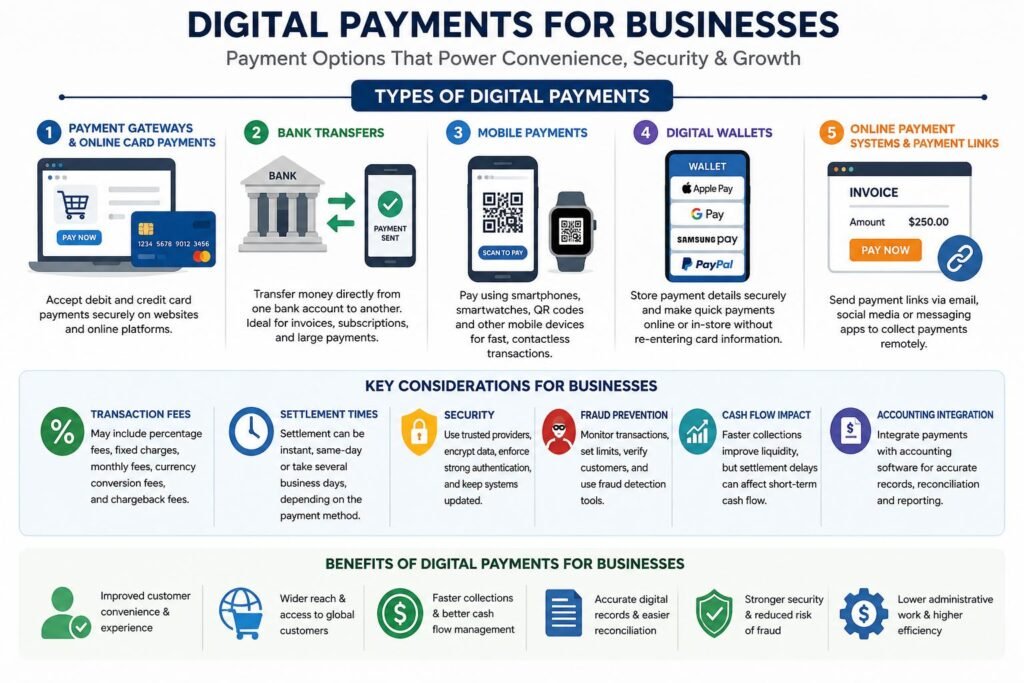
Payment gateways enable businesses to accept electronic payments primarily card payments, via web sites and online applications. At checkout, the gateway will securely share payment data with the customer, business, payment processor, and financial institution in question. This is a procedure that facilitates the validation of the transaction and the sending of an indication, either a “yes” or a “no” signal that the payment has been approved or refused. Payment gateways are especially beneficial for online businesses, such as ecommerce stores, subscription-based websites, online booking platforms, and businesses offering digital products. Gateway pricing is something businesses need to consider carefully as it may consist of percentage charges, fixed transaction charges, fees for the month, currency conversion fees etc., chargeback fees and additional costs of service. It’s not always immediate either, as approved transactions may take one or more business days to get the money into the business bank account.
Bank Transfers
Bank transfers are a way by which a bank customer can transfer money directly from one bank account to another. They can benefit a business-to-business transaction, invoices, subscriptions, large purchases and when consumers don’t want to use their credit or debit card. Transfers can be nearly instant if the involved banking system and payment network allows, or it can take longer for them to settle. Many times, bank transfers may even have lower transaction fees when compared to card payments too, depending on the banks and payment services involved. A business can receive many transfers, with partial or other inconsistent payment references, and this is one important factor to take into account when considering reconciliation. One way to minimize this is to make it clear to customers how to pay, ensure that all payments are numbered, and to make sure that accounting software is used that can match the receipt of payments with outstanding invoices.
Mobile Payments and Digital Wallets
As a result, customers can use digital wallets to carry payment credentials or even money digitally and subsequently use them to make purchases without having to re-enter card or banking details. Mobile payments take this convenience further by enabling customers to make payments by their mobile device—such as their smartphone, smartwatch, QR code, or other mobile device when making a payment. These approaches can help speed up checkout and minimize hassles especially if your customer bases is one that is mobile-savvy. When customers are given options to pay for which they are familiar and comfortable, they can expect faster transactions, and possibly increased conversions. But before businesses choose a wallet or mobile payment solution, they need to take into account the fees, available currencies, settlement terms, and geographical reach of each solution. They should also allow for the export of payment records or its integration into their accounting system, to avoid extra administrative work due to frequent small transactions.
Understanding Transaction Fees and Settlement Times
The price of electronic payments is very dependent on the payment provider and technique. Businesses can face charges ranging from percentages, fixed transaction fees, monthly subscription fees, currency conversion fees, chargeback fees, chargeback withdrawal fees or any other charges. The seemingly low cost payment option can cost a business more, if they have seen a surge in transactions or if the business is taking international payments. Another factor to keep in mind is that the time it takes for a customer to make a payment is not necessarily the same time it can be used by the business due to settlement time. There are some systems that will offer fast or instant settlements, while others will demand businesses to wait for processing and banking. However, businesses should consider the overall cost and cash-flow impact of each payment method and not just the transaction fee advertised.
How Digital payments contribute to Increased Customer Convenience
Businesses embrace digital payment options for various reasons, with convenience being among the top ones. Consumers are increasingly looking for a rapid transaction that does not require them to go to a store, accept cash or follow an extensive payment process. Providing multiple digital payment methods can help adapt to customer preferences and minimize cart abandonment due to a variety of payment choices. A retailer that sells online, for instance, might accept cards, bank transfers, mobile payments and digital wallets and thus offer customers choice at checkout. Payment links and virtual transactions can also be facilitated with digital payments; this means that a company could ask for a payment from its customers via an e-invoice or any other means of communication. Customers will be more satisfied with a smoother payment process, as it becomes part of a natural part of the customer’s purchase journey, not a hindrance.
Digital Payments and Business Cash Flow
Electronic money can also help in the better management of the cash-flow as businesses can receive money electronically as well as the monitoring of incoming transactions is more efficient. Quick collection of payments can minimize the lag time from when a business sends an invoice to when they receive payment, which is especially beneficial for a company with a need for timely cash for supplies, staff, rent, taxes and bills. Digital records also help ease the process of identifying outstanding payments and comparing the expected payments to the actual ones. But the difference between payment authorization and available cash should be differentiated, as settlement delays may impact short-term liquidity of the business. Unexpected delays in payments could cause a business to experience cash-flow problems if the payment processor is taking several days to hold on to the money. By keeping a close eye on the settlement process and keeping a good balance of cash reserves, businesses can thus benefit from digital payments without facing unnecessary liquidity issues.
Potential Security Risks and Ways to Prevent Fraud.
Digital payments bring great opportunities but also pose security challenges to businesses, which need to take a proactive approach in managing them. The bad guys could try to steal your payment info, mess with your customer accounts, make fraudulent payments or try to find holes in your business systems. Financial loss and loss of trust for customers can be caused by phishing, account takeover, stolen card details, payment fraud, and authorization access. These risks can be mitigated by employing trusted payment institutions, requiring multi-factor authentication, limiting access to financial systems, keeping software up to date, keeping an eye on suspicious transactions, and educating staff on recognizing attempts at social engineering. Other features like transaction limits, verification, fraud prevention and robust password requirements can offer extra security. Security should not be considered a ‘luxury’ for the payment system since a payment system is linked to customer funds, confidential data and the financial reputation of the business.
Financial Records Integration with Accountings
If the digital payment system can be integrated with accounting or financial management software, the benefit it provides to the payers is much greater. With no integration, you may end up having to download transaction reports manually, match them with bank statements, record payments, and match up invoices and payments yourself. This can lead to mistakes and also wastes time which can be better spent with other financial transactions. Payment integration can be used to sync payment data with accounting software, reconcile receipts and invoices, resolve unmatched payments and bank reconciliation duties. It also can improve the accuracy of financial reporting since sales and payment data can be integrated into the integrated accounting process. Businesses need to therefore check if a payment provider provides integration with their accounting software, if it can be done directly or via third parties, and if transaction data can be exported in a convenient format if it is not possible to do so.
Choosing the Right Digital Payment System
When choosing a digital payment system, businesses must delve deeper than its popularity and consider its suitability for their business operations. The first thing you need to take into account is the customers that the business caters for and how they would be likely to pay. If your e-commerce business is international and accepting payments in multiple currencies, you may have different needs from a local service provider. When selecting an international payments processor, businesses need to take into account transaction fees, settlement timelines, payment options, currencies, refund policies, chargeback policies, security measures, customer support, and integration options. They also need to think about scalability as it is important that the system can accommodate a high number of transactions if they are a larger enterprise that processes a lot more transactions per day. The reliability is also crucial as payment issues may cause disruptions in sales and customer dissatisfaction. A proper system will consequently strike equilibrium in between cost, security, ease, capability, and company needs.
How to make Digital Payments Effective
By setting up clear payment procedures and reconciling payments, businesses can enhance the value and security of their digital payment systems. All transactions should be able to be followed from the time the customer pays for the item until the item is settled and the transaction is recorded in the accounting records. Only those who have need to know payment information and systems should have access to them and sensitive payment information should be carefully protected. It is suggested that businesses regularly check their transaction reports for any unusual activity, check their payment accounts against bank statement report, monitor fees, and investigate any failed or disputed transactions as soon as possible. They also need to be able to clearly inform customers what payment they accept, how they will be refunded, who can request payment and what is acceptable and what is not to lessen the confusion and fraud. It’s also a good idea to check in periodically with the providers since business needs, customer tastes, and volumes of transactions may shift over time.
Conclusion
Digital payments are no longer about replacement of cash but a valuable part of today’s business. Payment gateways, bank transfers, digital wallets, mobile payments, and online payment systems offer businesses various options for efficiently accepting payments, and customers more convenience and flexibility. But with digital payments comes several issues to think about such as transaction fees, settlement time, risk of security breaches, fraud prevention, cash flow and accounting integration. It’s important for businesses to evaluate providers based on their specific needs, not just on the popularity of the system or the cost. With effective implementation, digital payments can ease the collection process, improve financial visibility, boost cash flow and minimize administrative work and provide a convenient customer experience. The best way to do this is to use payment solutions that are safe and scalable, that integrate seamlessly with the company’s financial workflow, and have robust controls in place for transactions and customer data.
Get more well researched information about Digital payments for businesses here.