Introduction
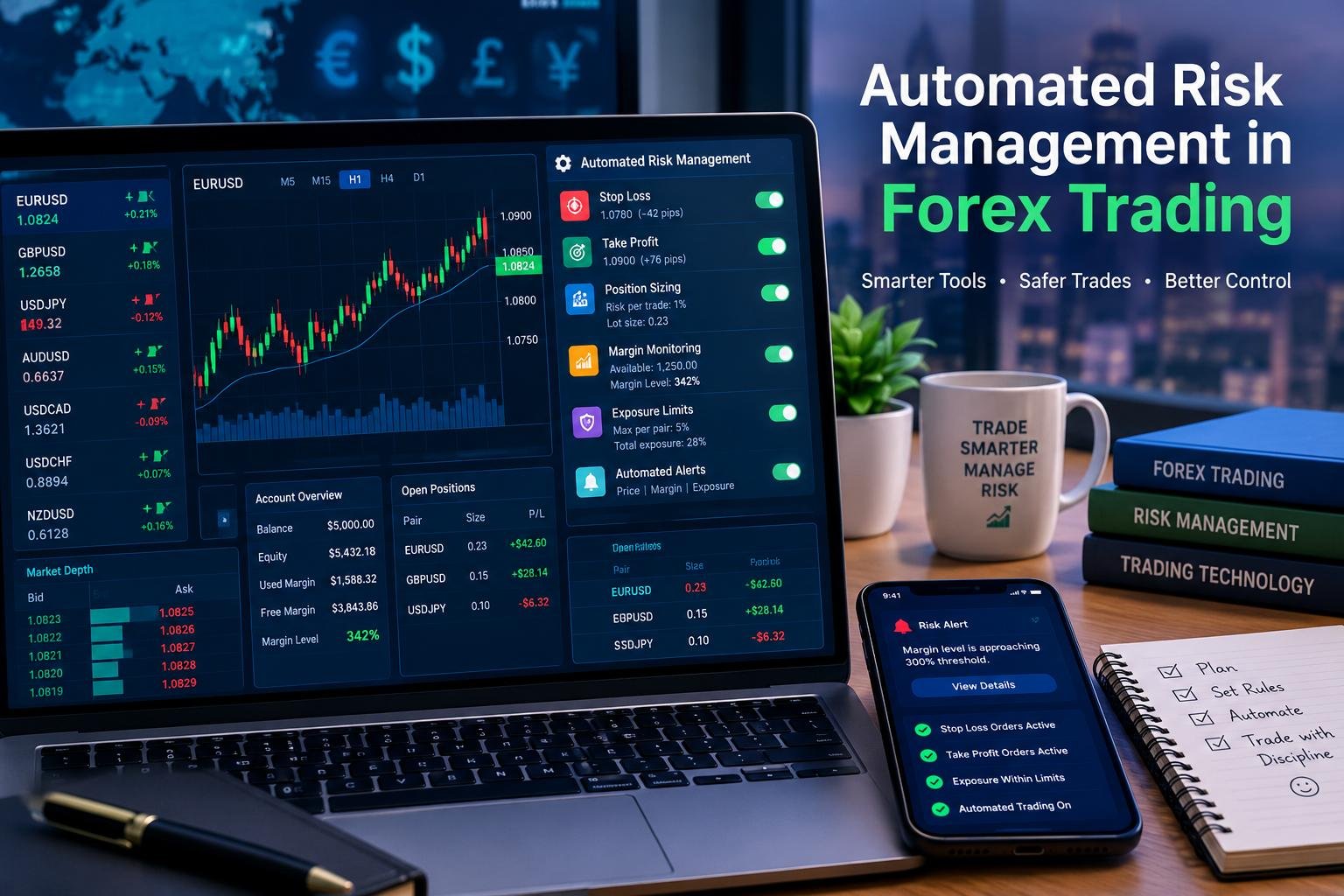
Effective forex risk management is an essential component of any trading strategy as foreign exchange trading has constant price changes, leverage, market characteristics and risk of loss. Technology will be able to automate a number of risk controls which would otherwise rely on manual decisions made by traders. Automated systems can only place stop-loss and take-profit orders, calculate the proper position size, monitor margin level, set the account-level restrictions with pre-defined rules, give alerts, and reduce all losses but not every single one. Their primary use, however, is to ensure that traders adhere to a set of rules consistently and minimizes the risk of errors resulting from lack of attention, distraction, delay and emotions. Knowing the technologies in detail can empower the traders to utilize automations in a responsible way.
How Technology is helping in Automated Risk Management
Today’s forex trading platforms integrate the following components: market data systems, order management technology, account monitoring, and programmable trading rules. As soon as a trader opens a position, software can instantly calculate and analyze the entry price, the amount of money that can be used for the trade, the amount of margin available, the account balance and even presets for risk management. Once they have set up the platform can do actions upon meeting certain conditions without the trader having to be in front of that platform. For instance, the system can automatically close a position at a specified stop loss level, may not allow entering a new position if exposure is greater than a set limit, or may alert if there is not enough available margin to enter a new position at a specified level. The advantage of these functions is that they can be used ahead of a trade, instead of during the active trading process, when there is pressure on making risk management decisions. But automated controls continue to rely on the trading technology’s accuracy, availability and setup.
Stop-Loss Orders
One of the most basic automated risk controls that are available on a forex trading platform is a stop-loss order. It will enable a trader to set a price that a trade would be closed if the market were to trade against the trader. After reaching the relevant market condition, the platform will send the order in accordance with the order execution rules. This can help free up some trading time for the trader to spend elsewhere and can set a limit on the maximum loss that can occur under standard execution, even though the trade may be executed as expected. This can help the trader save time in constantly monitoring a position and can provide a cap on how much the position can lose when executed as expected. Other platforms may offer trailing stops that can move the stop-up level with a positive position. However, a stop-loss is not a guarantee of the price that you will exit at. If the market is illiquid or moving at high speeds, or there are gaps in the market, execution may vary from the desired level.
Take-Profit Orders
Another way of automatic trade management is by using take-profit orders that enable a trader to set the price at which they want a profitable position to be closed. Once the market reaches the defined level, the platform can make the appropriate order without any man to man interference. This can help traders stick to their plans and not shift their objectives for gains and losses due to short term market fluctuations. A take-profit order might be especially helpful in some trading tactics where a definite profit target has been set prior to entering a trade. However, take-profit orders, much like stop-loss orders, have their own limitations of market executions. The price, if it is executed at all, may be altered by a fast-moving market, as may be the market conditions under which the price is executed if it temporarily hits the target price. The technology thus automates the instruction but it doesn’t eliminate the uncertainty of forex markets.

Automated Position Sizing
The amount of currency that a trader trades in relation to the account and the amount of risk that the trader is ready to take is called position sizing. Software can automate this process and apply the predetermined rules according to account equity, stop-loss distance, currency-pair characteristics, and/or a maximum cap of funds invested in any individual trade. A position sizing tool can automatically come up with a suggested size based on the data that the trader inputs, instead of having to size the trade manually each time. These calculations can be directly applied to some automated trading systems, when they come to the order process. This can help minimize arithmetic errors, and provide more uniformity to risk rules that run across different trades. But automated position sizing can only be as accurate as the assumptions and parameters that are used to determine it. Even when the software is properly programmed according to the formula, changes in volatility, contract specifications, exchange rates, transaction costs and leverage can change the practical risk of a position.
Margin Monitoring
Another margin monitoring aspect where trading technology can offer ongoing risk supervision is that of monitoring open trades. Forex positions are frequently opened via leverage, which suggests that a fairly small quantity of deposited funds might manage a bigger deal. A trading platform can then be able to show available margin, used margin, margin levels, other account information, etc. in real time. These figures can be tracked by automated systems and alerts be given when the account is nearing a set threshold. Additional trading may also be limited or come into play when margin requirements are tight, depending upon the platform. This is a useful feature since traders can’t always realize fast enough when the margin conditions are becoming unhealthy in a fast-moving market. But margin monitoring won’t stop you from losing money or being liquidated. Even if prices do not move in a trader’s favor, he or she can end up losing money, and even relatively small price fluctuations can have a significant impact on a leveraged position.
Exposure Limits & Trading Restrictions
The exposure is the amount of money risk involved in the open positions in one or more currency pairs. Some automated risk-management systems can set a maximum amount of the position size, exposure to any specific currency or the number of trades that can be open at once. For instance, a trader can set a rule that the account won’t have more than a certain quantity of a certain currency in its trading portfolio. A system may also prevent further jobs from being opened if the total amount of exposure is at the allowable level. These controls are important because, for some trades, multiple seemingly unrelated trades may have significant exposure to the same currency, or market factor. Traders can unwittingly hold onto more risk than they were intending when they don’t use an automated limit.
Automated Alerts
These alerts will alert software when certain risk conditions are met. Conditions that trigger alerts can be set to parameters that change account equity, margin levels, currency prices, volatility, open exposure, and/or status of individual positions. A for example, could alert a trader when available margin is about to fall to a certain level or when a currency pair hits a level that corresponds to a position. Notifications may be sent via desktop applications, mobile devices, email or via the various supported channels as determined by the trading system. The main benefit is that the trader doesn’t need to manually monitor each trading account variable all the time. Alerts can be used to highlight certain conditions that need to be considered, but not the trader’s final decision. But an alert does not necessarily mean an automatic protective action. Keep in mind that, if a trader gets a warning and does not act on it, the underlying risk could stay the same. There are therefore reliable notification settings and backup monitoring procedures, which are important.
Portfolio-Level Risk Controls
It is more complex when the trader has several trades open at a time. Portfolio-level controls means the software can take into account all the trades, as opposed to each one individually. A system can track the total amount of exposure, the accumulation of size in a position, the accumulation of concentration in certain currencies, as well as the correlation of trades. For instance, a trader could have multiple positions in the same currency that could expose them to a greater overall risk than they realize if they consider each trade individually. Automated Portfolio Controls can set overall account limits, and can block new trades if limits are violated. More advanced systems can also track when the portfolio composition changes, when trading a position is opened or closed. These controls help to guarantee uniformity since identical rules are applied to the account, instead of the trader having to manually figure out combined exposure. Nevertheless, correlations may vary over time and automated portfolio controls will not necessarily assure or maintain diversification.
Trading-Platform Risk Settings
Often, Forex trading platforms offer features which enable traders to set varying degrees of control over their trading activity. These can include order types, maximum trade size, leverage set, margin details, stop loss and take profit functions, trading permissions, and automated trading strategy control, among others depending on the platform and broker. These features can be enhanced with the use of expert advisors or other algorithmic solutions which utilize pre-programmed rules based on certain market or account conditions. These can be used to create a systematic framework for trading that allows a trader to open, monitor, and close trades based on certain algorithms or rules. These settings can be effective only if they are properly set up. Automation can behave differently than expected if any position size, threshold, trading logic or order behavior is incorrect. Consequently, testing in a controlled environment prior to the actual implementation with real money can be a vital component of a responsible implementation.
Backtesting and Monitoring Automated Controls
Traders can back-test the performance of the rules of an automated risk-management strategy over the past to see how it would have performed in the market. You can use back testing to discover technical issues, incorrect thresholds, unforeseen interactions between the various rules and circumstances where an automatic strategy may be placing excessive orders. The past performance of any entity does not mean that they will perform that way in the future as market conditions, liquidity, spreads, volatility, and/or execution may vary. Once an automated system is in place, therefore, it is important to continue to monitor. Traders should ensure that the placement of stop loss and take profit levels is correct, the size of trades is correct according to intended size, alerts are working correctly and calculations for margin and exposure are correct. While software can eliminate repetitive manual tasks, they are not meant to be a self-running system that doesn’t require supervision. Human monitoring of the technical failure is still significant and is crucial for determining if the risk parameters are suitable.
Limitations of Automation in Forex Trading
Automated risk management can help to ensure consistency but cannot eliminate market risk. Economic releases, central-bank moves, geopolitical events, random news and shifts in markets liquidity all can cause a Forex price change in a matter of seconds. Internet connection, platforms and servers can also experience disconnections or errors, data-feed errors, software bugs and execution delays. An exceptional market condition could mean the programmed stop-loss occurs at a different price. Another example of the errors that automated strategies can magnify is when incorrect settings are used in multiple trades simultaneously. Therefore automation is not a solution that will stop financial losses; it’s a tool to ensure the implementation of specific controls. Traders should have a plan of understanding what rules are getting automated, test their systems, ensure they are checking their accounts and ensuring they have realistic expectations of how much a trader can get from a technology that will never be able to replicate a successful trading strategy.
Conclusion
With automated technology, forex traders are able to implement many controls for risk-managing better in a consistent manner. Stop-loss and take-profit orders can define the exit points, position-sizing tools can estimate the size of trades and a margin-monitoring system can alert traders when their accounts are losing value. Setting concentration limits could limit excessive risk taking and automatic alerts would alert traders to major levels. Combined positions can be evaluated at the portfolio level, while the parameters for trading platforms can define certain trading and account activity rules. While these technologies have the potential to minimize some types of human error and support traders to adhere to a pre-set risk plan, they can’t eliminate the uncertainty associated with trading foreign exchange. Even with the best effort of the trader, uncalled and unconfirmed bids and offers, execution issues, and misconfiguration can lead to unforeseen results. The best use of automation is then to assist in disciplined risk control and to maintain confidentially informed decision making and testing at the heart of the trading process.
Get more well researched information about Automated Risk Management in Forex Trading here.