Introduction
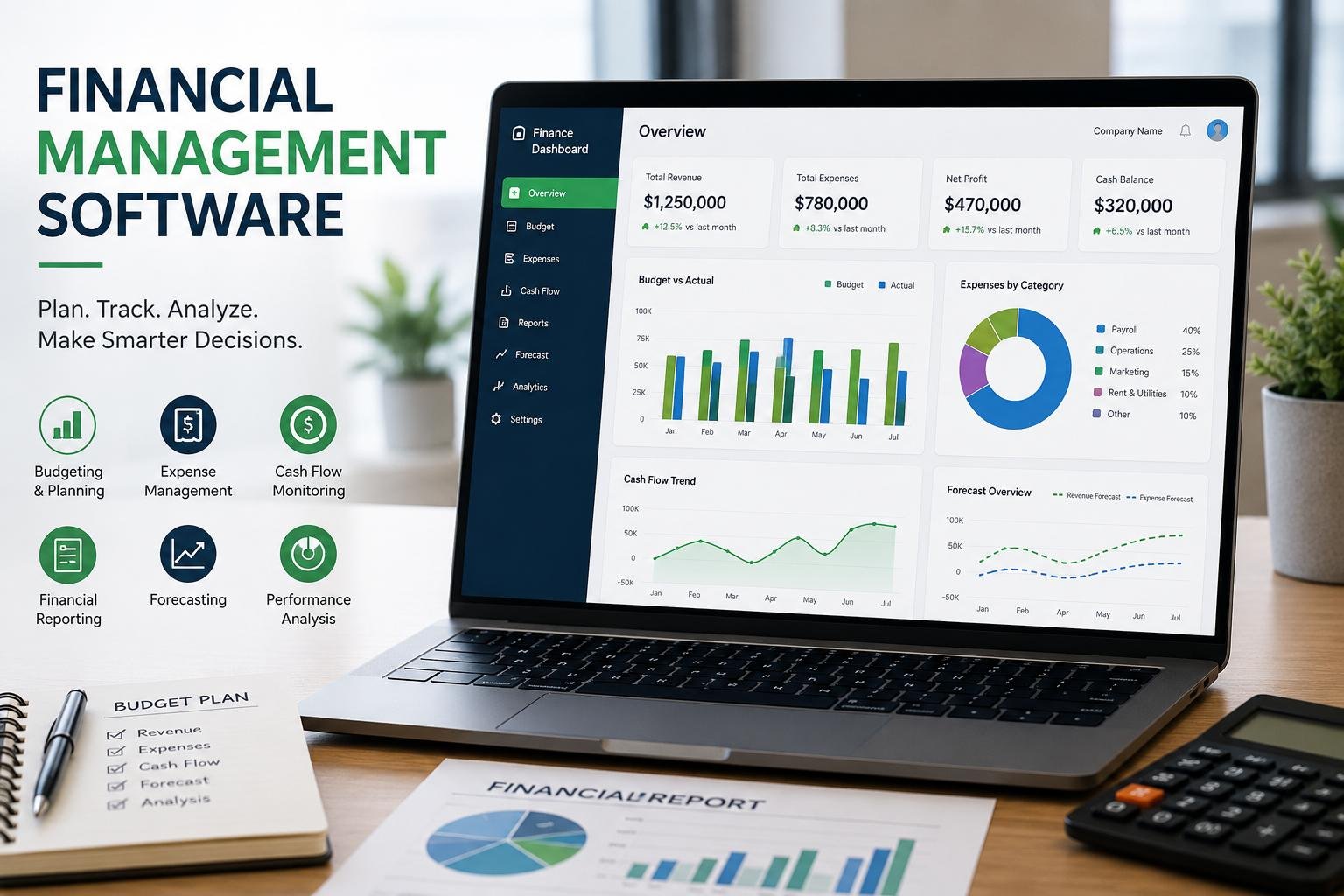
Running a business includes more than just keeping track of sales and costs. Businesses should make budget planning decisions, keep track of cash, manage expenses, create reports and evaluations, and compare actual performance to expectations to make decisions based on solid financial data. These duties are increasing and spreading out with the spreadsheet and individual applications becoming harder to manage as more than one person requires access to the same data. Financial management software creates a more cohesive approach for businesses to manage and organize financial activities. A modern platform can provide a single workflow for budgeting, tracking expenses, monitoring cash flow, forecasting, reporting and analyzing performance. For businesses looking into these features, Sage has resources to help them understand financial management software and how it can help with comprehensive financial management.
Financial Management Software
Financial management software is a digital system that is used to manage, analyze and control the financial activities of an organization. Specific features vary among the products, but these platforms help to integrate financial data into a single environment, allowing businesses to track transactions, monitor spending, create budgets, analyze cash flow, produce reports, and track performance. The software can integrate with accounting systems, banks, payroll software, payment platforms, customer relationship management software, and other systems. Users can access, work and report from the same information and processes in one place instead of having to access and work with individual spreadsheets, providing managers with a more holistic view of financial information across departments, projects, locations or business units.
Basic Accounting Software and Financial Management Platforms
Basic accounting software and other financial management systems have similar but distinct functions. The main activities of bookkeeping are integrated into the accounting software, including recording income and expenses, handling accounts payable and accounts receivable, reconciling bank transactions, handling the general ledger and generating regular financial statements. These functions are vital to the proper books and reporting. A financial management platform typically goes beyond recording transactions into financial planning and budgeting, forecasting, expense management, performance tracking, workflow management and more sophisticated reporting capabilities. Certain platforms are also able to accommodate several entities, currencies, departments, or locations. While the difference is not always clear-cut, the scope of the distinction is the most important: accounting software is used mainly for recording and reporting financial transactions, and financial management software is designed to assist an organization in planning and managing its finances, controlling and analyzing them, as well.
Managing Budgets and Financial Planning
Financial management software can have a tangible impact in one of the most vital parts of financial management: budgeting. Softwares can enable businesses to develop income and spending plans, allocate budgets to departments or projects, and compare actual performance with approved budgets, rather than doing it in a static spreadsheet and manually updating it. When there are unfavorable variances, managers will be able to detect them earlier and determine the cause of higher than expected spending or loss of revenue. A centralized system can also facilitate a more collaborative budgeting process through the capability to allow for users with authorization to provide information while having control over who is able to change the financial plans. Software can minimize the admin work of updating figures for businesses that are involved in the preparation of annual budgets, revisions or rolling forecasts. Financial planning isn’t necessarily better because of better budgeting, but it’s easier to manage because of organized timely information.
The Process of Managing Expenses and Controlling Spending
Another example of where expense management can be automated to save on unnecessary administration is in the reconciliation process. There are a number of expense items that have to be reviewed and recorded properly that businesses are likely to face, such as supplier payments, subscription payments, travel claims, employee expenses and other payments. Financial management software can offer workflows that allow the user to submit expenses, add supporting documents, send the transaction for approval, and classify the transactions based on set rules. Automated controls may be able to detect any transactions that are more than a certain amount or need a secondary authorization. Expense data is in one place, which saves time for finance teams to spend on receipts and merging siloed data. Managers can also check the money being spent and check if it’s in line with budgets for that department. Effective expense control can thus enhance efficiency and good financial practices without having to manually review each and every expense.
Monitor and Forecast Cash-Flow.
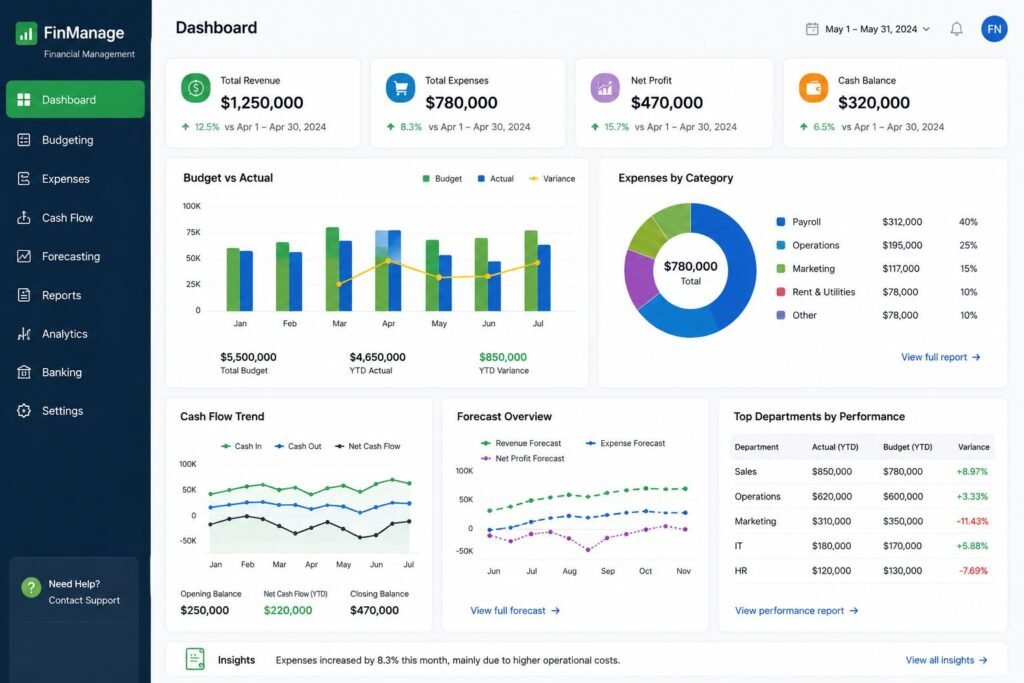
Profitability is not cash availability and hence cash flow management is crucial for businesses. By streamlining the tracking of anticipated receipts, impending payments, balance and future commitments, financial management software can assist the finance teams to manage these obligations in a more organized manner. Regularly updating financial information can provide managers a better idea of whether or not the business might have adequate cash to fulfill its obligations. Forecasting capabilities can also enable companies to simulate future income and expenses, under various different assumptions. If, for instance, management were considering the impact of delayed payments from customers, increased operating expenses or an investment they are planning to make, they would look at the impact of those. Forecasts are not predictions and will not be accurate, but can serve as an early warning system, aiding cash decision-making and minimizing the risk of being caught out with a forecast shortfall.
Business Visibility and Financial Reporting
Financial reporting transforms financial data into information that can be used by managers in evaluating the business. A financial management system can prepare reports automatically or help to simplify reports like income statements, balance sheets, cash-flow reports, budget-versus-actual reports, expense summaries and management dashboards. The information is filtered according to the platform (department, project, product, location, and reporting period). This can help to make it easier to study modifications in revenue, margins, costs or cash balances. When managers must be reactive to evolving situations it is especially valuable to get the report in on time. The data and accounting rules upon which automated reports rely is key to their reliability. Whilst appropriate reporting is required from good software, it is still important to have review and financial oversight.
Performance Analysis and Decision-Making
Financial management software can also guide firms from reporting on what has happened, to comprehending what the numbers might indicate. Performance analysis tools make it easy for managers to compare actual results, budgets, previous periods, forecast or key performance indicators. These comparisons can show an increase in costs, reduction in margins, poorly performing product or departments that are drifting out of line with their budgets. Some systems offer a dashboard reporting which enables important trends to be identified more easily, and more sophisticated systems may be able to offer scenario analysis and other planning options. The actual value is in having the financials that are relevant to your decision when it is needed. Financial results that link to operational activity enable managers to gain insight into any issues, resource allocations, and opportunities for improvement.
Key Features to Consider when Deciding on a System
It is important for businesses to consider financial management software that is suitable for their requirements and not just based on the number of features it offers. Such good integration with accounting is crucial since financial management tools require reliable transaction data. Other criteria companies should look at are budgeting and forecasting, expense management, cash-flow visibility, reporting, user permissions, audit trails, and bank or payment integrations. Automation plays a key role in repetitive activities, like report generation, approvals, and data collection and reconciliation. This is because ease of use is critical as a technically impressive system simply won’t provide any value at all if the employees are not able to use it properly. Additionally, businesses should take scalability into account when they plan to expand their workforce, business location, entities, or transactions.
Integration, Security and Data Quality
If the business relies on several other systems, they must be included in the financial management system. The companies should first determine the applications that will interact with the platform that need to exchange information with them, such as banking, payroll, invoicing, expense, inventory, customer and payment systems. Reliable integration can help minimize duplicate data entry and ensure data is consistent. Security is also a key factor, as financial systems have valuable business data. Access, authentication, and permissions, audit logs, backups, and the approach used by the provider to keep financial data safe should all be reviewed. The quality of data should be taken into account as well. While processes can be automated on a platform, the platform cannot fix incorrect information in the source by itself. Businesses must have clear data entry, account structure, approval and reconciliation and periodic review procedures to ensure that the information flowing through the system is reliable.
Cost, Scalability, and Implementation
Financial management software should be priced by looking at the TCO (total value and total cost of ownership) on top of the subscription. Implementation, migration, training, integration, support, extra users, and advanced features are some things businesses could have to take into consideration. The low cost system could turn into a costly one if it needs a large amount of time and effort to manage, or if it is not capable of growing. On the other hand, a complicated platform might not be necessary for a small business that has simple requirements. Scalability is thus a factor that needs to be taken into account. The selected system should be capable of scaling to accommodate more transactions as well as changing processes over time without requiring the business to upgrade the system too quickly. Planning of implementation needs to be carefully conducted as well. Any businesses that intend to use the system for critical financial activities should clean data, set rules for approvals, test the integrations, train users, and inescribe procedures.
Making the Correct Selection on a Financial Administration System
The first step in selecting the right system is to determine the business’s problems. Current processes and areas of unnecessary staff time, mistakes, delayed approvals and lack of management information should be documented. The results can be used as a checklist to help review platforms. Next, businesses should evaluate systems based on real-world needs and ask for demos, run key workflows and engage in support discussions with the providers. All finance personnel, managers, administrators and executives should be included as they may have different priorities. It is also important for companies to determine if the platform will be able to meet future needs or if they simply need something to meet the current demand of transactions. Functionality and usability, security, integration, scalability, support, and cost considerations are all important factors to consider.
Advantages of Financial Management Software
With proper selection and application, financial management software can provide a number of benefits to the operations and finances. Automation can help take the tedium out of repetitive administrative tasks and allow finance staff to concentrate on value-added work and analysis. Having all the data in one place can provide increased transparency and eliminate the need to match data between isolated spreadsheets. Reporting and automation can enhance the quality of the approval process, clarify responsibility and provide management with information faster. Improved cash-flow control and planning can aid in making appropriate investment and working capital decisions. These systems can also enable businesses to recognize duplicate transactions sooner, as well as odd expenses, overdue receivables, and budget variations. The advantages will rely on the trustworthiness of the data, user adoption, and solid monetary approaches, yet a decent framework can bring more consistency and proficiency to monetary management.
Conclusion
Financial management software can be used to create a more integrated financial management strategy that goes beyond just recording transactions to include budgeting, expense management, cash flow tracking, forecasting, reporting and performance analysis. The right platform can help minimize manual tasks, enhance visibility into finances, improve internal controls, and arm managers with information to help them make better decisions. But, companies must not presume that the most feature rich and costly system is the most suitable system. The decision on which to use will depend on the size, technology, financial complexity, need for security and future plans of the organization. Evaluating existing processes, comparing key features, verifying integration and security, and meticulous planning will help businesses choose a financial management solution that will enhance their business performance over time and help with their day-to-day financial needs.
Get more well researched information about Financial Management Software here.