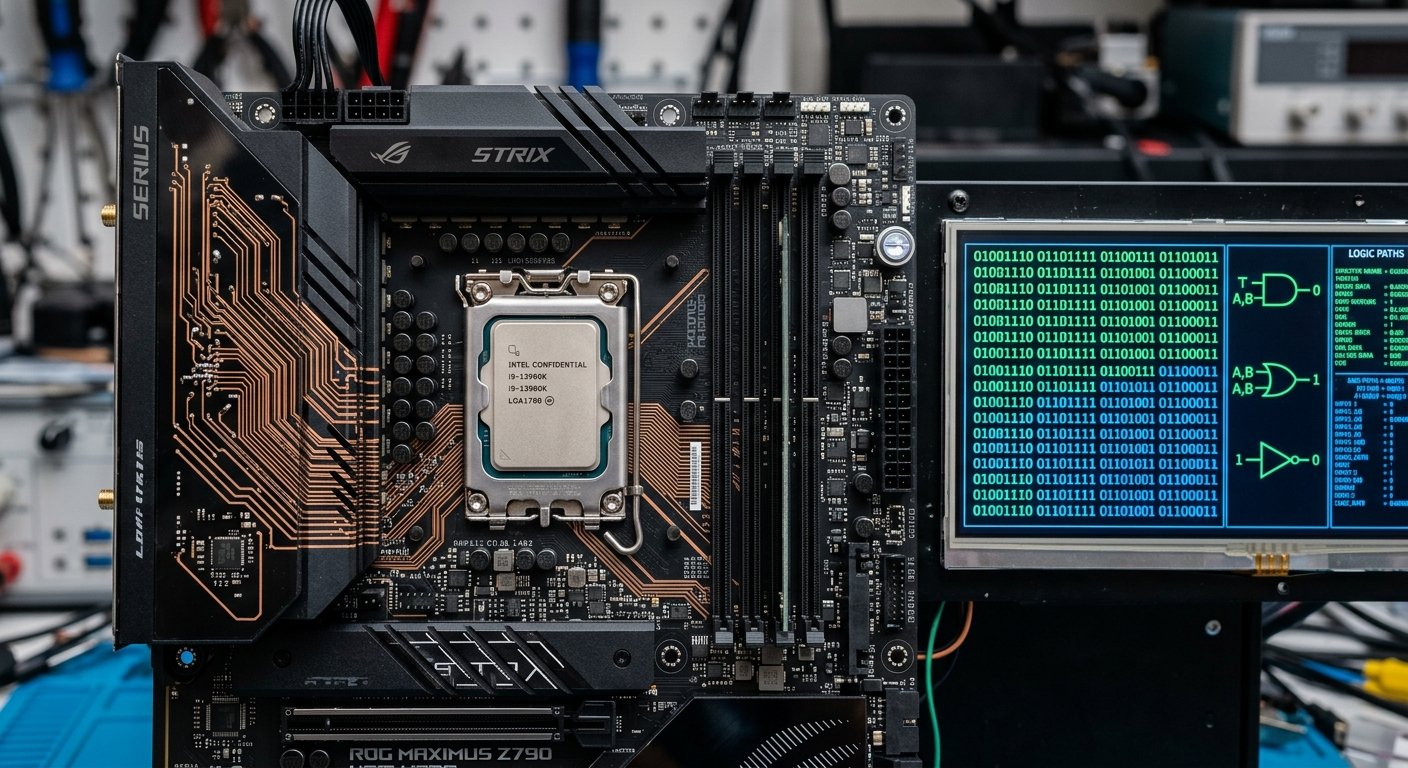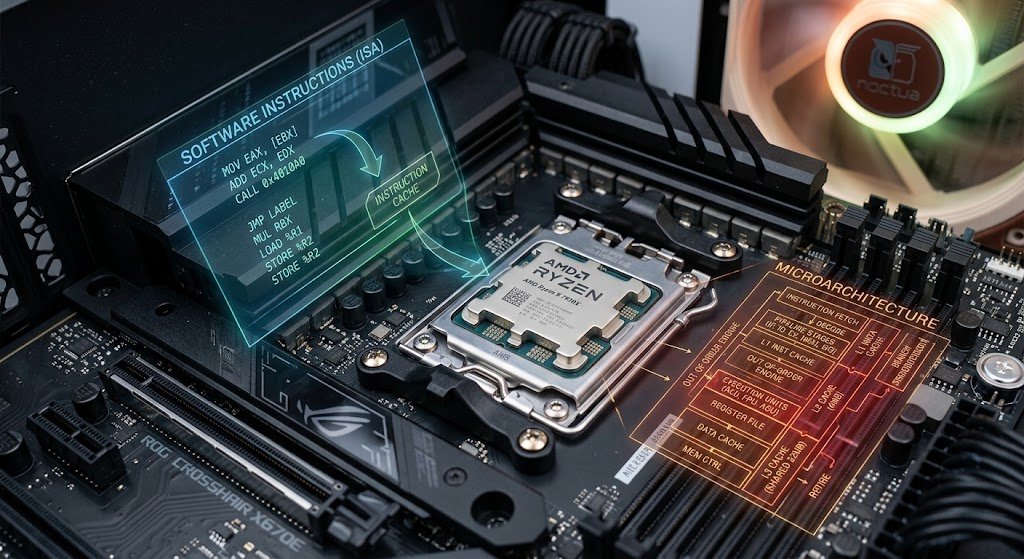
To understand how a modern processor works, it is important to differentiate two concepts that are often confused, namely Instruction Set Architecture (ISA) and microarchitecture. These terms are often used in combination in computer organisation discussion, but they refer to different levels of processor design. ISA specifies rules and instructions that software developers communicate with, whereas microarchitecture refers to the internal hardware techniques used to efficiently execute such instructions. ISA is the contract or deal between the software and hardware, and microarchitecture is the hardware that carries out that contract.
An ISA is used by all programs running on a computer since it defines the structure of the instructions, the way data is to be processed, and the way software interacts with the processor. The performance of these users, however, relies heavily on the microarchitecture as it governs the internal design decisions impacting speed, power and efficiency. Two processors may be based on the same ISA, but have different implementations of the ISA’s instruction set, memory management, and parallel processing.
This difference is what makes it possible for processors from different companies to execute the same applications but with entirely different designs. For instance, both Intel and AMD make x86 processors, so that software written to run on x86 systems can more or less be run on chips from either manufacturer. Intel and AMD devise their own microarchitectures, though, to gain the performance, energy efficiency and scalability edge. This insight into the relationship between ISA and microarchitecture can aid students, engineers, and tech enthusiasts in comprehending the design of modern CPUs.
What is the meaning of ISA (Instruction Set Architecture)?
Instruction Set Architecture, or ISA, specifies the rules used to communicate between software and processors. It is a collection of instructions that the CPU can understand and execute. The programmers’ basis is the ISA when they write software, while the compiler uses the ISA as a basis when it translates the high level programming languages into machine code. The ISA defines what operations are supported, how they are structured, how data is treated, and how a program accesses the hardware resources.
ISA doesn’t tell about the physical structure of a processor. Rather, it offers an abstract representation of the capabilities of the processor. It specifies commands to add numbers, move data to or from memory or registers, perform logical operations and control program flow. The ISA abstracts away the particulars of how transistors are coupled inside the CPU, so that software developers need not be concerned with them.
There are different ISAs for different processor families. For instance, x86 is among the most popular ISAs for desktop computers and servers, while ARM is more prevalent in smartphones, tablets, embedded devices, and numerous contemporary laptops. Examples are RISC-V, Power ISA and MIPS. The goals, instruction formats, and design philosophies are different for each ISA. Some look for compatibility and a lot of features, others take simplicity and efficiency.
The ISA is similar to the contract between software developers and processor manufacturers. When a processor complies with a particular ISA, software for this ISA will run correctly. This means multiple generations of processors can run the same applications even if the application’s internal hardware architectures change substantially.
What Is Microarchitecture?
Microarchitecture is the actual internal design and implementation of a processor that implements the instructions defined by the ISA. ISA specifies what operations the processor must support, but the microarchitecture specifies how these operations are performed on the inside of the processor. It comprises execution units, pipelines, caches, branch prediction systems, instruction scheduling mechanisms and techniques for executing multiple instructions simultaneously.
As opposed to ISA, the microarchitecture can’t be accessed directly by programmers. It is generally not the software developer’s concern to know whether a processor is pipelined or uses a specific cache design when he is writing an application. But these internal decisions have a significant impact on the final product’s speed and efficiency. Engineers continually augment designs of their microarchitectures to provide greater performance at lower energy consumption and heat output.
Modern processors implement the instructions faster than the simple sequence of operations defined in the ISA: For instance, the CPU in a computer can pipe in different stages of processing instructions. The processor breaks the execution of one instruction into stages and performs multiple instructions at the same time. Other methods, like out of order execution and speculative execution, enable processors to anticipate future operations and make the most of the resources.
The distinction between the architecture and microarchitecture is apparent when considering the functions of these two in processor design. Architecture outlines the characteristics and capabilities of software while microarchitecture outlines the engineering approaches used to provide the characteristics and capabilities. For more information about the difference between architecture and microarchitecture please visit the following resource. It is important to recognize this difference when studying computer organization as it will help you understand how multiple processors can operate on the same instruction set, yet have different levels of performance.
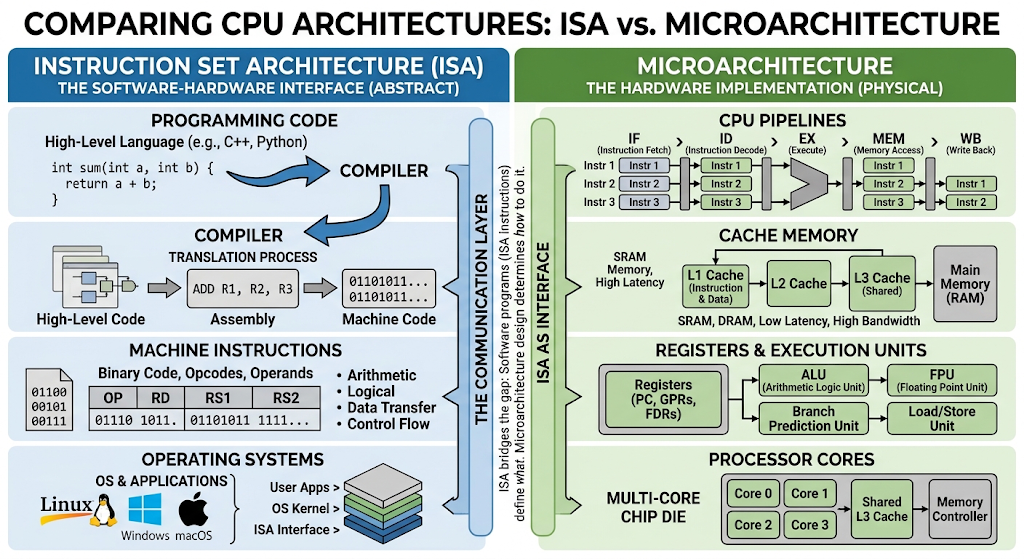
ISA and Microarchitecture – Some significant differences between them.
ISA and microarchitecture are closely related, but they are different aspects of computer design. ISA is the computer programmer’s view and microarchitecture is the computer hardware view. The most significant distinction is that software is indirectly dependent on the ISA, but not on the microarchitecture. The same program can be compiled for a specific ISA and executed on various processors that implement that ISA.
Flexibility is another key consideration. An ISA change may cause some serious compatibility issues as existing software may not be able to function without any changes. To this end, processor manufacturers typically keep the ISA in line for many years. The x86 processors, for instance, have been used for decades, and it is possible to use programs that were written for older computers.
Microarchitecture, however, may be updated often without the software losing the ability to run on the processor. Processors are developed over time with new architectures, and the ISA remains the same. These enhancements reduce companies’ need to recode applications to boost performance. It has facilitated the evolution of the computer industry quickly and with an openness towards existing software ecosystems.
The main differences are summarized in the following table:
| Feature | Instruction Set Architecture (ISA) | Microarchitecture |
| Purpose | Describes instructions and how they interact with software | Determines the sequence in which programs will run |
| Visibility | Programmers and compilers can access it. It can be accessed by programmers and compilers. | Mostly concealed from software |
| Focus | Compatibility and functionality | Performance and efficiency |
| Changes | Software compatible and rarely changed. | Frequently improved by engineers |
| Examples | x86, ARM, RISC-V | Intel Core designs, AMD Zen designs |
Intel vs AMD: The same ISA but different microarchitectures.
The most prominent example of the relationship between ISA and microarchitecture is between Intel and AMD. Both companies’ chips are based on the x86 ISA, the basic set of instructions the computers, desktop machines, laptops and servers that are common across the world can understand. Typical programs created for x86 processors can generally be executed on processors built by either firm, as both have the same architectural rules.
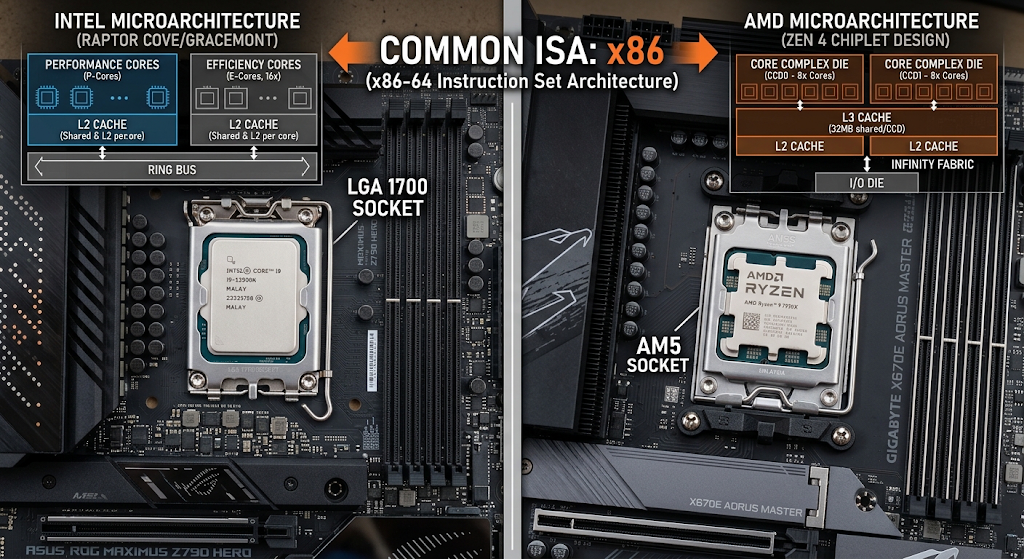
But Intel and AMD aren’t making the same kind of processors. Every company designs its own microarchitecture to enhance the performance, efficiency and competitiveness in the market. Intel has given its processor line the Core name, encompassing several generations of microarchitectures and AMD has the Zen microarchitecture for its Ryzen and EPYC processors. These designs can have the same x86 instructions, but they do so in different ways internally.
Two processors, for instance, could be performing an addition of two numbers but might process the instruction quite differently. There may be different branch prediction systems, different pipelines, bigger cache, more execution resources, etc. among different processors. These differences impact the speed at which the processor can execute real-world tasks, like video editing, server workloads, scientific computing, and games.
This example illustrates that the performance of processors cannot be assessed based on the ISA alone. The instruction set is the foundation, and its effectiveness comes from how well its microarchitecture is utilized. That’s why you can get varying benchmark scores and user experiences from two processors that are basically the same.
How “microarchitecture” contributes to a processor’s performance.
There are numerous innovations in modern microarchitectures, focusing on boosting processing speeds. Instruction pipelining is one of the key techniques: allows a processor to execute multiple operations of multiple instructions simultaneously. Like an assembly line in manufacturing, pipelining is done to make the processor more efficient, by keeping the various parts of the processor working at the same time.
One of the other big enhancements is the design of the cache. Processors store tiny amounts of data in nearby, high-speed cache areas that allow processors to access data faster than they can access data stored in main memory. The microarchitecture decides the structure of these caches, the amount of data they contain and how well they anticipate what data the processor will require next.
Another crucial microarchitectural characteristic is branch prediction. Programs often also include decisions on what instructions to run, using “if” statements and loops. Modern processors don’t wait for each decision to be made, but anticipate what the next decision might be and prepare instructions for it ahead of time. Correct predictions help a processor do better, and when it gets this wrong, the processor will need to recover and start over.
Another common application of out-of-order execution is in the architecture of modern CPUs. It enables the processor to change the sequence of internal operations to optimize the algorithm, but not change what it does at the end (final outputs). These are some of the most advanced features, illustrating how the microarchitecture of the computer is optimising a set of basic instructions into a powerful computing machine.
What is ISA and Microarchitecture?
It is essential for students of computer science, computer engineering and computer architecture to understand the difference between ISA and microarchitecture. It introduces principles of computer processor differences, operating systems and hardware, and software compatibility over generations of computers.
For computer users, the significance of ISA is the ability to design programs that can be executed by a particular computer type. Understanding microarchitecture is useful to developers as they seek to optimize performance-sensitive applications for the processor, such as memory access patterns, parallel execution, and processor limitations.
Microarchitecture is a very integral aspect of processor innovation for hardware engineers. CPUs are designed by engineers who understand circuits, computer organization and performance analysis to perform instructions more quickly and efficiently. As microarchitecture has evolved over time, it has made significant strides in fields such as artificial intelligence processing, cloud computing, mobile devices, and high-performance computing.
The future relationship of ISA and Microarchitecture
ISA design and microarchitecture development are still growing areas of innovation, as is increasing the demand of computing. New ISAs, including RISC-V, are getting recognition for offering an open standard that enables organizations to build their own custom chips. However, long-standing ISA architectures – such as x86 and ARM – are still maturing to meet new demands for computing.
In the years to come, microarchitecture will be a large theme as engineers strive to find new methods that will increase performance while reducing energy consumption. Advanced techniques like specialized accelerators, optimized designs for artificial intelligence workloads, and enhanced parallel processing are expected to be used by future processors.
The concept of ISA and microarchitecture will continue to be one of the key concepts in computer engineering. Microarchitecture allows for creativity and improvements in the engineering of processors to make them faster and more efficient, and the ISA ensures that software and hardware are compatible and communicate with each other.
Conclusion
ISA and Microarchitecture are two different, but related, levels in processor design. ISA is the contract with the programmer describing what the processor can do, while microarchitecture is the actual way the processor is implemented describing how efficiently it performs the instructions. processor design can appear complicated if these concepts are not separated because they can be confusing; computer organization is easier to understand when these concepts are separated.
This is what Intel and AMD have so aptly illustrated. Both companies support the x86 ISA and hence compatibility of the software over their processors, but they use different microarchitectures in order to be competitive. One of the central concepts that enables the computing industry to change without violating compatibility is the separation between software interface and hardware implementation.
With the knowledge of ISA and microarchitecture, the students and the technology professionals can have a better understanding of computer functioning from software level to hardware components which form the power base of the modern digital systems.