Introduction
How voice assistants work depends on several technologies that allow users to interact with smartphones, computer, smart speakers, and connected devices via speech. Users can ask for a reminder to be set for a time (e.g., “Set a reminder for seven tonight.”), ask the weather forecast for the next day (e.g., “What is the weather tomorrow?”), or turn off the lights (e.g., “Turn off the lights.”). The assistant reads the request, carries out the required action and answers by speech or text.
These interactions might seem simple, but rely on multiple technologies. The automatic speech recognition translates speech into text, the natural language understanding understands what it is and the intent detection determines the intended action. The assistant can then link to an application or online service, and then give a speech response using the text-to-speech feature.
In this article, you will learn how the voice assistants understand the spoken commands.
1. Capturing Speech and Recognizing Words.

It starts with a microphone, which converts the voice of the user into digital data. Many assistants are configured with a wake word, such as “Alexa” or “Hey Siri,” that is used to identify when someone wants to communicate with the assistant. This initial detection can be carried out in some systems locally, or with other activation means. The quality of the microphone, the distance between the person and the microphone, and ambience/background noise can all affect the quality of the recorded sound.
Audio is captured and then analyzed by an automatic speech recognition (ASR) system to translate it into text. For instance, the system tries to recognise each word in the sentence to answer the question, “What is the weather in Lagos tomorrow?” Today’s speech recognition systems make use of machine learning to identify speech patterns, but they can still be incorrect when people have unfamiliar names, loud background noise and varying pronunciation. The assistant’s task next is to get a copy of the transcription that is accurate.
2. Natural Language Understanding and Intent Detection
Once spoken words have been converted into text, natural language understanding (NLU) helps the assistant interpret their meaning. This process relies on natural language processing, which enables computer systems to analyze human language, recognize relationships between words, and interpret requests in context. Informal expressions, indirect requests, and incomplete sentences are common in everyday communication. For instance, “It’s cold in here” could be a simple observation or an indirect request to raise the temperature. Understanding how voice assistants work requires recognizing that the assistant must interpret the user’s likely intention rather than simply identify individual words.
Intent detection is the ability to tell which action the user wants to perform. The intents for “Wake me up at six tomorrow” and “Remind me to study at six” are different.The intents for “Wake me up at six tomorrow” and “Remind me to study at six” are different. Both requests have a time in them, but they are for different operations. The assistant also pulls out crucial information like dates, place, and device names, which aids in ensuring that the action is appropriate for the user’s request.
3. Connecting to Applications and Online Services
It is not sufficient to know what someone wants, the assistant also has to know how to do it. It can invoke an application that’s already installed, launch an application if it’s supported, or interact with an internet service, depending on the task. APIs are like translators that enable various software systems to communicate with one another, sharing data and requesting certain actions.
For instance, if the user asks for the weather, the assistant could reach out to a weather service and get a forecast for the user’s desired location. A reminder may be sent to a reminder application when the user requests a reminder with a description and time. Such actions require the proper integrations and permissions. The service might fail, even if the spoken command was interpreted correctly, because the service itself is not available or the assistant is unable to access it.
4. Executing the Request
The required information to execute the action is sent to the assistant by the correct service selection. The application records the task and the date and time that it was scheduled. The assistant could even give a command via the connected platform to turn off the lights or set a thermostat, if an appropriate smart-home device is present.
The system can then be fed back a result, stating if the operation was successful or not. The assistant can verify the action to the user when it has been performed. If a device is not connected or a permission is missing, or important information is not clear, the assistant might have to describe the issue or ask for clarification. It’s significant to make this distinction because just because a command is understood doesn’t mean that it is completed.
5. Generating Natural Language Responses
The assistant prepares a response after completing an operation or retrieval of information. Natural language generation makes it easier to present the result clearly and relevance. If the reminder was successful, the following message could appear: “Your reminder is set for 7 tonight.” A weather question might give a summary of the forecast, the temperature, or if there is any rainfall in the forecast, the chances of it.
The answer should be correct in reflecting the result. If the application has denied saving the reminder, then “saved” is not a correct message for the assistant. Likewise, it should differentiate between forecasting and a certain result. Some systems rely on pre-defined responses, and others use language models to create more flexible responses. Either way, the aim is to convey meaningful information without misrepresenting the system’s knowledge and/or actions.
6. Text-to-Speech Synthesis
Text to speech synthesis (TTS): Text-to-speech technology turns written text into voice messages, which enables assistants to read back to the users. Neural networks can be employed in modern systems to generate natural speech with correct pronunciation, rhythm and intonation. It enables an assistant to create numerous potential answers with one recording of the text per sentence instead.
For instance, once the reminder application is successful in its reminder, the assistant translates the confirmation message into speech and, using a speaker or headphones, plays it back. Even the names, abbreviations, numbers and unfamiliar words can pose problems for pronunciation. Know more about the technology of speech-to-text conversion and how it converts written language to speech.
7. Set and respond to Reminders and Questions
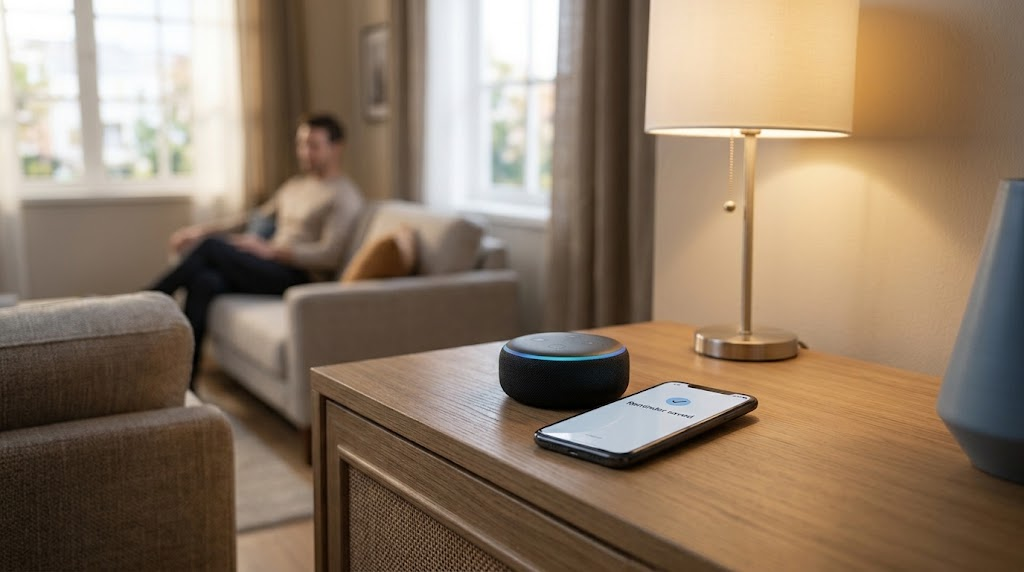
When a user says, “Remind me to complete my homework at 7 tonight,” the assistant recognizes the spoken words, identifies the reminder request, extracts the task and time, and sends the information to a supported application. The reminder must be saved successfully before the assistant can confirm that it has been created. Depending on the user’s needs, task management apps can also help organize tasks, manage deadlines, and keep reminders in one place. Understanding how voice assistants work helps explain how spoken instructions can become scheduled tasks, while also showing why an assistant may need to ask a follow-up question when important information is missing.
If your answer to the general question, it is not quite the same. The assistant understands the question and offers an answer with knowledge and/or information sources that have been linked. Some questions need current information or information about changing conditions, and may need to be answered using online information; other questions may be answered without a live search.
8. Accessing the weather forecast and managing the smart-home.
To provide the information, the assistant has to determine the location and time span for weather requests, for example, “Will it rain in Lagos tomorrow?”; the assistant must then query a weather service for the information. It then summarizes what information is available for forecast and provides the answer. Usefulness of the response is determined by the accuracy of interpretation, trustworthy weather data and an internet connection if needed online data.
In smart-home control, the process is likewise, but leads to a physical action. The user states, “Turn off the lights in the living room”, and the assistant then detects the target device and transmits a command via a compatible home-control system. It then tries to perform the request. The action succeeds if the user has permissions, network connectivity and compatibility.
9. Background Noise, Accents and Pronunciation
Speech can be difficult to hear with background noise from other people talking, music, traffic and television. The assistant might mishear a word and consequently misunderstand the request. Clear speech, increased distance to the microphone, and minimizing competing noise can help facilitate recognition, but will depend on the device and environment.
There is also a performance impact from accents and pronunciation. A system might be more accurate in some speech patterns than others, especially if it is not trained using enough data to represent various speech patterns in different languages and regional accents. It can be particularly challenging if you’re unfamiliar with names and words. More diverse training information and more capable speech-recognition models will lead to better performance, but the user may have to repeat or rephrase a command if there is a failure in speech recognition.
10. Internet Connectivity, Privacy and Security
There are voice assistants that can work on their own device and there are voice assistants that rely on a remote server for speech recognition, complex answers, or internet services. Poor internet connection may slow down replies or cause some requests to not be fulfilled. Offline: Device commands may be available even if searches or connected services are not available.
Voice requests could also include personal information, which is why privacy and security are important. The provider may process or store audio or transcript depending on product and settings. Checking recording, history, microphone and data sharing settings. Permission and confirmation steps should also be applied to help prevent accidental or unauthorized actions on connected devices and/or personal accounts that are controlled by assistants.
Voice Assistants
Voice assistants are an aggregation of technologies due to their ability to do different things. The words are identified by speech recognition, the language is understood by language understanding and the requested action is detected by intent detection. Information or perform operations through applications and online services, or communicate the result using natural language generation and text-to-speech synthesis.
The stages may vary according to the assistant. But any mistakes at any stage could impact the final answer. An incorrect word may be interpreted as a different intention, and an incorrect network connection may result in an understood request being never sent. Reliable systems must therefore have an error-handling mechanism, user feedback, user permissions, and means to seek clarification from the user.
Conclusion
Voice assistants convert spoken speech into machine-readable instructions using speech-to-text, language recognition, intent recognition, application integration and generation of responses. Such technologies enable users to send reminders, ask questions, monitor the weather, and manage other smart home technologies without having to run all the applications.
They still rely on sound quality, pronunciation, internet connection, privacy options, and ability of services accessed through the internet. With the evolution of AI, voice assistants are expected to grow in capability, becoming more conversational and able to manage more complex requests. They will have to not only understand speech in a natural manner, but finish actions properly, defend user information and communicate clearly in the event of errors.