Introduction
Computing has become an essential aspect of the contemporary life, which affects the manner in which individuals interact, work, study and solve problems. The decades of innovations and experimentation have led to the modern-day digital systems of smartphones and cloud-based systems, as well as artificial intelligence and quantum computing. The historical evolution of computing can offer a good perspective of how the present-day technologies came to be and the reasons why they operate the way they do.
The historical evolution of computing is not an overnight event and instead, it was seen to take place in separate stages that were characterized by mechanical ingenuity, electronic breakthrough, and fast radical digital transformation. Every epoch had its own peculiarities that transformed society and preconditioned the further innovations. This paper follows the history of computing since the early computing machines to the modern intelligent systems with reference to major milestones, computer generations and the legacy of previous inventions on the current technology driven world.
The First Foundations of Computing: Mechanical and Manual Computers
Even before the existence of electronic computers humans have used nothing more complicated than some primitive tools to assist in calculation and record keeping. Such early computers provided the conceptual base of computing, in that they automated arithmetic operations. The abacus was one of the earliest known computing devices and it was invented in Mesopotamia circa 3000 BCE and perfected in China, Greece and Rome. The abacus was able to achieve faster and more precise calculations, though simple, which proves the desire of humanity to mechanize numerical operations.
Mechanical calculators were invented in the 17th century and contributed to a much higher level of calculation. In Pascaline (1642), Blaise Pascal created a machine that was intended to help his father in calculating taxes and was able to add and subtract with interlocking gears. The Step Reckoner was later created by Gottfried Wilhelm Leibniz and increased the ability to multiplication and division.
Another significant conceptual breakthrough in history was made in the 19th century by Charles Babbage who is commonly referred to as the father of the computer. His design of the Difference Engine and his subsequent design of the Analytical Engine presented concepts that led to the modern computer like; a central processing unit, memory, and programmable instructions. In spite of the fact that these machines were not even constructed to completion in his lifetime, Babbage envisioned this and provided the intellectual foundation of what was to become the computer development. Another interesting fact is that an employee of Babbage, Ada Lovelace, wrote what is commonly regarded as the first computer algorithm, and therefore is credited as the first computer programmer in the world.
The Electronic Age of Computing
Electronic computing became a landmark in the history of technology, replacing mechanical computing. The innovations of early 20th century electricity and electronics allowed creating machines, which were able to process data at unprecedented speed.
In the world war two, the necessity of speed in calculations stimulated the evolution of computers. Other machines like ENIAC (Electronic Numerical Integrator and Computer) which was completed in 1945 made use of a thousand vacuum tubes as they could be found in complicated calculations to be carried out by the machine. ENIAC was enormous, consuming a lot of power and not very serviceable, but it provided evidence of the enormous potential of electronic computing.
The other technology that was important was the concept of the stored-program computer, which came up with John von Neumann. This design meant that instructions and data could be stored in memory and this made the computers to be reprogrammed easily. This concept formed the basis of almost all computer systems in the modern world.
To get a more insight into this evolution, refer to the section on the historical evolution of the computing and how the innovations during early times contributed to the development of the current systems.
Computer Generations and their Characteristics
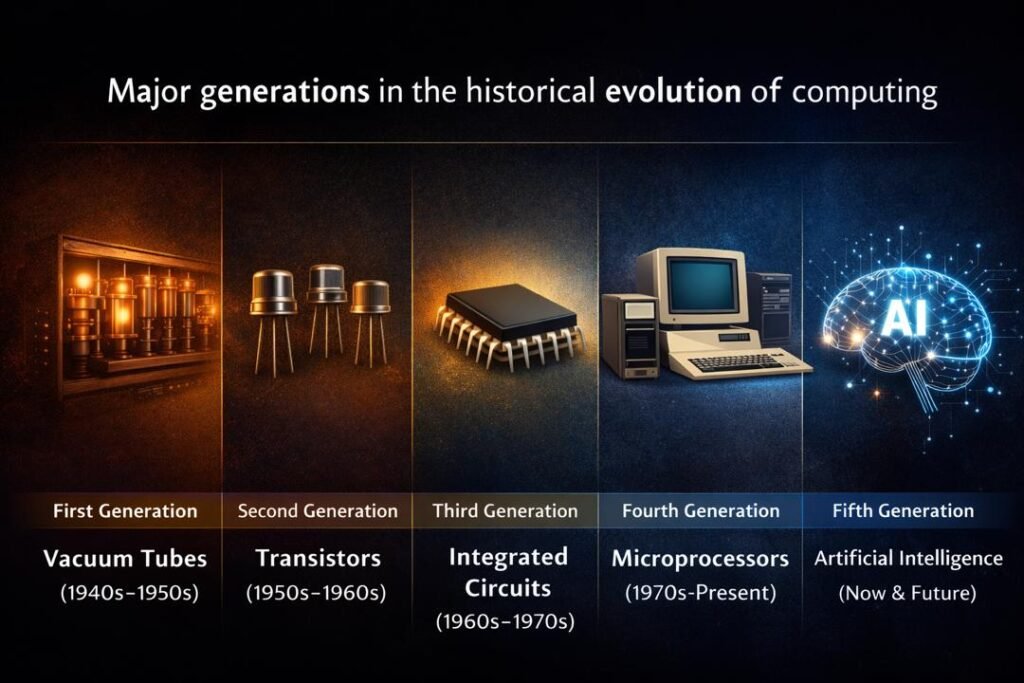
Historical evolution of computing is typically discussed in terms of generations of computers which were characterized by significant technological innovations that enhanced performance, size, and usability.
The First Generation Computers (1940s-1950s): Vacuum Tubes
The first-generation computers utilized vacuum tubes to build the circuitry and magnetic drums to store information. They include UNIVAC I and ENIAC. These machines were highly enormous in size, consumed huge power, generated a lot of heat, and were liable to frequent breakdowns. They were difficult to operate as they were programmed using machine language.
The first-generation computers helped to demonstrate that electronic computation is feasible and can be employed to process large amounts of data in spite of their limitations.
The Second Generation Computers (1950s-1960s): Transistors
The Transistor was invented and this revolutionized the world of computing as the large vacuum tubes had been substituted with transistors. Transistors were compact, more dependable and power saving. This development led to computers being made smaller and more affordable.
The programming languages that emerged in this time were FORTRAN and COBOL, which simplified computer programming and increased its application in the business sector, science, and government. The second generation computers represented the transition of experimental machines to practice.
Third Generation Computers (1960-1970): Integrated Circuits
Computing was further revolutionized by the introduction of integrated circuit (ICs) which led to the combination of several transistors in a single chip. Computers in the third generation were cheaper, reliable and faster than those in the second generation.
This was the period when operating systems sprung up that facilitated multitasking and improved management of resources. Computers have started to be able to accommodate more than one user at a time and this marked the beginning of the wider institutional and commercial application.
Fourth Generation Computers (1970s-Present): Microprocessors
The microprocessor was one of the greatest inventions in the history of computing. The development of microprocessors enabled the manufacturing of personal computers (PCs).
Such companies like Apple and IBM were instrumental in the popularization of personal computing. Graphical user interfaces, computer networking and software application grew to an alarming rate during this generation. Computers turned into domestic appliances and not institutional property.
Fifth Generation Computers (Now and Future): Artificial Intelligence
The fifth-generation computing is oriented at artificial intelligence (AI), machine learning and enhanced human-computer interaction. Such systems are meant to imitate human intelligence so that computers learn, reason and adapt.
The technologies of natural language processing, robotics, and quantum computing are the focus of this generation. Although the use of fully autonomous intelligent systems is still a work in progress, the contemporary developments are still pushing the limits of computer capabilities.
The Rise of Modern Digital Systems
The current computing systems have become characterized by connectivity, speed, and intelligence. The advent of the internet brought computers 5 out of the standalone machine to become globalized. Cloud computing also reinvented the art of data storage and processing by enabling access to resources outside the company.
The society has also been redefined by mobile computing. Smartphones and tablets have blended the power of the processor and have the advantage of being portable and thus allow an individual to get access to information at any time. Meanwhile, embedded systems have begun to be used in the day-to-day appliances like cars, medical equipment, and home appliances.
Big data analytics and artificial intelligence have taken the center stage in business, healthcare, and governance decision-making. These technologies are somewhat based on the principles that were set at the previous levels of computing development.
The Influences of the Past Innovations on the Modern Technology
The impacts of the initial advancements of computer technologies are traced in almost all spheres of modern technologies. Ideas put forward by computer architecture pioneers, such as Babbage and von Neumann, are still central to computer architecture. The programming languages have also been developed; however, they use the logical structures that were established decades ago.
The computers of each generation overcame the constraints of the previous one to develop a clean-up process of computer innovation. It has been facilitated by miniaturization, more processing power, and ease of use to facilitate what was previously considered impossible technologies.
This development brings out the significance of historical knowledge in technological progress. The systems we have today did not come into existence in isolation; they have been developed over time as a result of the gradual improvement that has been done based on previous discoveries.
Conclusion
The history of the development of early mechanical computers and the more sophisticated digital computers depicts the fantastic rate of human development. The history of computing shows that every step such as mechanical, electronic and digital computing brought its own peculiarities of inventing the new features that changed the society and made it possible to reach the modern technological level.
Through the history of the evolution of computing, the reader has an enhanced insight on how the underlying concepts and inventions still manage to influence the present world of technology. With the further development of computing into artificial intelligence and quantum systems, it is necessary to understand its history to find the way forward in its future.
Get more properly researched information about the historical evolution of computing here.