
Learning how computers solve problems involves more than syntax of programming languages or memorizing single coding skills. Data structures and algorithms are two fundamental concepts in computer science that go hand-in-hand: programs require an organized method for storing information and a reliable method for processing it. A data structure is a way in which the data is organized, stored, and manipulated in a computer program, whereas an algorithm is a list of instructions that specifies how to perform a particular operation.
If these two are integrated, software can easily process the information, respond promptly to users, and use system resources effectively. Even with a correct algorithm, pairs that are poorly matched can make the algorithm slow or waste memory. For this reason, students and budding developers typically learn data structures and algorithms concurrently, rather than as distinct courses.

What are Data Structures?
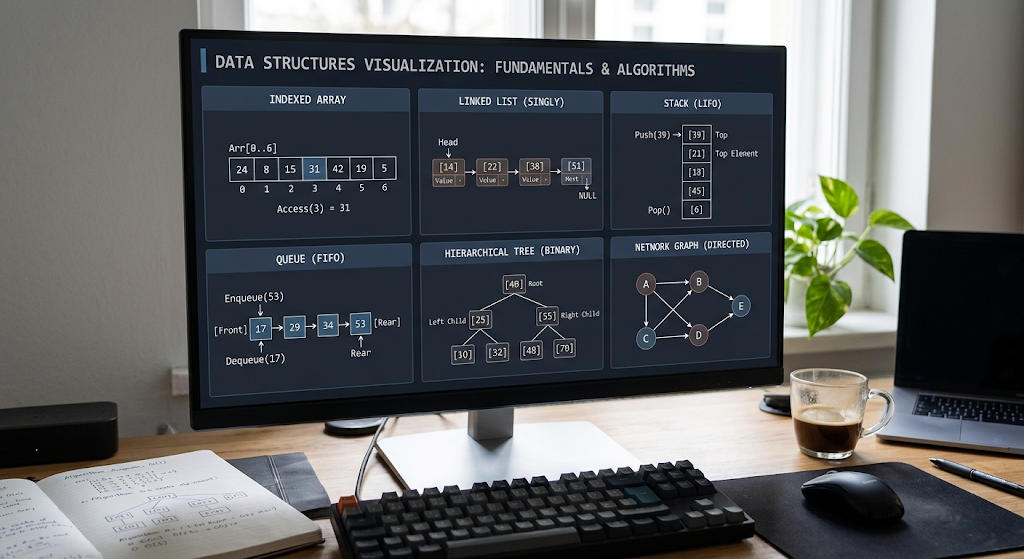
Data structure is a way to store collections of data and organize them in such a way that they are easy to access and manipulate by the computer program. Various structures for various types of information and operations. For instance, the elements in an array are stored in an order and typically allow an item to be accessed quickly if the array’s index is known. In a linked list, the elements are linked together by references, which makes it easier to insert and delete elements at certain positions if they are known. The principles of a stack are LIFO and the principles of a queue are FIFO. Trees can be used to model hierarchical relationships, and graphs can be used to model complex relationships between objects.Trees can be used to express hierarchical relationships, and graphs can be used to express complex relationships between objects. Every structure has its pros and cons, and therefore, developers need to keep in mind how data is going to be used before choosing the type of structure to use. The type of structure can have a direct effect on the number of operations an algorithm has to perform.
Many algorithms are then built on data structures, which can then be considered as the building blocks. An algorithm could have to look at records, sort values, delete irrelevant data, add new elements, or examine all the elements in a collection. The operations that can be performed and how they will be performed depends on the structure that holds those items. When looking for a value in an unsorted array, you might have to check lots of elements individually; however, searching in an array that has been properly organized might take a lot less work. For example, inserting an element into the middle of an array might also involve shifting existing elements in the array; a different structure might have a method of connecting the new element in less drastic ways. With a larger volume of data, these differences are significant as one operation that appears to be simple for a few records is costly when it’s applied to millions of records.
What Are Algorithms?
An algorithm is a precise set of instructions to perform a computation or solve a problem. Whether it’s a simple application that calculates the largest number in a list or a more complex one like routing information over a network or suggesting information to users, algorithms are used in a variety of applications throughout software development. An algorithm is the logic that is required to convert an input to a desired output and various algorithms can produce the same output from the same input but with different efficiencies. For instance, a program can go through each item in a collection to look for a particular item, or it can use a more efficient method of searching the data when it is organized appropriately. This helps to understand how the algorithm will impact execution time, memory usage, scalability, and whether an application will be more responsive or not.
Algorithms are not separated from the data they work on. There are assumptions about how information is organized that are often used in a particular algorithm. Different algorithms such as sorting algorithms, searching algorithms, traversal techniques and graph algorithms access the data structure differently. Data structure and algorithm are closely related because when a developer sees a good algorithm in one context, he or she may be able to apply it to another but realize it would not be suitable. Each of the above data structures might call for a different solution to the same problem. This is one of the main concepts in efficient programming—the structure dictates how a program can access information, and the algorithm dictates how the information will be processed.
Data Structures and Algorithms: Why Study Both at the Same Time?
Data structures and algorithms are usually addressed jointly because the complexity of an algorithm greatly depends on the data structure that it is operating on. Suppose you have a program that has to find customer records many times. If the records are kept in an unsorted and simple collection, then many records may have to be checked to locate the desired record. If the same information is presented structured for quick access, the search may be able to be much more efficient. The algorithm is significant, but so is the manner in which the base data is organized. The two subjects being learned at the same time enables the programmer to think about the whole solution rather than writing instructions to get the right output.
When developers think about the operations that this application calls the most, the connection becomes even more apparent. If the elements are constantly added and deleted, the structure might need to be designed for efficient operations for both adding and removing. If an application calls into its system to determine if a specific value is present, a structure designed to search for values could be useful. If the system needs to process the jobs in order, it can obviously use a queue. In the meantime, an application could need a graph which represents relationships between locations, users, or devices. In each one, data structure determines the algorithms that are feasible, and the efficiency of the algorithms. Learning both concepts concurrently will help developers to start with the problem requirements and choose a structure and algorithm that satisfies the requirements.
How to Organize Data to Make Algorithms Efficient.
The structure of data affects the workload for an algorithm. Using search is a very simple one to consider. If the data is kept in an unordered collection, a simple search could require traversing through each element in the collection in turn until it is found. The algorithm could discard a significant percentage of the search space in each iteration if the collection is ordered and uses an appropriate search strategy. An algorithm can then be more effective by using an appropriate data structure without altering the purpose of the program. The difference becomes particularly significant as datasets become larger. Efficient data organisation is a basic concern in real-world software development because if an approach works well for 100 records it might not work well for millions of records.
The same principle is followed with insertion and deletion. Arrays are easy to access using an index but inserting or removing from the middle may require shifting the elements in the array. Some insertions and deletions can be performed differently in a linked structure, since the elements do not need to be moved in a single sequence, but only the new or removed elements in the structure. In every case one isn’t automatically superior to the other. The benefits of using an array can outweigh the disadvantages of its insertion costs if a program is frequently using the elements by position. When connections between elements are modified often, another structure might be better. The algorithm and data structure are thus to be taken together as a part of the same design choice.

Connection between Searching and Data Structures.
An example of the influence of data structures on algorithms is searching. Simple linear search is used to search elements of a collection sequentially until the desired element is found or the end of the collection is reached. This is a simple way to do it, and can be used with a variety of data structures, but the number of comparisons may increase proportionately to the size of the data set. When the data has properties that can be useful as a search tool, other searching methods may help reduce the work. For instance, a binary search can be used to partition a suitably sorted collection in a way that allows the search to proceed in smaller steps instead of one individual element at a time. It shows an important concept: efficiency of an algorithm can be dependent upon the structure or nature of the data on which it is applied.
Another significant example is hash tables, which are based on efficient key-based access. A hash table eliminates the need to search through all the stored records for a specific program to locate where a specific key is going to be linked to the stored information by using a hashing mechanism. With appropriate conditions, it can offer very fast average case lookup, insertions, and deletions. But hash tables have their drawbacks too, such as using a lot of memory, and the risk of having collisions if keys can be mapped to similar locations. What is important is that one should never choose a specific data structure for searching, but rather one should choose the data structure that is most appropriate for the access pattern used. This knowledge can help the developer make a better decision rather than simply picking the structure that he/she has used the most recently.

How Data Structures Affect the Sorting Algorithms.
Data structures and algorithms also have a close relationship in the area of sorting. Sorting Algorithms sort the data in a specific order, for example, numerical order, alphabetical order, or a specific order. Each of the sorting techniques has different performance, and the type of data structure may affect which one is feasible. Some algorithms can operate directly on the array, and employ quick indexed access, whereas others may be modified to operate on the linked structures or specialized collections. The developers also have to think about the fact that the data should be kept sorted as the new items are being added continuously, or it’s possible to retrieve the data first and then sort it. The requirements can result in a variety of data structure and sorting strategies.
Sorting may be an expensive operation if the application sorts large amounts of data. For a few dozen records, there may be no noticeable differences between a few versions of the program sorting in different ways; for a large collection, however, significant differences may become apparent. The amount of memory consumed may also be a factor, since some sorting methods need extra memory, whereas others do not. This is where it is not sufficient to study sorting as a stand-alone concept. Developers should have some idea of what type of data they are sorting, how data is stored and if it changes often, and how often sorting needs to take place. A good solution is one that compromises between algorithmic efficiency and the features of the data structure used and the application’s needs.
Selection Proper Structure for Insertion and Deletion Operations.
The insertion and deletion show why it’s important for developers to consider more than just access time when choosing a data structure. If an application is adding new items to its collection constantly, it could take a lot of time to add this data to the collection. If the structure that is selected needs to be extensively rearranged each time an item is added to it, the total cost can be significant. Likewise, if information is removed from the middle of a collection, other information may be moved or reorganized. A more natural structure of these operations can lead to lesser workload of related algorithms. This does not imply that insertion and deletion should always be preferred – it depends on the full load of the application.
For instance, a task manager app that is regularly getting new tasks and eliminating tasks that are completed. If it does primarily process the tasks one by one, the desired behaviour is naturally represented by a queue. If users want to cancel recent operations, a stack might be better as the most recent operation must be done first. The examples illustrate how a data structure may directly represent the logic of an algorithm. The programmer can choose a representation which is suitable for a structure that makes the desired operations natural and efficient for the algorithm rather than forcing an algorithm to operate on an unsuitably represented structure. This not only makes the program easier to understand, but it also makes it easier to implement, and can help with its performance.
Traversal and the role of Trees and Graphs
The structure of the data being traversed is a crucial factor in traversal algorithms. The act of traversing means visiting elements in the structure in a manner following a specified strategy. For instance, in a tree, algorithms can traverse the nodes using techniques like preorder, inorder, or postorder traversal. Each approach results in a different visiting sequence and may be useful for various tasks. The inorder traversal of a binary search tree can be used to obtain values in sorted order, showing how the properties of the structure can be useful to an algorithm. These relationships allow the developer to realize that traversal is not just about visiting everything, but because it depends on the structure, the developer needs to select a systematic approach appropriate for the structure and problem.
Graphs are an even more general example since they can represent relationships between locations, people, computers, websites or other entities. Some algorithms (e.g., breadth-first search, depth-first search) can be used to traverse graph structures, and the results they produce vary depending on the way the graph is represented. For instance, an adjacency list records the connections differently than an adjacency matrix, and this may lead to different memory usage and the cost of some graph operations. Two graphs can thus require different representations, one dense and the other sparse. In this way, these examples bring to light why data structures and algorithms should not be considered as independent subjects. The representation is what is available to the algorithm in a manner that is immediate, and what work is required to access the information.
Big O Notation and Measuring Efficiency
Big O notation is typically taught in conjunction with data structures and algorithms because it is used to express the growth of resources as a function of the amount of input. Instead of considering specific time for a particular program to run in a particular computer, complexity analysis is used to reason about the behavior of the algorithm as the amount of data varies. Real programs may have many other forms of complexity, but the common ones are constant time, logarithmic time, linear time, and quadratic time. This way of thinking assists the developer in the comparison of possible approaches and to find algorithms that can get costly as the data sets increase in size.
The cost of common operations differs from one data structure to another and hence there is a close relationship between complexity analysis and data structures. Typical memory access for an array is linear for index access, and linear for adding an element in the middle. Access to an arbitrary position may be slow for a linked list, while some insertions may be efficient if a suitable node is known. The hash table is useful for achieving an average-case efficient operation for finding an element, and the balanced search tree can be useful for achieving an operation with predictable logarithmic time behavior under certain conditions. These differences illustrate why the question of “fast vs not fast” for a data structure isn’t the right question for the developer. Instead, they should ask which operations need to be fast for the particular application.

Real-world Impact on Software Applications.
For large software applications, where small inefficiencies can compound over millions of operations, the relationship between data structures and algorithms becomes significant. A search engine might be required to deal with huge quantities of information and to retrieve information relevant to the search query in a timely manner. When it comes to navigation apps, they must be able to show where things are and how they’re connected, and then they must be able to use algorithms to find a suitable route. A web-based store could require effective architectures for product catalogues, customer information, inventory, and transactions. Social network platforms have to maintain the relationships between users, posts, messages, and other types of interconnected data. In each case, the developers decide how to represent the information and which algorithms to use to process it. These choices can affect how responsive a system is, how much memory it uses, how scalable it can be, and whether or not it can handle more demand.
Performance also impacts on user experience. If an application is efficient, users will not need to consider the data structures and algorithms used to implement it. However, if the processing takes too long, the design starts to become apparent. The wrong structure will lead to inefficient traversal or memory usage, repeated data movement, or non-productive searching. Some significant improvements can be achieved in these regions without altering what the user can see, and sometimes just by optimizing them. This is why data structures and algorithms are a major part of the topics covered in technical interviews and computer science courses. The aim is not simply to solve the set of artificial programming problems, but to learn to think about computational problems and to write programs that can be extended to work with larger and more complex workloads.
How to pick an Algorithm Data Structure
A data structure should be selected based on the most often used operations of the program. The developers should consider the application’s need to have rapid access, frequent inserts, frequent deletion, efficient searches, ordered data, hierarchical relationships, or connections between many entities. They should also take into account if memory is a big problem, and if the data set is small or will increase significantly over time. The following questions help to reduce the number of options available. For instance, if an application has to be accessed by position, it might prefer an array-like structure, while an application based upon key-based lookup would consider a hash table. The hierarchical nature of the information could be represented by a tree, and a graph might be used to model a network of relationships.
Choose the algorithm to operate on the data in mind as well. It is possible for a data structure to make one operation efficient while making another more expensive. Hence, it is essential to look at the entire workload rather than optimize a single operation. Fast lookup can be more important than making the insertion as cheap as possible if the application accesses thousands of times for each insertion. When an application is constantly retrieving tasks to process in a specific sequence, queue behavior might be important rather than random access. This is the type of thinking that is central to algorithmic problem solving. For any application, the developer should determine the requirements of the application in question and select the structure – algorithm pair which will best serve the most significant operations efficiently rather than which data structure is best.
Common Mistakes while Learning Data Structures and Algorithms.
A frequent error of novice students is that they learn the definitions without grasping how various structures are formed. It is useful to know that a stack has a last in first out property, or that a queue has a first in first out property, but it is all the more useful to know when either of these properties is a solution to a real problem. Another error is to ignore the workload, data size, data structure, and the amount of memory required in implementing a particular feature and concentrating only on the theoretical complexity. A big o notation is a critical tool, but not an all means all tool. Developers need to be familiar with relating complexity analysis to actual operations and the significance of the numbers in software design.
The other common error is believing that the more complex the algorithm, the better the solution. More sophisticated methods can add unnecessary complexity if you have only small data sets and/or trivial applications. In other cases where data is small and simple, a simple algorithm might be perfectly adequate; if requirements evolve, a more scalable design might be necessary. This is the important skill, rather than learning the greatest number of algorithms, and deciding which one to use. Students should be encouraged to recognise that there is a problem, look at the data and write down the operations needed, think about constraints and then choose an appropriate structure and algorithm. This process introduces transferable problem solving skills that can be applied in many software development areas.
Constructing robust Data Structures and Algorithms abilities
To get comfortable with a data structure and algorithm, students should learn the theory and then get into some programming. Common structures, including arrays, linked lists, stacks and queues, hash tables, trees and graphs, should be studied, and simplified versions should be implemented and their behavior and complexity discussed; and students should use these to solve problems. By writing code, abstract ideas become more real, exposing the details of accessing, inserting, deleting and traversing data. Students can then compare various solutions for the same problem and see how changes in the structure will impact the algorithm. This practice helps develop pattern recognition skills and not just the ability to memorize definitions.
The practice of problem solving should gradually increase in difficulty. A beginner could begin by learning about search and sorting in a simple collection and then learn to manipulate linked lists, learn about stack and queue problems, learn how to traverse a tree, explore a graph, and so on, and then work on more advanced optimization problems. Throughout this process, complexity analysis should be done, enabling the students to think about efficiency from the outset. It is also useful to look at problems after solving them and see if there is another data structure that can make solving the problem easier. This habit helps to foster deeper thinking and illustrates the importance of the relationship between data structures and algorithms, specifically that the relationship between the ways in which data is structured and the strategies for processing it is important.
Conclusion
Data structures and algorithms are closely related because efficient software relies on the organization of information as well as the procedures used to process (manipulate) information. Data structures are the ways to store, access, modify, represent data, and algorithms are the steps used to search, sort, insert, delete, traverse, and transform data. The right fit can help speed up an application, improve its scalability, and save on system resources—even if the program delivers accurate results—but the wrong fit can result in needless computational expenses. By grasping this connection, developers will no longer simply need to memorize a list of programming concepts, but can begin considering a complete computational solution.
These topics are important for students and future software developers to study in tandem, as they will help them develop more effective problem-solving skills and software design. The key is not just about “which is the fastest algorithm/structure in every circumstance”, but rather because there is no “best” algorithm/structure for every problem. Rather, the structure and algorithm that will be used should be determined by examining the data, understanding the operations that will be performed by the application, and taking into account the timing and memory requirements. After this line of thinking gets into your head, terms like search, sort, insert, delete, walk and complexity are linked together as a single field of study. It is not just useful in computer science programs and during technical interviews, but also in creating software that will be able to accomplish tasks over time without getting bogged down in the complexity of the data and user needs.