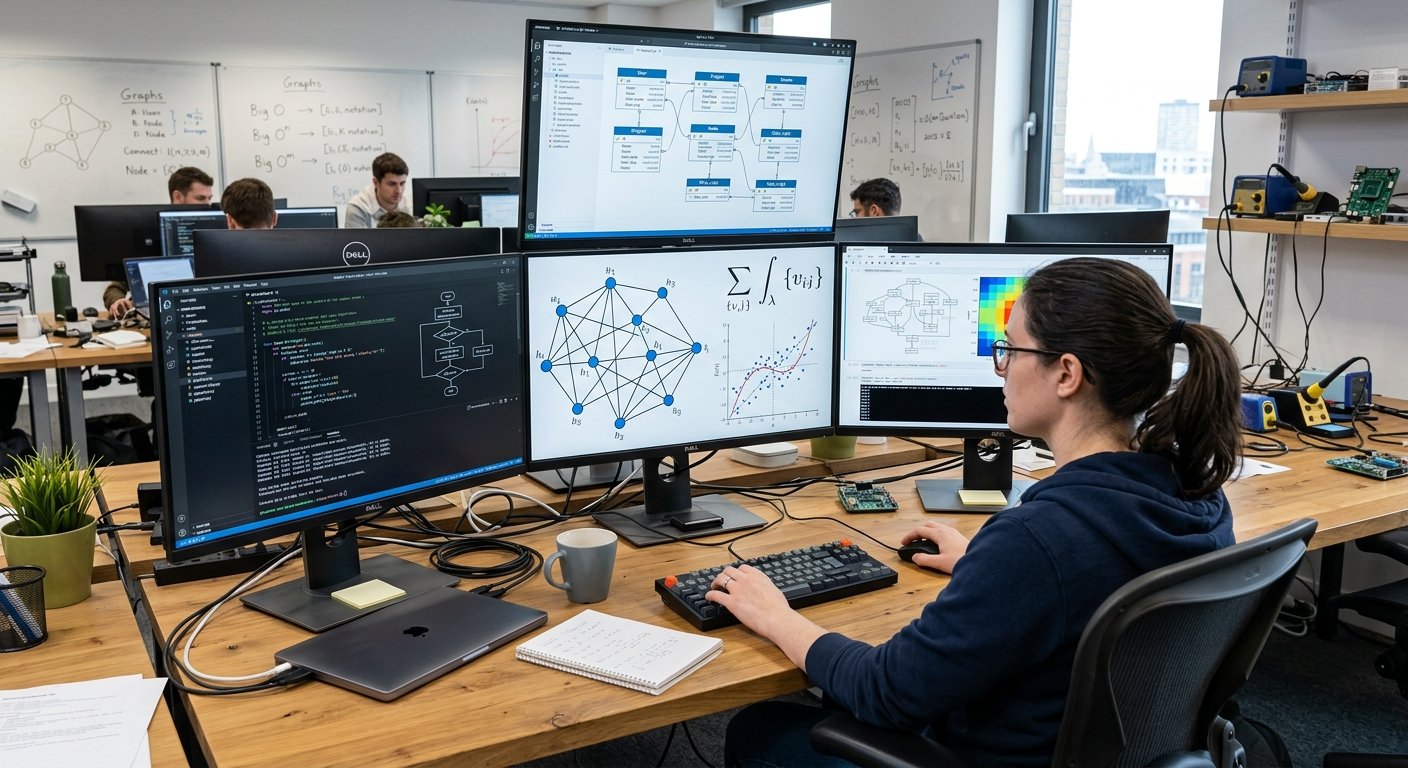
Computer programming is one of the most flexible technical skills in which a person can be trained in a multitude of career options instead of just one. Programming is the language used to build a website, a software app, a video game, a database, an automated system, a cloud-based service, a security system and an AI solution. But, turning into a professional programmer is not just while learning a programming language. The programming skills, technical skills, problem solving, experience in projects, communication, and continuous learning, are all combinations that are important for different technology careers.
A person who likes making websites can take a different route from one who’s interested in AI or cybersecurity. This awareness of these career paths can assist the new person in deciding on an area of interest as well as in recognizing the required skills and experience to be developed for success. Programming skills can be the base for various technology careers if practiced regularly and with practical projects.
Web Development Careers
After starting to learn how to develop professional programming skills, one of the easiest career paths is web development. The role of web developers is to design and develop websites and web applications for people to use on computers and mobile devices via browsers. The user-facing and interactive components of a website are the subject of front-end development, which typically includes HTML, CSS, JavaScript and contemporary JavaScript frameworks. The server-side aspect of web app creation involves working with APIs, authentication, application logic, and databases, typically implemented in languages like Python, JavaScript, Java, PHP, C, or others.

Full stack developers operate in both the front and back end. Web developers need to know basic security, databases, APIs, browser behavior, testing, accessibility, responsive design, and programming. Creating a personal website, blog, dashboard, online store, or booking system is a great way to give concrete applications to these skills and build up a portfolio for a beginner.
Top Skills and Experience for a Web Developer.
It takes more than just learning the syntax of programming languages to become a successful web developer, as practical problems have to be solved and different technologies must be integrated together. Beginners should learn how web pages are organized, how the web browser communicates with servers and how data is stored and retrieved, and how applications react to user actions. Developers often need to see how things are changing and want to work with other developers, so it is useful to have options like Git and version-controlling.
Handling real projects is especially relevant since it lets you know if they can apply their knowledge to a real product. A beginner may begin with a responsive site, then develop an interactive Web application that accesses a database and other external APIs. Then on to testing, debugging, optimizing, making it accessible and accessible and making it safe. Web technology is constantly evolving, and developers must stay up to date on development frameworks, tools, browser features, and development practices during their careers.
Software Engineering
Another general pathway for software engineers who are interested in creating, coding, testing, and maintaining software systems is through the field of software engineering. A software engineer can be a part of a desktop team, an enterprise platform team, an operating system team, a developer tools team, a financial system team, a business application team, or a large software team. They may need more familiarity with algorithms, data structures, software architecture, object-oriented or functional programming concepts, testing, debugging, version control and system design.
Engineers may program in languages like Python, Java, C++, C, JavaScript, Go, Rust, or any other language as needed for the job. Software engineering also deals with the understanding of how the parts of a system can work together and how software can be reliable in the face of increasing size and complexity. Practical experience can be gained by working on applications, contributing to open source projects, creating command line tools or systems to solve a realistic problem. Communication and collaboration skills are also required for engineers because they are frequently required to communicate and collaborate with designers, product teams, testers, administrators, and other developers.
Mobile App Development
Mobile development is the process of creating applications for mobile devices such as smartphones and tablets. Based on their interests and career objectives, developers can choose between Android, iOS or cross platform development. Kotlin and the Android platform are typical technologies used in Android development, and Swift and Apple’s development tools are typical technologies used in iOS development. Development of cross-platform applications that run on multiple mobile platforms with the same code is possible through the use of cross-platform technologies. Mobile developers must know the basics of programming and user interfaces, app lifecycle management, device capabilities, networking, local storage, authentication, notifications and performance.
They must also take into account variations in mobile operating systems, screen sizes, hardware capabilities and operating system versions. For a beginner, a practical project like a note taking application, an educational tool, a productivity application, a personal finance tracker can be of great help to develop useful experience. Running apps on various devices and understanding how to troubleshoot crashes and performance issues are also crucial for creating a successful mobile app.
Game Development
Game development is a blend of interactive design, graphics, audio, storytelling, physics, and user experience, along with programming. All sorts of things can be created in this area, such as the gameplay systems, the characters’ artificial intelligence, the physics systems, rendering features, networking capabilities, and tools for game designers. The programming languages and technologies used also depend on the game engine and platform, such as C for the Unity game engine, and C++ for other high-performance game engine areas, including Unreal Engine.
There are several advantages for game developers in learning algorithms, object oriented programming, mathematics, debugging, optimization and software architecture. Small games are a great way for beginners to learn and get experience, without jumping straight into developing a big commercial game. These are all concepts that can be introduced through a simple platform game, puzzle game, strategy prototype or interactive simulation. If you are a developer, creating multiple mini-projects can also guide you in determining your favorite aspect of game design.
Data Engineering
Data engineers tend to use large data-processing tools, distributed systems, cloud platforms, data pipelines, data warehouses, and databases to collect, process, organize, transform, and deliver data for people and technology to use. Programming languages like Python, Java, SQL, and others are often helpful, and skills in database design, data modeling, APIs, data integration, and distributed computing can be relevant, depending on the specific job. Someone who has an interest in this field could gain hands-on experience by writing a pipeline that receives information from an API, processes the information, writes the processed information to a database, and exposes the information for analysis.

Knowledge of data quality, reliability, security and monitoring is also beneficial as organizations rely on accurate data for reporting, analytics, machine learning and operational decision making. Cloud and data-processing technologies are becoming increasingly common and data engineers may need to acquire new skills as they work with increasingly complex data systems.
Using Data to Make Decisions in the Workplace.
Programming knowledge is just one facet of being prepared for a data engineering career. Relational databases are important in many data environments, so strong SQL skills come in handy. Developers should also be familiar with notions like tables, relationships, indexes, queries, transactions, data modeling, and database performance. Understanding cloud services may aid in working with scalable data infrastructure, and Python can be employed to create data-processing scripts and connect various systems.
Project experience may range from establishing an automated data pipeline, building a mini data warehouse or processing public data or making your data sources communicate. It’s important that data engineers are able to recognize incomplete and inconsistent data, as well as duplicate and incorrect data, in addition to data that is poorly formatted. There are ways of monitoring pipelines and what to do in case of failure that can make projects more feasible. Modern data systems keep evolving, and professionals in this space often continue to build their distributed processing, cloud infrastructure, orchestration, streaming data, and other skills.
Careers in Automation and DevOps.
Programming can also result in jobs that revolve around automation and DevOps, where software program growth and IT operations grow to be more efficient and reliable with the help of systems developed by programming. Scripts can be created by automation specialists to repeat or automate repetitive tasks, manage infrastructure, process files, monitor systems, test software, or communicate with other services. Roles in DevOps sometimes include programming, operating systems, networking, cloud, continuous integration and continuous delivery, containers, monitoring, and configuration management, among other things.
Depending on the environment, it may be helpful to use Python, Bash, PowerShell, Go, and other languages. A beginner can learn by producing the scripts to automate repetitive computer tasks, configure a continuous integration process for a software project, or write an application that automatically executes tests as code changes. An important lesson to be learned from these projects is that programming can be used to enhance application development processes, along with the development, deployment, monitoring and maintenance processes.
Cloud Development
Cloud development recognizes the creation of applications and services that run on cloud computing infrastructure. Cloud developers can build web applications, APIs, storage solutions, serverless functions, distributed services, and more, leveraging resources offered by cloud platforms. While programming is still a primary concern, developers must also be knowledgeable about networking, databases, authentication, APIs, deployment, scalability, monitoring, and security. It’s helpful to know the services offered by leading cloud vendors depending on the role and platform. Furthermore, as developers build on increasingly complex environments, containers and infrastructure-as-code tools will likely play a role.
To start, a basic application can be deployed on a cloud platform and then a database, authentication, automated deployment, logging and monitoring are added over time. Developers must also have insight into the differences between developing an application in their own environment and running it in a production environment. In cloud development it is especially crucial to be continuously learning because cloud providers are constantly launching new development practices, tools, features and cloud services.

Cybersecurity Careers
While programming skills can be beneficial in a cybersecurity job, a security professional must have knowledge beyond just programming. Cyber Security is a process that safeguards systems, applications, networks, devices, accounts and data from unauthorized access and any threats. Programmers may be tasked with developing secure software, secure automation, vulnerability assessment, security tools, incident response systems or application security depending on the specialization. Knowing programming gives security experts a better view of the way software operates and helps them better pinpoint weaknesses.
An understanding of operating systems, networks, databases, authentication, encryption ideas, access control and secure coding is also beneficial. Newbies can learn to code safely in a secure learning environment, and can engage in safe coding projects and defensive coding exercises. For instance, a developer may develop an app that requires authentication, and then learn about common security concepts to see how accounts and data should be secured. The world of software technology, defensive techniques and cybersecurity threats is constantly evolving, so there is a need to keep up to date.
AI & Machine Learning
AI and machine learning have opened up an additional avenue of interest for algorithmic, data-driven, and intelligent systems programmers. AI-focused developers can build applications that can classify information, identify patterns, analyze language, make predictions, produce content, or help users complete advanced tasks. Alongside libraries and frameworks for data processing and model development, Python is used extensively in various AI and machine-learning applications. But, knowing how to call an AI library is not sufficient to succeed in this field.

Developers need to have an awareness of math, statistics, algorithms, data preparation, model evaluation, software engineering, and responsible data handling. Project experience can range from building a prototype for recommendations, to building a text-classification application, experimenting with image recognition, or implementing a system that uses a machine learning model via an API. AI technologies evolve rapidly and require a knack for reading documentation, learning new techniques, assessing results, and grasping the limitations of the systems built.
Deciding on a Programming Career Path
Once you have decided to pursue a programming career, you don’t have to commit to a specific specialization straight away. As the interests and experience of many technology professionals evolve, they make transitions between related fields. Online developers might ultimately end up in cloud engineering, cybersecurity, software architecture, or AI. An individual who has been programming for mobile apps could have an interest in systems or data processing behind the scenes.
The key is to get basic programming skills that can be applied to various fields of work. They include variables, data types, conditional statements, loops, functions, data structures, debugging, algorithms, error handling, version control, and basic software design. When these concepts are familiar then learners can try various projects and find their liking for the problem type. Individual personalities, opportunities for learning, project experiences, and needs for specific jobs may all affect choices made.
The Value of Project Experience.
Projects are one of the best methods for demonstrating programming skills. While reading tutorials and doing exercises is a great way to introduce important concepts, it is through independent projects that a developer will need to make decisions, handle unforeseen challenges, debug errors and integrate multiple technologies. You don’t have to have dozens of applications in a project portfolio. A more limited number of well-developed projects are able to show more useful skills if each project makes clear the problem that it addresses, the technologies involved, the role of the developer, and the difficulties faced.
A web developer could develop a complete Web application and a prospective data engineer may construct an automated data pipeline. An enthusiast of cloud development could launch an app and explain the infrastructure he used, while an aspiring cybersecurity professional could write a secure app and explain the security principles he utilized. Projects also allow for the practice of documentation, testing, version control, and communication, which are all key aspects of work in the professional technology world.
Preparing for Career Success and continued Education
The nature of programming jobs is that you have to constantly learn more and more as technology advances. Programming languages get updated, new versions of development frameworks become available, cloud services grow, security practices evolve, and new tools emerge, all of which can affect the design and deployment of software. It doesn’t imply that developers have to know all new technologies that come out. Rather they must be able to assess new tools, know when they are appropriate, and pick them up when they are applicable to their work.
It’s possible to learn continuously by reading official documentation, taking structured courses, reading technical books, creating experiments, or by looking at other people’s code or joining in developer communities. Professionals also have the opportunity to develop communication, teamwork, documentation, testing, and project-management skills. Independent study skills are particularly useful since programming jobs may come with the challenge of working on an unfamiliar system and/or problem. Good foundations ensure flexibility in the face of change in tools and technology.
How to Build a Successful Program Career.
A programming career can be built incrementally with education and become a specialized career. The first step is typically the acquisition of fundamental programming ideas and confidence through simple projects. The next step might include choosing a specialty like Web Development, Software Engineering, Mobile Development, Game Development, Data Engineering, Automation, Cloud Development, Cyber Security, or Artificial Intelligence. Once learners have decided on a direction, they have the opportunity to build up complementary technical skills, build up more realistic projects, study industry practices, and look for opportunities for collaboration with others.
With experience, it can be clear that certain specialties and tasks are more fascinating. Programming, however, is not just about coding; it’s a framework that can be applied to a variety of technology tasks. Aspiring developers can develop flexible career paths and adapt to the evolving nature of the tech industry by leveraging their programming knowledge and hands-on experience, as well as technical skills, problem-solving ability, communication, and constant learning.